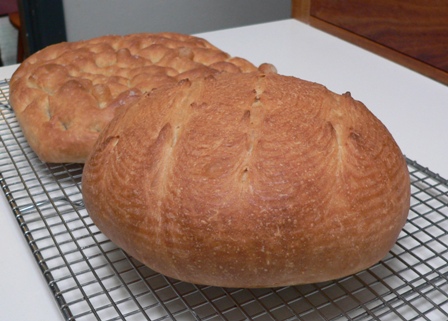
Warning: this is a ridiculously long tutorial! Once I got started, it was hard to stop…
Baking your own bread is one of the most rewarding things you can do. If you’ve never tried before, or you’re daunted by the prospect of it, please let me assure you that it’s a relatively simple process. You can make a decent loaf of bread from start to finish in two to three hours (depending on the ambient temperature) and for most of that time the bread is simply rising or baking on its own while you get on with other things. We’ve been making all our own bread for years now, and this is where we started (although we’ve since moved to sourdough rather than yeast).
The most important thing to know is this – the quality of your bread and how much it rises is almost completely contingent upon the flour you use. If you can’t get a decent high-protein bread flour, then wait until you can, because if you make bread with plain flour, you’ll be disillusioned and won’t try again. The gluten protein in the flour must be high enough for the yeast to make the bread rise. Fortunately, bread flour, also known as bakers flour, is now readily available in most supermarkets. Here, with lots of photos and videos, is how I make basic yeasted bread. The recipe is based on Richard Bertinet’s olive dough and it’s very versatile – you can shape it into rolls, loaves, epi, stuff it with interesting fillings, or spread it out flat and make pizza (it actually works brilliantly as pizza dough).
- 500g bread or bakers flour
- 10g dried yeast (or one sachet)
- 8g fine sea salt
- 320g water (weigh it if you can, as you’ll get a more accurate result. If not, use 320ml)
- 50g olive oil (I use extra virgin)

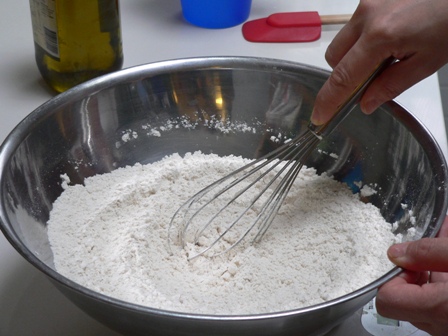
1. Pour flour into a mixing bowl. Whisk in yeast. Then whisk in salt.
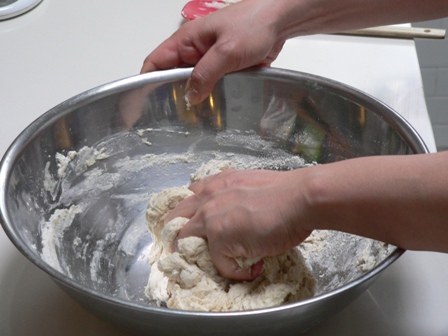
2. Add water and olive oil. Mix first with a spatula, then get your clean hand in and scrunch all the dough together. Scrape your hand off, cover and allow to rest for 10 minutes (trust me, this little resting time makes kneading much easier!).


3. Turn the shaggy mass onto a lightly oiled bench and knead until smooth. This is a high hydration dough (ie. it’s quite wet). I knead it using Richard Bertinet’s method which involves slapping the dough down and folding it over, rather than pushing it with the palm of your hand. I’ve included some photos and a couple of short videos so you can see the technique I use. You’ll be surprised how quick and easy this method of kneading is!
. . . . .
. . . . .
Scoop the bread up with your fingertips…

Slap the bottom of the dough onto the bench…

…and lift the top up and over.


Give the dough a quarter turn each time. Repeat until the dough is smooth and elastic – it should take you about five minutes of kneading.
4. Oil the bowl you mixed in, then turn the dough into it to rest for about an hour, or doubled in size . Cover the bowl with clingfilm to stop the dough forming a skin.
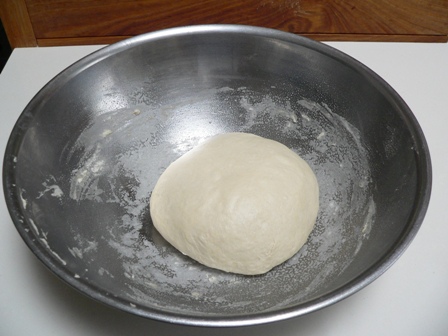
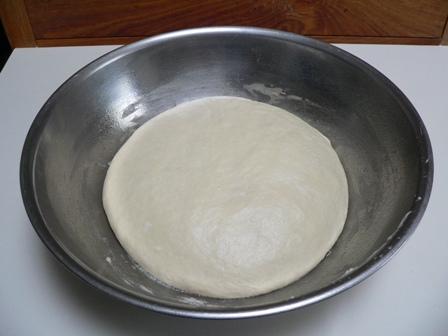
5. Turn the risen dough out onto an oiled bench and fold it in on itself a few times to knock the air out.
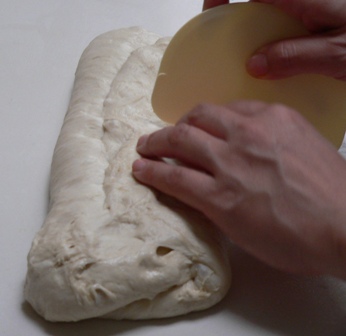
Now you’ve got lots of options. I turned this batch of dough into a round loaf and a small focaccia. I’ve just included the shaping instructions for the loaf – focaccia instructions to follow.
. . . . .
Basic loaf
Preheat the oven to 250C (480F).
Shape the dough into a round shape by folding the edges into the middle. Turn the dough over and shape it into a ball by twirling it around on the bench between your cupped hands.
. . . . .
. . . . .
I’ve placed my loaf right side down into a plastic wicker basket to rise, but if you don’t have one of these, you could easily use a loaf tin, providing you place the dough in right side up if you’re planning to bake it in the tin.
Or just place the shaped dough onto a sheet of parchment paper, lightly spray the top with oil and cover with a piece of cling film (see photo below).
Allow to rise, covered with oiled clingfilm, for half an hour, or until doubled in size. The loaf I’ve made uses half the dough, but you could easily use the full amount if you wanted it larger.
Before and after rising photos:

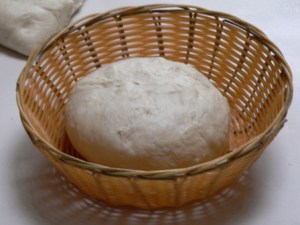
Or you could shape the loaf and let it rise under oiled clingfilm on a baking tray:
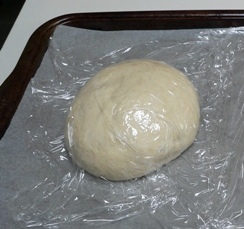
Once your shaped dough has had a second rise, drop the oven temperature to 220C (430F). Remove the cling film and turn the risen dough onto a baking tray lined with parchment paper. Slash the top of the loaf with a serrated knife or lame (razor blade), spray the dough with a light mist of water, then slide the tray into the oven.
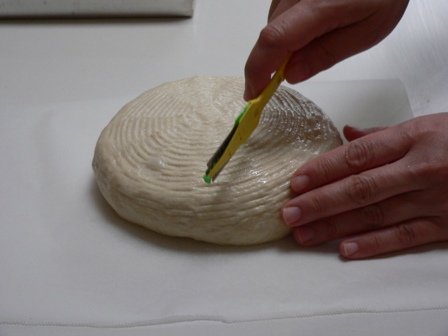

Allow to bake for 20 – 30 minutes, or until the loaf is golden brown. Remove from the oven and allow to cool on a wire rack before cutting.

© copyright 2009 by Fig Jam and Lime Cordial. All rights reserved.
. . . . .
Using the basic dough to make other breads :

 Fig Jam and Lime Cordial
Nice Tutorial. I especially liked the video on kneading using Richard Bertinet’s method. I have not seen this before and will try it next batch of dough.
Thanks,
John
Thanks Johnny! Because most of my doughs are quite wet, I almost always use the slap and fold kneading method now (bagels are the exception, because the dough is so stiff). It works particuarly well with the sourdoughs I make.
The resting time before you start kneading (autolysing) is important, because it makes the dough much much easier to knead. There is a video of Richard Bertinet kneading here – if you’d like to see a longer clip.
Cheers, Celia
Woohoooo!!!! You clever, clever girl! Great job and tute!
Praise from the master! Wow..thanks Teep! :)
Hi,
Whilst researching bread/bakers flour I’ve just discovered your website – very welcoming and interesting. I’ve recently finished work to concentrate on full time motherhood and have visions of baking my own bread and starting a mini garden. One of my farewell gifts from work was a bread machine (received from a colleague horrified that I want to actually take time to make my own bread!). So I guess I’m stuck with the machine for now and whilst feeling slightly sheepish about asking…I do hope you can help. I have not baked bread before and on researching various flours now realise the importance of having a good quality product. Wanting to retain a healthy diet I am reluctant to introduce white bread. I would like to make wholemeal/grain breads – is there such a flour? (Yes I will be using this flour in the bread machine – for now). Appreciate your advice and time. Jill
Hi Jill, thanks for dropping by! The bread machines are wonderfully easy to use, and a great way to start with breadmaking, because they’re almost foolproof, which means you’ll be encouraged to make more bread. I’m sorry I don’t know any recipes for use in the machine, though. As you’ve figured out already, the quality of your flour will determine the quality of your finished bread – try to find a high protein bakers or bread flour, as plain (all-purpose) flour won’t have enough strength to give you a good rise.
In terms of wanting to avoid white flour, there are heaps of options. Most supermarkets will sell mixes for bread machines, and lots of these will have grain or wholemeal variations. I’m based in Sydney, Australia and I buy all my bread flour from Bakers Perfect, but they only supply in bulk.
One way to prevent your loaves from being all white is to add some more interesting flours into the mix – I like adding 10% rye to my loaves, or up to 50% spelt flour, both of which add wonderful colour and flavour to the loaves. Both of these flours should be available in your local health food stores. You don’t need to add a lot (too much rye will give you a very heavy loaf), but just a little can stop a loaf from being “boring white”. Hope this helps!
Celia
Thanks so much for replying. I really appreciate your advice and I’ve now the extra confidence to get stuck into breadmaking! I’m really enjoying your site and have been eagerly talking to friends about it. Cheers!
You’re most welcome, Jill and thanks for checking out the blog. Enjoy full-time motherhood, it’s just wonderful and there’s nothing quite like it! Look forward to hearing how you go with the bread.. Celia
Great tutorial. We’re always glad to see fellow bread enthusiasts !
I stubbled across your site and after reading decided to give baking bread a go. I used your tutorial and it worked out fantastically. I am so inspired that I have been claiming never to buy bread again. Thanks!
Alex
Alex, you’ve made my day! :) Thanks so much for letting me know..
Celia
Hi again Celia,
I am desperate, I have tried now three times to make bread and each time my dough rises beautifully for the first two rises & then when I bake it, it doesn’t move & ends up all doughy dense & not very tasty at all! Does that all come down to the fact that my oven is crap! ie Not heating to high enough heat? I am new at this so really have no idea but whilst typing I am thinking that maybe I should invest in one of those things that tell you the exact heat your oven is at. I am a little afraid as my oven is old and not very good quality I think. Any tips & advise greatly appreciated from the chief of fine bread!
Thanks again for your wonderful site & I am loving my tiny weeny bags!
xx
Keri
Keri, don’t give up! If your dough is rising well, then the yeast is obviously fine. It’s possible you’re letting your dough rise too long the second time – try letting it just rise until it’s nearly but not quite doubled (or even less) before baking. It’s possible that your oven isn’t hot enough though, as it needs a good burst of heat to get the dough to spring in the oven.
Maybe try making something which doesn’t need as much oven spring – like a focaccia? Make the dough, let it rise once, then spread it out into a lined roasting pan and let it rise a bit before drizzling it with oil and salt and dimpling it with your fingers. That way there won’t be a big lump of dough in the middle and even if your oven isn’t getting as hot, it might have more success in cooking it through?
Please feel free to email me if you want to talk about this more!
Celia
Celia, I recently discovered your blog via a link on facebook and it is absolutely fantastic! Where did you source your plastic wicker proving baskets?
Melissa, thanks for stopping by! I found the little plastic baskets at Rewards Distributions in Camperdown Sydney – they’re a hospitality supplier.
Excellent – thank you – we have one of those here in Toowoomba. Thanks again for a wonderful site!
Ooh, have fun! Be warned, it’s a bit of an Aladdin’s cave of treasures! :)
Thanks very much – I’m a total beginner and not too bright and even I managed to create my own bread using your method – thanks again
Oh that’s wonderful, thanks so much for taking the time to let me know, Pete! :)
Hi Celia – regarding mixing in other flours – do these alternative flours like spelt etc need to be bread flour as well? Or is it sufficient that the white flour is bread flour? I’m wanting to try your filled bread rolls recipe with a mixed flour and this is my first attempt at bread making. One more question – can the basic dough recipe be kneeded in a stand mixer with dough attachment – dying also to use my new KitchenAid my hubby got me for Christmas!
Happy holidays!
Lyn
Hi Lyn,
I never use a mixer to knead dough, but I know lots of people who do with great success. I haven’t tried it on this recipe though. In terms of mixing flours – depending on your flour, most need some white flour, or the gluten levels are too low to rise the bread successfully. We have had some very high gluten spelt of late, but usually spelt is quite low protein, and usually works better with either a little added gluten or mixed with bakers flour. Same with kamut/khorosan. I find rye flour makes a very heavy loaf indeed when used on its own, so I usually only ever make a very low % rye loaf – about 10% is enough to give the bread a distinctive rye flavour. Hope this helps!
Cheers, Celia
Thanks Celia – will give it a shot and see how I go. You have so many wonderful recipes to try, am loving your stories too!
Oh – one more question, when you say “oiled bench”, how do you normally oil your bench? with oil? or butter? using your hands or baking paper and wiping it down?
Thanks!!
Lyn
Lyn, I usually spray a little canola oil on the bench – I used the canned spray oil – but just wiping a little oil on with your hands would work too. Have fun! :)
Celia – I made your stuffed rolls yesterday and they turned out suprisingly well for my first attempt at bread! I used 400g bread flour / 100 g spelt wholemeal and though I made a little mistake (forgot to put yeast in at the dry stage, added it in after i had added water!) it still turned out ok. Rose slowly, but I guess I will experiment with the flour as you said and different yeast. I put smoked ham, oven dried tomatoes and ricotta in mine and kids loved it. I want to try sourdough next, but will need to do some reading on starter? I don’t think I will find it here in SG, but will let you know how I go…! Where did you buy yours again?
Thanks
Lyn
Lyn, that’s fantastic, thanks for letting me know!! I bought my starter from Theresa at Northwest Sourdough in the US (is SG in the US? Or Singapore?) – she mails them out. They’ve been wonderfully reliable! http://www.northwestsourdough.com/
Have fun! :)
Thanks Celia – I’ve been googling, but will now try your lady. Yes – SG = Singapore…
Just pulled my two spelt loaves out of the oven and they look amazing – thanks for all your advice!! They rose much better during the first rise (I remembered to add ingredients in correct order this time).
Now… to deliver my first loaf of bread….
Lyn
Isn’t one gram of water one millilitre? Curious as to why you indicate they might not be the same?
It is indeed the same but, at least in my experience, it’s easier to get exactly 320mg using scales than it is to eyeball 320ml in a measuring jug. :)
Celia – do you have a post for a basic sourdough loaf recipe? I’ve been searching and searching as I swear I’ve read one before, but can’t seem to find! My starter is ready and I’m looking for a simple recipe to try out.
Many thanks!
Lyn
Lyn, thanks for the prompt, I didn’t realise I’d never posted it here before! I’ve written a post on it for you! :)
Cheers, Celia
This is outstanding tasting bread and the texture was one of the best as well. The only thing I would add would be to ensure folks know that the water temperature when adding yeast to dry ingredients should be between 120 and 130 degrees F to ensure the yeast reacts correctly.
Thanks for the tip, Frank. I just use water out of the tap! :)