All of our jam is made with homemade pectin stock. We make it in large batches, whenever apples are cheap at the markets, and can it – that is, we seal it in sterilised glass jars which are then heated in a boiling water bath for 10 minutes. This preserves the pectin so that it can, in theory, be stored for up to 12 months on the shelf, although we’ve never had it for more than about eight months (by which time either stonefruits or berries are in season, and the whole lot gets used up in jam-making).
In our opinion, the homemade version tastes better and, unlike commercial pectin, it can be boiled for a long time, which makes the jam process a lot easier. To give you some idea of cost, we purchased a 16kg box of Royal Gala apples last Friday for $10, which produced 17 x 300ml jars of strong pectin – enough to set up to 50kg of fruit. The pulp of the apples also provided us with 16 jars of applesauce.
Ingredients:
- Lots of apples (not over-ripe, as they don’t seem to work)
- Water
1. Peel and core the apples (don’t waste the pulp – turn it into apple sauce or apple butter, or use it for apple pies). Place all the peel and cores into a large pot and pour in enough water to just float them.
OR
Cut the apples into quarters and place them in a large pot. Pour in enough water to just float them. Doing it this way will produce a slightly nicer tasting pectin, and you can pass the leftover pulp through a food mill to make apple sauce or apple butter.
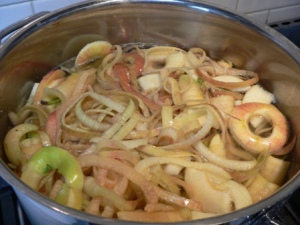
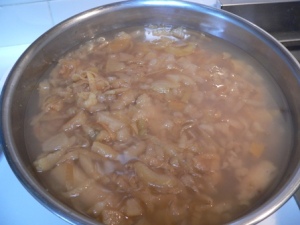
2. Cover and bring the pot to a rolling boil, then reduce the heat and allow to boil gently (covered) for a couple of hours, or until the solids turn soft and mushy.
3. Line a colander with a clean piece of calico and pour boiling water through it to sterilise the fabric. Place the colander over a large stock pot and carefully tip the apple mass and liquid through it. Do not press the pulp, or you’ll get cloudy pectin. Leave the whole thing to drip for several hours or overnight (I usually fold the ends of the cloth over the top of the apples, then cover gently with the stockpot lid, in a perhaps futile attempt to keep the insects out).
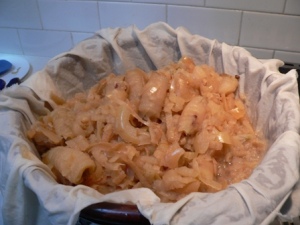
4. When the liquid has completely drained through, remove the colander and reheat the pectin until boiling. You now need to reduce the pectin until it reaches the strength you require – as we don’t want it to set rocky hard (Pete likes his jams softly set), we normally just boil it a bit to make sure it’s all hot before we start canning.
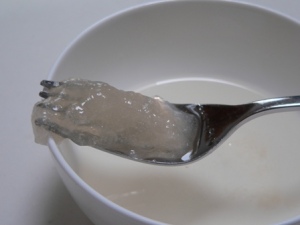
Here is the test – pour a little pectin into a small bowl and put it in the fridge to cool (test won’t work if the pectin is hot). Pour some methylated spirits into another bowl, then tip the cold pectin into it. If you’ve made decent pectin, it will coagulate in the meths, and you should be able to lift it out as a jellied blob with a fork. Please – make sure no-one accidentally eats or drinks the contents of the bowl – it’s poisonous!
5. In order to store the pectin, you can either freeze it, or pour it into sterile glass jars, seal, and then process the jars in a hot water bath for 10 minutes.
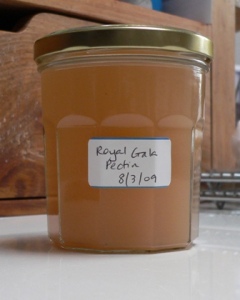
Tip : When you go to use your homemade pectin, do what Pete does, and taste a tiny bit of each jar as you open it. The pectin should taste like mild, unsweetened apple juice. It may have darkened slightly with storage, but if it tastes good, then it’s should be fine.
More on pectin making here: Compost Jelly.
For tips on making jam, please have a look at our Jam Making Primer.
. . . . .
© copyright 2009 by Fig Jam and Lime Cordial. All rights reserved.

 Fig Jam and Lime Cordial
Wow!
I now know what to make with the peel and core when I do my annual fall apple baking extravaganza! In the past, I would just collect the peel and simmer them on the stove top with dried spices to make homemade potpourri. Your pectin recipe is an ingenious way to recycle apple peel. – tess
Tess, thank you! A friend told me that the term for all the bits leftover from the apple (peel, core, stem etc) is “apple leavings”. I thought that was such a wonderful name for it!
What I now do is freeze all my leavings until I get enough to make a big batch. My son takes a cut apple to school each day, so I religiously freeze the single apple core each morning. Plus I freeze all the leftovers when I make apple pie, which we do a lot, as it’s Small Man’s favourite dessert. It really pays off, because over the weekend I took all my bags of bits and pieces out of the freezer and had enough to make 12 x 300ml jars of strong pectin..
Celia
Thank you for this. I’ve got a whole bunch of free apples since its apple season now in Washington State. I have a question, how much pectin do you use in a recipe of jam?
Thanks!
Melissa, I tend to use our apple pectin to boil the fruit in, (instead of using water), and normally we use around 1 jar per kg of fruit. For naturally high pectin fruit you don’t need that much, but for low pectin fruit, (like berries), you might need a bit more. The good thing is you can add another jar if it doesn’t seem to be setting properly and boil it up again. Of course, all this depends on how strong the pectin you make is, which in turn depends on your apples. Over-ripe apples don’t have much pectin, if any. One last thing – we’ve found that you almost always need to add some acid (we use lemon juice), for the jam to set. More on this in our Jam Making Primer.
Heaven this is for me….I have confidence to make my own pectin now. Thanks a lot
You’re most welcome! Pete makes about 300 jars of jam a year – he finds it such a rewarding hobby – I hope you get as much joy out of it as he does. :)
Best, Celia
Thanks for the great primer and instructions on jam-making! I made my first batch last night (plum jam; I”m pretty pleased with the results) and found your site when learning more about the process.
If you have a moment, I have two questions.
How do you know which fruits are naturally high in pectin (I had read plums were before making the jam)? Is this just something you have to know or is there a way to tell?
My jam came out a little sweeter than I like. Is there any rule of thumb for how much I can cut the sugar, or will I need to experiment?
Thanks!
Christa
Christa, high pectin fruit includes apples, some plums, quince, apricots, crabapple and citrus skin. Under ripe fruit is highest in pectin, over ripe fruit will have much less. You can test using methylated spirits or rubbing alcohol (mix 2:1 with spoonful of cooled cooked fruit). High pectin fruit will form a surprising gelatinous lump. (Do not eat or taste this – it’s poisonous!)
Most of the pectin comes from the skin and seeds.
An average sugar to fruit proportion for jam is around 1:1. I have had good results reducing the sugar down to half this amount. If you use less sugar you will get more fruit flavour although it may take more cooking. I usually start with as little sugar as I can then add more if required (for taste or if it just won’t set).
Hi…so I’ve seen an offer on at a fantastic shop I go to: a 3kg box of Apples for under 3 euros. My dilemma – shall I buy coxs, golden delicious, jonagold or elstar? Does the variety matter
Oz, they’re not varieties I’m familiar with, but Google turned up this information:
“Researchers have found that raw apples are the richest of fruits in pectin, with the jonagold variety of apple leading other varieties.” Source: http://www.nutrasanus.com/apple-pectin.html
From our experience, green apples are better than red apples, but the big thing is ripeness – under-ripe apples have lots more pectin than ripe ones (which sometimes don’t have much at all). Hope this helps..
Celia
BTW, what do you do with all the jams you make – ok, eat some, give more away…but there must still be some left!
Oh, that one I can answer. :) Give some away, eat some, sell some to friends at cost ($3/jar) so they can give them away, and work lots of jam into baking recipes (cakes, shortbreads, cookies)! Then the rest sits in our pantry and makes me feel warm and cosy and ready for any emergency..lol. Celia
Thank you Thank you! I am so tired of trying so hard to keep costs down for jam jelly and home preserves and having to buy store bought pectin and up it shoots with the costs of pectin lids and sugar . I have a small acreage so I have most of my own fruit and it is so nice to know I now have conquered at least one of my problems!!! Yahoo my day is good!
Thanks Colleen! It really is so nice to be able to make something from what is essentially scraps that would normally go into the compost! I don’t even buy apples to make this any more – we just freeze the leavings from whatever we’re making – apple pies, cut apples for school lunches, apple cake – and once I get a large enough collection in the freezer, I pull it all out and make a big batch of pectin.
You’ll need to change your jam making process a little with homemade pectin (but we think in a good way). Commercial pectin can only be boiled briefly (I think the last packet we had said 5 minutes, no more), but the apple pectin seems to boil away for ages with no problem. Pete often starts his jams by putting fruit, lemon juice and pectin on to simmer, and once the skins are softened sufficiently, he adds sugar (as they won’t soften any more after the sugar is added). If the jam doesn’t set, there’s no problem to add pectin/sugar/acid at a later stage. The homemade pectin is just so much more versatile!
Cheers, Celia
[…] of Fig Jam and Lime Cordial who has wowed me with her recipe for making your own Homemade Pectin for […]
thankyou,i found your recipe for pectin most useful.i make a lot of jams,jellies & chutneys myself to sell locally, or to give to friends and family. for some fruits that are low in pectin i usually use chopped apple (skins, core and flesh)boiled up and strained through muslin and mixed in equal quantities with the other fruit.unfortunately this does not keep long and is cheapest to make when apples are abundant during the fall.i never had the confidence to make my own pectin and have no desire to use bought pectin but thanks to your page i will make some using apples from a neighbours orchard in preparation for my next batches of berry jam.
Sounds like you make a lot of preserves, Michelle! If you make the pectin in large quantities, you can either can it or freeze it, although it apparently loses a little of its oomph if frozen. Pete always uses extra pectin with the berries, since they’re so low pectin to begin with. His strawberry and his raspberry jams are my favourites, although he prefers the stone fruits.. :)
Thanks for your comment – I love hearing from other people who make their own jams! Most of our friends think we’re a bit bonkers, but it’s something we enjoy so much!
Many thanks for this. I am new to making jam.
I have a few questions and would love to get your answers..
1-We have lots of anna apple trees in our farm, how can I make apple jam as all the recipes I found were for apple jelly; and what is the difference between apple jam and apple jelly.
2-will the apple pectin change the taste of an apricot jam for instance by adding apple taste to it?
3-Is the pectine needed for thikness or as a preservative?
4-If I make a nectarine jam with 1:1 fruit to sugar and no external pectin or water added, will the natural pectin content of the nectarine be enough to preserve it as I dont really care about thikness?
Many Thanks…May
May, I’ll do my best to answer your questions…
1. We’ve made apple jelly and apple butter – I’ve never seen a recipe for apple jam. I think when you boil down the apple pulp you get apple sauce?
2. The apple pectin has a very mild flavour – we don’t find it stands out much when added to jams.
3. I don’t know if the pectin acts as a preservative, but what it does is set the jam, ie. firms it up.
4. The way I understand it, firmer jams last longer than runny ones. Having said that, sometimes stone fruits have enough natural pectin to set the jam without needing to add any more – we often don’t need to add pectin to fruits such as plums and apricots. It depends on the ripeness of the fruit, though – the riper the fruit, the lower its natural pectin. Don’t forget you need to add some acid to activate the pectin – such as lemon juice.
In terms of preserving jams, you should probably process the sealed jars, either in a hot water canner or a proper pressure canner, depending on what you’re making. You might find this website useful: http://www.foodpres.com/
Cheers, Celia
Many thanks celia…
I will have more questions as I progress but I know now where to find the answers..Thanks again
[…] (barely) from Homemade Pectin at Fig Jam and Lime […]
Can I make pectine the same way out of citrus peel. I have 2 orange tree and a lemon tree in my yeard and harly use much of the peel?
Do I just cut up slightly unripe lemon peel and boil and strain? Or would this be bitter?
Don’t apple seeds contain cyanide?
Thanks
Jan, we’ve never tried with citrus peel, but I think it might alter the flavour of your jam more. Re the apple seeds and cyanide, all the internet advice is that you’d have to actually eat huge quantites every day to get a lethal dose – have a look here : http://www.snopes.com/food/warnings/apples.asp
Can you use pomegranite to make pectin? Or is apple the only thing with a bland taste? I heard you can use citrus seeds too.
I have no idea, Frances, sorry! We’ve only ever used apples.
I can’t thank you enough for your exacting measurements and directions. For many years Ihave been trying to determine how my much-loved Grammy would know how many apple peelings, yes, APPLE PEELINGS, she would know to pull from a large plastic bag she kept in the freezer, then drop into the boling, strained, black raspberry juice, to make her never-fail black raspberry jelly. If your 300ml jars contain the pectin to make a standard batch of jelly/jam/preserves, then, if my math is correct, approximately 4 1/4# (2.2k) of apple peels + cores = sufficient pectin!
Our strawberries were a week earliier this year due to an early start on summer, which means the black raspberries, usually ready arounf the 4th of July will be here early too…mine are already showing color.
I can’t thank you enough for the “baseline” with which I can experiment! Keep up the nice post! I am so fortunate to have found you!
Kathie Phelps
Altoona, PA, USA
It’s late, and I must go to bed. I certainly shall have sweet, if not fruitful, dreams! I have 4 qts of beautiful strawberries waiting to be made into something other than shortcake in the morning…
Kathie, thanks for this lovely comment! I love that your grandmother used her apple peelings too! It’s not quite that precise – the strength of the pectin tends to vary enormously depending on how ripe the fruit is, what variety of apple is used etc. I’d suggest you cut up a whole lot of not too ripe apples, or use peels and cores, then boil them all up for ages in water until they’re mushy. Strain them, then test a little of the cooled liquid to see if it sets up. If it only sets softly, you might need to boil it a bit more to concentrate it. Then you can add it to your raspberry or blackberry juice and boil them all together with sugar and lemon juice. Berries don’t have a lot of natural pectin, so it won’t set on its own. As the mixture is boiling, expect to see foam forming on the top – that’s a good sign that the pectin is working. Good luck!
2 questions:
1) Wondering if instead of boiling for a couple hours, we could do 15-30 minutes in a pressure cooker instead. It’d be faster and save a bit of electricity/gas. Would the pectin be OK, or would the higher temperature ruin it?
2) Do you worry that you’re making concentrated-pesticide-residue pectin when you use the skins?
@ May: We made apple jam last fall and found it to be one of our favorites (we usually do rhubarb, strawberry, mulberry, raspberry). We have an old-fashioned hand grinder we bought off e-bay. Peel & core the apples, then cut into pieces that you can feed through the grinder. Treat the ground apples like any other fruit you’d make jam out of.
When we process our apples, we boil the skins & cores and then strain to make apply syrup (we do the same with our pears). Basically jelly without the added pectin & lemon juice. FYI we do wonder whether we’re making concentrated-pesticide-residue syrup…
I’m afraid I’ve got no idea at all about the pressure cooker, sorry. I have one, but I don’t use it very often.
Personally I don’t worry about the pesticide, since these are apples we’re happy to eat raw, skin and all. But hopefully our trees will give us fruit next year, and we’ll have our own crops to play with!
Your apple jam sounds a bit like American style apple butter, which is quite delicious – it’s like caramelised apple sauce! :)
Cheers, Celia
[…] of 10 cardamom pods, crushed 1 cup sugar (which I will reduce next time) 2 cups (~500ml) homemade apple pectin (recipe coming […]
I really like this recipe. . . especially the suggestion that you test it using rubbing alcohol (and the photo). I made some apple pectin for the first time earlier this summer, using the recipe from another blog, and although I followed the recipe to the letter, the pectin was useless for its intended purpose. (I know I’ll use the very runny not-jam in other ways . . . but when I started that project, I really wanted to end up with jam.) Apparently the apples themselves did not have sufficient pectin in them. I learned — too late — that apples not recently picked, even tart ones like the Granny Smiths I used, have less pectin in them. I used commercial apples (rare for me, but I really wanted to try the pectin and local apples would not be available for 6-8 weeks). What turned out to be a frustrating experience could have been avoided, had I tested the pectin level as described in your helpful primer. So, the lessons here are, make your pectin with less than fully ripe apples, recently picked, and test it before putting it up. It’s apple season now, and I really want to go out to pick a lug or two for making apple butter and apple sauce, so I plan to try making my own pectin again. Thank you for sharing this information, and for taking the photos and describing the method so well. ;o)
Antonia, thanks for this helpful comment! We’ve been caught out with apples that were too ripe as well – part of the problem is that if you try and make pectin when the apples aren’t in season, then they’ve been cold stored for ages and probably just won’t work. We usually have quite good luck with Grannies, though, and sometimes you can boil the apple stock right down and get a workable pectin. The other thing to remember is that sometimes it’s not just the pectin, but the combination of pectin/acid/sugar/fruit that affects the set, so maybe your runny not-jam needs more lemon juice or sugar?
Cheers, Celia
[…] out the following links : The Forager on making pectin Celia of Fig Jam and Lime Cordial with her apple pectin primer Tigress in a jam and green apple pectin Toast and making apple pectin […]
Do you think I could use crabapples to make pectin? There are a bunch of trees in my neighborhood and the fruit just goes to waste.
Thx, melissa
Melissa, I absolutely think you could! :) Crabapples are really high in pectin usually – we used some to make crabapple jelly, and didn’t even need to add pectin. Here’s the post on the jelly in case it’s of use to you: https://figjamandlimecordial.com/2009/03/05/crabapple-jelly/
Hello, I have also made my own apple pectin using your recipe- thankyou so much for taking the time to share it!!! i have made several batches and found the last one I tasted REALLY tart! Now, this one had been made using Bramley apples ( cooking, tart variety),and I’m really not sure if this is due to their flavour or is my pectin gone off? I haven’t canned it, just poured it into hot sterilised jars before sealing them.
Olga, I’m not sure what Bramleys taste like, but our pectin always tastes like quite mild unsweetened apple juice (we don’t drink it, but Pete does taste a little from each jar before he makes jam). If you’re going to keep it for any length of time, I really think you do need to hot water process it, or freeze it. It seems to keep ok in the fridge for a few days too if you’re planning to use it in the near future. Cheers!
You amaze me, a recipe for Pectin, I don’t normally use it thinking it is a cheats ingredient but now I know it is made from something natural I will not hesitate, however won’t be making my own until I get an apple tree!
Sending John to town to buy some pectin, the easy way today.
I have put to much pectin in my jam and it has set to hard.
Is there any way of correcting this.
Robert, if you used homemade pectin, sometimes you can reheat the jam and dilute it with water to loosen it up a little. Not sure if this will work if you’ve used commercial pectin, as I believe the instructions say to only heat it briefly.
Just had a quick look on Google, and there’s a suggestion on the Pick Your Own site to add boiling fruit juice before canning to thin out the jam: http://www.pickyourown.org/how_to_fix_runny_jam.htm
Good luck!
[…] But you can find the recipe lots of places online as well, here a clear explanation on the blog Fig jam and Lime Cordial. I was very excited to find some beautiful lime green early apples at the […]
Hi.
I was wondering if you know anything about using rose hips instead of lemon to activate the pectin. We live in Denmark and have a lot of rose hips in our community garden, but no lemons. As I’ve heard that rose hips are high in vitamin C (ascorbic acid), I thought it might be a substitute.
Bill
[…] down your apple ‘juice’ until it reduces by ~half. Here is a good post about making apple pectin. This was my first time, so I’m not sure how well it set up, not having under-ripe apples to […]