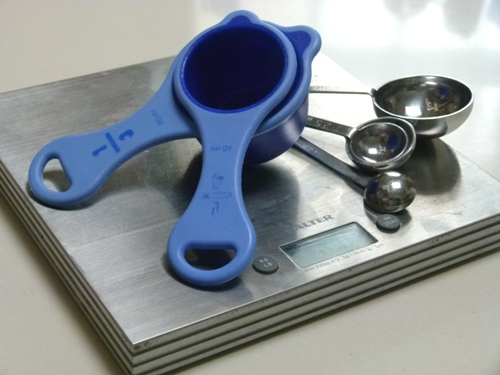
A post written somewhat selfishly for my own benefit, but hopefully some of you might find it useful as well.
Conversion tables published on the internet are often variable, so I thought I’d list (for my own reference) the quantities that I use for baking. These are the weights I’ve come up with through trial and error and I’ve found they work well with our local ingredients.
- 1 cup flour (plain/AP, self-raising, bread) = 150g
- 1 cup or 2 US sticks of butter = 250g
- 1 cup white or caster (superfine) sugar = 220g
- 1 cup packed brown sugar = 210g
- 1 cup Dutch-process cocoa = 110g
- 1 cup natural cocoa = 100g
- 1 cup icing sugar mixture (confectioner’s sugar) = 125g
- 1 cup almond meal = 125g
- 1 cup water (250ml) = 250g
- 1 cup oil (250ml) = 225g
- 1 US/UK tablespoon (15ml) = 3 teaspoons
- 1 Aus tablespoon (20ml) = 4 teaspoons
- 1 US tablespoon of butter = 15g
- 1 cup cornflour (cornstarch) = 135g
- 1 oz = 30g
- 1 large egg = 59g
- 1 teaspoon baking powder = 5g
Most American recipes (and some older Australian ones) list their ingredients by cup measure. Before I bake such a recipe, I will mark it up with the equivalent metric quantities, and then proceed to measure out using a set of digital scales. My cookbooks are all scribbled in, and I keep a flour-encrusted calculator on my kitchen bench specifically for this purpose!
PS. I’ll add this listing to our Suppliers page on the top toolbar, so it will be easy to find at a later date!

 Fig Jam and Lime Cordial
Liquids are never measured in g. They are measured usually in ml, dl or l.
I am from Europe and I find this article very helpful.
Thank you so much for this article :)
Simona, thanks for stopping by! I actually always weigh my liquids, as I find I get a more accurate result. Water is 250g per cup (250ml), but oil is less, and I found it only weighed 225g! I have amended the post slightly, hope that makes things a bit clearer. :)
Very useful indeed. Interesting that you list a UK tablespoon as 4 teaspoons (i.e. 4 x 5ml) – I didn’t think it varied from the US one (just goes to show).
By the way – loving the retro music in the sidebar…Aretha is a goddess :)
Sally, it can be very confusing indeed. All our Oz cookbooks work on a 20ml tablespoon, but the US ones are all 15ml. It can make a big difference in some cases! Aretha is a goddess indeed! :)
Oops, my mistake, just checked Wiki and it says a UK tablespoon is 15ml, not 20ml. Seems we Aussies are alone on the 20ml tablespoon. Thanks Sally for the pick-up! I’ve amended the post accordingly.
Thanks, Celia!
This is brilliant!
And very convenient.
I have a sheet taped up on my cupboard door and it is also quite helpful, but it has the opposite direction grams to cups. :)
Heidi, that’s funny! :) I really can’t figure cups out, especially for flour. Every time I measure flour, it weighs in slightly differently, depending on the humidity (which varies quite a lot in Sydney!). Nowadays I automatically convert 1 cup of flour to 150g in my head before I start! :)
Wow you’re organised! I’m only just getting disciplined enough to measure by the cup and spoon, rather than the smidgin and dollop. I find dessertspoons are the spoon measure I use the most. Tablespoons have always confused me, exactly because of the 15ml-20 ml thing, and because I can never find mine when I want it, and because I only have one and it is always wet when I want it dry or needing washing up from the last ingredient. Dessertspoons are the spoon I actually have on hand and use routinely, but I’ve discovered writing recipes it’s an unusual measure to use.
Linda, I like to be able to replicate a recipe, particularly if it works well, and I was finding I couldn’t do that without my scales! It’s funny what you say about dessertspoons – we love them too, and have always used them as our preferred eating utensil. What I have found is that the standard ceramic Chinese soup spoon (of which there are several in my cutlery drawer) is 20ml – a standard Aus tablespoon – so it’s easy for me to grab one whenever I need a tablespoon measure! :)
Thank you!
Most welcome! :)
How thoughtful of you to post these up, Celia.
I have 2 vegan books from America that usually bounce you around the pages – vegan stock pg 225, vegan cream pg 118 – that sort of thing.
Coupled with weights being in cups, it’s quite a chore bouncing around the internet for conversions.
Your list will prove very helpful. And I shall pop a printout inside the books for the future.
Grilly, I scribble all over my cookbooks, usually in pencil, so I can rub out if I have to. I think once you get used to using scales (as I did when I started baking bread), the whole cup thing gets hard! :)
I wish people would stick to weight or volume, whatever the system. Spoons of any size are vague, variable and problematic.
Cosmo, I’m sure our friend Lee the scientist would have a thing or two to say about precise measures.. ;-)
Oh this is a very helpful post :) I’m gonna need to paste this on my fridge :)
Thanks Tes! Hope it helps!
Very useful, Celia, if only to confirm that the conversions I use are more or less accurate. I use a little less sugar, but that is probably no bad thing. Most of my conversions are taken from published tables, not my own work.
Like you, i usually weigh liquids for accuracy – it’s certainly easier for oil, in preference to making one more greasy jug to wash up!
Flour is the biggest problem – I usually use 150g per cup, as you do, but did an experimental weighing a while back – working from weights back to cups – and found that 350g of strong white flour was only just under 2 cups, making it more like 160-170g per cup! I think the problem is caused by packing – whether you scoop the flour out of a pack, or pour it into a measuring vessel makes a lot of difference.
Suelle, I occasionally work on 1 cup white sugar = 200g, but when I actually measure it, it tends to be a little more. I agree completely on the flour – sometimes my flour can be really heavy, depending on everything from humidity to my hormonal state. ;-) It’s much easier to get a consistent repeatable recipe when I use the scales!
Sometimes I see US conversions that specify 120g for a cup of flour, and I have no idea how they manage that, mine is always much more than that!
As I said, these are the numbers that work for me, that’s all I can offer. :)
Celia you’re a gem! I have been converting recipes to gluten free and a small difference can make the difference between a complete flop and wow it worked.
Elaine, I hope they work for you – I’m afraid I don’t have a lot of experience converting to gf. I wonder if gf flours weigh the same?
This is wonderful. I still use one old American cookery book called Joy of Cooking that uses volume measure, and I’ve been metric for so long now that it can really throw me sidewise when I use it. This list will be very helpful.
Glad it will be of use, Misk! I find these are almost all the numbers I need to make most of the things I bake…
:)
♥ x
I’m surprised you weigh your liquids…We have the same set of weighing scales :D
I’ve found that it’s actually more accurate to weigh liquids – a tip I picked up from breadbaking gurus! :)
Thank you. I will bookmark this. The internet is amazing at times, but also confusing. We bought some super metric scales here in France, and I’m converted!
a quick question – are Ausie cups different to American? For some reason I thought they were….
Claire, there is a small difference, but I just ignore it. :) A metric cup is 250ml, I believe in the US a cup is 240ml. I’ve never found it to be a problem, although it might explain the slight difference in flour weights.
Brilliant post!!! I’ve just printed it off to stick up in the cupboard where I keep my baking provisions.
Tony
Glad it’s of use, Tony! Nice to hear from you! :)
Fabulous! Thank you! I tend to measure everything in g because it’s just so much easier. I ought to find out how much 1tbsp (UK) golden syrup and treacle weigh, because they’re a pain to measure in tbsp’s.
I have to admit that I’m pretty lazy and tend to avoid recipes written in cups if there is an alternative in grams, and there usually is! I’d be utterly lost without my scales (especially because I use them to weigh rice and pasta for dinner, otherwise I’d permanently be cooking too much or too little rice/pasta!).
C, I’ve usually lazy and just use a tablespoon measure for syrups – I always think I should weigh it, but I don’t use it often enough to bother! I did see on Nigella recently a tip that might help – she wipes her tablespoon measure with oil on a paper towel before measuring the treacle/honey/golden syrup, and it just slips off! :)
Brilliant! Thanks Celia, that will be a lot of help. I always wonder when following recipes if I’m meant to be using UK or AUS tablespoons. Which one do you normally use?
It really does depend on the recipe I’m making – if it’s a Women’s Weekly or other Aus one, I’ll use my standard 20ml tablespoon, but if it’s a US one, I’ll convert each tablespoon to 3 teaspoons. The other confusing thing of course is that many of the tablespoon measures sold here are now 15ml – you often have to look to find an Australian 20ml one!
Thank you . You really are a tenacious woman!. I am always try to rewrite my recipes into cups to make it easier for Us readers to cook . I dont know how they cope.
Tania, I think I’d find it even trickier to convert the other way! :)
Dear Celia,
I’m a baking tragic so perhaps the two items that give me a bit of idea is the water and egg LOL!
Chopinand, I can’t believe you’re a baking tragic! :)
Really nice tool!
Thanks Greg! As I said, it really was posted so I could find the conversions all in the one spot – usually I scroll my old recipes to see what I used in the past! :)
Very helpful but I have to admit I had given up trying to convert by myself and bought the Taylor gadget. It is a Large plastic pitcher that measures from weight in oz to grams or the other way and can be set for different ingredients. My mind is poorly equiped in the math dept. so it helps a lot. (got mine at Amazon)
Now I learn a tabelspoon is not a tablespoon. Now we not only have to convert but we have to know from whence the recipe came!
It is a wonder we get anything on the table ever.
Patricia, most of the time recipes work out, regardless of if you use cups or scales. I just prefer to use scales, so I always make the effort to convert. I think it’s a hangover from being a breadbaker! :)
Thanks Celia that’s a great reference. It took me a while to figure out the stick/cup/grams of butter.
Yep, that one threw me for ages too! It also took me a while to figure out the Aus equivalents of things like baking soda (bicarb) and all the different sugars! :)
Ah – thank you! I just went through 3 Nigella books 30 mins ago trying to find 1 cup flour in metric and ended up with Heston. I’m following Tony and printing it out!
You’re welcome, Anna! Hope you’re all well! :)
What a great contribution to humanity- at least the baking community! There is so much discrepancy between cups/ weights/ spoons….. Weighing ingredients, including liquids, is the only way to go. Great job Celia!
Becca, every professional chef I’ve ever known has said exactly the same thing! In a restaurant kitchen or bakery, everything is weighed! :)
Great idea, Celia! Coming from the UK I have always used weights and was a bit thrown when I arrived in Aus in 1970 – as you say a lot of the recipes were in cups here back in those days. As a matter of interest, how on earth do the Americans manage to measure butter in cups?! At least sticks are an easy conversion and i have managed to memorise that one.
Ann, I have no idea how that works! I think everyone must just know that 2 US sticks of butter = 1 cup, and then work from there! :)
This is brilliant Celia, thank you, it’s going to be a great resource for so many of us. Mine’s printing as we speak and will go on the fridge.
I always guess with most ingredients but a bit more precision would help my baking immensely. Have you any idea how liquid sweeteners such as honey and maple syrup convert?
Rose, I don’t use honey and syrup in enough quantities to have ever measured them, although I’ll make a point to next time! :)
Thanks Celia! That will be really useful for all those American books I have. Will print it out straight away :)
Hannah, I find it easiest to scribble right into the books, so that when or if I go back to the recipe at a later date, I can remember what I’ve used. My cookbooks always end up covered in food anyway.. ;-)
Awesome stuff Celia – I should check these measurements against what I have put in my book.
On a separate note, I thought of you when I saw a local gardening show on the telly the weekend for growing potatoes – they used old tyres. They started with one filled with soil and bonemeal and the spuds and as soon as they grew, they added another tyre and more soil and then again and again until the plants flowered and the spuds were ready for harvesting. I know you battled with the sacks and thought you might like to try this method – even though stacking tyres is the prettiest – you can also paint them to be more attractive in the garden.
:-) Mandy
Mandy, thank you for the suggestion, but we have a friend who works in the tyre industry, and he won’t let us do this. He reckons chemicals will leach from the rubber into the soil! They do it a lot over here though, and I saw Hugh doing it on River Cottage recently as well!
Eek, don’t want chemical infected spuds! Thanks for letting me know. :-)
Mandy, so many people seem to do it, but since our friend said this, we’ve avoided it!
Thanks Celia! This is a really handy reference for recipe writing too! :D
Hope it helps, Lorraine! It really is just the weights I’ve figured out through trial and error though…
THANK YOU, THANK YOU AND THANK YOU! Printing!
Cheers Norma! Hope it helps! :)
Wonderful! I have a couple of cookbooks from my time living in France and I always agonize over the conversion. Luckily, I don’t do a lot of baking and when I do, I have a digital scale that has both metric & US measurements. Your chart will be handy.
Lynn, scales are invaluable, aren’t they? Mine do metric and imperial too – makes life much easier!
For those asking about syrup – golden/treacle/honey etc – it weighs 375g per cup and 30g per (Aust) tablespoon. I used to try and measure it by volume, but always felt I ended up with half of it left in the spoon/cup!
Beck
Thanks Rebecca! :)
Sorry to be a drag, but I have US sticks of butter in my fridge right now and they’re 113g, not 125g. There are 8 tablespoons in a stick, so a tablespoon will be 14.125g.
Also, according to Bill Granger, a cup of un-Dutch cocoa is 120g, a cup of flour is 125g & castor sugar 235.
Different oils have different weights, so olive and canola will not be the same. Oils also have different weights at different temperatures.
You’re not being a drag, Jade! As I said, I was just listing the conversions that work for me and what I’ve come up with when I weigh things. :)
I keep checking, and I never get a cup of flour weighing under 150g, so that’s what we use. Thanks for the headsup on the oil and butter.
PS. I use two US sticks of butter = 250g because that’s what a standard stick of butter weighs here. :)
[…] you can imagine. And if like me you need to convert the measurements into metric call into Celia at Fig and Lime Cordial where she has a very simple and useful conversion chart. Oh and a lovely garden and amazing recipes […]