Feeds:
Posts
Comments

Archive for the ‘Cool Things’ Category

bp

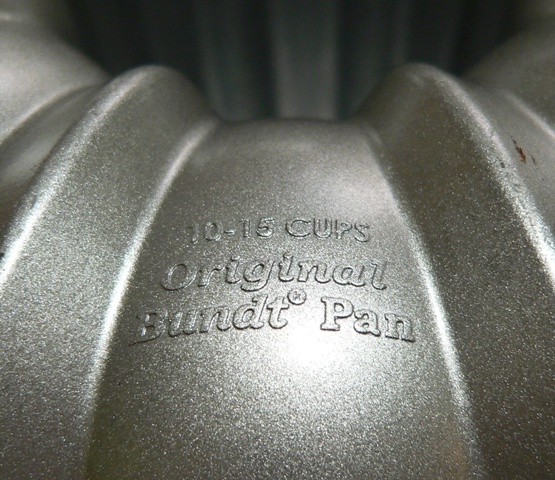
Hello, my name is Celia and I’m a bundt panaholic.  It’s been three weeks, four days and eight hours since I purchased my last bundt.

It all started five years ago, when Maude bought a Nordic Ware daisy pan. We’ve both been collecting these magnificent cast aluminium pans ever since.  Surprisingly, our extensive collections have very little overlap – perhaps a culinary manifestation of the “I’m not wearing the same dress as you” phenomenon.

I don’t know how many pans I have, and I refuse to count them (trust me, it’s better that way).  These Nordic Ware and Wilton cake tins are heavy, non-stick and easy to care for, and priced accordingly.  That’s why I’m posting this now, so you can get your lists off to Santa in time.

Speaking of Christmas, my friend Janelle gave me this tree bundt a couple of years ago.  I adore the toy train set that runs around the bottom of the pan.  A light dusting of icing sugar “snow” over the pine trees is the perfect way to finish off the cake.

006

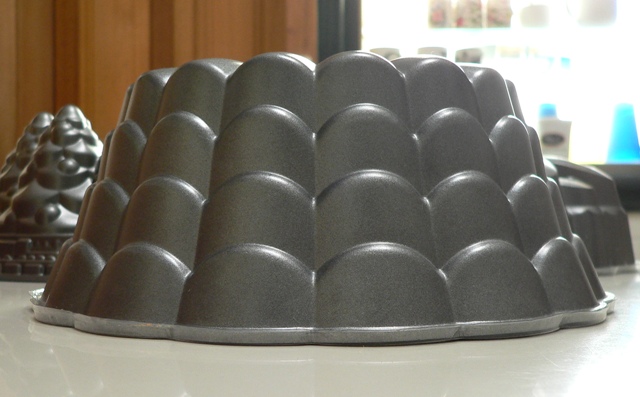
This Wilton Belle bundt is the most versatile tin in my collection.  It produces a cake which is elegant and easy to slice, and because the design runs all the way down the side of the pan, it can be filled to different levels (which means it can accommodate a number of different cake recipes).
008

cake-002

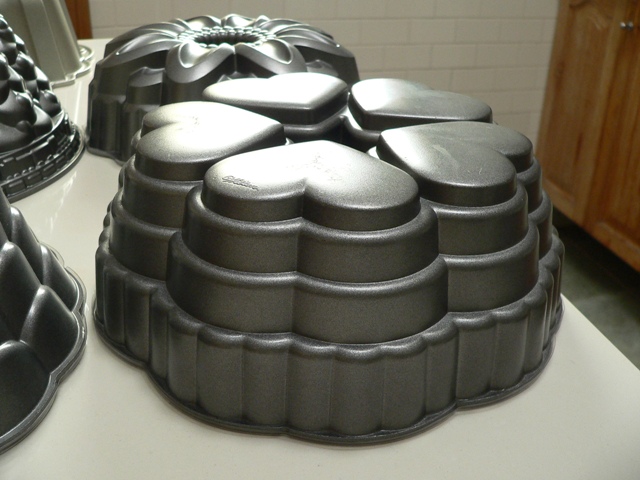
A friend once baked a packet mix in her Wilton Queen of Hearts tin and  stunned her guests by turning out a magnificent looking cake. Presentation might not be everything, but in baking terms, it counts for a lot!
009

This is my current favourite – a Heritage Bundt from Nordic Ware that Big Boy bought me for Christmas last year.  It reminds me of my mother’s  Marquesite brooch.

012

Most of the cakes baked in these pans only need a dusting of icing sugar to dress them up.  Here’s the cake I baked for Dan’s birthday in my Nordic Ware Chrysanthemum bundt pan.

dan's cake 017

cwcc 015

Some bundt pan tips:

  • To grease the pans, spray the inside with a light vegetable oil.  I always use a canola oil spray – olive oil will stain the pan, as did a rice bran oil I tried recently.
  • Reduce your oven temperature by 10 – 20C, as these pans brown much more than regular bakeware.
  • Always wait at least 10 minutes before turning your finished cake out, to maximise your chances of getting the cake out intact.
  • Don’t wash your pan in the dishwasher.  The instructions that come with the pan always say to wash by hand only, but that didn’t stop me trying the dishwasher just once.  It was a mistake.
  • Buy a soft brush to clean out any crumbs stuck to the pan.  Pete found one in the auto department – petrol heads are very protective of their cars, and as a result they’ve come up with some very gentle cleaning tools.
  • Don’t overfill your pans – two-thirds full is about right.
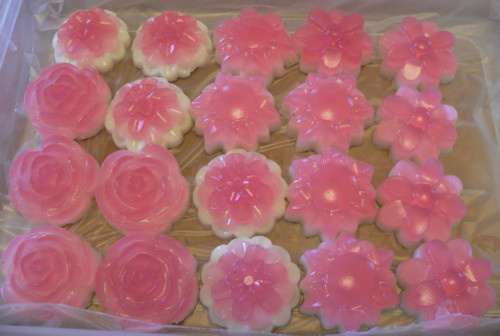
  • Resist the urge to buy the teeny tiny holed pans, unless you’re planning to use them for jelly or chocolates.  I bought a petit fours pan with 24 small flower moulds, but it’s hard to get perfect little cakes out of it.  It’s great for agar jellies though!  Having said that, the six holed pans like the floral one in the top photo work brilliantly for large muffin sized cakes.
christmas 007

Read Full Post »

021

Plastic water bottles are supposed to be bad for us, particularly if we’re perpetually refilling them.  Until now, the only alternative I’d found were aluminium bottles with a plastic lining, which didn’t seem much of a solution.

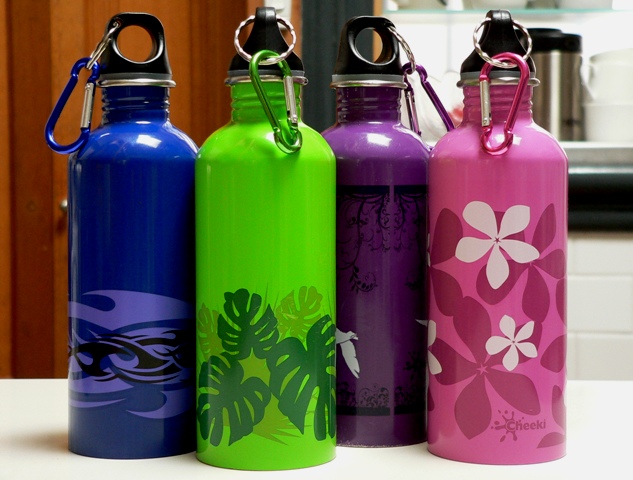
Then Santos Trading, a truly fabulous organic foods store in Byron Bay, brought in  these Cheeki water bottles.  Made by an Australian company, they come in a variety of sizes, from small ones for the littlies, to a one litre version, perfect for camping or travelling.  I bought four of the 500ml  bottles, in  different colours, so that every member of the family could have their own (mine is pink, in case you’re wondering).

These bottles are great; the water doesn’t taste of plastic, they’re sturdy enough to survive school bags and they fit perfectly in the cupholders of the car.  My only gripe is that the coloured lacquer tends to scratch off a bit, but that’s not a huge problem unless you’re rolling  it on the asphalt of the school playground.  My pink one, for instance, is still in pristine condition after several weeks of continuous use.  But if you’re buying for small people, you might want to consider the plain stainless steel version.

They’re not cheap – the 500ml bottles are $16.95 each, excluding shipping – but they are economical, in theory.  I say “in theory” because obviously they can be refilled an endless number of times, which makes them a much cheaper option that bottled water.  In practice, of course, that’s rarely the case.  Small Man had his green bottle for less than a fortnight before he left it on the cricket pitch during sport.  At $16.95, Pete had to drive back and scour the park until he found it!

PS. If you’re in Sydney, you’ll also find these at Dr Earth in Newtown, Blooms Pharmacy in Leichhardt Market Town or Mr Vitamins in Chatswood.  I’m pretty sure there are lots of other stockists as well.

Read Full Post »

Cool Thing #8 – Kiva

Kiva is a micro-finance organisation, based in the USA.  Their mission is “to connect people through lending for the sake of alleviating poverty”.

In practical terms, that translates to this – through Kiva, you can lend a small amount of money to a small business owner in a third world country.  It’s an easy process; you simply go to the Kiva website, find someone you’d like to assist, then transfer the funds via PayPal.

When I say small amount, I mean really tiny – each micro-loan starts from just $25.  The money you lend is combined with small loans from other lenders until the total is enough to provide meaningful working capital to the borrower.  The money is lent to them interest-free (on your part), but it is a loan, and will, if at all possible, be repaid.

The recipients of these funds, most of whom don’t qualify under the usual banking systems, aren’t asking for charity, they’re seeking assistance to be independent.  They often need small amounts, a leg-up to help them get established – $800 to buy materials to sew clothes to sell, or $600 to buy drinks to resell at a small cafe –  that order of magnitude.

Can I tell you the most wonderful thing about this system?  I began with two small loans of $25 each less than twelve months ago.  One loan was repaid in full by May this year, the other one is 88% repaid.  I was able to re-loan the money I was repaid, thereby helping another person, and I’ll do the same again when the second loan is repaid.  So for my tiny investment of $50, I’ve helped three people earn a living, support their families and build their communities – all with the dignity of knowing that they weren’t dependent on a handout. It’s very rewarding, and it really is a case of helping someone to help themselves.

If you’re interested in knowing more, visit the Kiva website : www.kiva.org.

Note: 98.35% of Kiva loans are repaid, but there is no guarantee you’ll get your money back, so it’s important to lend with that in mind.  Having said that, I have friends who have re-loaned the same money several times over now, having been repaid in full each time!

Read Full Post »

lumix 004

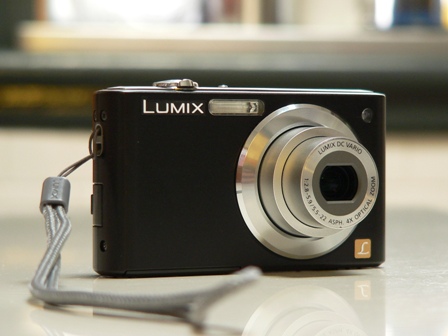
I have a new camera.

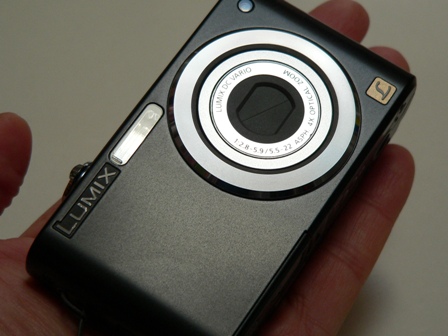
It’s a Panasonic Lumix DMC-FS4 and baby, I think I’m in love.  Up until now, almost all the photos on this blog have been taken with a  Panasonic Lumix FZ20, which we bought for nearly $800 in 2004.  Compared to today’s cameras, it’s almost archaic, offering only 5-megapixel resolution.  But it has a magnificent Leica lens, takes wonderful photos and, after a short tutorial from über photo-whiz Chris D, I’ve been able to make it do everything I want it to.  Except be small and compact, so that it could fit in my handbag.

Yesterday, I decided I needed a “pocket” camera (can you tell that I’m a child of the 70s?). Preferably a Panasonic one, so that I wouldn’t have to relearn menus and functions – I’m very hard-wired in that way.  Today, I bought the base model of the Lumix range , and I’m  completely astounded by how far the technology has come in just a few short years.

lumix 008

Firstly, this tiny camera – less than 10cm x 6cm x 2cm in size – takes 8MP photos.  And this was the bottom of the range – everything else was 10 and 12 meg.

Secondly, it has a rechargeable battery (a Pete prerequisite – he refuses to pay for disposable batteries), an adjustable white balance (my prerequisite – I hate the blue and red cast from fluorescent lights) and best of all, an adjustable ISO, which means I was able to take all the photos below without a flash.

Thirdly, and this is the kicker, this highly featured, seriously cool little camera cost…$169.  That’s less than a sack of Belgian chocolate or dinner for one at Tetsuyas and about 20% of what we paid for our original Lumix camera five years ago.  We brought it home, charged up the battery and took it for a test run at the Canterbury Leagues Club.

The fact we were having dinner at the Leagues Club made Kara and Christina smile, so I’ve taken lots of photos to show them how interesting the place really is.  It has some unusual features, starting with the large fountain you pass on the way in, which turns into a fire display at about 7pm (weather permitting).

020809a 045

Walking into the foyer always reminds me of large Asian hotels – complete with waterfall, tropical pond and recorded bird calls.

020809a 042

020809a 038

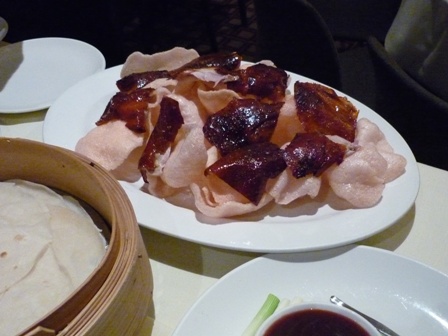
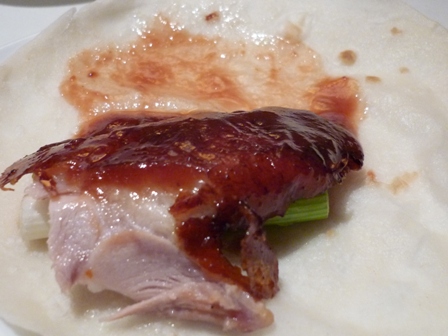
The club has an independently operated Chinese restaurant, which does a great Peking Duck.  It’s always divided into two courses, beginning with the duck pancakes – a piece of crisp duck skin, dressed with shallot, cucumber and sweet sauce, then wrapped in a soft flatbread. This is  followed by San Choy Bow, in which the leftover duck meat is fried with bamboo shoots, water chestnuts, Chinese mushrooms and sauce, then served in lettuce cups.  These photos are for Chris’ son, the Finicky Eater, who is a mad keen foodie and will one day be a Masterchef judge – I’d almost bet money on it.

020809a 022

020809a 025

020809a 026

020809a 031

Can you believe all these photos were taken at night time, without a flash or tripod?  Under fluorescent lights? On a camera that cost $169? And they are SOOC – straight out of the camera – which means I haven’t had to adjust or fix them up in any way.

I am completely smitten with this little gem.  Watch out for more photos of the big wide world in days to come!

In case anyone’s interested, we bought our Lumix from Ted’s Cameras.  Note that it didn’t come with a memory card. This is absolutely not a paid ad, and I suspect that if you hunt around, you might even find it a bit cheaper.

Edit: even cheaper at Bing Lee at the moment – $149!

Read Full Post »

015

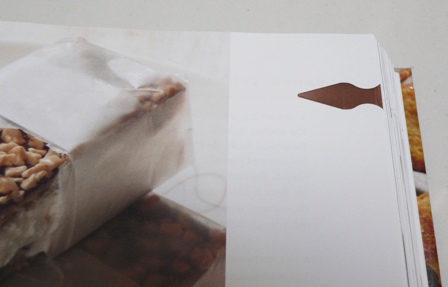
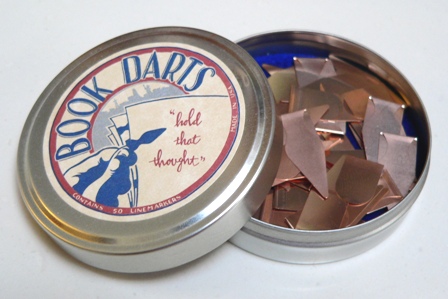
This wonderful doodad is a Book Dart, invented by Bob and Jeanette Williams of Oregon.  It’s a little piece of thin bronze shaped into an arrow, which clips to a given page of text and highlights not only the page, but also the line of choice.  Apart from being aesthetically pleasing, they are archivally safe and won’t mark or distort the page in any way.  Bob Williams is an English teacher, librarian and archivist, so he’s pretty fussy about the way books are treated.

The Book Darts are inexpensive, particularly for a reusable item, and if you buy them from the charming, albeit slightly clunky,  Book Darts website, then they can cost as little as 11c each.  Or, if you’d rather buy them here in Australia, they’re available from the über chic Remo General Store.

I’ve been buying small envelopes of book darts to add to birthday and thank you cards. They’re the perfect gift for lawyers and barristers, high school students, teachers of just about anything, avid readers and, in my case, people with huge collections of cookbooks in which they can never find a recipe a second time. Everyone I’ve ever given these to adores them. They’re really very clever.

014


Read Full Post »

« Newer Posts - Older Posts »