Feeds:
Posts
Comments

Archive for the ‘Gluten Free’ Category

fudge-007

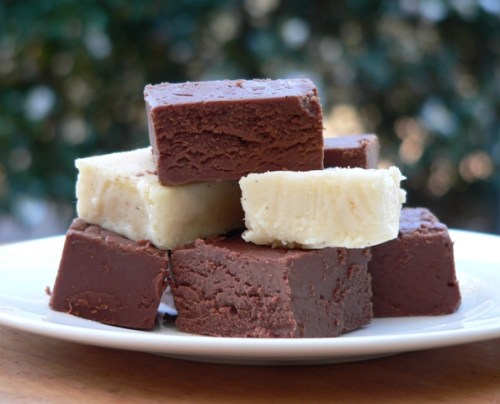
After eleven attempts, I’ve finally figured out how to make fudge which keeps my family happy.  Unlike the rest of the universe, they don’t want hard, crumbly fudge.  They want soft, silky, melt-in the-mouth fudge, which is firm to touch, but halfway in texture between cream and cake.

The most important thing I’ve learnt is this: fudge making is about gentle handling and calmness, and if you can relax and work peacefully, the whole process will be much easier.  It’s something that really can’t be rushed – the sugar needs to be melted very slowly in order for the crystals to dissolve completely, the mix needs to be boiled over the lowest possible heat, and the beating needs to be done at the minimum setting on your mixer to ensure the fudge candies with the smallest possible crystals (thereby ensuring a smooth texture).

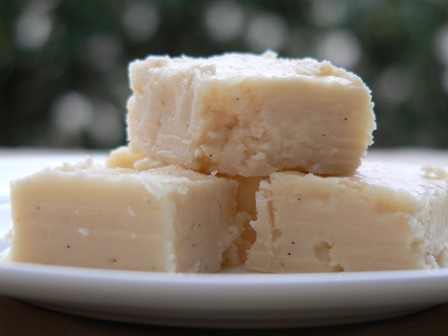
Here is a recipe for a creamy vanilla fudge. It tastes astonishingly like a good vanilla milkshake. The methodology is essentially the same as the chocolate fudge recipe, except that this makes a lesser amount, so you might wish to set it up in a smaller pan.  In my opinion, the key to successful fudge doesn’t lie with the ingredients, but rather with the handling of the candymaking process.  Remember – gently does it.

  • 2 cups sugar
  • 1 cup heavy cream (35% fat)
  • 1 Tbsp glucose or corn syrup
  • 45g (1.5oz) unsalted butter, chopped into small pieces
  • 2 tsps vanilla extract
  • seeds scraped from half a vanilla pod (optional)

1. Combine the sugar, cream and glucose syrup in a medium sized saucepan. Calmly, over a low heat, stir the mixture  until the sugar is dissolved and the spoon no longer feels like it’s running over grit at the bottom of the pan.  This can take several minutes. Try to dissolve the sugar completely before the mixture boils.

2. With a pastry brush dipped in hot water, brush the insides of the pan to wash down any sugar crystals (if you don’t do this, these crystals can cause the fudge to go grainy later).  Use as little water as you can. When the mixture boils, stop stirring and clamp a candy thermometer onto the side of the pan, making sure it doesn’t touch the bottom.

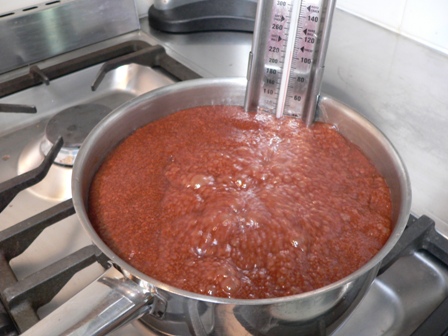
3. Allow the pan to boil without stirring, over a medium-low heat, until the temperature reaches 238F (which is one notch below the “Soft Ball” mark on my thermometer).  This can take up to 10 minutes – you might need to turn the heat up a little bit, but resist the temptation to turn it up too high, or you’ll ruin the fudge. You want to keep the mixture at a rolling boil but with the smallest amount of heat you can get away with. Keep an eye on the pan to make sure it doesn’t boil over.

4. When it reaches 238F, place the pan on a heat proof surface to cool, leaving the thermometer in place. Add the butter, vanilla extract and (optional) vanilla seeds, but do not stir.  Breathe and stay calm.  Get a cup of coffee and unstack the dishwasher while you’re waiting for the fudge to cool.

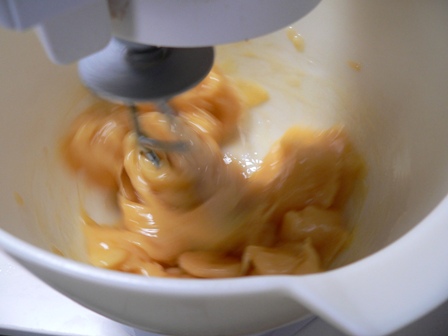
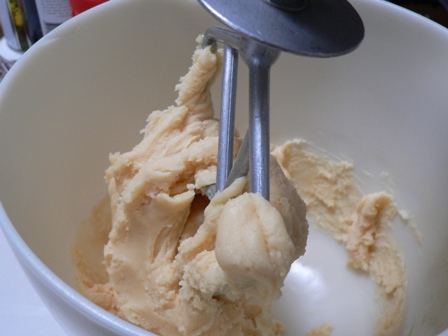
5. When the temperature reaches 120F, check to see if a slight skin has formed on the mixture, under the melted butter.  If so, scrape the fudge , butter and vanilla into the bowl of a stand mixer (if not, allow to cool a little longer).  Mix at a very low speed, pausing occasionally, until the fudge “sets up”.  The mixture undergoes a chemical change – it starts off sticky and similar to pulled toffee and seems to do nothing for a while in the mixer, then suddenly, in an instant, it changes – losing its gloss and becoming more granular and dull in colour.  Here are photos of the fudge before and after it has “snapped”, to give you some idea of what I’m talking about.  Interestingly, when the fudge does snap, it also releases heat (as a result of the chemical reaction), so the mix in the bottom photo was quite warm and tacky to touch (as opposed to gooey and sticky, which is how it was prior to mixing).
vanilla-fudge-021

vanilla-fudge-007

6. Tip the fudge into a buttered pan and work it in with your hands.  When it has cooled slightly, score or cut into small pieces.  It can take several hours to set completely.
vfudge-010

Read Full Post »

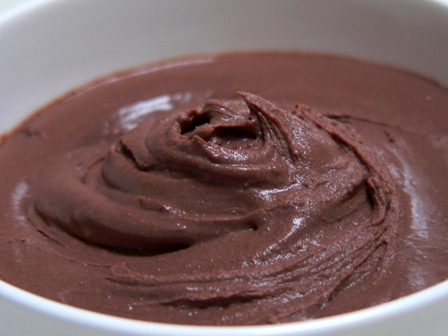
ganache-022


Have you ever made chocolate ganache?  It’s the easiest thing in the cooking world and oh so wickedly decadent.  It’s a great thing to do with any quality leftover chocolate (in the past we’ve used Lindt Easter eggs), and the finished ganache will keep in the fridge for at least a couple of weeks.

There are only two ingredients in ganache – heavy cream and chocolate.  You can make it with just about any sort of chocolate, although I’d strongly suggest that you use the very best you can afford.  There really isn’t much to this, so the flavour of the chocolate won’t be masked in any way.  We normally use Callebaut 54% dark callets, but in the past we’ve also made milk and white chocolate versions.

The proportion of chocolate to cream determines, not surprisingly, the viscosity of the finished product.  The recipe I’ve given here results in a creamy ganache that will stay soft in the fridge, but if you increase the chocolate content, you can make a firm ganache that will set hard enough to form into centres for chocolate truffles.

  • 3 cups of heavy cream (35% fat)
  • 450g (1lb) dark chocolate, either in callet form or finely chopped

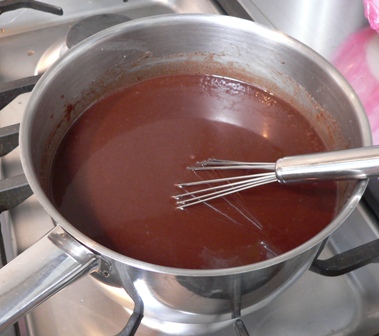
1. Put the chocolate in a heatproof mixing bowl. In a saucepan, bring the cream to a boil,  then pour over the chocolate. Stir gently with a whisk until smooth – this can take a few minutes, so don’t rush it. Don’t whisk it hard – you don’t want to beat air into it. At first it will look like it’s not combining, but soon you’ll have a velvety chocolate liquid.

2. Pour the mix into containers, cover and store in the fridge, until cold. The photo above was taken after the ganache has been chilled and stirred.

Having a tub of ganache in the fridge is very empowering!  We use it as a chocolate sauce over icecream, a glaze for cakes, an easy hot chocolate mix or sometimes we simply eat it with a spoon.  Swirl it through custard before churning in an ice cream maker, or heat it gently,  and serve fondue style at the table with cut up fruit.

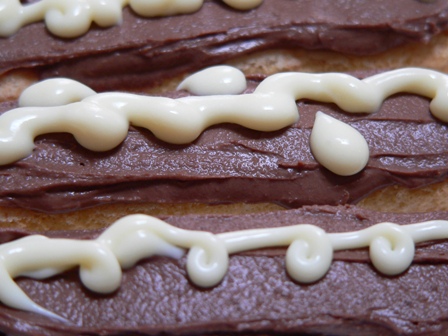
Last night we had friends over and I needed an instant dessert – all my addled brain could come up with on short notice was savoiardi biscuits (ladyfingers) topped with dark and white chocolate ganache. They were delicious, if somewhat artistically challenged.

ganache-saviordi-006


ganache-saviordi-003

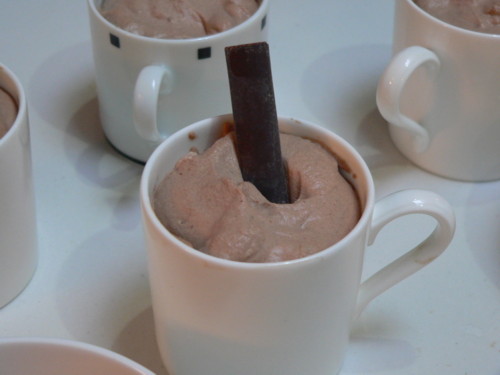
Chef Ming Tsai suggests making an easy chocolate dessert by mixing whipped cream with a generous dollop of ganache.  This produces a dark chocolate mousse (without any raw egg angst), which we serve in little espresso cups, accompanied by Belgian chocolate sticks for dipping. Be warned, it’s very rich – you really can’t eat a lot of this!

chocmousse


Read Full Post »

fudge-and-torte-018

Fudge is hard.  Unless you’re willing to make a condensed milk version, fudge making is a tricky process – one that involves delicate timing and temperatures, followed by controlled beating for a precise amount of time.  After throwing out an entire batch yesterday that went grainy, I was  about ready to give up on fudge.  But, loathe to admit defeat, we tried again today.

What did we learn from yesterday’s disastrous attempt?  Firstly, not to try and increase the amount of chocolate, or the mixture is likely to end up grainy.  Secondly, that everything has to be well dissolved before the mixture starts to boil, or the sugar will crystallise and the whole thing will end up in the bin.  Finally, that the addition of a little corn or glucose syrup can make the process much easier .

Here is our fudge recipe – I was pretty happy with the end result, and Pete and Big Boy tried to eat it all before dinner. I didn’t let them!

Edit 24/4/09 – some amendments made to methodology.  We’re trying to make a creamy fudge, as opposed to a harder crumbly one, and I’ve found the more gently you handle the candy, the less likely you are to get a grainy result. The fudge making process is a work in progress!

Ingredients:

  • 3oz (90g) dark chocolate (I used 70% Callebaut)
  • 3 cups sugar
  • ½ cup full cream milk
  • ½ cup cream (Australian cream is like a US heavy whipping cream)
  • good pinch salt
  • 1 Tbsp glucose syrup (or corn syrup)
  • 3 Tbsp (45g) butter
  • 2 tsp vanilla extract

1. Grease a square or rectangular glass pan with butter. My pan was a 7″ x 11″ (18 x 28cm) pyrex dish, but the original recipe recommended an 8″ (20cm) square one.

2. Mix together the sugar, milk, cream, glucose syrup and salt in a saucepan.  Stir with a spatula over a low heat until the sugar is dissolved, then add the chocolate and stir together until melted.  At this point, I used a whisk  – everything needs to dissolve before the mix starts to boil, so you might need to adjust your heat accordingly.   Whisk gently and try not to splash too much sugar onto the sides of the pan.  Use a pastry brush dipped in a little bit of hot water to wash any sugar crystals down from the side of the pan.

fudge-and-torte-001

3. As soon as the mixture starts to boil, stop stirring and clip a candy thermometer to the side of the saucepan, being careful not to let it touch the bottom. The pot I used was probably a little too small – be aware that the mix will rise up as it boils!  Boil over a medium-low heat – if you raise the temperature of the mixture too quickly, it’s more likely to end up grainy.

4. Let the mixture boils until it reaches the soft-ball stage, 235F – 240F (113C to 115C). Stay there and watch it – don’t wander off! I pulled mine off the heat at about 238F, to make sure it didn’t get too hot.  You can test for “soft ball” by putting a little into a glass of ice water and seeing if you can squeeze it together into a soft ball – if so, it’s ready to go.

fudge-and-torte-0021

5. As soon as it reaches the soft-ball temperature, remove the pan from the heat and allow it to cool.  I put mine onto the stainless steel bench, but you might need a heat mat if your bench isn’t as resilient.  Allow to cool to  110-120F (43.5 – 49C).  At that point, a slight skin will have formed on top.  Add the chopped up butter and vanilla, but don’t stir. Don’t try to rush the cooling time, or the fudge won’t set properly. I find cooling to 120F resulted in a creamier texture, whereas 110F gave us a firmer, more crumbly fudge.

6. Once it has cooled, scrape the fudge into the mixing bowl of a stand mixer.  Beat the fudge at a low speed until it “sets up”.  Pause occasionally to let the fudge react (and also to make sure you don’t blow your mixer motor up). The big thing to look out for is a change in appearance – the fudge will lose its gloss and turn a dull, matt brown.  It will also significantly lighten in colour and stiffen up.

7.  As soon as you see this colour and sheen change, scrape the fudge into the prepared pan and press it down with your hands to flatten it evenly into the tray.  Allow the fudge to cool to room temperature, then cut it into squares and store in an airtight container at room temperature.

. . . . .

The fudge experiments continue : The Gentle Art of Fudge Making

Read Full Post »

080409-003

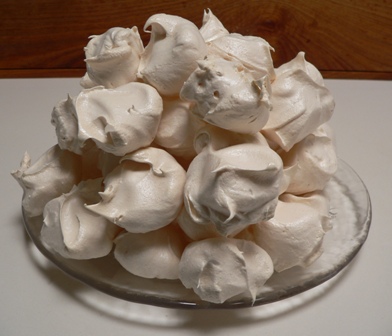
Can you believe this mountain of meringues was made from just four egg whites?  They were leftover from Pete’s pasticcio and I was loathe to waste them.  I’ve frozen half of these meringues and left the remainder in the cookie jar for emergency sugar hits.

Meringues are the easiest thing ever – for each egg white, you’ll need 60 grams  (2oz) of caster (superfine) sugar and a tiny bit of vanilla.  My batch of four whites used 240g caster sugar and ½ teaspoon of vanilla.

Preheat the oven to 150C (300F).  Beat the egg whites with an electric mixer until stiff, then gradually (a spoonful at a time) beat in the sugar.  Add the vanilla and continue beating, until your mixture is thick and glossy.

Drop dessertspoon dollops of the mixture onto baking trays lined with parchment paper.  You should have enough to make a ludicrous number of meringues.  Put the trays into the oven, and immediately drop the oven temperature to 110C (230F) or 100C (210F) with fan.  Allow the trays to bake until the meringues are light and crisp, about 65 – 75 minutes.  This makes a dry, crunchy meringue that will keep well – if you want a more marshmallow centre, you’ll need to bake them for less time on a slightly higher heat.  It’s worth playing around with small batches until you’re happy with them (after all, it’s only a couple of egg whites and some sugar).

Once the meringues are cooked, allow them to cool in the oven with the door slightly ajar.  This will give them a chance to dry out properly, without getting too sticky on the outside.  For some reason it’s quite hard to make meringues on a humid day – the end result is often a bit gummy and soft.  Enjoy!

. . . . .

Edit: You can also make swirly meringues – a very girly party favourite!

Read Full Post »

gfpb-cookiesq2

Pete A (so designated to distinguish him from Pete D, Pete V, Pete L and my Pete) is “allergic” to wheat.  At least that’s how Small Man describes it – what he actually has is coeliacs disease, which means his body can’t process gluten in any form. I’ve made it my quest to find him gluten-free treats which pass muster, with a particular focus on those that will satisfy his chocoholic tendencies (Pete is the proud and occasionally indulgent sire of the Boy Wonder, should anyone wish to join the dots).

Over the last few years, I’ve tried everything from tricky recipes which were no more than cream, butter and chocolate, held together by happy thoughts and fairy dust, to dead simple ones which are almost foolproof.  This is definitely one of the latter!

Edit: I’ve just realised that if you choose your chocolate chips carefully (read the label – most dark chocolate doesn’t contain any dairy), this recipe can be lactose-free as well as gluten-free.

Flourless Peanut Butter and Chocolate Chip Cookies

(based on a recipe from Bon Appetit, September 1999)

  • 1 cup chunky unsalted peanut butter (note: if you’re in Australia, the best one I’ve found is the Sanitarium 100% Natural Chunky Peanut Butter – give it a good stir before you start)
  • 1 cup (packed) dark brown sugar
  • 1 large egg
  • 1 tsp bicarbonate of soda (baking soda)
  • ½ tsp vanilla extract
  • 1 cup of dark chocolate chips

1. Preheat the oven to 175C (350F) or 160C (320F) with fan and line a large baking tray with parchment paper (Bake).  I have a 90cm oven – if yours is smaller, you might need two baking trays.

2. In a large mixing bowl, mix the peanut butter, sugar, egg, bicarb soda (sifted) and vanilla extract, and stir well to combine.  Mix in the chocolate chips. (You don’t need a mixer for any of this – just stir it all together with a large spoon).

3. Using a small greased icecream scoop, or a tablespoon, place generous balls of dough onto the baking tray(s), leaving a gap of about 5cm (2″) between each.

4. Bake the cookies until they puff up but are still soft to touch in the centre, about 10 – 12 minutes.  These cookies over-cook very easily, so watch them carefully and pull them out as soon as they’re golden brown (in my oven, that’s about 11 minutes).  I rotate them once during the baking time.  Don’t be put off by the fact they’re still soft when you pull them out, as they’ll harden as they cool.  Once the colour is right, they need to come straight out of the oven.

5. Allow to cool on tray(s) for five minutes, then transfer to racks and allow to cool completely.  If you’ve made these correctly, they’ll have a nice, loose crumb with melting chunks of chocolate sandwiched within them!

gfpb-cookies1

Read Full Post »

« Newer Posts - Older Posts »