Feeds:
Posts
Comments

Archive for the ‘Recipes’ Category

fc5a

I apologise for putting two similar recipes up in quick succession, but if you’re going to make these, then you’ll need to do it soon, or they won’t have time to mature and develop before Christmas.

I normally bake a large 25cm/10″ square fruitcake every Christmas.  It has a lovely, rich flavour and keeps brilliantly for months – we’ve just finished eating one that I made in March.  We always store our fruitcakes in the fridge, as we find they keep and cut better cold, although it’s best to let the slices return to room temperature before serving.

fc 002

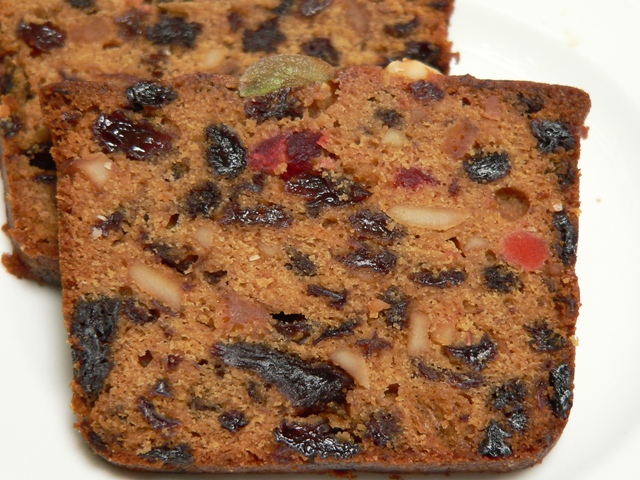
This year, as I had the mini loaf tins out for the Fruit and Nut Cakes, I decided to use those instead.  These small, richly flavoured fruitcakes (yes, we’ve eaten one already) are a perfect size for gift giving.
fc aa

Our cakes are based on an old recipe from the Australian Women’s Weekly,  which has been used extensively by home bakers since 1937.   It’s fabulously reliable, and we’ve had consistent results with it for nearly twenty years (and baked several hundred cakes in the process, I might add).  It will make one deep 25cm square cake, or  one deep 28cm round cake, or two deep 20cm square cakes, or eight to nine 15 x 8cm mini cakes.  I’m sure you could bake it in other tins as well – just be aware that your baking times will vary depending on the size of your cakes, so make sure you don’t overcook them.

Some notes on ingredients:

1. We vary the fruit mix from time to time, depending on what we have on hand.  The recipe is quite flexible, and there’s no problem with substituting extra dried fruit in place of the glacé cherries and mixed peel if desired.  However, if you substitute fruit for the almonds, you’ll end up with a cake which is a little too sweet (at least for our tastes).

2. I’ve used cumquat jelly when we’ve run out of marmalade, but don’t be tempted to substitute a sweet jam instead.  You need the slight hint of bitterness to balance out the cake.  The original recipe specifies 1 Tbsp of grated orange rind, but I’ve never included that.

fc 007

Women’s Weekly Prize Winning Fruit Cake
(the original recipe is here)

  • 500g (3 & 1/4 cups) sultanas
  • 500g (3 & 1/4 cups) currants
  • 250g (1 & 1/2 cups) chopped raisins
  • 125g (2/3 up) glacé cherries, halved
  • 60g (1/3 cup) mixed peel
  • 185g (1 & 1/2 cups) slivered almonds
  • 1/3 cup Seville orange marmalade or cumquat jelly
  • 2 teaspoons grated lemon rind
  • 1/4 cup lemon juice
  • 2/3 cup brandy
  • 500g (2 cups) unsalted butter, softened
  • 420g (2 cups) brown sugar, firmly packed
  • 8 large (59g) chicken eggs, or 6 large duck eggs
  • 450g (3 cups) plain flour
  • 150g (1 cup) self-raising flour
  • glacé fruit and blanched almonds for decoration
  • extra brandy for finishing

1. In a very large bowl (I use a big Corningware casserole with lid), place the dried fruits, cherries, peel and almonds.  Add the lemon juice, brandy, lemon rind and marmalade, and give the mixture a good stir.  Cover and leave overnight or for up to one week.

2. The following day, in another large bowl and using an electric mixer, cream the softened butter and sugar until just combined.  Add the eggs one at a time and beat after each addition, again until just combined.  The mixture may curdle slightly (I’ve found it’s less likely to do so with duck eggs than regular eggs), but fear not, as it will smooth out once the flour is added.

3. In a separate bowl, measure out the plain and self-raising flour now, as your hands are about to get very dirty.  Preheat the oven to 150C (with fan).  Spray nine non-stick mini loaf tins (15 x 8cm) with oil, and line their bases with parchment paper.

4. Tip the butter and egg mix into the fruit mix, or vice versa, depending on which bowl is bigger.  Now, with really clean hands, squish the batter and fruit  together until well combined.  You could probably do this with a wooden spoon, but it’s such a large mixture that hands are just easier.

5. Add half the flour (two cups worth) and work it through with your hands, then add the remaining two cups of flour.  Mix really well and make sure there are no large clumps of flour or fruit.  Scrape off your hands and wash them for the next step – now wasn’t that fun?  I think this is my all time favourite part of Christmas cooking.

6. Spoon the mixture evenly into the tins, filling them to ¾ full.  Smooth out the tops.  Decorate the cakes with glacé fruits and blanched almonds.

7. Bake the cakes in the preheated oven for 1 – 1¼ hours.  The cakes are cooked when a thin bladed knife inserted into the middle comes out clean.

8. Remove the cakes from the oven and, while they’re still hot, brush over liberally with brandy.  Cover the tops of each cake with foil,  stand them side by side, then wrap a tea towel around them and allow to cool completely overnight.  The aim is to cool them as slowly as possible, to give the brandy a chance to soak in.

The following day, carefully loosen around the edges  with a butter knife and turn out the cakes.  Wrap them in two layers of foil, and store in the fridge until needed.  Try to resist eating them straight away!  I failed, but the advantage of eight mini cakes is that you still have seven left…

fc 006

Note:  You could, of course, bake this recipe as a large square or round cake.  If you’re going to do that, make sure you grease and line your tin carefully, bringing up the paper at least 5cm above the top of the pan, to protect the cake during the cooking process.   And despite what the original recipe says, I’ve never needed five hours to cook this cake in a fan forced oven – from memory, it’s usually about 2½ – 3 hours (I think the fan dries the cake out more quickly).

. . . . .

Please see our Christmas page for more gift ideas!
Read Full Post »

Ginger Jam

g3

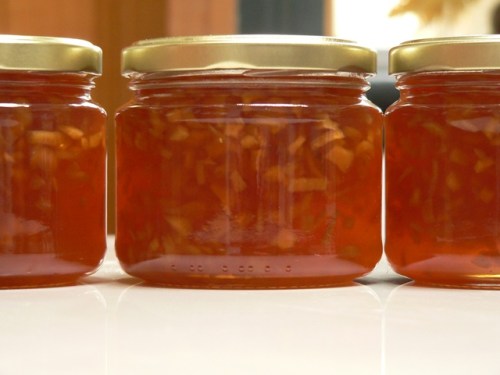
Pete tried his hand at ginger jam last weekend and the end result was this delicious cross between jelly and jam, with a hot bite and suspended pieces of ginger.  I’m not entirely sure what we’ll do with it yet, but it is certainly tasty.

We purchased “medium” old ginger pieces at the markets for $6/kg.  Young ginger won’t have enough flavour for this, and old or very old ginger might be a bit stringy.

  • 1kg ginger pieces
  • 2kg white sugar
  • 3 x 300ml jars homemade pectin
  • juice of 1 lemon

g1

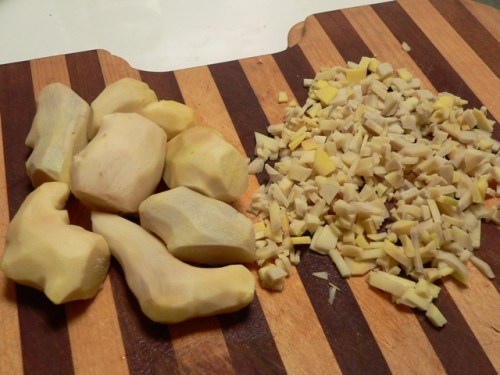
1. Peel the ginger and chop it finely.  Place it in a large pot with the pectin and lemon juice and simmer for half an hour (or more), covered, until soft.

g2

2. Add sugar and boil gently until the sugar is dissolved, skimming off any surface scum as you go.  Once the jam is cleaned of all foam, raise the temperature and bring the mixture to a rapid boil.

3. Boil until set.  Test by putting a small amount on a cold saucer – the jam is set if it wrinkles slightly when pushed.  Make sure you turn off the heat while you do this, or your jam might burn.  If the jam hasn’t set, boil it up again for a little longer.  If it still doesn’t set, you might need to add more sugar, pectin or lemon juice – as the ginger doesn’t have any natural pectin or sugar (I’m not sure about acid), all these things need to be added.  The consistency of this jam is really more of a thick, sweet, syrupy jelly with suspended pieces of ginger.

4. Ladle the jam into sterile jars and seal tightly, then process the jars in a boiling water bath for 10 minutes, ensuring that the water covers the lids by at least 2.5cm.  Note: make sure you put the hot jars into hot water – if you use cold water, the glass jars may crack.

Does anyone have suggestions on what we might do with this, other than eat it on toast?  Thanks…

006

g4

. . . . .

See our Jam Making Primer for more tips on making jam.

Read Full Post »

Pete chastised me for feeding some of this cake to Ellen tonight.  As we’re making these for Christmas, he told me I was “telegraphing my punches”.  I suspect he’s forgotten that I was planning to post the recipe here.  Do me a favour – if you get one of these from us this Christmas, act surprised – it will keep my husband happy.

These gorgeous, delicious mini fruit and nut cakes are based on an old Women’s Weekly recipe.  They’re gluten and lactose free, low in added sugar and keep well for up to three months in the fridge.  The original recipe was sized to make two  bar cakes, but the same amount will also make four or five mini loaf tin sized cakes.  We did both, so the photos you’re seeing are of a double batch.

This cake was a regular part of our Christmas baking for years, until the cost of the ingredients became  prohibitive.  Now, with access to very reasonably priced supplies at Harkola, it’s back on the list for Christmas 2009.  If you’re planning to make these en masse as we do, try to source bulk suppliers of fruits and nuts.  The brazil nuts and  glacé fruits can get quite expensive, so it’s definitely worth a trip to your local food wholesaler to stock up on supplies.  And who knows what else you might find there?

Assembling the ingredients and lining the cake tins are the hardest parts of this recipe – the actual cooking process is very simple.  Although finding a spot in the fridge to store 30 odd cakes can be a bit challenging…

Ground Almond Fruit Cake
(recipe adapted from the Australian Women’s Weekly Celebration Cookbook)

  • 250g seedless dates
  • 100g mixed peel*
  • 50g glacé apricots, cut into pieces*
  • 90g red glacé cherries*
  • 90g green glacé cherries*
  • 80g raisins
  • 250g brazil nuts
  • 185g walnuts
  • 100g ground almonds
  • ½ teaspoon baking powder
  • 3 large (59g) eggs
  • 2 tablespoons (40ml) honey
  • 1 teaspoon homemade vanilla extract
  • 2 tablespoons rum

*Note: you could really use any mix of glacé fruits you choose.  If you decide not to use the apricots, increase the mixed peel to 150g (which is how the recipe was originally written).

1. Put the dates in a large mixing bowl, checking carefully for pips as you go (as dates are mechanically harvested and processed, some seeds are occasionally missed).  Give the dates a quick rinse (they can sometimes be a bit dusty).

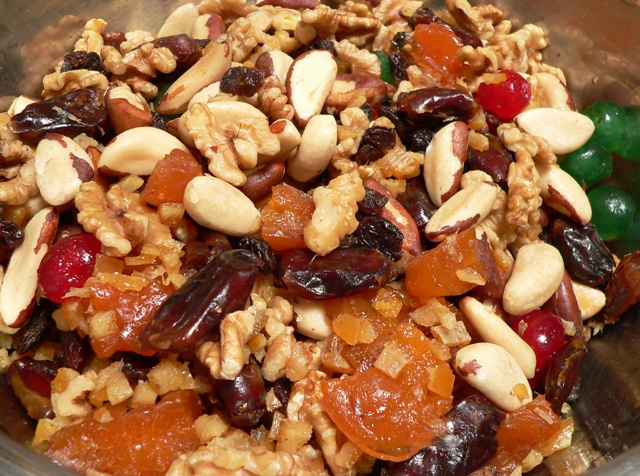
2. Add all the remaining fruits, brazil nuts and walnuts and stir well.  Add the ground almonds and baking powder and stir to combine.

cc 001

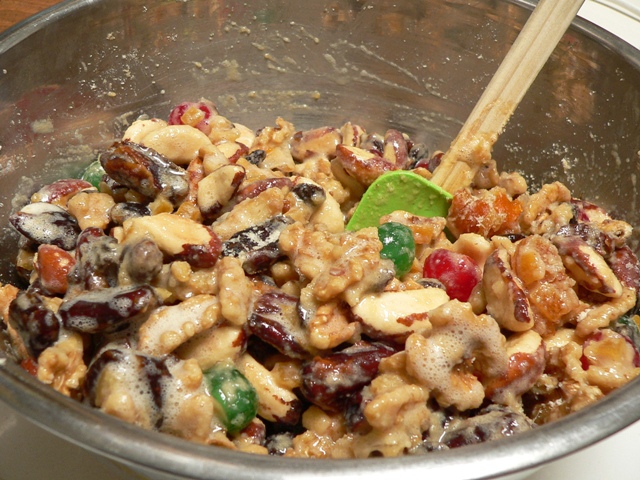
3. In a small bowl, beat the eggs until thick and creamy, then beat in the honey and vanilla extract.  Pour the eggs into the fruit mix and stir well to combine (remember these photos are of a double batch).  Make sure that every piece of fruit and nut is well coated with the batter.

cc 003

4. Preheat the oven to 150C with fan.  Line two bar pans (8cm x 26cm) or five small loaf pans (8cm x 15cm) with parchment paper. Divide the mixture evenly between the pans, making sure to work it well into the corners.

cc 004

5.  Bake for about an hour (start checking after 50 minutes), or until the cakes are firm and dark brown.  The original recipe specified 1½ to 2 hours, but we’ve never needed that long in our fan forced oven (although it does run hot).  Brush the rum over the hot cakes, then wrap  tightly in foil and allow them to cool in their pans overnight.

When completely cool, wrap the cakes tightly in foil and store in the fridge until required.   The cakes cut well when cold; allow slices to return to room temperature before serving.

cc 010

PS. Please have a look at our new Christmas page for more gift ideas!

Read Full Post »

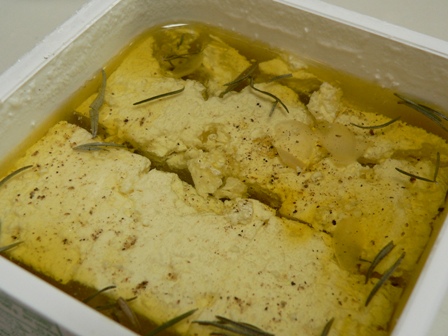
fet 010

We used to pay a lot of money for marinated feta.  On our quest to source the delicious, creamy version used by our local Greek taverna, we tried just about every type available at the deli counter, including Persian, Greek and Australian.  None were quite what we were after.

Then one day, in desperation, I asked the taciturn Greek owner which feta he was using.  He grunted, “Bulgarian”.  It had never occurred to us to try the inexpensive brined cheeses available at the supermarket, but they turned out to be exactly what we were looking for.

These cheeses often don’t even have “feta” on the packaging.  They’re very cheap – we pay about $8 for 500g (a little over 1lb) – and they come with a long expiry date.  That’s because the cheese has been brined (soaked in salty liquid) to preserve it.  The secret to enjoying it is to rinse and soak it first – it’s way too salty to eat without processing.

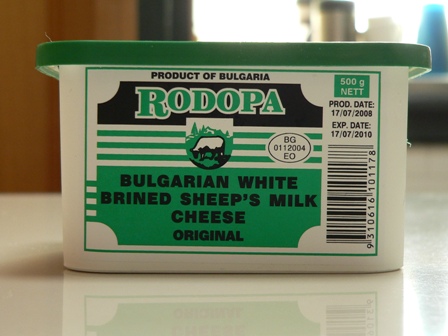
Here is the brand we now buy:

fet 001

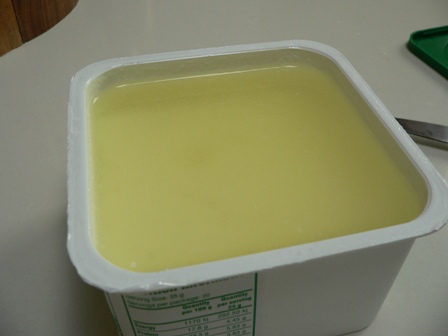
This is what it looks like when you first open the container – soaking in a salty brine.  Carefully tip the liquid out of the container, then cut the solid block into large chunks.  Be gentle, as the cheese can be quite crumbly.

fet 003

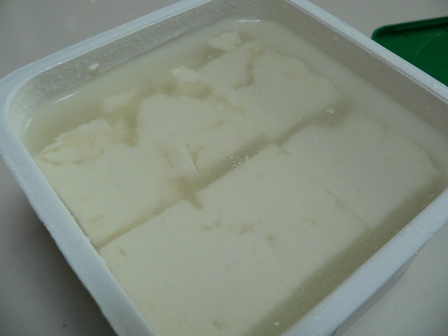
Fill the container with cool filtered water, cover and allow it to sit in the fridge for a few hours or overnight.

fet 004

The next day, drain the water off.  If you can, arrange the blocks so that they fit tightly into the bottom of the container – this will minimise the amount of oil you need to add.  Pete will often tip them over, so that they’re packed closely together, but I tend to break them up when I do that, so I don’t bother.  The oil isn’t wasted anyway – we’ll use it on our pizzas and focaccias.

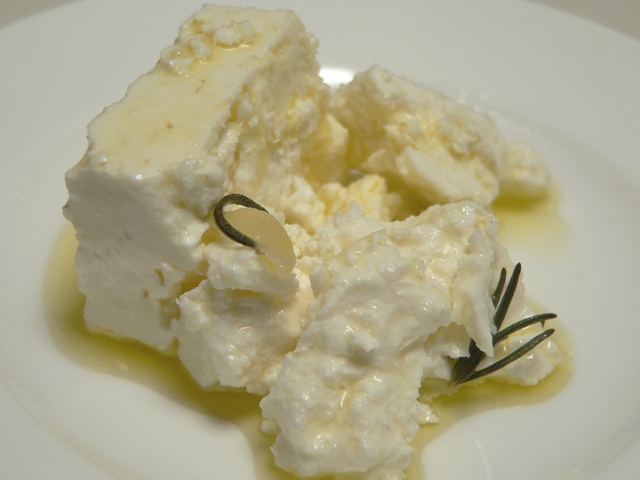
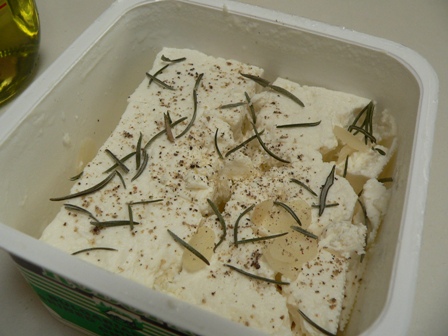
Sprinkle over some dried rosemary and a little ground pepper. I slice a couple of cloves of garlic, fry them in a little oil, then add them in as well. Of course, you could add whatever you want here – whole peppercorns and spices might be nice.

fet 006

Cover the feta with a mixture of extra virgin olive oil and grapeseed oil.   The flavour is wonderful, but if you use straight olive oil, it will coagulate in the fridge.  We find grapeseed oil works well, but use other vegetable oils if you prefer.  Just make sure the olive oil is 50% or less of the total oil added.

Store the marinated feta in the fridge, where it will keep for several weeks.  Make sure to keep the container tightly sealed and the blocks covered in oil.

fet 007

Read Full Post »

misc 005

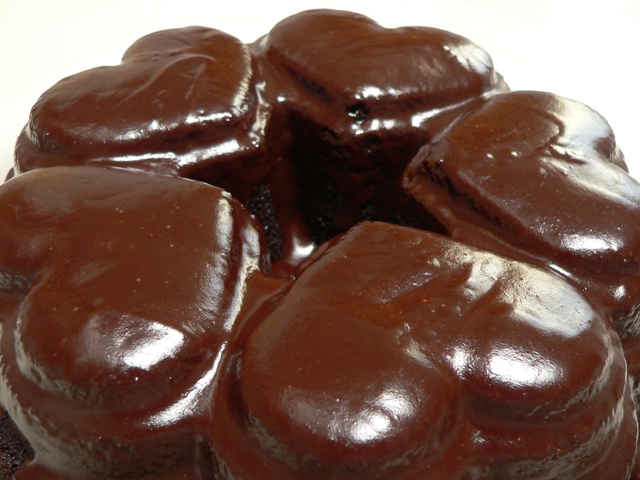
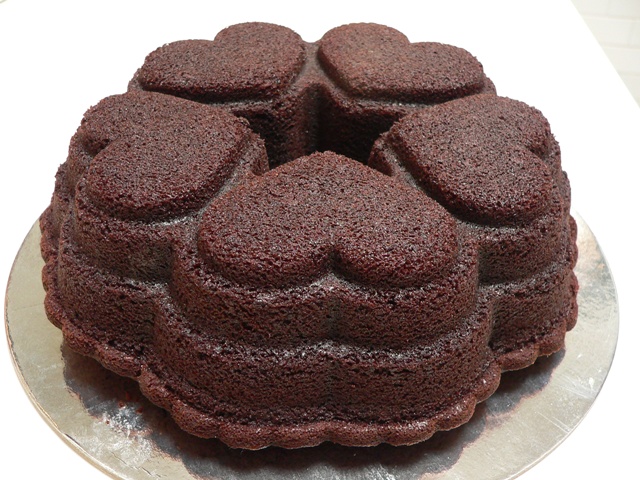
A birthday cake for Marty, who loves dark chocolate and Guinness!

Click here for a printable version of this recipe

Guinness Chocolate Cake
(adapted from the Rich Stout Cake recipe in the Green & Black’s cookbook)

  • 250g unsalted butter
  • 1¾ cups (375g) soft dark brown sugar
  • 4 large (59g) eggs
  • 12/3 (250g) cups plain flour
  • ½ teaspoon baking powder
  • 2 teaspoons bicarbonate of soda (baking soda), sifted
  • 440ml can of Guinness, at room temperature
  • 1 cup (110g) cocoa powder, sifted
  • 150g dark chocolate, finely ground or grated (I used Callebaut 54% callets)

1.  Preheat oven to 160C (325F) with fan.

2. Spray a 10-cup bundt pan with canola oil spray (or other vegetable oil, just not olive or rice bran oil).  Also spray a couple of extra small tins – muffin or mini-loaf tins, as there will be excess batter after the bundt pan is filled.

Alternatively, you could grease and line a 23cm/9″ springform cake tin with parchment paper. The amount of batter also bakes perfectly in a large 12-cup bundt pan.

3. Grind the chocolate up – either using a grater or a mini food processor (which is what I did). If you’re using the latter, pulse the chocolate until finely crumbled, but be careful not to heat it up too much, or it will melt.

misc 012

4. In medium sized bowl, stir together the  flour, baking powder, sifted bicarb soda and sifted cocoa. Note that you really do need to sift the bicarb and cocoa, or you’ll end up with bitter lumps in your finished cake. Stir in grated chocolate.

misc 014

5. In a large mixing bowl with an electric mixer, cream together the butter and sugar, then add the eggs one at a time, mixing well after each addition.

6. Add some of the flour mixture to the batter and mix well.  Then add in some Guinness and mix again to combine.  Continue in this fashion, alternating flour and stout, making sure you finish with a reasonable amount of flour at the end.  The mix may appear to curdle, but the final addition of flour will smooth it out again.  Beat until the batter is thoroughly mixed – it will be quite soft.

misc 017

7. Pour the batter into the prepared pan, filling the bundt pan to about two-thirds full.  Pour the remaining batter into the smaller tins.

misc 019

8. Bake the larger cake for about one hour, or until a skewer inserted into the centre of the cake comes out cleanly.  The smaller cakes will cook much faster – start checking muffin sized cakes after about 20 minutes.  If you bake the cake in a 9″ springform, you might need a longer cooking time – if it begins to brown too much, cover the top with foil after the first hour.

9. Remove from oven and let the cake rest for 10 minutes before turning out onto a wire rack to cool.

misc 023

Chocolate Topping
(from Jamie Oliver’s Return of the Naked Chef)

  • 100g/3 ¾ oz butter
  • 100g/3 ¾ oz best cooking chocolate
  • 100g /3 ¾ oz icing sugar (sifted)
  • 3 tablespoons (60ml) milk

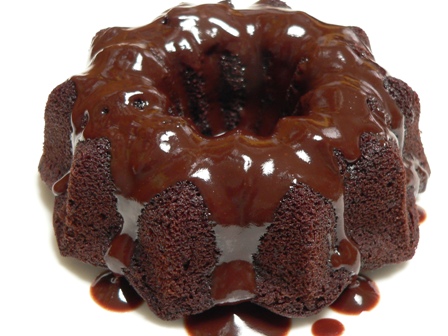
Melt the chocolate topping ingredients in a bowl over some lightly simmering water. Stir until blended well and allow to cool slightly. Pour over cake and allow to set.

misc 029

We gave the large cake to Marty for his birthday, and kept our two mini cakes as tasting samples. This moreish, moist recipe is very dark and grown up – perfect for those who don’t like their chocolate cake overly sweet.

Gillian at Some Say Cocoa made this cake recently as well – check our her version here.

misc 031

misc 032

Read Full Post »

« Newer Posts - Older Posts »