Feeds:
Posts
Comments

Archive for the ‘Recipes’ Category

Smoked Rainbow Trout

“Dredgey, I have two rainbow trout in the freezer. Will you smoke them for me, please?”

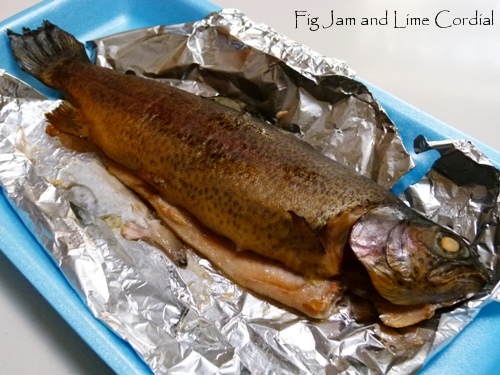
I can’t tell you how happy I am to be able to ring a neighbour and ask him this on a Saturday morning.  Farmed rainbow trout are a good buy at the moment, with these two fish costing me $11 in total. I took them out of the freezer first thing in the morning, and they were defrosted by early afternoon…

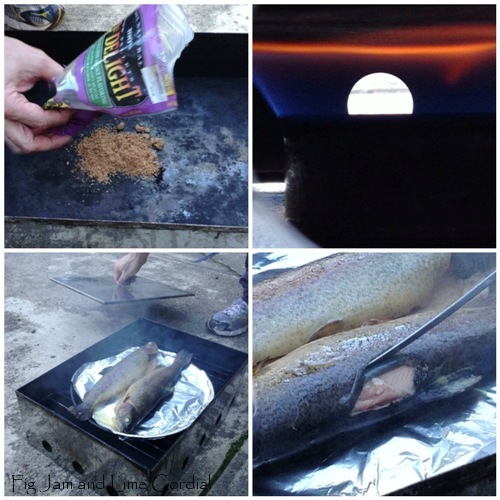
The smoker is a small metal box with holes in it. For some reason, I always think of smoking as a difficult process, but it’s actually incredibly easy.

Dredgey began by pouring a small mound of hickory sawdust onto the base of the smoker. The fish was laid out on a foil-lined metal plate (old pizza tray) on a wire rack, and placed over the wood. The lid of the box was positioned on securely to keep the smoke in.

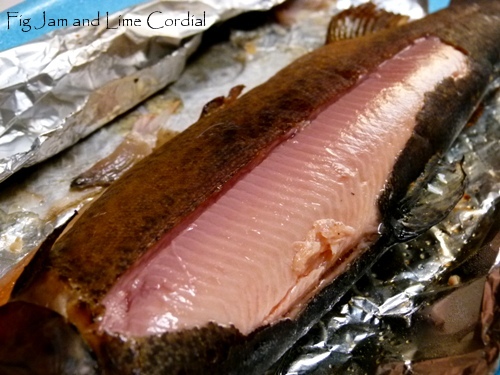
An old tuna tin was half filled with methylated spirits and lit, then the smoker was placed on top of it.  We sat and chatted for twenty minutes while the fish cooked to perfection – tender flaky flesh, with just the lightest smoke flavour…

Pete’s not a fan of smoked meats, but Big Boy and I adore them…

We gave one fish to Dredgey, who then swapped half of it for squid with Louise across the road. Have I mentioned how much I love our neighbourhood?

Do you own a smoker? If so, what do you use it for? Dredgey has smoked everything from fish to sausages to almonds in his little box!

Read Full Post »

International Scone Week is, as we like to say over here, a bit of a lark.

Which means it’s not terribly serious, but rather just an excuse to have some fun. Three years ago, a group of us found ourselves serendipitously baking scones at the same time. One thing led to another, and the next thing we knew, a tradition was born to bake and share our scones during the second week of August.

Of course, it’s a very loose tradition, definitely a “play if you feel so inclined” kind of thing. But if you’d like to join in, please leave me your links or photos in a comment below (you don’t need to be a blogger) and at the end of the week, I’ll put together a roundup post. There are no rules, bake any scones you like – sweet, savoury, round, triangular – whatever takes your fancy. And if you need some inspiration, here are last year’s photos!

Here is my latest experiment, using the farm cheese that I mentioned in my August In My Kitchen post. The crumbly curds gave the scones a rich flavour and crisp exterior, without making them taste savoury or cheesy. They turned out a little denser than my regular scones, but with a very tender crumb, and they went down a treat – Small Man ate three of them for lunch!

  • 300g (2 cups) plain (AP) flour
  • 2 generous teaspoons baking powder
  • pinch of fine sea salt
  • 50g  unsalted butter
  • 75g Brancourts Farm Style Cottage Cheese
  • 50g caster (superfine) sugar
  • 125g (½ cup) milk
  • 1 large free range egg
  • a little milk for brushing the tops before baking

1. Preheat oven to 200C (400F) or 180C (360F) with fan. Line a small baking tray with a sheet of parchment paper.

2. In a medium bowl, whisk together the flour, baking powder and salt.  Sieve the dry ingredients into a large mixing bowl.

3. Cut the butter into small cubes and crumble the farm cheese, then rub both into the flour with your fingertips. Don’t worry about getting it all mixed in too neatly. Stir in the sugar.

4. Whisk together the milk and egg, then pour it onto the dry ingredients. Mix together gently with a butter knife, then turn the dough onto a lightly floured surface and bring it together gently. Because of the added cheese, the mixture will be slightly stickier than usual.

5. Lightly pat the dough to a thickness of about 2½ cm (1″). Using a well-floured round cutter, cut out circles, taking care not to twist as you push down. Lay the scones on the parchment-lined tray and brush the tops with a little milk. Bake for 20 – 25 minutes, or until (hopefully) well-risen and golden brown. Makes six large scones.

Happy baking everyone!

PS. If you find regular scones intimidating, you might want to try
making the lemonade version – they’re very easy!

PPS. The baking has started! Check out these fabulous posts:

Heidi @ Steps on the Journey

Anne @ Life in Mud Spattered Boots

Glenda @ Passion Fruit Garden

Tandy @ Lavender and Lime

Tracy @ Sunny Corner Farm

Read Full Post »
Beef Short Ribs

Necessity, or in my case, the offer of lunch with a friend, is the mother of invention.

I had defrosted a kilo and a half of grassfed beef short ribs with the intention of making Chicago John’s brilliant sticky recipe. But when my friend Terri called and asked if I’d like to join her and the adorable Jackhammer for lunch, it was too tempting an offer to refuse.

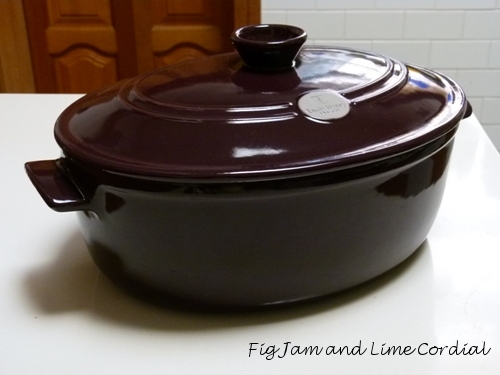
John’s recipe takes quite a bit of prep time, which I suddenly didn’t have. So instead, I dragged out my ginormous Emile Henry Flame pot

I roughly chopped three Spanish onions and threw them over the base of the pan, then laid the short ribs on top. A third of a jar of Pete’s quince jelly was smeared over the meat, before adding a bottle of tomato passata, half a bottle of red wine, homemade beef stock (from the freezer), a little water, salt and plenty of freshly cracked black pepper. The lid went on, and the pot went into a preheated 160C oven for three hours.

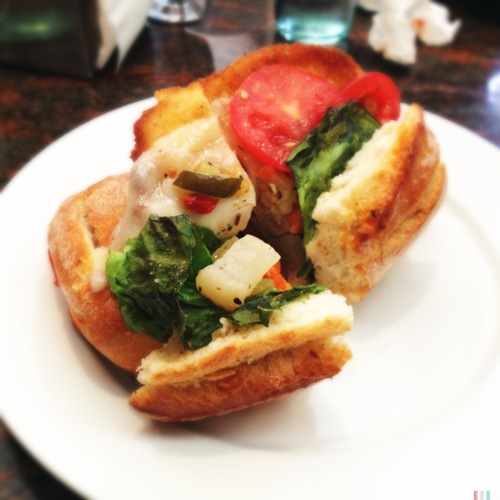
And I went out to lunch! Terri and I shared a chicken schnitzel and gardiniera roll…

As Jack is only three, I took a couple of Big Boy’s old engines for him to play with. It’s amazing how these worn old toys can still work their magic after all these years…

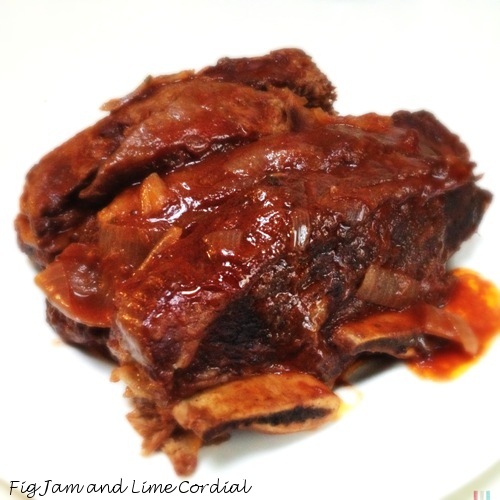
When I finally pulled the short ribs out of the pot, they were fork tender and unctuously rich, with a delicious gentle sweetness from the quince jelly. They would have been perfect as they were, served simply on a bed of mashed potatoes and topped with a little sauce.

Instead, we shredded the meat and de-fatted the cooking liquid (which was then blitzed smooth with a stick blender). In a separate pan, we fried chopped onions, carrots and a pinch of celery salt, and added two tins of San Marzano tomatoes and a little sherry vinegar (to balance out the flavours).

The shredded meat was added to the pan, and cooked gently to allow it to break down even further. Finally, the pureed braising stock went in and the sauce was simmered until thick.

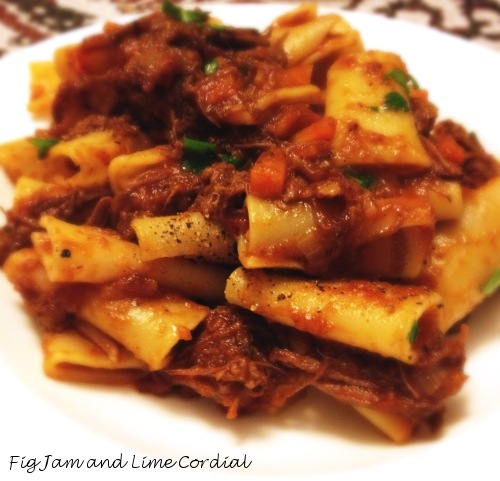
The end result was this luscious slow cooked beef ragu, served with our favourite Occhi di Lupo pasta…

I was really pleased with how well the “set and forget” technique worked with the short ribs – I didn’t do anything to the meat other than defrost it – and it only took a few minutes to assemble. I’m pretty sure this method will work with beef brisket as well.

Best of all, this recipe made enough ragu to feed my starving tribe twice, which means that the next time Terri invites me out to lunch, I’ll already have dinner on standby in the freezer!

Read Full Post »

Peanut Butter Chocolates

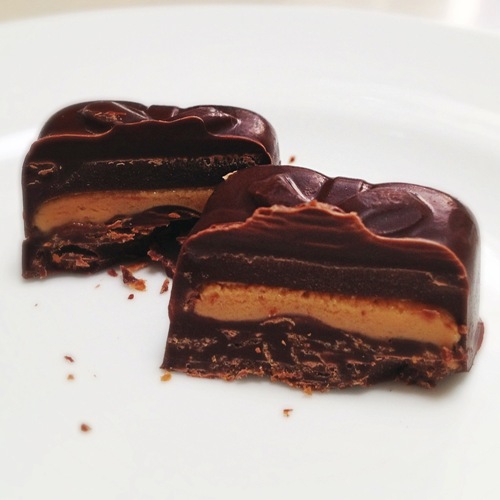
These little chocolates are incredibly rich.

To me, they taste like a bit like a really good Snickers bar, and they’ve gone down like a house on fire with almost everyone who has tried them.

A couple of weeks ago, I had an interesting conversation on Twitter with my friends Lucas and Mei-Lu. We were discussing Reese’s Pieces, a US candy, and its sister confection, Reese’s Peanut Butter Cups. I thought it might be fun to try making them at home.

I made a filling by beating together (with a metal spoon) half a cup each of smooth peanut butter (Krafts) and icing sugar mixture (confectioner’s sugar).  I then tempered a 50/50 batch of Callebaut 811 (54% dark) and 823 (milk), and half filled my small square moulds with the chocolate.

Spreading the chocolate onto the sides of each square well with a tiny spatula was fiddly and produced less than perfect results. The alternative though was to fill each hole to the brim and then tip out the excess – a process that would result in far more chocolate wastage than I was happy with.

The moulds were set briefly in the fridge before a teeny spoonful of the peanut butter mixture was scooped into each cavity. We discovered that banging the trays on the bench helped to level off the peanut butter…

A small dollop of tempered chocolate then went on top to seal in the filling…

I suspect that these are less sweet (and salty) than the original, as I’ve used a high cacao milk chocolate coating, and only a small quantity of filling in each piece. They’re not the neatest choccies I’ve ever made, but they’ve definitely been one of the most popular!

Addendum: Since drafting this post, I’ve had another go at these. To the second batch I added a handful of Pailleté Feuilletine to the base layer of chocolate, and reduced the amount of peanut butter. They’re even more moreish with the added wafer crunch…

Read Full Post »

Garden Tabbouleh

Our garden is quite unpredictable.

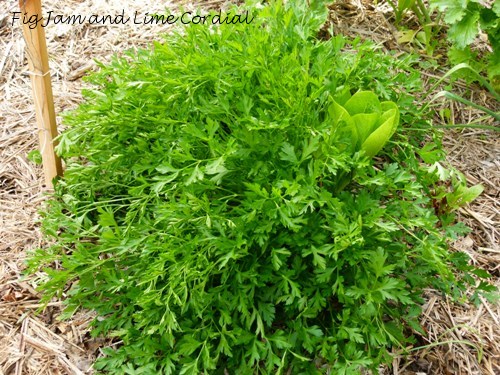
Actually, it’s probably more accurate to say that we haven’t had quite enough experience to completely understand what’s going on. Last year we had an amazing crop of peas, but very little parsley. This year the pea plants are short and stumpy, but the parsley is self-sown and growing in huge clumps…

In our first couple of years of gardening, we tried to figure it out, but it nearly drove us bonkers. So instead we’ve given up and simply adapt our eating to whatever we can grow in any given season. This winter, it’s lots of Chinese leafy greens, the ever reliable chard and leeks, and mountains of continental parsley.

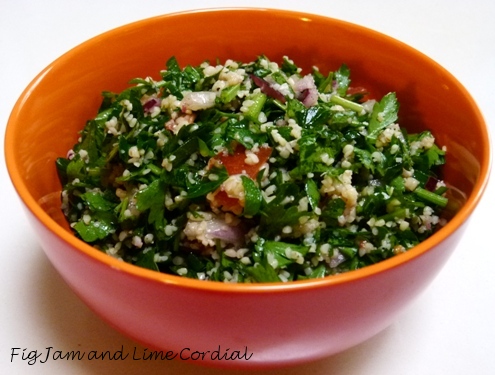
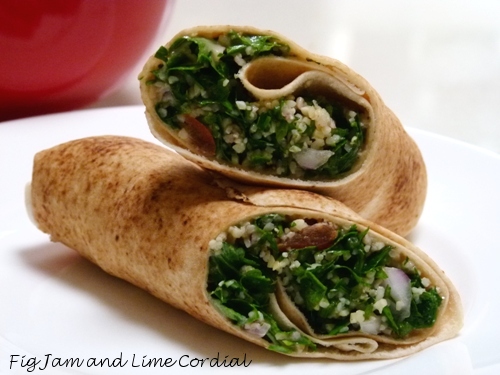
My favourite lunch at the moment is a vegetarian wrap, spread with tahini and stuffed with a simple tabbouleh. I’ll occasionally add meat or fish, but it really is just as good without it.

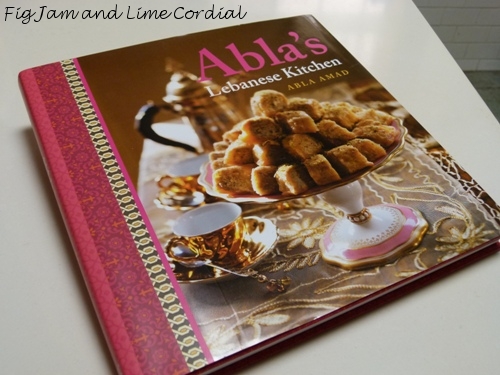
Inspired by a recipe from Abla’s Lebanese Kitchen, our salad is very rough and basic. I make up a batch every few days and stash it in the fridge.

  • very large bunch of continental parsley
  • tomatoes
  • half a Spanish onion
  • ½ cup fine bulgur
  • salt to taste (I use about ¾ teaspoon, but I’m making quite a lot)
  • freshly ground black pepper
  • ½ teaspoon (or less) of ground pimento (allspice)
  • lemon juice
  • extra virgin olive oil

1. Place the bulgur in a heatproof bowl, and cover with ½ to ¾ cup boiling water (how much you need will vary depending on the bulgur you buy). Cover with cling film and allow to absorb while you prep the other ingredients.

2. Chop up the continental parsley as finely as you can without risking damage to your fingers (this warning is issued from experience!). I use all of the leaf and a bit of finely chopped stalk. Chop up the tomatoes (I only ever have a few from the garden), and dice the Spanish onion. Combine them all together in a large mixing bowl.  The original recipe also includes mint, but it’s not doing so well in our garden at the moment.

3. Stir in the bulgur grains with the salt, pepper and pimento. Stir in the lemon juice and olive oil to taste (Abla’s recipe specifies 150ml of each to 5 cups of chopped parsley, but I just slurp it in).

4. Split a pita bread in half, and spread one side generously with tahini. Add a generous scoop of tabbouleh, roll up and enjoy!

Read Full Post »

« Newer Posts - Older Posts »