Feeds:
Posts
Comments

Archive for the ‘Recipes’ Category

Sourdough Fruit Buns

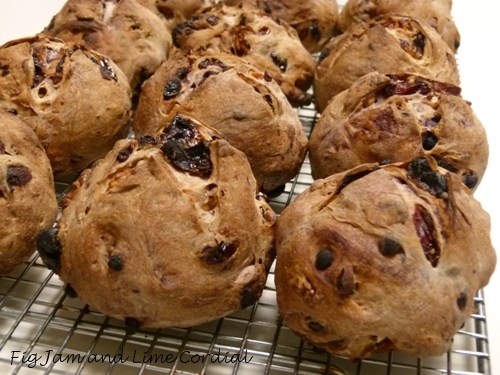
Inspired by Shady Baker Jane’s gorgeous fruit buns, I baked a batch for Pete last weekend.

I used a variation of my sourdough fruit loaf recipe, increasing the water just a little as the mix seemed to need it on the day.  According to my iPhone note, the buns included walnuts, sultanas, dried sour cherries, cranberries, sunflower kernels, golden raisins, candied orange rind, Greek figs and dried blueberries.

  • 200g active sourdough starter ( 166% hydration, ie. fed at a ratio of one cup water to one cup flour)
  • 700g bakers/bread flour
  • 375g – 400g water
  • 15g extra virgin olive oil
  • 12g fine sea salt
  • 1 teaspoon mixed spice (I used Herbie’s)
  • 10g brown sugar
  • 600g mixed dried fruit and nuts

Note: 600g of fruit and nuts is a ridiculous quantity for this much dough and made shaping the buns very difficult.  If you’ve just starting baking bread, you might want to use a much smaller quantity (say 300g), which will make the mixture far more manageable.  As so often happens, I got carried away.

1. In a large mixing bowl, combine the starter, water, oil, mixed spice, brown sugar, fruit and nuts.  I cut the figs up into smaller pieces, and finely chopped the candied rind, but otherwise left the other inclusions whole.

2. Add the flour and sea salt and mix to form a shaggy dough.  Make sure all the dry ingredients are incorporated. Scrape off your fingers, cover the bowl with clingfilm or a tea towel, and allow to rest for 30 minutes.

3. Uncover the bowl and give the dough a quick knead.  Cover again and allow to prove until double in size – in my winter kitchen, this took about 8 hours (in summer, it might take half the time).

4. Turn the dough onto an oiled surface, give it a couple of folds onto itself, then divide it into 12  – 13 equal portions.  The weight of each bun will depend on the quantity of fruit and nut you’ve used – I made 13 x 150g buns.  Shape each portion as best as you can into a tight round bun – try to get as much fruit inside the dough as possible to minimise burning.  Mine were pretty messy…

5. Lay the buns out on a parchment lined tray, cover loosely with a teatowel and allow to prove – mine didn’t expand much at stage, maybe 50%. Preheat oven to 220C with fan.

6. Slash a cross into the top of each bun and spritz with a little water, then place the tray into the oven, dropping the temperature to 200C with fan as you do.  Bake for 20 minutes, then rotate the tray and reduce the temperature to 175C with fan for a further 10 minutes, or until well browned.  Fruit buns have a tendency to burn because of all the sugar, so please keep an eye on them.
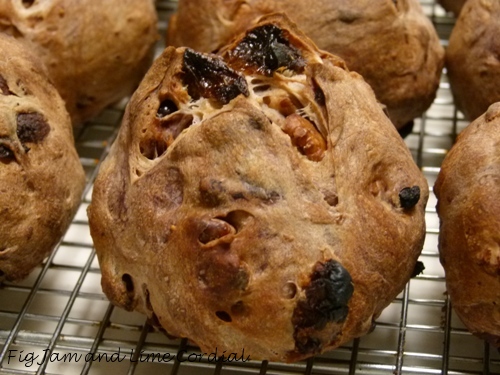
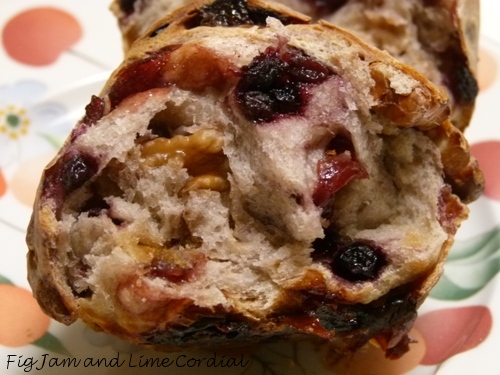
Pete loved these, but as you can see, there’s not a lot of dough holding all the fruit together!

Read Full Post »

Mrs M’s glasses, which were given to me when she passed away…

I love Italian nonnas.

When we moved into this house over twenty years ago, our neighbour Mrs M was already in her mid-70s.  She’d arrived from Italy at the age of thirteen and had gone straight to work in the canefields of Cairns.  She was sharp as a tack, stubborn as a mule and tough as nails – she used to trim the edges of her lawn with a cane knife (machete).  I adored her.

Our house was a deceased estate that had been empty for nearly two years, which gives you some idea of the state it was in.  There was no shower or inside toilet, the kitchen had 53cm (21″) of bench space – divided into three sections, and the front bedroom had layer upon layer of rotting carpet.

We were in our early 20s, and had borrowed money from everyone we knew to make the purchase price.  We were also stupid. We laid a white tiled kitchen floor – because I liked how shiny and clean it looked – and spent $2500 of the $3500 we had allocated for furniture on an antique Kilim hall runner.  We sat on beanbags for the first year.

Mrs M, bless her soul, took pity on us.  She would bring over covered plates of pasta and peas, and vegetables from her garden, and figs from her enormous trees.  She would make me espresso coffee strong enough to dissolve a spoon, and hem my jeans so that I didn’t have to pay $12 to the drycleaner. She taught me how to be a good neighbour.

And I grew to love the older Italians in our neighbourhood.  They’re incredibly kind, brutally honest, and passionate about life.

. . . . .

Jump forward twenty years to last week when I was having a chat with Chicago John about his Zia’s tripe dish which traditionally began with a batutto.

Batutto is a soffrito which uses a specific type of Italian salted pork.  I decided to see if it was available at the cheese shop.  When I arrived, Johnny’s mum Rita and her friend Teresa were both there.

I couldn’t see anything marked as “batutto” in the fridge cabinet, but I did find guanciale, speck and pancetta. I asked the ladies if one of those would do.

No, no, no, batutto had to be made at home, using pork belly bought from a butcher in Campsie (not from a regular butcher, as the pork would be too lean).

What, I asked, was the difference?  The guanciale, speck and pancetta  were all salted pork products – couldn’t I substitute one of those?

The speck, I was told, was too smoky, the pancetta wasn’t the right flavour for tripe, and guanciale could only be used in Amatriciana sauce.  A vigorous discussion then ensued as to whether Amatriciana sauce should or shouldn’t have onions in it.

As I said, I love Italian nonnas.

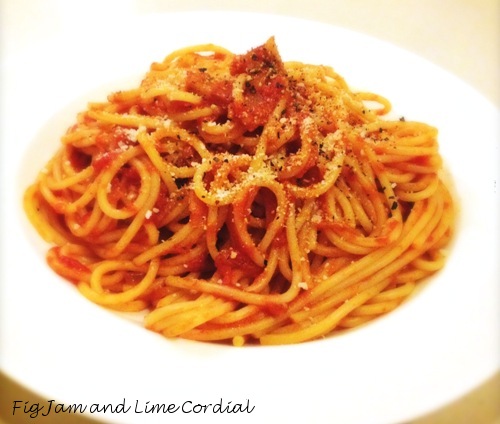
So I bought some guanciale, made from the jowl of a pig, and used it to create Spaghetti all’Amatriciana.  My apologies, Teresa – the only recipe I could find included onions.

I followed this New York Times recipe very closely, substituting half a fresh cayenne for the dried chilli flakes.  If you need guanciale or San Marzano tomatoes, Johnny carries them in his cheese shop, but ring first to check, as both items are frequently out of stock.

Here are the ingredients I used:

  • 1 tablespoon oil
  • 1 medium onion, very thinly sliced
  • 3 cloves of garlic, thinly sliced
  • 100g guanciale, chopped into 5mm thick slivers
  • 2 x 400g tins San Marzano tomatoes
  • half a red cayenne pepper, chopped
  • salt to taste
  • ¼ cup (3 – 4 tablespoons) grated pecorino
  • 400g dried pasta

The recipe only required a small square of guanciale, but the flavour was strong enough to permeate through the whole dish.  Make sure to remove the tough rind before chopping it up.  (More about guanciale here.)

It was a big hit with the boys – while I was taking the photo above, they ate the entire pot!

Read Full Post »

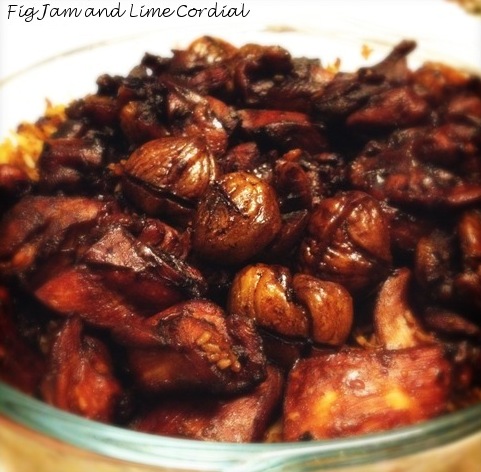
I remember Donna Hay saying on the first Masterchef series that taking photos of brown food was hard.

Writing a recipe for this dish was also hard, because I never follow one, but I made an effort to keep track last time, so that I could at least offer you a rough guide.  Please treat it as such, and change whatever you feel like to make the dish your own.

  • 6 chicken thigh fillets, cut into chunks
  • 20 cooked peeled chestnuts, or tinned chestnuts
  • 3 cloves garlic, peeled and chopped
  • small knob ginger, peeled and chopped or julienned
  • 3 tablespoons dark sweet soy
  • 1½ tablespoon light soy or Teriyaki sauce
  • ground pepper
  • 1 – 2 teaspoons sesame oil
  • vegetable oil, for frying
  • 4 – 5 cups cooked rice, hot

Note: I used a ceramic Chinese soup spoon as a measure – each holds 20ml, which is the equivalent of an Aussie tablespoon.

1. In a large bowl, combine the thigh fillets, dark soy, light soy and sesame oil.  Season with ground pepper.

2. In a wok or large skillet, heat the vegetable oil and fry the garlic and ginger briefly.  Add the chicken, all the marinade and the cooked chestnuts.  Cook, stirring, until the chicken is cooked through, the chestnuts are soft and the sauce has thickened slightly – add a little water if it gets too dry during the cooking time.

3. Have the hot rice in a microwave proof container with a lid.  Pour the chicken, chestnuts and all the sauce over the rice and stir to combine.  Pop the whole thing into the microwave for a couple of minutes to warm through before serving.

I don’t put onions in this dish simply because my mother never did.  Then again, she never put chestnuts in it either, and is quite appalled whenever I do.  And now that I think more about it, I believe she used chicken wings instead of fillets.

Despite all that, I find this dish homely, comforting and reminiscent of my childhood. As I said, please feel free to change it up however you wish – rice and meat dishes like this are incredibly satisfying in all permutations!

Read Full Post »

Mocha Bars

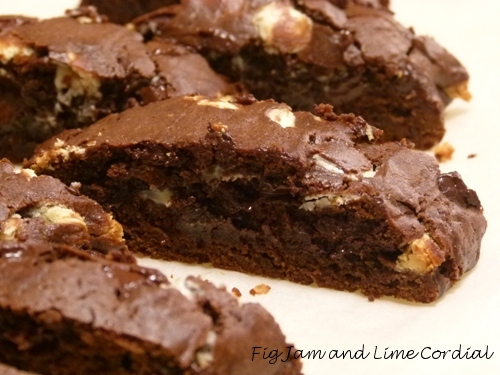
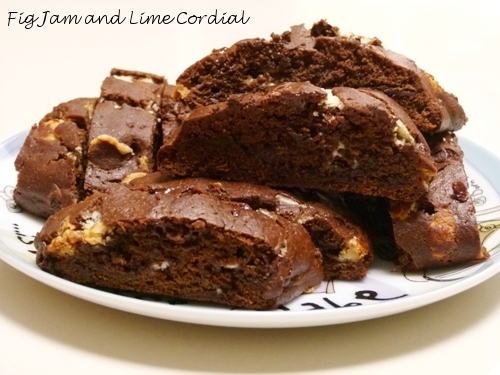
These mocha bars are based on a recipe from Debbi Fields’ Great American Desserts and they’re essentially a once-baked biscotti (I wonder if that makes them a cotti?).

The recipe makes four logs of dough – one to bake for immediate eating and the rest to stash in the freezer for an easy treat at a later date.  The Dutch-processed cocoa powder imparts a dark chocolatey flavour that is particularly appealing…

  • 125g (½ cup) unsalted butter
  • 55g (½ cup) Dutch-processed cocoa powder
  • 3 large (59g) free range eggs
  • 150g (¾ cup) white sugar
  • 100g (½ cup) brown sugar
  • 20ml (4 teaspoons) vanilla extract (I use homemade)
  • 40ml (8 teaspoons) Tia Maria
  • 375g (2½ cups)plain (AP) flour
  • 1½ teaspoons baking powder, sifted
  • good pinch of fine sea salt
  • 180g (6oz) white chocolate chips (I used Callebaut white callets)
  • 180g (6oz) semisweet dark chocolate chips (I used Callebaut Fairtrade 811 54%)
  • 100g (3½ oz) bittersweet dark chocolate chips (I used Callebaut 70%)

1. In a large glass or Pyrex bowl, melt the butter in the microwave. Add the cocoa powder and stir until smooth.

2. In a separate bowl, whisk or sift together the flour, baking powder and salt.

3. In a large bowl and using an electric mixer, beat together the eggs and sugars for several minutes until well combined and light. Add the melted butter and cocoa mix and beat well until smooth, scraping down the bowl as needed. Add the vanilla and Tia Maria and beat in well.

4.  Add the flour and mix gently until just combined, then add the chocolate chips and mix on the lowest speed until the chips are just mixed in.  Cover the bowl and refrigerate for a couple of hours or overnight.

5. Preheat the oven to 160C with fan and line an oven tray with parchment paper.  Divide the cold dough into four pieces and shape each into a 4cm thick (diameter) log.  Wrap any logs that you don’t plan to bake straight away in parchment paper and then foil, and store in the freezer until needed.

6. Place the log(s) to be baked on the tray, leaving room for spreading.  Bake for 25 minutes or until the tops have cracked and a skewer inserted in the centre comes out cleanly.  Allow to rest for 10 minutes on the tray before transferring to a wire rack to cool completely.  With a sharp knife, cut the log into thick slices before serving.

It’s been a while since I last made these, and I’d forgotten how delicious they were – the first baked log was hoovered up within the hour, which meant I had to bake a second one the same day. Pete asked me to wait a week before baking anymore, as he’s finding them hard to resist!

Read Full Post »

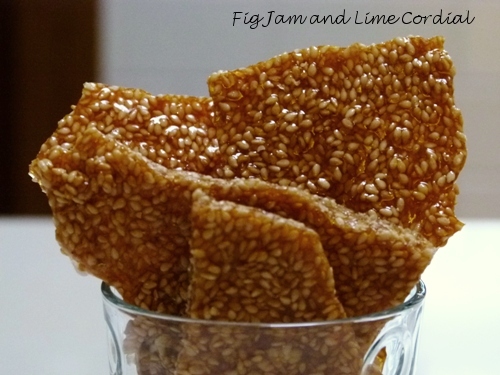
Sesame praline was one of my favourite childhood treats, so when I came across a Jamie Oliver recipe a few years ago, I couldn’t resist trying to make them at home.

It was an unmitigated disaster. The burnt caramel and sesame seeds bubbled over the top of the pan, smoking out the kitchen and sticking to the hob like concrete.

It’s taken me several years to build up the nerve for a second attempt, and this time I made sure I had Pete with me.  As I mentioned previously, he’s now in charge of hot sugar in our family – my nerves aren’t up to it anymore.

If you do decide to try this, please be careful. It’s quite a large quantity of molten sugar and it needs to be cooked in a large diameter pot that won’t overflow.  Pete has asked me to emphasize that the pot needs to be wide rather than tall and skinny.

And don’t take your eyes off the sugar, as it can burn in a heartbeat.

  • 500g white sugar
  • 200ml water
  • 200g white sesame seeds

1. Lightly oil a large heatproof surface – I used the silicone baking mat that Davey gave me, but Jamie Oliver suggests using an oiled non-stick tray in his recipe.

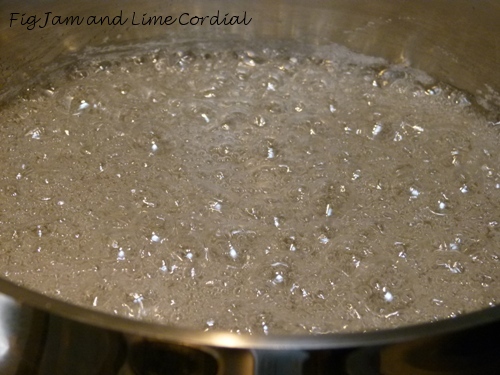
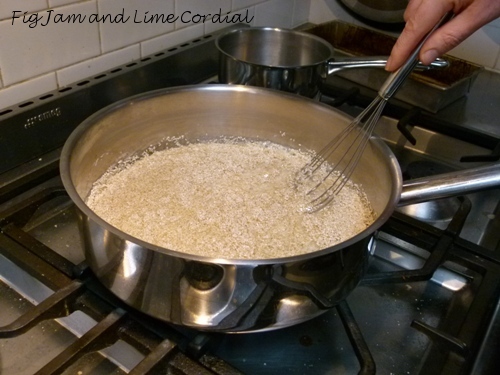
2. In a large pot (we used a stainless steel sauté pan), bring the sugar and water to boil over a low heat, whisking to combine.  The aim is to have all the sugar crystals dissolved before the mixture comes to a boil.

3. Once the mixture starts simmering, stop stirring, but keep an eye on the pot, swirling it frequently to ensure it cooks evenly.  Keep adjusting the heat as necessary to keep it at a low bubble.  Be patient, this stage can take quite a few minutes, depending on your hob and your pan.

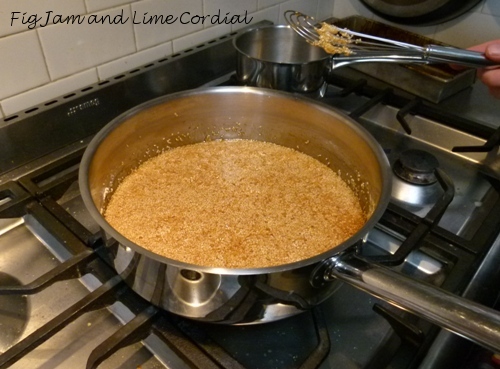
4. As soon as the mixture starts to turn a light golden colour, turn the heat down, add all the sesame seeds and stir to combine.  It’s hard to tell from the photo below, but the sugar syrup was a pale brown before the white sesame seeds went into it.

5. Continue cooking gently until the mixture darkens and the sesame seeds are lightly toasted. Resist the urge to put your fingers anywhere near the boiling hot sugar lava!

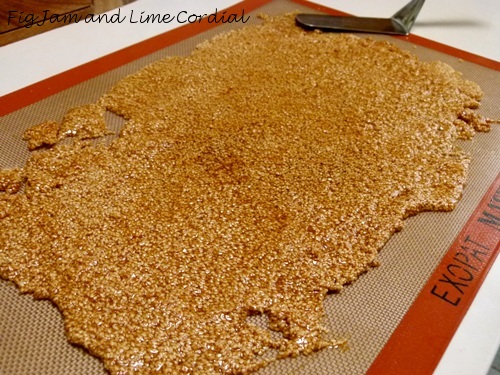
6. Working quickly (it helps to have two sets of hands here), pour the praline onto the prepared surface and spread it out as thinly as possible with an oiled palette knife.  You’ll only get a few seconds to do this.  Don’t spend time trying to scrape the last remnants out of the pan – if you do, the bulk of it will set hard before you get a chance to spread it out.

7. Allow the praline to cool completely before snapping into pieces.

I tried blitzing a few shards of the praline into a fine powder and then adding them to tempered dark chocolate.  The results were quite pleasing, but I think I prefer the sesame snaps plain – nostalgia adds an extra layer of flavour!

Read Full Post »

« Newer Posts - Older Posts »