Feeds:
Posts
Comments

I know what you’re all going to say, and you’re right, we probably do have the most spoilt chickens on the planet.

They’re fed the best food we can afford to give them, from whole heads of cabbage to sourdough pancakes to oven roasted tuna. And because we’re running a chicken spa, they also get a custom dust bath every couple of days.

With the recent wet weather, it’s been hard for the girls to find a spot in the chook dome to take their dust baths – an essential grooming process, necessary to keep them clean and parasite-free.  So…we’ve half-filled an old recycling bin with carefully sifted dry dirt, and this goes into their coop every afternoon for an hour or two.

It’s hysterically funny to watch them – they line up and take turns in the tub,  rolling around in the dirt and flicking it under their feathers to clean them.  They end up coated in a fine sheen, which makes them look as if they’ve been dusted in talcum powder.

Despite being brutally windy yesterday, the sun was quite bright, and I managed  to record this clip of Francesca undertaking her daily ablutions. I thought you might enjoy a glimpse into poultry preening…

. . . . .

For more chicken posts, please click here

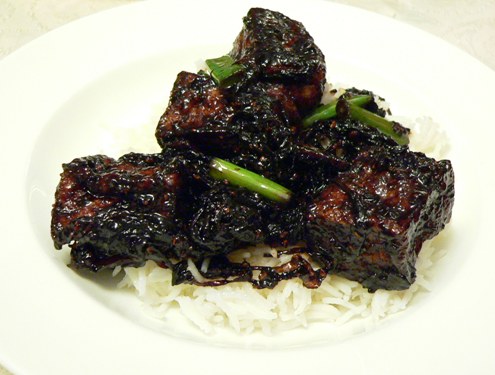
We made black pepper tofu from Yotam Ottolenghi’s Plenty last Friday night – it was rich, sticky and flavoursome.  The recipe can be found on the Guardian’s New Vegetarian blog, and we followed it to the letter.  Interestingly, the Guardian photo looks nothing like the photo in the book (which our pic above closely resembles) – perhaps the editors felt an all black dish might not appeal?

Do be aware that this is a very spicy dish – we cut the peppercorns down to three tablespoons instead of  five (!!) and reduced the number of chillies.  It still packed a punch!

. . . . .

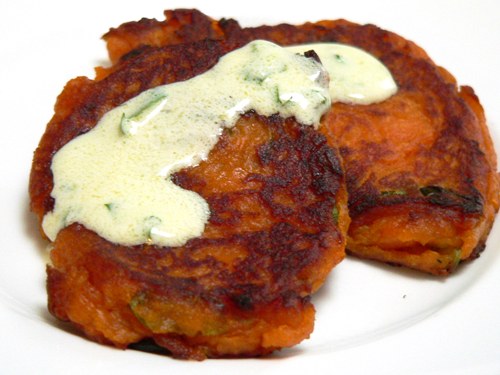
Yesterday, inspired by our success the previous night, we tried another recipe from Plenty.  These sweet potato cakes were easy to make and delicious with their accompanying yoghurt sauce (we omitted the sour cream as we didn’t have any on hand).  We served them as a side with our roast lamb dinner, but they would have made a great vegetarian starter or main course.

As the cookbook is a compilation of recipes from Ottolenghi’s Guardian column, this recipe can also be found online.

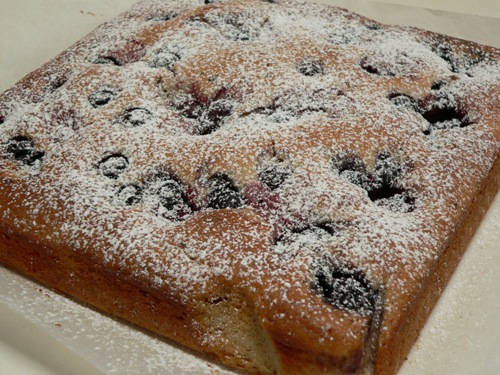
This old-fashioned little cake is pretty easy to make.  It’s moist with a soft crumb and like most tea cakes, it only keeps fresh for a day or so.  It’s supposed to be baked in a 20cm/8″ square pan, but I’ve always used a 23cm/9″ one – mistakenly at first, and then out of habit ever since.

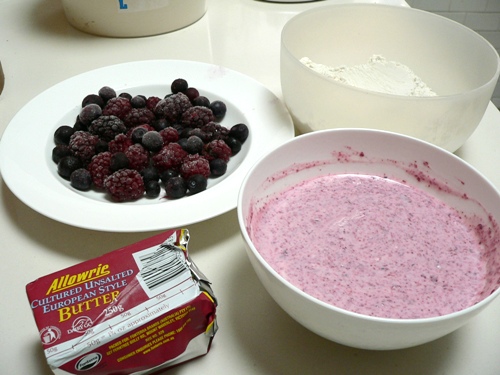
This particular cake came about quite serendipitously – our miller friend Kevin Sherrie spotted us a half bag of self-raising flour (half a 25kg bag, that is), I had berries from our last trip to Marrickville, and Pete had a fresh batch of yoghurt made, which I flavoured with a little berry puree.

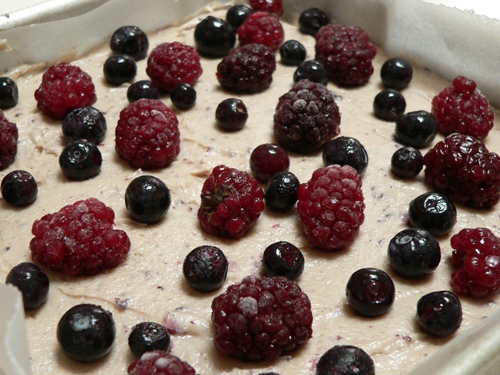
The original recipe specified fresh blueberries, but I never have them on hand, so I always use defrosted frozen berries.  Note that you really do need to let them defrost, or they’ll sink like stones into the cake batter.  As it was, mine were still a little too cold, hence the craters in the top of the cake.

  • 150g (10 tablespoons) butter, cut into pieces
  • 155g (¾ cup) caster (superfine) sugar
  • 2 large (59g) eggs
  • 265g (1¾ cups) self-raising flour
  • 200g (7oz) berry yoghurt (I used homemade, but the original recipe recommended Attiki brand fat-reduced strawberry)
  • 150g (5.3oz) berries, fresh or defrosted if frozen
  • Icing sugar (confectioner’s sugar) to dust

1. Preheat oven to 180C (360F) or 160C (320F) with fan.  Line the base and sides of a 20cm/8″ or 23cm/9″ square cake pan.

2. Beat together the butter and sugar in a large bowl until pale and creamy.  Add the eggs one at a time, mixing well after each addition.

3. Stir in half the flour and half the yoghurt until just combined.  Then stir in the remaining yoghurt and flour until combined.  Scrape the batter into the prepared tin and smooth the top.  Scatter the berries evenly over the top and bake for 35 – 40 minutes (check it after 30 minutes), or until a skewer inserted into the centre comes out clean.

4. Allow the cake to rest for 10 minutes before removing from the pan to finish cooling on a wire rack.  Dust with icing sugar before serving.

Click here for a printable version of this recipe

Aren’t these cute?

I’m inviting Ozoz (The Kitchen Butterfly) and Heidi (Steps on the Journey) over for a virtual tea party.  Oz because these are known here as butterfly cakes, and Heidi because our recent discussion inspired me to seek out this old-fashioned recipe, a staple of kids’ birthday parties alongside the fairy bread and chocolate crackles.

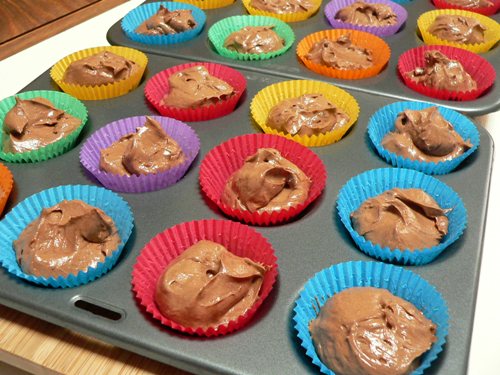
Butterfly cakes are usually vanilla flavoured, filled with cream and decorated with a little jam for colour,  but I couldn’t resist this simple recipe from Trish Deseine’s Chocolate cookbook. The cake component is quite mildly flavoured, making it a perfect foil for the rich buttercream.  Of course, you could easily adapt this technique to any cupcake recipe!

Cakes

  • 125g (8 tablespoons) unsalted butter, softened
  • 125g (40z) white sugar
  • 3 large (59g) eggs
  • 100g (3½ oz) plain (AP) flour
  • 25g (1 oz) cocoa powder (sifted)
  • 1½ teaspoons baking powder (sifted)

Butter cream

  • 150g (10 tablespoons) unsalted butter, softened
  • 250g (9 oz) icing sugar mixture (confectioner’s sugar)
  • 40g (1½ oz) cocoa powder  (sifted)

1. Preheat oven to 190C (375F) or 175C with fan (350F with fan).  Line patty pans with paper cups.

2. In a mixing bowl, beat together the butter and sugar until soft, then add the eggs one at a time and beat to incorporate.  Add the flour, cocoa and baking powder and mix well to combine.

3. Half fill the paper cups (mine took a heaped dessertspoon full each) and bake for about 15 minutes or until firm.  The little cakes will be quite flat with a slightly domed top.  Allow to cool completely.

4. To make the butter cream, stir the cocoa powder into two tablespoons of hot water to dissolve. In a mixing bowl, beat the dissolved cocoa powder, butter and icing sugar together until light and fluffy, adding a little more hot water if necessary.

5. With a small sharp knife, carefully cut out a circle from the top of each cake, leaving a hollow dip on the top.  Fill the hole with butter cream (I used a piping bag).  Cut the removed circle into two halves, and position them in the butter cream at an angle to resemble butterfly wings.  Now invite a few friends around for a tea party!

Click here for a printable version of this recipe

I really can’t complain about our living costs.   Since we started along this path of  “quasi-sustainability”, our food expenses have dropped dramatically.  Paradoxically, we’re eating better than ever before, with very little  pre-prepared or heavily processed food in our daily diet.

It’s tough economic times though, so we’ve again reassessed to see where we can save a bit of money without feeling like we’re depriving ourselves.  We’ve already made lots of big changes, but there’s still room for a bit of tinkering.  These things won’t save us a fortune, but it’s surprising how quickly it all adds up!

Homemade pasta

As I mentioned in a previous post, we used to struggle with homemade pasta.  So much so that until recently, we’ve always purchased it from our mate Joe at Peppe’s Pasta, at $7.50 per 500g.  Now that we have our trusty Ottolenghi recipe down pat, we’ll be making this at home. And since our girls are reliably laying five eggs a day at the moment, the pasta will only cost us $1.20 per 500g!

Homegrown lettuce

Everyone talks about how wonderful it is to have homegrown herbs, but I’ve only just realised how fabulous it is to grow lettuce!  It’s ready to harvest within a matter of weeks, and I go out every morning and pull a few leaves off for the boys’ lunches.  If you have room for a small herb garden, even if it’s in pots, I’d recommend you plant a little lettuce as well.  If nothing else, it might convince the kids to eat their greens!

No more pinenuts

I  love pinenuts, but they’ve recently become prohibitively expensive – good quality ones from Lebanon or Spain are between $60-$100/kg.  I now happily substitute slivered almonds, which are a tiny $12/kg from Harkola. There’s always a bag hidden in the fridge somewhere.

No more packaged dips

Not that we were buying many, but it’s so easy to make dips at home that we really don’t need to spend money on them anymore.  In addition, the commercial versions tend to have a lot more oil and salt than our homemade ones.  We make our own hommus, taramasalata, roasted beetroot dip and nasturtium pesto – more than enough variety to fill a nibbles tray.

Aldi

Friends, if you’re not buying at least some of your groceries from Aldi, then you’re probably spending more money than you need to.  I know we certainly were.  I think the notion that Aldi products are inferior is a misconception – they may not always be better than what you can buy at Woolies or Coles (although sometimes they are), but they’re usually comparable in quality.  And they’re almost always cheaper!  Aldi also have a great organic range, with items you won’t find in other supermarkets.

Emergency meals = no more takeaway

I once read somewhere – I think it was in Shirley Conran’s Superwoman – that one of the best ways to reduce stress in the kitchen is to have a list of emergency meals written down.  These need to be easy to prep and preferably quick to cook, with minimal washing up.  It was suggested that the list be taped to the inside of a cupboard, where it could be referred to whenever exhaustion might otherwise drive you to pick up the telephone and order $60 worth of takeaway.  Our list includes dishes like baked bean toasted sandwiches, risotto and survival soup. Our boys adore them all!

If you have any money saving tips, please share them with us.  Every little bit helps!

. . . . .

Previous Frugal Living posts: