Feeds:
Posts
Comments

Archive for June, 2009

140609 028a

This is one of those recipes that I can’t make too often, because when I do, everyone makes themselves sick.  Big Boy ate ten of these and then worried my parents no end when he couldn’t eat any dinner that night.  All up we made a double batch of 60 doughnuts, two-thirds of which were filled with Pete’s homemade jams, and by the end of the day, there were just three left.  We didn’t eat them by ourselves, of course, which meant the day was filled with visits from friends. Which is why I reflect on doughnut making with great affection – it always turns into a social event!

This is a recipe from Richard Bertinet’s Dough.  It’s based on his versatile sweet dough, which I use for everything from hot cross buns to a mock brioche loaf.  It’s particularly easy to make if you have access to UHT (ultra heat treated) milk, because then you can forego heating the milk and then cooling it to blood temperature.  There is a great video of Bertinet making the sweet dough at the Gourmet website – well worth watching before you start.  My methodology is slightly different because I’m using dried yeast, but the dough handling techniques are pretty much the same.  The ingredients below make about 30 doughnuts, although the photos are of a double batch.

  • 500g bread flour
  • 10g instant yeast
  • 7g fine sea salt
  • 40g caster sugar
  • 60g unsalted butter
  • 2 large eggs
  • 250g full cream milk, at blood temperature, or UHT milk, unrefrigerated

1. Whisk together the dried yeast and bread flour in a large, wide mixing bowl.  Add the salt and sugar and whisk in well.

2. Add the unsalted butter, cut into small cubes, then rub the butter into the flour mixture until well crumbled.

140609 006

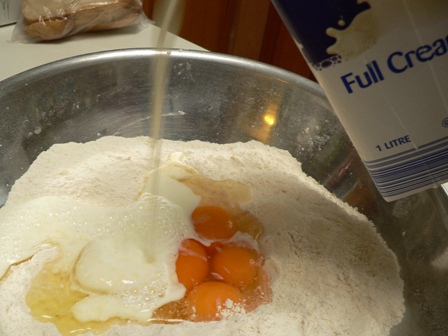
3. Add the eggs and milk, then mix together with a spatula until it forms a shaggy dough.  Cover with a tea towel and allow to rest for 10 minutes.
140609 009

4. Knead the dough until smooth.  Oil the scraped out mixing bowl, then return the dough to the bowl, cover with clingfilm and allow to rise until doubled in size (about an hour).

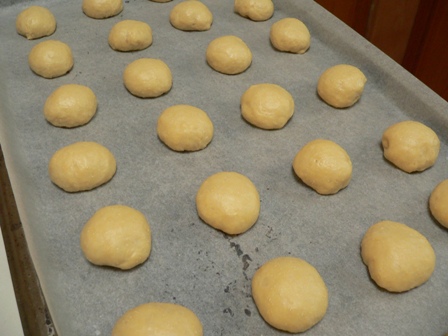
5. Knock back the dough, then divide into 30 x 30g portions.  Shape each portion into a tight ball, then allow to rise on a baking tray lined with a sheet of parchment paper (flour the sheet as well – I forgot to do that and the balls were a bit sticky and hard to get off).  Cover with large pieces of oiled clingfilm and allow to rise until doubled in size, about 45mins.  Start heating the oil about 10 minutes before the dough is ready.
140609 019

6.  Heat an oil with a high smoking point (180C).  Now, this bit is a two person job, so it’s best to get a helper.  While one person loosens the dough balls, the other person gently places them in the hot oil.  The balls will immediately expand like little balloons.  Turn them over often to ensure even browning.  Let them get quite brown and then remove to a wire rack, placed over an old tea towel to catch the dripping oil.  Allow to cool.

140609 022

140609 024

7.  To make plain doughnuts, toss the cooked balls in caster sugar.

140609 030a

8.  To make jam doughnuts, poke a chopstick into the centre of a doughnut and wiggle it around a bit to make a cavity.  Then using a piping bag filled with soft jam (a smooth jam is best, as the chunky ones block up the piping nozzle with bits of fruit), pipe a generous amount of jam into the centre of the doughnut, then toss in caster sugar.  We filled ours with Pete’s jams – apricot, rhubarb and berry,  and strawberry!

140609 035

Read Full Post »

lime tart 010

lime tart 009

Flaky pastry isn’t de rigueur for sweet tarts, but I had some sour cream pastry dough in the freezer, so that was what I used.   The dough was defrosted, rolled out and baked blind until golden, allowed to cool, and then filled with  freshly made microwave lime curd.  The flaky pastry worked surprisingly well with the filling, keeping its crispness even when covered with the hot curd.  The top was dusted with vanilla sugar and caramelised with a mini blowtorch.

The whole process took mere minutes (excluding the baking time) – an easy dessert to have up your sleeve when you need something in a hurry!

PS: This tart works even better with shortcrust pastry – I just didn’t have any in the freezer at the time.

Read Full Post »

080609 012

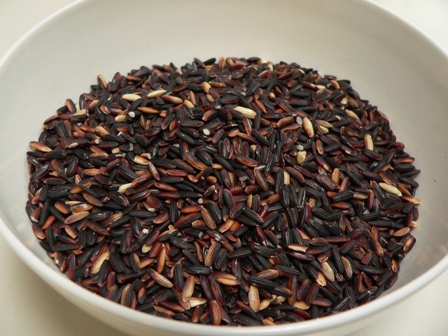
Pulut Hitam means, literally, “Black Rice”. It’s a Malaysian dessert made from slow cooking black glutinous rice with coconut cream and palm sugar until it turns a thick, spoonable consistency similar to a soupy rice porridge.  It isn’t everyone’s cup of tea, but I could eat it for every meal of the day.  We make it using a version of Amy Beh’s recipe, modified to accommodate the lack of fresh coconuts and dried longan in our part of the world.

  • 300g black glutinous rice
  • 5 litres water
  • 100g castor sugar
  • 100g palm sugar
  • 1 pandan leaf, knotted (optional – we buy them at the markets and freeze them)
  • 2 tbsp cornflour
  • 3 tbsp water
  • 1 cup coconut cream (Kara brand, if possible)
  • ½ tsp fine sea salt
  • extra coconut cream for serving

140609 001

1.  Rinse the rice thoroughly in several changes of water, or place it in a sieve and rinse well under running water. Place the rice in a large pot (we used a 28cm La Creuset dutch oven) and add the 5 litres of water.  Allow to soak for several hours.

2. Place the pot over a medium heat and cook uncovered until the rice is soft and almost creamy.  Add the knotted pandan leaf, if using.

3. Add the two sugars and simmer for a further 15 minutes over a gentle flame.  Make sure you don’t add the sugar too early, or the rice won’t soften properly.

4. Mix together the cornflour, water, coconut cream and salt and whisk well to combine.  Add to the rice and bring to a boil, then remove from heat.   This dish will stay warm for a little while, particularly in the cast iron pot, so there’s no overwhelming rush to serve it straight away.  For each person, ladle a generous amount into a rice bowl and drizzle a spoonful of thick coconut cream over the top.  They’ll be plenty left over for seconds!

Read Full Post »

vanilla syrup 012

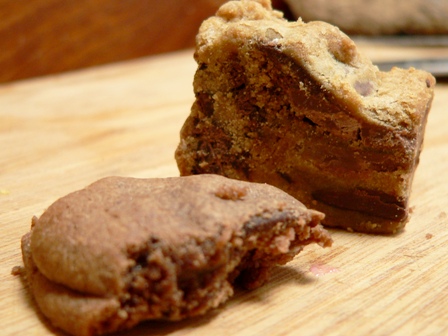
A couple of years ago, we started routinely sending treats to school for Big Boy’s mates – a tradition that became known as “Feed the Friends Friday”.  One of his good friends, Gabby AKA The Screaming Mongoose, was particularly enamoured with the marshmallow cookies, although they would often overload his system. “Celia, they’re really great, but they make me mental in period seven..” (which was how long it took the sugar to kick in from the cookie he’d eaten at lunch time).

Last week, his older brother George made butterscotch bars and  marshmallow cookies from the recipes here and sent a sample home with Big Boy for us to try.  They were delicious, and what you see above is all that was left by the time I thought to take a photo. George made eighty marshmallow cookies for his church bake sale, which astonishes me – I get exhausted making a batch of twenty!

I can’t tell you how chuffed I am by this  – George is all of nineteen years old and he was able to decipher my recipes.  I know that actually says more about the man than anything else, but I’d like to think it says a little bit about the recipes too.  Thanks George, you’ve made my day!

Read Full Post »

015

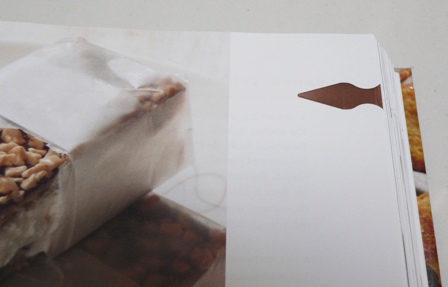
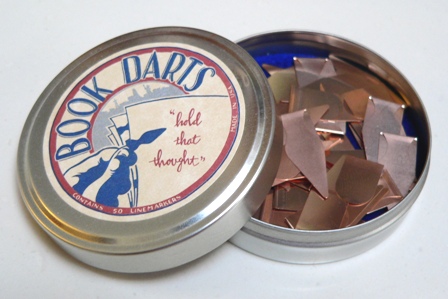
This wonderful doodad is a Book Dart, invented by Bob and Jeanette Williams of Oregon.  It’s a little piece of thin bronze shaped into an arrow, which clips to a given page of text and highlights not only the page, but also the line of choice.  Apart from being aesthetically pleasing, they are archivally safe and won’t mark or distort the page in any way.  Bob Williams is an English teacher, librarian and archivist, so he’s pretty fussy about the way books are treated.

The Book Darts are inexpensive, particularly for a reusable item, and if you buy them from the charming, albeit slightly clunky,  Book Darts website, then they can cost as little as 11c each.  Or, if you’d rather buy them here in Australia, they’re available from the über chic Remo General Store.

I’ve been buying small envelopes of book darts to add to birthday and thank you cards. They’re the perfect gift for lawyers and barristers, high school students, teachers of just about anything, avid readers and, in my case, people with huge collections of cookbooks in which they can never find a recipe a second time. Everyone I’ve ever given these to adores them. They’re really very clever.

014


Read Full Post »

« Newer Posts - Older Posts »