Feeds:
Posts
Comments

Archive for June, 2012

Small Man is a committed carnivore.

He will routinely consume half of whatever meat we put on the table.  I suspect it’s a product of being in his mid-teens – Big Boy did exactly the same thing at that age.  Small Man seems to be laying on muscle before our very eyes and for him, that entails a hefty protein intake.

Last week I defrosted a large slab of sublime Cape Grim scotch fillet.  We cut it into seven steaks – one each for Pete, Big Boy and I, and two for Small Man.  We hid the remaining two before he could ask for a third.

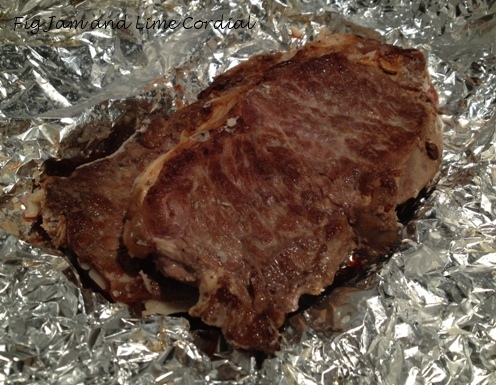
Pete has a deft touch with steaks, providing you’re happy to eat them rare.  And with this incredibly tender grass-fed meat, grown in the cleanest air in the world, it would be a great shame to cook them any longer than absolutely necessary.  The two extra steaks were seared and then stashed in the fridge overnight…
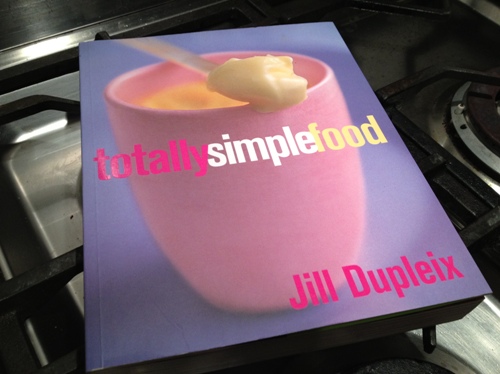
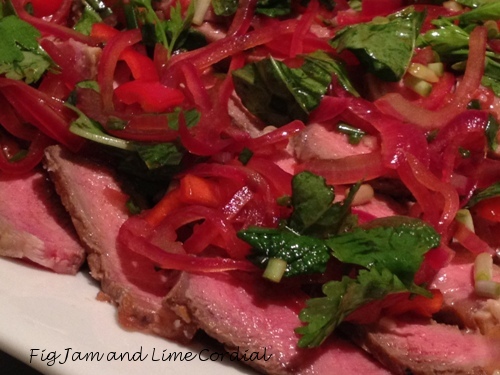
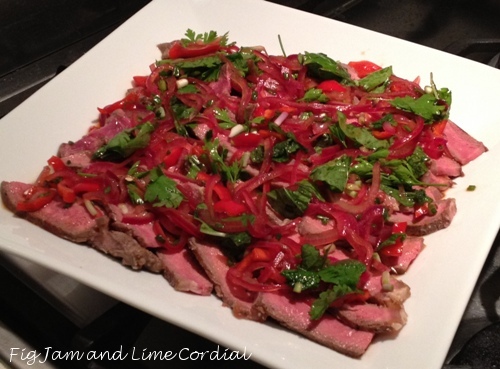
The following evening, we assembled a modified version of the Rare Thai Beef Salad recipe from Jill Dupleix’s Totally Simple Food

The steaks were allowed to come to room temperature, then sliced and topped with a dressing of:

  • half a Spanish onion, finely sliced and rinsed in boiling water (to mellow out the sharpness)
  • a few chopped spring onions
  • herbs from our garden – mint, coriander, parsley and the last of the basil
  • one of our homegrown bishops’ crown chillies, deseeded and sliced
  • the juice of half a lime
  • 2 teaspoons light soy
  • 2 teaspoons fish sauce
  • 2 teaspoons sesame oil
  • 1 teaspoon white sugar

We whisked together the lime juice, soy, fish sauce, sesame oil and sugar (quantities adjusted to taste), then stirred in the remaining ingredients.

The salad was delicious served with steamed rice.  Definitely a dish we’ll make again, and a great way to use up leftover steak!
PS. It wasn’t nearly enough to fill Small Man, who ate two oven roasted duck marylands as well!
Read Full Post »

Römertopf Loaf

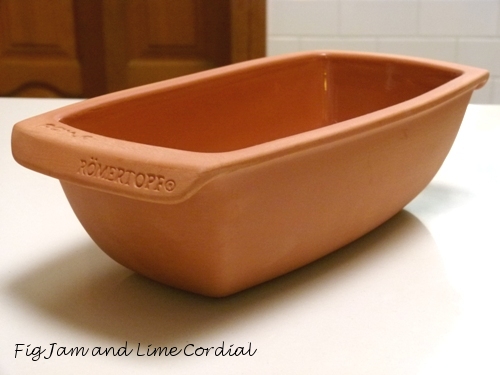
Sorry to be posting in such quick succession, but I wanted to give my fellow Aussie bakers a headsup on these clay loaf pans while they’re on sale.

They normally retail for $45, but at the moment, Peters of Kensington have them reduced to $9 each.  They’re beautifully made (as you know, I’m a bit besotted with clay cookware) and wash up perfectly in the dishwasher, but they can’t go into a preheated oven.

Conventional wisdom dictates that to achieve a really good rise in a loaf of bread, the dough needs to go into a hot oven.  The shock of the intense heat causes the yeast to burst into action one last time before dying, in a process known as “oven spring”.  This is certainly important in traditional sourdough loaves such as ciabattas, where a holey crumb and crunchy crust are highly prized.

But there is an alternate school of thought that great, albeit different, loaves can be produced by putting the dough into a cold oven, and allowing it to heat up as the oven does.  This is how my friend Linda bakes her bread, using the same sourdough starter as mine.

I thought it was worth $9 to test this out!

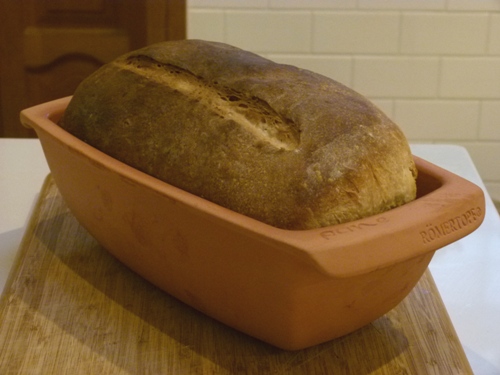
The Römertopf loaf pan is a different kettle of fish yet again. The enclosed instructions recommend placing the dough into the loaf pan for its second rise (I sprayed the interior lightly with oil first). The pan is then placed into warm water for twenty minutes (I sat mine in a sinkful of 40C tap water for half an hour).  The clay absorbs water and in theory, returns it as steam once it begins to heat up in the oven.

I have to confess – I was dubious.  So much so that I didn’t fuss with shaping – I just rolled up the proved dough and plonked it in. The dough took up two-thirds of the pan to start with; by the time it was out of the warm water, it had risen to the rim.

The wet pan went into a cold oven, and the heat was turned up to 210C with fan.  I watched in surprise as the dough rose..and rose…

So what’s the verdict?

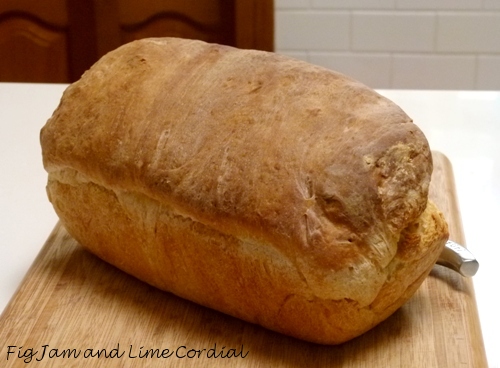
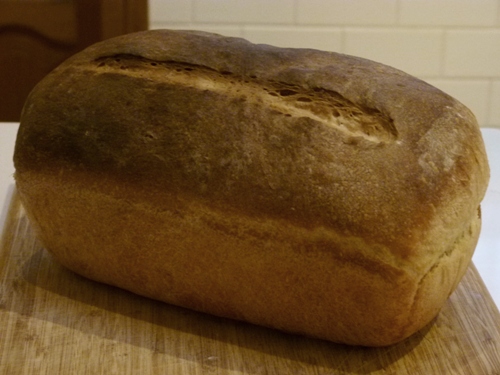
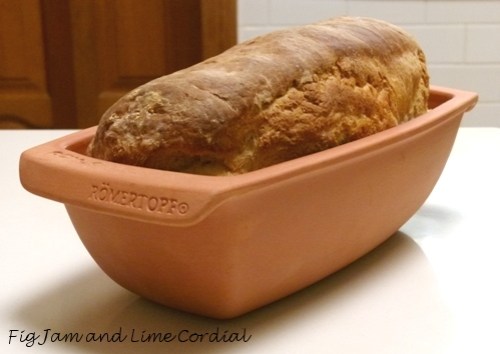
Not the prettiest loaf I’ve ever baked, according to my husband, but it is proof of concept…

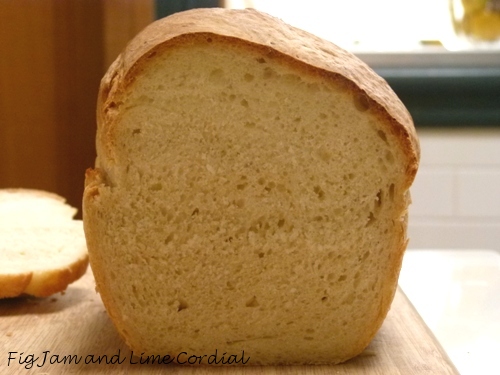
The finished bread has a fine, tender crumb that is neither dense nor stodgy (I used this recipe).  We made toasted sandwiches with it today…

Pete would like me to bake more bread in this manner – he believes it will save electricity. I’m unlikely to give up my hot preheated oven anytime soon, but it’s certainly nice to have a different technique up my sleeve!

PS. No scientific conclusion is valid unless it can be repeated, so I tried the pan out again today.  I made more of an effort with shaping this time and was quite pleased with the result!

Follow up: Römertopf White Sourdough Loaf

Read Full Post »

Some recent chocolate adventures…

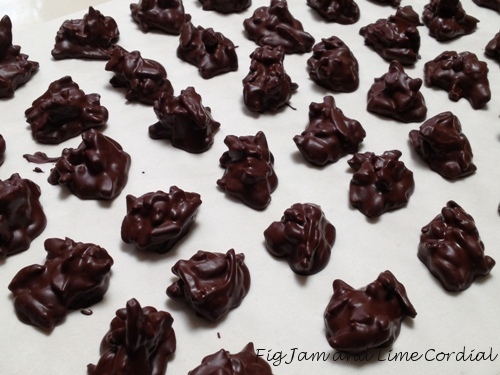
A batch of dark chocolate almond rochers – I tossed slivered almonds in Kirsch and icing sugar, toasted them until golden, and then dipped them in a tempered mix of dark Callebaut and Valrhona chocolate…

It doesn’t matter how many I make, they never seem to last more than a few days…

These music themed choccies were made for Chris’ birthday – they’re a 50/50 blend of Callebaut 811 (dark 54%) and 823 (milk)…

I’m always amazed that this particular chocolate mould exists – Big Boy plays the French Horn and Small Man the trumpet…

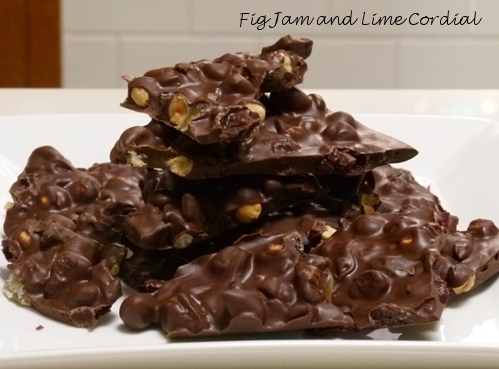
The leftover chocolate from the musical pieces went into a fruit and nut bark, filled with cranberries, ginger, candied peel and roasted skinned hazelnuts…

It makes a very nice after dinner nibble!

Read Full Post »

We’ve been friends with Stephen for thirty years.

The son of an Australian father and an American mother, he was raised in Fiji where his father worked as a Christian minister.  Over the four years that we lived together at college, he shared with us his love of mellow music (Cat Stevens and John Denver can still be heard in my kitchen to this day), his strong sense of social justice, and his wonderful tales of growing up in Fiji.

Stephen always gets particularly excited (and a little wistful) when talking about the food of his childhood. We’ve marveled at his stories about the coloured milk that never went off, the tamarind chutney that’s bringing about social change, and his  school lunches of “curry and roti”, which used to cost just 15c at the tuckshop.

Fijian curries, he insists, are different from those found in other parts of the world. They’re quite spicy, usually drier than their Indian or Malaysian counterparts, and served with a unique style of roti – a very thin, wide flatbread rather than the rich, flakier versions found in other countries.

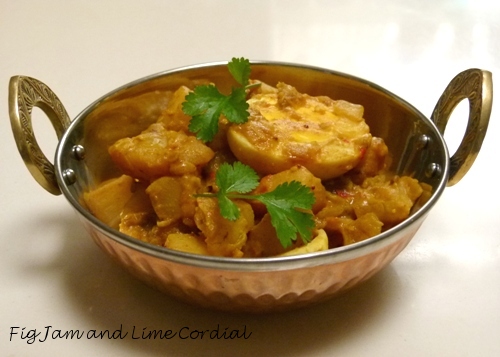
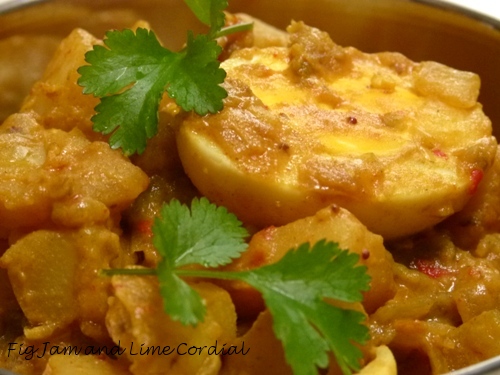
As it was Stephen’s birthday today, I woke up early to make him this egg and potato curry.  It was the only recipe I could find for a vegetarian “Fiji-style” curry, so I thought it was worth a try.  Thankfully, it turned out to be quite delicious…

Egg and Potato Curry
(adapted from Dave Dewitt’s A World of Curries)

  • 3 – 4 red chillies, deseeded and chopped coarsely
  • ½ teaspoon mustard seeds
  • 6 cloves garlic, peeled
  • ½ teaspoon cumin seeds
  • ½ teaspoon black peppercorns
  • 1 teaspoon coriander seeds
  • ½ teaspoon ground turmeric
  • ¼ teaspoon ground ginger
  • ¼ teaspoon ground cinnamon
  • 1 tablespoon water
  • 3 tablespoons ghee or vegetable oil
  • 2 medium onions, chopped
  • 2 large boiled potatoes, peeled and diced (they should be cooked, but still firm)
  • 2 cups coconut milk
  • 8 hard-boiled eggs, peeled and halved
  • 1 tablespoon lemon juice
  • coriander to garnish
  • Kashmiri chilli powder, to taste
  • salt to taste

1. In a small food processor or blender, blitz together the chillis, mustard seeds, garlic, cumin, peppercorns, coriander, turmeric, ginger, cinnamon and water to form a thick paste.

2. Heat the ghee or oil in a large sauté pan and fry the onions for about five minutes, or until soft.  Add the spice paste and fry for a few minutes until fragrant.  Add the potatoes and stir over a low heat for two minutes more.

3. Add the coconut milk and bring the curry to a boil, then reduce the heat and simmer uncovered until the potatoes are softened and the sauce has reduced, about 10 minutes.

4. Add the eggs and juice and stir gently to heat through – this should only take a couple of minutes.  Taste the curry and adjust seasonings as desired (I added salt and a little Kashmiri chilli powder, although these weren’t listed on the original recipe). Garnish with the coriander leaves.

PS. Dave Dewitt’s book is now out of print, but he’s reproduced parts of it on his Fiery Foods website. If you’re a curry lover, it’s well worth a look here.

Read Full Post »

How NOT to make Tamales

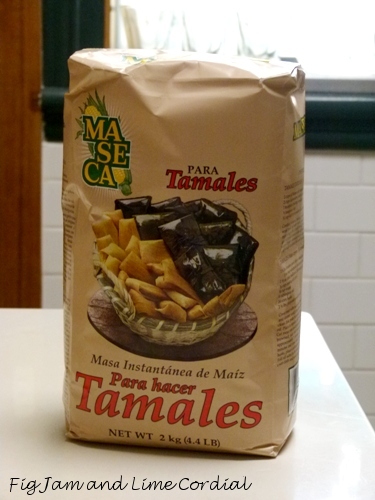
When we were buying ingredients for our corn tortillas at Fiji Market in Newtown, this bag of tamale flour caught my eye.

“Oooh, look, tamale flour! Let’s try making those!”

“Babe, we have never eaten a tamale.  Actually, we’ve never
even seen one.  We’re not even really sure how to pronounce
the word. How are we supposed to make them?”

“Aww, c’mon Petey, how hard can it be?”

Sigh.  My husband and I have a lot of conversations like this.

There is, of course, a great art to making tamales.  And it helps if you have the right ingredients to start with.

We didn’t have any lard.

We didn’t have any corn husks.

We did, however, have a bag of tamale flour, some leftover nachos topping, a couple of Mexican cookbooks and a healthy measure of enthusiasm.  Surely that would be enough?

In place of the lard, I thought I’d try using my frozen duck fat.  Unfortunately, an integral part of the recipe is to beat the lard or vegetable shortening until light and fluffy. And as room temperature duck fat is a liquid, that actually proved impossible to do. I presume the process incorporates air into the batter, as the instructions went on to say that the mixture should be beaten until a small ball of it was light enough to float in a glass of water.

I beat that sucker to within an inch of its life, but it kept sinking like a stone.

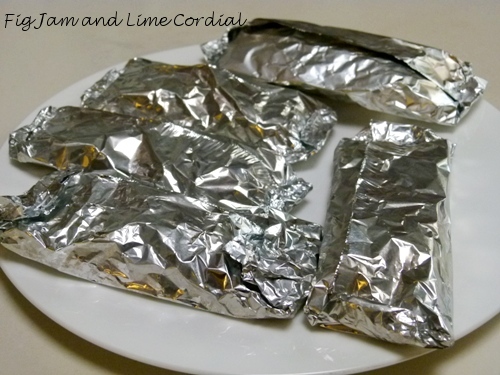
Thomasina Miers’ cookbook suggested that the tamales could be wrapped in parchment paper and foil instead of corn husks.  This bit actually worked well, although I had no idea how much mixture was supposed to go into each one…

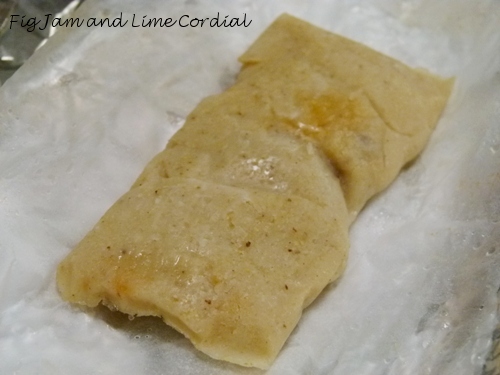
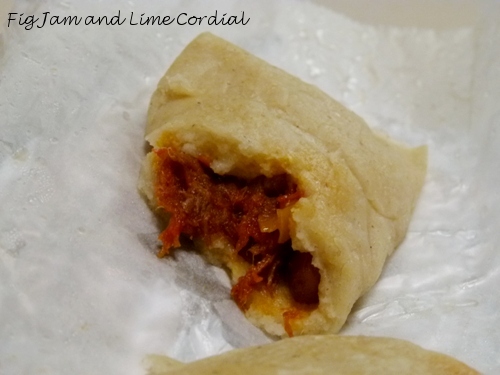
The little parcels were steamed over a vigorously boiling pot for just over an hour. And, despite our complete ignorance, the end results were quite tasty.

So here are our duck fat, parchment wrapped, nachos-topping filled “tamales”…

To tamale purists everywhere, our humble apologies.  Please feel free to quote this post as an example of how not to make tamales! (But we did have fun!)

Read Full Post »

« Newer Posts - Older Posts »