Feeds:
Posts
Comments

Archive for the ‘Gluten Free’ Category

tomatoes 009

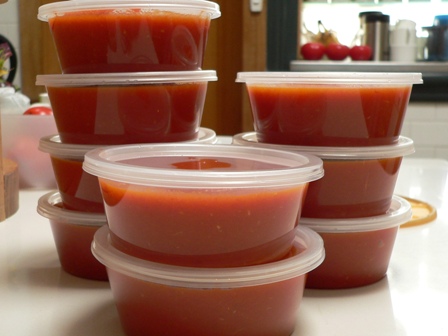
Whenever we can, we make our own tomato passata, using an adaptation of a Bill Granger recipe.  Forget your preconceived notions of sauce making being an all day affair involving barrels of tomatoes and backyard boilers – this is an easy way to make a reasonable quantity of passata in a relatively short time.  We freeze our sauce in one cup (250ml) takeaway containers, which is a good working quantity for us – one tub is enough to top three pizzas, or three tubs will make a batch of bolognese sauce.

To give you some idea of value – we bought a box of romas from Jimmy the Tomato Man last Friday for $10 ($1/kilo).  We still have two kilos left, which means the eight kilos we used cooked down to nine small takeaway containers.  It doesn’t seem like very much, but remember that the tomatoes have already reduced.  As a result, you don’t need to use nearly as much in a recipe, nor do you need to cook it for as long. Apart from being  more economical (our bolognese sauce uses $9 – $10 worth of tinned and bottled tomatoes, when we don’t have our own), the homemade passata tastes better – Big Boy now won’t eat pizzas topped with anything else.

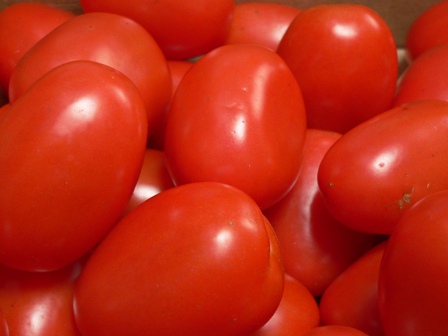
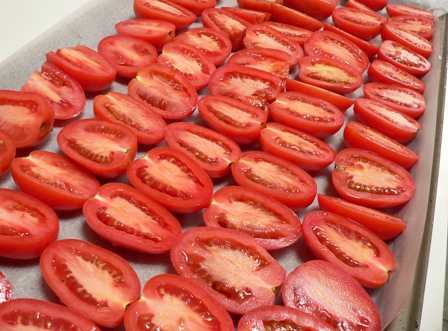
Step 1: buy great tomatoes.  Romas are by far the best if you can afford them, but the recipe will work with any sort of red tomato, providing they’re ripe and juicy, but not too mushy. Wash them and cut them in half, then lay them out on a large oven tray lined with parchment paper.
tomatoes 003

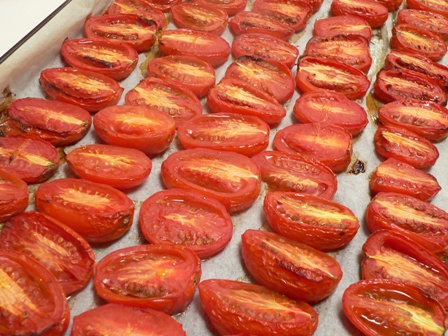
Step 2: Drizzle with olive oil and sprinkle over with salt. Bake in a preheated 220C oven for about half an hour, or until some of the edges just start to blacken.
tomatoes 013

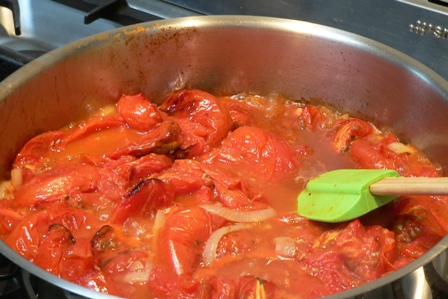
Step 3: In the meantime, heat olive oil in a large pan and fry some chopped onion and garlic until soft.  Add the roasted tomatoes with any juices to the pan and stir well.
tomatoes 016

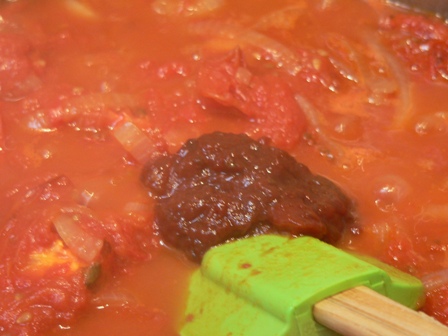
Step 4: Add a large spoonful of tomato relish (optional). We use one that Pete makes.
tomatoes 017

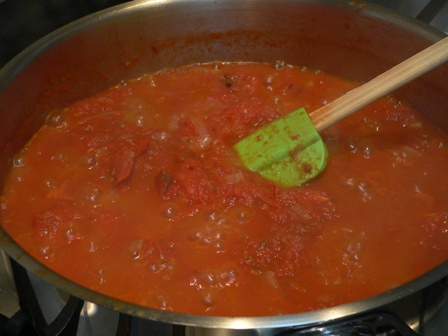
Step 5: Cook well until the skins separate from the tomato flesh and the passata is reduced and thickened to your liking.
tomatoes 021

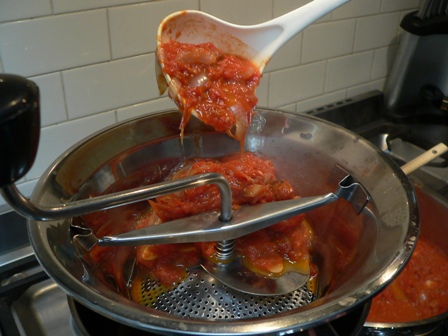
Step 6: Process the sauce through a food mill to remove the skins.
tomatoes 022

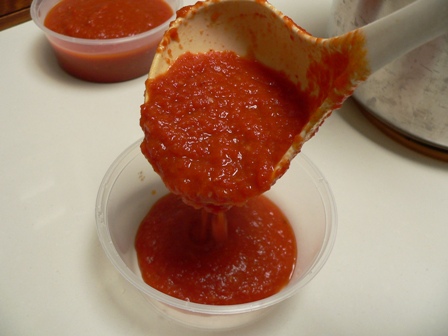
Step 7: Ladle the finished passata into containers, label and store in the freezer.
tomatoes 028

tomatoes 031

. . . . .

© copyright 2009 by Fig Jam and Lime Cordial. All rights reserved.
Read Full Post »

tarama 010

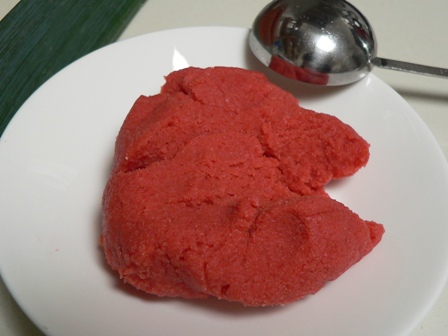
I used to make this regularly a decade ago after Soula the Greek Girl (as she was known at the time) gave me the recipe.  I hadn’t thought about it in years, but when I passed a tub of tarama roe at the markets recently, I couldn’t resist buying some, despite having Pete in my ear, saying “Are you sure you want to do this?”. I understood his concern. Whenever I’d made this in the past, I’d eaten it until I was sick, then sworn off it forever – it’s one of those recipes…

But this time I was smarter, I made the batch and split it four ways to share with the neighbours.  It’s something you have to do straight away, before you get a chance to (over)eat it – if you think about it too long, you’ll have eaten a tub in the “just tasting for seasoning” process.

This is quite an unusual taramosalata recipe in that it uses potato as thickener rather than bread crumbs.  It’s a lot lighter as a result, but probably won’t keep as long (not that I’ve ever had that problem).  It has the advantage of being gluten-free, and I’ve varied Soula’s original version to lower the fat content, which is hard to believe given that there is still one to two cups of olive oil in the recipe. However, it does make a large quantity – my batch filled four 750ml takeaway containers (now I wish I’d kept two for myself, as I’ve eaten mine).

  • Juice of 1 large lemon
  • 1 Tbsp white vinegar
  • 5 medium pink potatoes (approx. 1kg)
  • 1 large brown onion
  • 2 cups boiling water
  • 1 – 2 cups pure olive oil
  • 200g taramosalata roe

Note: taramosalata roe, or “tarama” as it is sometimes labelled, can be bought from most continental delis.  It’s sold by weight – look out for a large white tub of brilliantly hued paste.

tarama 003

1. Wash the potatoes, but don’t peel them. Prick them all over with a fork, then microwave in a covered pyrex dish until soft – in my microwave that took about 13 minutes, but it will vary depending on the size of your potatoes.  Take them and allow them to cool slightly.

2. While the potatoes are microwaving, puree the onion in a large food processor.  Add the lemon juice, salt, vinegar, tarama and ½ cup of oil, and blitz until well combined and as smooth as possible.

3. Peel the hot potatoes, cut them into pieces, and while still hot, add them to the food processor one potato at a time.

4. Add the boiling water and oil as required to keep the mixture loose and dip like.  I like to add the full amount of boiling water and as little of the oil as I can get away with (but a minimum of one cup).   The finished result should be like a very runny mash potato – it will thicken up as it cools in the fridge. 

Note: Soula’s original recipe specified 1 cup boiling water to 2 cups olive oil, in case anyone wants to try the full fat version.

I know it’s culturally incongruous, but I always serve this with corn chips or corn crackers – there’s something about the flavour combination that really appeals to me!

Read Full Post »

gooey-cake

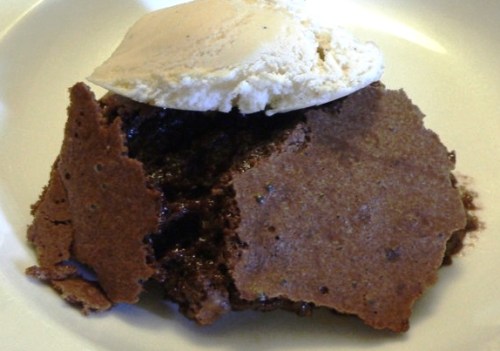
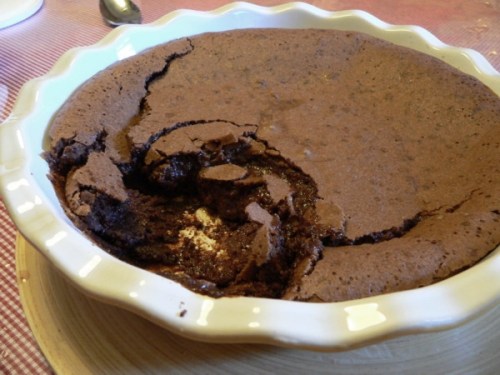
This dead easy recipe from Trish Deseine’s book Chocolate has become a household staple.  It’s exactly as the name describes it – gooey, puddingish and rich – and has the added advantage of being gluten-free.  It’s best served with homemade vanilla icecream (recipe to follow) or whipped cream (or, in Big Boy’s case, both).

Here is my version, sized down to fit my 26cm (10″)  pie dish (comfortably serves 4 – 5).

  • 150g (5.5 oz)  dark chocolate (I use Callebaut 54% callets)
  • 150g (5.5 oz) unsalted butter
  • 4 large eggs (59g), separated
  • 150g (5.5 oz) sugar

1. Preheat the oven to 180C (350F) or 160C with fan.

2. Place the butter and chocolate in a large pyrex bowl.  Melt them together in the microwave in short 20 – 30 second bursts on high (or use a double boiler on the stove).  Allow the mixture to cool slightly (so that you don’t scramble the eggs in the next step).

3. Beat the egg yolks and sugar together in a large mixing bowl until the mixture is pale.  Combine this with the butter-chocolate mix.

4. In a separate bowl, whisk the egg whites until they form stiff peaks.  Stir a generous scoop  into the chocolate mixture to lighten it, then gently fold the remaining egg whites into the batter.

5. Pour the mixture into a 26cm (10″) pie dish and bake for about 25 minutes, or until the cake is well risen and just past the really wibbly stage.  The cake will collapse as it cools, leaving a slightly raised crust around the edges.  You can serve this warm or cold, simply scooped out with a large spoon.

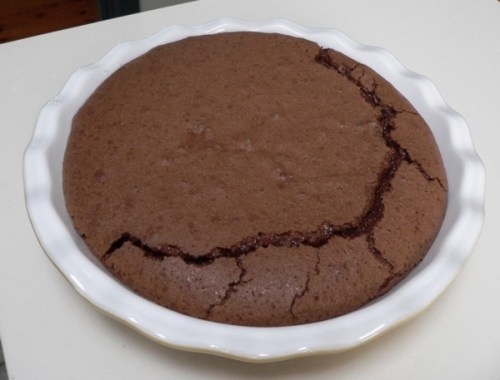
Here is the gooey cake just out of the oven, all puffed up….

gooey-cake-2

…and after it has sunk slightly on cooling.

gooey-cake-3

Read Full Post »

220609 007

For a far more detailed tutorial on tempering chocolate, please have a look at our Chocolate #101: Tempering at Home post. Thank you!

. . . . .

Pete finds these ironic.  Whilst they have the shape of a regular chocolate frog, they’re really an adult version – 70% dark Belgian chocolate studded with cacao nibs (crushed cocoa beans).  They’re super dark both in colour and taste, and I’m sure they’re good for you, given that 70% dark chocolate is supposed to be both low GI and high in anti-oxidants.

Several years ago, instructed by David Lebovitz’ The Great Book of Chocolate, I taught myself to temper chocolate.  It’s a great skill to have up your sleeve and, once you’ve got your head around it, it’s actually quite easy to do.

It’s helpful to understand from the outset that all candy making works on similar principles. Whether you’re tempering chocolate, making fudge or creating nougat, the aim is dissolve the crystal structure and teach it to reform in a different way.

Tempering chocolate is about melting the chocolate into a liquid form, then teaching the crystals to reform in a manner that will allow it to set hard and glossy, rather than dull and brittle.  From experience, there are two important elements in all candy making – temperature and patience.  If you want to temper chocolate well, you need to invest in a good thermometer.  Mine is digital and waterproof and I use it as frequently as my dishwasher, so it has well and truly justified its $70 purchase price.

Tempering Chocolate #101 – Dark Chocolate

Step 1: Pour some chocolate callets (50 – 70% cocoa) or finely chopped chocolate into a small pyrex bowl.  The amount isn’t really important, although you want enough to make it worthwhile – I use a minimum of 400g.

dark choc 010

Step 2: Melt the chocolate in short 30 second bursts in the microwave.  You need to get the melted chocolate to a temperature of 115F to ensure that all the crystals are dissolved.  Make sure it doesn’t get much hotter than that, or you’ll scorch the chocolate. (Now you can see why a good thermometer is critical.)

Step 3: Put a large chunk of tempered chocolate into the melted liquid.  The theory here is that the tempered chocolate will “teach” the melted crystals to reform in a particular way.  I keep large pieces of chocolate in the fridge specifically for this purpose.   Keeping them cold speeds up the process, but you’ll still need to be patient.

Instead of one large lump, you could use pieces of chocolate – the important thing is that the chocolate should be hard and glossy (tempered) to start with.

Give the bowl a good stir and check the temperature.  Allow the molten chocolate to drop to a temperature of between 88F – 90F.  Go away, read a book or play solitaire on the computer, coming back occasionally to give it a stir.

dark choc 014

Step 4: When the melted chocolate has reached 90F, start testing it by smearing a little onto a plate and putting it in the fridge.  Once it’s tempered, it will set hard and glossy quite quickly (untempered chocolate will stay soft and sticky). Using a large fork, scoop the remains of the chunk out of the melted chocolate and wrap it in a sheet of parchment paper to reuse another day.

Step 5: In order to work with the chocolate, it needs to be kept at a temperature of 88F – 90F.  If it falls below this it will be out of temper (cranky?)  and won’t set properly.  I use a heat mat covered with a folded tea towel, which holds  the chocolate at the perfect temperature for enrobing.

dark choc 018

Step 6: The tempered chocolate is now ready to use.  You can stir inclusions into it, as I did (they’re cacao nibs you see in the photo below), dip truffles into it, pour it into moulds or pipe it onto a cake.  One of the easiest things to make is nut bark, which involves stirring in a variety of nuts and then spreading the whole mix onto a large sheet of parchment.  Once it has set hard, it can be broken into irregular shapes and stored in an airtight container.

dark choc 020

dark choc 021

Note: Milk and White Chocolate can be tempered in the same way, although the setting temperatures for these are slightly lower than for dark.

Read Full Post »

gf loaf 012

Dan the Man has created the best gluten-free bread recipe ever.

I’ve been on a quest to find Pete A a decent gluten-free loaf for years.  Every attempt has  been an abysmal failure.  Most have a cake-like texture, and only just pass muster if toasted.  The closest I ever managed was a gluten-free soda bread, but even that was solid and heavy in a pumpernickel kind of way.

What Dan Lepard has now given us is a chewy, elastic, tangy bread which keeps well for several days.  His secret ingredient – psyllium husk – mimics the gluten in wheat, and almost unbelievably, this recipe actually “proves” like real bread. (Note that I used psyllium husk and not psyllium husk powder – the former was readily available at our local health food store.)  The finished loaf is chewy with a crunchy crust and a non-stodgy middle, unlike the tapioca based breads which were hitherto the gluten-free standard.  Another nice thing about this recipe is that it uses readily available ingredients – just make sure you buy gluten-free cornflour, as many are wheaten.  Here are some photos, so you know what to expect.

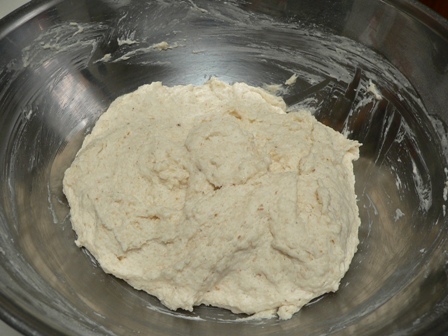
The dough works together easily in the mixing bowl, after a good minute or so of stirring.  A mixer or breadmaker really isn’t needed here.  It will seem quite wet at first, but the moisture will be absorbed during the first hour of resting.

150509 007

Shape the rested dough into a baton (basically flatten it out into a disc and then roll it up), and place it into an oiled loaf tin.  Allow to rise another hour and a half, during which time it will just about double in size.

150509 009

150509 011

Tah-dah!  The finished loaf…

150509 018

Pete A was so wonderful – he arrived at 10.30pm  to pick up his loaf (the man works way too hard), ate a slice on the spot, and said, “How have you done this?  It tastes just like bread!”

I received  these  messages from him over the following days:

Day 1 : ”Just had a lovely Enzo lunch; bread oil balsamic.  Bread getting a little tough in an Italian way so all perfect.  No toasting needed yet.”

Day 2 : “Just had lovely French toast.  Bread no tougher.  Still ‘Italian’ ”

I can’t remember a time when baking was more rewarding than this. Dan Lepard’s recipe is here – follow it to the letter, and it will treat your gluten-free friends and family to a taste that they’ve probably been missing for a long time.

gf loaf 016

Edit 23/5/09:  Here’s a photo of tonight’s Kalamata olive and rosemary loaf :

olive gf 001

. . . . .

More gluten-free recipes here…

Update: 10 Nov 09: Gluten Free Christmas Cakes

Read Full Post »

« Newer Posts - Older Posts »