Feeds:
Posts
Comments

Archive for the ‘Recipes’ Category

220609 007

For a far more detailed tutorial on tempering chocolate, please have a look at our Chocolate #101: Tempering at Home post. Thank you!

. . . . .

Pete finds these ironic.  Whilst they have the shape of a regular chocolate frog, they’re really an adult version – 70% dark Belgian chocolate studded with cacao nibs (crushed cocoa beans).  They’re super dark both in colour and taste, and I’m sure they’re good for you, given that 70% dark chocolate is supposed to be both low GI and high in anti-oxidants.

Several years ago, instructed by David Lebovitz’ The Great Book of Chocolate, I taught myself to temper chocolate.  It’s a great skill to have up your sleeve and, once you’ve got your head around it, it’s actually quite easy to do.

It’s helpful to understand from the outset that all candy making works on similar principles. Whether you’re tempering chocolate, making fudge or creating nougat, the aim is dissolve the crystal structure and teach it to reform in a different way.

Tempering chocolate is about melting the chocolate into a liquid form, then teaching the crystals to reform in a manner that will allow it to set hard and glossy, rather than dull and brittle.  From experience, there are two important elements in all candy making – temperature and patience.  If you want to temper chocolate well, you need to invest in a good thermometer.  Mine is digital and waterproof and I use it as frequently as my dishwasher, so it has well and truly justified its $70 purchase price.

Tempering Chocolate #101 – Dark Chocolate

Step 1: Pour some chocolate callets (50 – 70% cocoa) or finely chopped chocolate into a small pyrex bowl.  The amount isn’t really important, although you want enough to make it worthwhile – I use a minimum of 400g.

dark choc 010

Step 2: Melt the chocolate in short 30 second bursts in the microwave.  You need to get the melted chocolate to a temperature of 115F to ensure that all the crystals are dissolved.  Make sure it doesn’t get much hotter than that, or you’ll scorch the chocolate. (Now you can see why a good thermometer is critical.)

Step 3: Put a large chunk of tempered chocolate into the melted liquid.  The theory here is that the tempered chocolate will “teach” the melted crystals to reform in a particular way.  I keep large pieces of chocolate in the fridge specifically for this purpose.   Keeping them cold speeds up the process, but you’ll still need to be patient.

Instead of one large lump, you could use pieces of chocolate – the important thing is that the chocolate should be hard and glossy (tempered) to start with.

Give the bowl a good stir and check the temperature.  Allow the molten chocolate to drop to a temperature of between 88F – 90F.  Go away, read a book or play solitaire on the computer, coming back occasionally to give it a stir.

dark choc 014

Step 4: When the melted chocolate has reached 90F, start testing it by smearing a little onto a plate and putting it in the fridge.  Once it’s tempered, it will set hard and glossy quite quickly (untempered chocolate will stay soft and sticky). Using a large fork, scoop the remains of the chunk out of the melted chocolate and wrap it in a sheet of parchment paper to reuse another day.

Step 5: In order to work with the chocolate, it needs to be kept at a temperature of 88F – 90F.  If it falls below this it will be out of temper (cranky?)  and won’t set properly.  I use a heat mat covered with a folded tea towel, which holds  the chocolate at the perfect temperature for enrobing.

dark choc 018

Step 6: The tempered chocolate is now ready to use.  You can stir inclusions into it, as I did (they’re cacao nibs you see in the photo below), dip truffles into it, pour it into moulds or pipe it onto a cake.  One of the easiest things to make is nut bark, which involves stirring in a variety of nuts and then spreading the whole mix onto a large sheet of parchment.  Once it has set hard, it can be broken into irregular shapes and stored in an airtight container.

dark choc 020

dark choc 021

Note: Milk and White Chocolate can be tempered in the same way, although the setting temperatures for these are slightly lower than for dark.
Read Full Post »

vanilla syrup 006

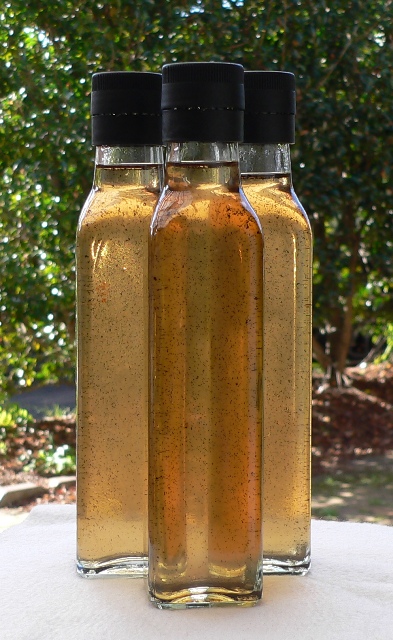
Here is the recipe for Pete’s fantastic vanilla syrup.  It works brilliantly in milkshakes, for poaching fruit, or as a drizzle over oat porridge or icecream.  Because he used our homemade extract, the syrup has a clean, almost crisp, vanilla flavour and a flotilla of  small black seeds.  It’s an easy recipe to prepare, providing you remembered to make extract three months before, but tricky to get just right.  Pete has a particularly fine palate when it comes to syrups and jams – he always manages to produce a perfect balance of flavours and textures.

  • 2 litres filtered water
  • 1 kg white sugar (possibly more)
  • ¼ cup brown sugar
  • 1 or more fresh vanilla pods
  • 2 Tbsp homemade vanilla extract (plus a couple of vanilla pods that were soaking in the vodka)

1. Scrape out the fresh vanilla pod and add the seeds, plus the pod into a large pot.  Add the water, sugar, soaked vanilla pods and brown sugar and heat gently until the solution boils and the sugars dissolve.

2. Add the vanilla extract and bring back to the boil briefly.  Allow to cool a little, then check that the syrup has thickened slightly (otherwise you’ll just end up with sugary water).  The thickness of the syrup is related to the amount of sugar – if you’d like greater viscosity, simply add more sugar until it reaches a consistency you’re happy with.  Taste for vanilla – you want to add as much vanilla extract as you can whilst still keeping the syrup in balance. This recipe is all about tasting as you go to ensure the flavour is smooth and well-rounded.

3. Ladle the syrup into sterilised bottles and seal well. Place the used vanilla pods in a small jar and top up with a little syrup.  Store this in the fridge and use it as a “starter” for your next batch, by putting it into the pot with the other ingredients.  The starter can be used several times before the macerated beans lose their oomph.

vanilla syrup 002

Read Full Post »

140609 028a

This is one of those recipes that I can’t make too often, because when I do, everyone makes themselves sick.  Big Boy ate ten of these and then worried my parents no end when he couldn’t eat any dinner that night.  All up we made a double batch of 60 doughnuts, two-thirds of which were filled with Pete’s homemade jams, and by the end of the day, there were just three left.  We didn’t eat them by ourselves, of course, which meant the day was filled with visits from friends. Which is why I reflect on doughnut making with great affection – it always turns into a social event!

This is a recipe from Richard Bertinet’s Dough.  It’s based on his versatile sweet dough, which I use for everything from hot cross buns to a mock brioche loaf.  It’s particularly easy to make if you have access to UHT (ultra heat treated) milk, because then you can forego heating the milk and then cooling it to blood temperature.  There is a great video of Bertinet making the sweet dough at the Gourmet website – well worth watching before you start.  My methodology is slightly different because I’m using dried yeast, but the dough handling techniques are pretty much the same.  The ingredients below make about 30 doughnuts, although the photos are of a double batch.

  • 500g bread flour
  • 10g instant yeast
  • 7g fine sea salt
  • 40g caster sugar
  • 60g unsalted butter
  • 2 large eggs
  • 250g full cream milk, at blood temperature, or UHT milk, unrefrigerated

1. Whisk together the dried yeast and bread flour in a large, wide mixing bowl.  Add the salt and sugar and whisk in well.

2. Add the unsalted butter, cut into small cubes, then rub the butter into the flour mixture until well crumbled.

140609 006

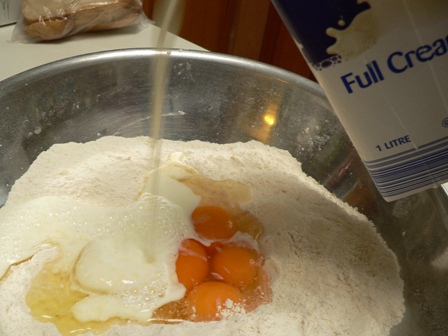
3. Add the eggs and milk, then mix together with a spatula until it forms a shaggy dough.  Cover with a tea towel and allow to rest for 10 minutes.

140609 009

4. Knead the dough until smooth.  Oil the scraped out mixing bowl, then return the dough to the bowl, cover with clingfilm and allow to rise until doubled in size (about an hour).

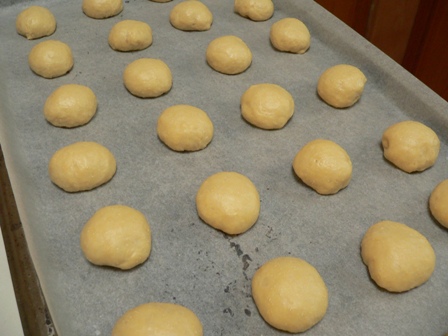
5. Knock back the dough, then divide into 30 x 30g portions.  Shape each portion into a tight ball, then allow to rise on a baking tray lined with a sheet of parchment paper (flour the sheet as well – I forgot to do that and the balls were a bit sticky and hard to get off).  Cover with large pieces of oiled clingfilm and allow to rise until doubled in size, about 45mins.  Start heating the oil about 10 minutes before the dough is ready.

140609 019

6.  Heat an oil with a high smoking point (180C).  Now, this bit is a two person job, so it’s best to get a helper.  While one person loosens the dough balls, the other person gently places them in the hot oil.  The balls will immediately expand like little balloons.  Turn them over often to ensure even browning.  Let them get quite brown and then remove to a wire rack, placed over an old tea towel to catch the dripping oil.  Allow to cool.

140609 022

140609 024

7.  To make plain doughnuts, toss the cooked balls in caster sugar.

140609 030a

8.  To make jam doughnuts, poke a chopstick into the centre of a doughnut and wiggle it around a bit to make a cavity.  Then using a piping bag filled with soft jam (a smooth jam is best, as the chunky ones block up the piping nozzle with bits of fruit), pipe a generous amount of jam into the centre of the doughnut, then toss in caster sugar.  We filled ours with Pete’s jams – apricot, rhubarb and berry,  and strawberry!

140609 035

Read Full Post »

lime tart 010

lime tart 009

Flaky pastry isn’t de rigueur for sweet tarts, but I had some sour cream pastry dough in the freezer, so that was what I used.   The dough was defrosted, rolled out and baked blind until golden, allowed to cool, and then filled with  freshly made microwave lime curd.  The flaky pastry worked surprisingly well with the filling, keeping its crispness even when covered with the hot curd.  The top was dusted with vanilla sugar and caramelised with a mini blowtorch.

The whole process took mere minutes (excluding the baking time) – an easy dessert to have up your sleeve when you need something in a hurry!

PS: This tart works even better with shortcrust pastry – I just didn’t have any in the freezer at the time.

Read Full Post »

080609 012

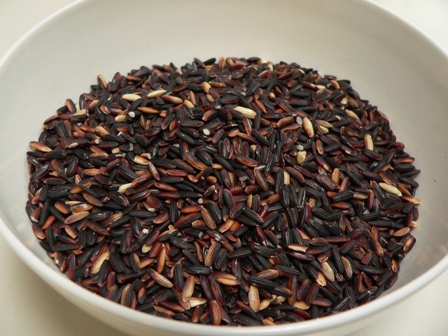
Pulut Hitam means, literally, “Black Rice”. It’s a Malaysian dessert made from slow cooking black glutinous rice with coconut cream and palm sugar until it turns a thick, spoonable consistency similar to a soupy rice porridge.  It isn’t everyone’s cup of tea, but I could eat it for every meal of the day.  We make it using a version of Amy Beh’s recipe, modified to accommodate the lack of fresh coconuts and dried longan in our part of the world.

  • 300g black glutinous rice
  • 5 litres water
  • 100g castor sugar
  • 100g palm sugar
  • 1 pandan leaf, knotted (optional – we buy them at the markets and freeze them)
  • 2 tbsp cornflour
  • 3 tbsp water
  • 1 cup coconut cream (Kara brand, if possible)
  • ½ tsp fine sea salt
  • extra coconut cream for serving

140609 001

1.  Rinse the rice thoroughly in several changes of water, or place it in a sieve and rinse well under running water. Place the rice in a large pot (we used a 28cm La Creuset dutch oven) and add the 5 litres of water.  Allow to soak for several hours.

2. Place the pot over a medium heat and cook uncovered until the rice is soft and almost creamy.  Add the knotted pandan leaf, if using.

3. Add the two sugars and simmer for a further 15 minutes over a gentle flame.  Make sure you don’t add the sugar too early, or the rice won’t soften properly.

4. Mix together the cornflour, water, coconut cream and salt and whisk well to combine.  Add to the rice and bring to a boil, then remove from heat.   This dish will stay warm for a little while, particularly in the cast iron pot, so there’s no overwhelming rush to serve it straight away.  For each person, ladle a generous amount into a rice bowl and drizzle a spoonful of thick coconut cream over the top.  They’ll be plenty left over for seconds!

Read Full Post »

« Newer Posts - Older Posts »