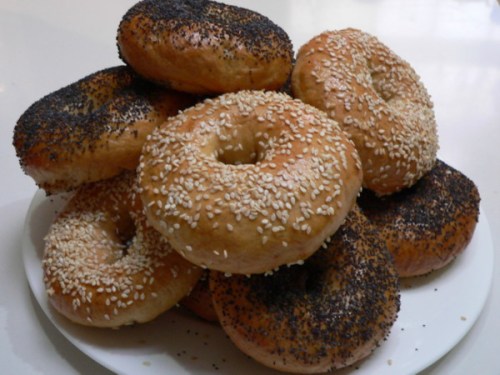
I’ve saved a copy of my bagel making tutorial here – hope you’ll have a look! Here’s a photo of our bagels …
Posted in Recipes, tagged bagels, homemade bagels, make your own bagels on March 8, 2009|
I’ve saved a copy of my bagel making tutorial here – hope you’ll have a look! Here’s a photo of our bagels …
Posted in Food & Friends, Recipes, tagged crabapple jelly on March 5, 2009| 7 Comments »
We have a crabapple tree in our backyard which, to our great disappointment, never fruits. I suspect it isn’t particularly suited to our suburban clime, but every year we watch it hopefully, willing it to provide us with some treasure to play with. Sadly, it never has, so when Christina offered to share some of her dad’s bounty with us, I gratefully accepted. A couple of hours later, a handsome man rang our doorbell and presented me with a plastic bag of ripe, red crabapples.
They were so beautiful! I’ve never seen crabapples en masse before, and I was amazed by their rosy colour. They reminded me a little of the lilly pillys we’d harvested for jelly last month, only the fruit was much larger. I suggested the we turn them into pectin (crabapples have wonderful setting properties), but Pete argued that crabapple jelly is the queen of all preserves, and that it would be a shame to do anything less with them. There was a little over a kilo of fruit and we began by washing and cutting it all into pieces.

The chopped fruit was covered with water and brought to a boil, then left to simmer for (literally) hours, until the crabapples had completely softened and turned into mush.
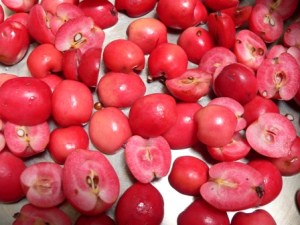
We tipped the boiled mass through a sieve lined with a clean piece of calico (I’d poured boiling water over the cloth to sterilise it first), then allowed it to drip through for a couple more hours. It’s important not to press the fruit during this sieving process, or you end up with cloudy jelly.

Once it had finished dripping (you’re meant to let it go for four hours or overnight, but we were a little impatient), we added 700g sugar and lemon juice to the litre of strained liquid in the pot. This was brought to a gentle boil, skimmed carefully and then taken to a rolling boil until the jelly reached its setting point. Pete seems to instinctively knows when this is, but I still test a blob on a cold plate (when you push it and it wrinkles, then it’s set).

The crabapples produced the reddest, most jewel-like jelly I’ve ever seen, with a delicious, slightly tart and very distinctive flavour. The kilo of fruit produced three large jars and one baby jar of jelly. Such a fun afternoon! Thanks Christina!

. . . . .
See our Jam Making Primer for more tips on making jam.
Posted in Food & Friends, Recipes, tagged buttermaking, homemade butter, make your own butter on February 28, 2009| 7 Comments »
Last night, our friends Kevin, Carol and their Astonishingly Nice Juniors came over for dinner. It was Kev’s birthday, and we were making pizzas to celebrate. The four of us go back a long way – over 25 years in fact. The wonderful thing is, we’ve been close for all those years – this hasn’t been a friendship that has waxed and waned – we’ve seen them regularly over the entire time we’ve known them, and being with them is like being with family. I can say what I think, feel what I feel, all without fear of judgment. We certainly don’t live out of each other’s pockets, but when we haven’t caught up for a couple of months, I find myself missing them. So last night was easy, relaxed and reaffirming – a perfect Saturday night.
As Carol was bringing fruit, I didn’t make a cake for dessert, and opted instead for a batch of Divine Dorie’s World Peace Cookies.
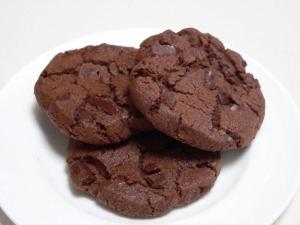
Pete thinks they would be more aptly named “World Conflict Cookies”, because either everyone fights over them OR you have an internal struggle not to eat five at one sitting. The recipe is from a great cookbook called Baking from My Home to Yoursand was recently discussed on Dorie Greenspan’s blog (there’s a recipe link here). For our batch, I used homemade butter, homemade vanilla extract and Belgian chocolate. As this recipe is quite simple, it really showcases the ingredients, so it pays to use the best you can find.
Homemade butter
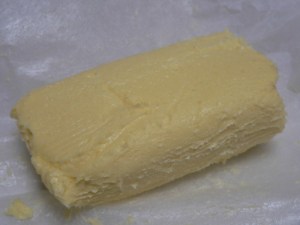
This is one of the maddest, most empowering things you can do in the kitchen. Making your own butter is so easy, and yet it always makes me feel like Ma Ingalls from Little House on the Prairie. We never planned to make butter – it’s really just a byproduct of our desire not to waste anything.
Instead of throwing away cream that’s near its expiry date, we now beat it, with just the tiniest bit of salt, in the stand mixer until it splits into butter and whey (start with the whisk and move to the paddle attachment if it gets too thick). Rinse the butter in cold water, then it needs to be beaten to get all the residual liquid out of it. We do this by placing a wooden chopping board over the sink at a slight incline (to allow the liquid to drain off) and smacking the butter on it with wooden gnocchi paddles (one will work, but two is much easier). Surprisingly, the ridged paddles don’t stick to the butter, and the whole process is really quite quick, although it can leave your kitchen an oily, cream-speckled mess.
It really is delicious and worth trying – after all, how often do you get to taste butter which is just minutes old? But being able to use our own butter in cakes and cookies – that makes me blissfully happy.
. . . . .
More here : Butter Making #2
and here : Step by Step Butter Making Photos
Posted in Recipes, tagged capsicum chutney, capsicum jam, chile jam, chili jam, chilli jam recipe on February 28, 2009| 6 Comments »
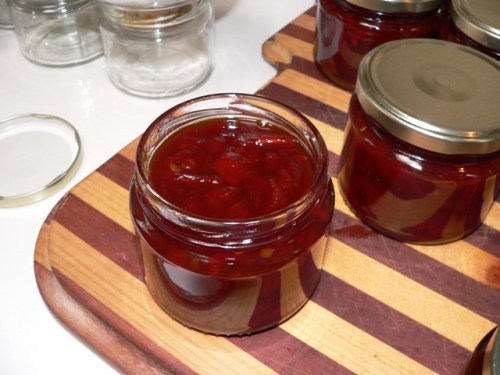
For all our friends who love Pete’s chilli jam – here is the recipe. This was our very first attempt at preserving – years before the recent jam making mania. It’s really a spicy capsicum relish and when you make it on a large scale, it’s an all day affair. We started this morning at 8am and we’ve just pulled the last jars out of the hot water bath now, at 5pm. But it’s worth it! Over the past week, we’ve had three friends request a jar, as they’ve used up their allocated supply. It’s always very flattering to be asked, so yesterday at the markets we picked up a 10kg box of capsicums, some bagged apples, two sorts of chillies and some Australian garlic (which is only available for a few months each year). The capsicums were $14 (and we didn’t use all of them), the apples and chillies $4 each, and there was about $1 worth of garlic in the mix. Add to this the juice, sugar and vinegar, and our total outlay today (excluding electricity and the cost of the jars) was about $35, which is pretty good given that we’ve made 19 jars of chilli jam!
Pete’s Chilli Jam
Approximate quantities per jar :
Today we used :
Put all the prepared ingredients into a large stock pot (or in our case, two), and bring to a boil.

Once the mixture has reduced slightly and you can fit the sugar in, add the sugar. Then it’s just a case of boiling the jam, stirring regularly, until it thickens – it will reduce by at least half by the time it’s done, and will gurgle like molten lava. Be sure to stir constantly once it reaches this stage, as it’s liable to catch and burn very easily. Our batch today took a good six hours of boiling to reduce down, with an hour of non-stop stirring at the end (while wearing welders’ gloves and protective clothing). We bottled them in slightly larger jars this time, but the per jar quantity given above is about right for a 200 – 250ml jar (depending, of course, on the size of the capsicums and apples). The jam doesn’t need to be made in such large quantities, and we’ll often make a smaller batch, sized accordingly to the amount of fruit we have on hand.

Once the jam is ready (determining this point takes a great deal of discussion, but Pete always has the final say), we pour it into sterilised jars, and then put the sealed jars into a large pot of boiling water and boil them up for 10 minutes.
Posted in Food & Friends, Recipes, tagged fig jam recipe, fig rhubarb jam, fig rhubarb recipe, fresh fig jam, green fig and rhubarb jam on February 25, 2009| 7 Comments »
Last night, Pete made Fig and Rhubarb Jam from Mrs M’s figs. He used all the tarter green figs and about half the black figs (the riper ones), and combined that with a kilo of rhubarb we had in the freezer.

It’s a nice feeling to reap the rewards of proactive shopping. About six months ago, we bought a box of rhubarb offcuts at the markets – rhubarb retails for $3.99/bunch most of the year, so when we spotted a box with the equivalent of about 40 bunches for $12, it was an easy decision to make. We actually bought two boxes (as you do) and gave one to a neighbour. Unlike him, we washed and chopped up the rhubarb, and stashed most of it in the freezer in half kilo bags. Our neighbour was heading away for a week with friends, so he took his box with him and cooked it up for breakfasts and desserts during the holiday. Needless to say, he hasn’t been that keen on rhubarb ever since.
Most of the fig jam recipes online use dried figs, which isn’t surprising given how expensive fresh figs are. But if you’re fortunate enough to have access to an abundance of them, then this fresh fig jam really is superb.
Pete’s Fig and Rhubarb Jam
Boil up everything except the sugar in a large pot until well cooked. It’s important to make sure all the skins are completely softened before adding the sugar. Add the sugar, and cook at a rolling boil until the jam sets and wrinkles on a cold plate. Spoon the hot jam into sterilised jars, seal tightly, then boil the jars for 10 minutes in a hot water bath. Label and store and eat.
. . . . .
See our Jam Making Primer for more tips on making jam.
© All text and photos are copyright 2009 - 2024 Fig Jam and Lime Cordial. All rights reserved. Please ask first.


