Feeds:
Posts
Comments

Archive for the ‘Recipes’ Category

I love how blogging begets blogging.

Since Ella Dee gave me the headsup on buying Burrawong Gaian products in Sydney, I’ve been dropping in to see George and Yiota at Dulwich Hill Gourmet Meats and picking up a bird on a monthly basis.

Last Friday, we slow roasted one of Beth’s ducks for three hours in the Römertopf – after rubbing with a little salt, the duck was placed into the presoaked pot, covered, and given 40 minutes at 200C with fan, followed by a couple of hours at 150C with fan. This was followed by a brief bake with the lid off at a slightly higher temp to crisp up the skin.

A couple of times during the roasting process, I took the Romy out of the oven and poured off the oil. The end result was so tender that it practically fell apart as I lifted it out of the pot. My sons attacked it like cavemen…
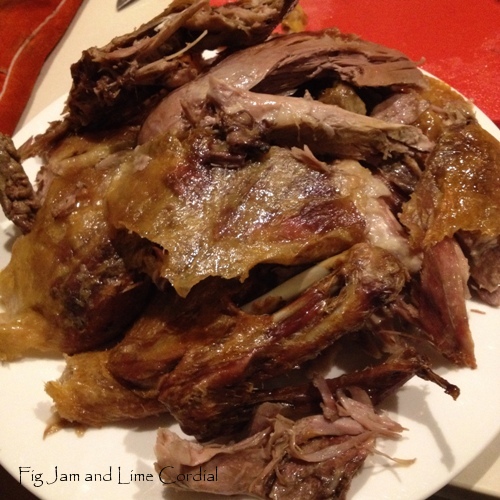
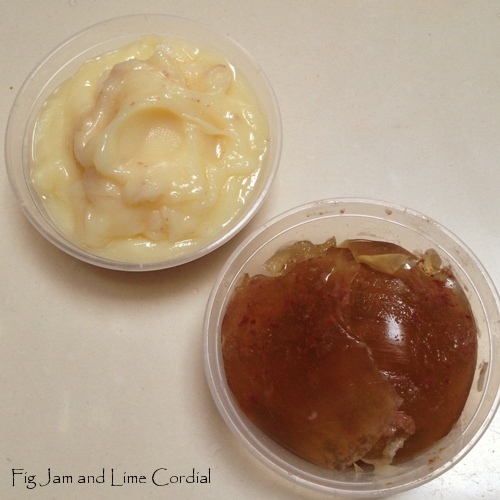
As I mentioned to Beth on Twitter the next day, the duck was sublime, but the leftover fat and gelatinised stock were gold

The ever fabulous Chica Tanya mentioned recently that in Spain, lard is often mixed with a little pimenton and served on grilled toast for breakfast. Inspired, I combined 50g of the duck fat with half a teaspoon of pimenton (paprika), and smeared the paste onto half a kilo of risen high hydration sourdough that I just happened to have on the bench…
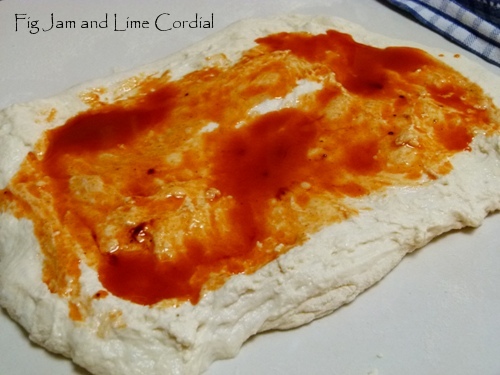
The dough was rolled up into a thick log – it was a seriously messy process – then cut into slices. Further inspired by Lorraine’s bacon ring, I stretched each slice out and twisted it up. At this point, the dough was looking like torqued intestines, complete with blood (but I was having fun)…

After a brief rise while the oven preheated, the sticks were baked at 220C with fan for twenty minutes. They were divine. Big Boy and Small Man ate them hand over fist…

duck4

See what I mean? Blogging begets blogging! We had a lovely dinner, with thanks to Ella Dee and Burrawong Gaian Beth, and scrumptious, unique, whacky bread inspired by Tanya and Lorraine! ♥
Read Full Post »

Recycled Cake Crumble

Those of you who have been reading our blog for a while will know that I tend to get a little enthusiastic when things work well.

A sensible person might think, “ooh that recipe was great, I’ll make it again next year”. I, on the other hand, wonder how many variations I can concoct before the boys jack up and refuse to eat any more.

Such was the case (as you probably noticed) with my recent tea cake recipe. For a solid month, I pulled out different flavour combinations until everyone – Pete, the boys, the neighbours – had eaten their fill.  Eventually, I was left with a large slab of passionfruit and glacé ginger cake…

I didn’t want to waste it, so I was chuffed to find a crumble recipe in Jacques Pépin’s Essential Desserts which used cake crumbs as topping. The Kindle version of this book is very reasonably priced (about $4), but please note it only works on certain devices (and it’s not 700 pages long – it’s just an excerpt from one of his larger cookbooks)…

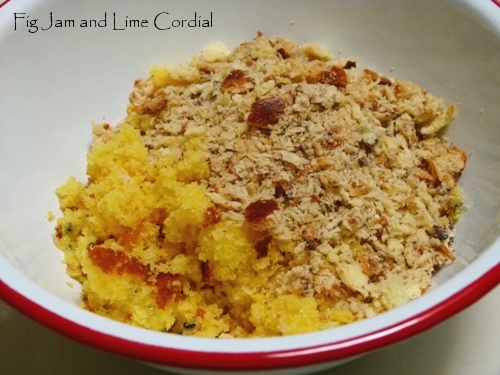
The recipe calls for a cup and a half of crumbled “pound cake, sponge cake or leftover croissants”. I used a mix of tea cake (icing removed) and stale faux brioche crumbs…

  • 2 cups fresh or frozen berries (I used a mix of raspberries and blueberries)
  • ¼ cup apricot jam (we used Pete’s homemade version)
  • 2 tablespoons apple juice
  • 1½ cups crumbled topping

Preheat oven to 160C with fan.

Warm the jam briefly to soften, then mix in the apple juice. Stir together with the berries, then tip the mixture into an ovenproof dish and top with the crumbs, covering the berries completely.

Bake for 20-30 minutes (check it to see that the topping doesn’t get burnt), then allow to rest and cool a little before serving.

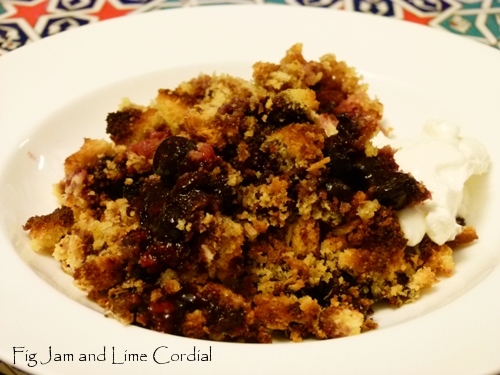
This was hands down the best crumble we’ve ever made! The cake and brioche crumbs crisped up beautifully and the berries were sweetened just enough by the jam and juice. Small Man declared it to be his new favourite dessert, and the dish was scraped clean within minutes.

It made me wonder – was this how crumbles originated, as a way of using up leftover pastries and cakes? In the past, I’ve always made the topping from scratch, using various combinations of flour, butter, nuts and oats, but this was so much better that I doubt I’ll ever bother making it any other way again. What I will do though, is stash all my leftover cake in the freezer from now on!

Read Full Post »

Last weekend, our darling neighbour Michelle had a baby shower. Little Arturo (our current working title for her bump) is expected to make an appearance any day now and we’re very excited for her and Shaun!

The day before, we’d picked a bowl of lemons from our heavily laden tree, and I was keen to incorporate them into a cake to take to the party…

Early on Sunday morning, I consulted my copy of The Flavor Bible. This fabulous tome isn’t a cookbook, but rather a detailed study of how we perceive and taste food, accompanied by comprehensive lists of different ingredients and their recommended pairings. I read recently that it’s a favourite with chefs, who will often refer to it when creating new dishes.

I turned to the “lemon” listing and noted “almond” and “poppy seeds” as two of the recommended matches. From there, it was a doddle to adapt our tea cake recipe to suit…

  • 250g unsalted butter
  • 200g white sugar
  • grated zest of two large lemons
  • 4 large (59g) free range eggs
  • 150g self-raising flour
  • 150g blanched almond meal
  • 30g poppy seeds

Icing

  • 150g icing sugar mixture (confectioners sugar)
  • juice of half a large lemon (or as much as needed)

1. Preheat oven to 160C with fan and line a baking tray with parchment paper (I used a rectangular 30cm x 23cm / 12″x9″ pan enamel baking pan).

2. In the large bowl of the food processor, blitz together the butter, sugar and lemon rind until light and fluffy. Add the eggs one at a time and pulse until combined, adding in a spoonful of the flour if required to stop the batter from splitting. Scrape down the sides as needed.

3. Stir together the flour, almond meal and poppy seeds, then add to the food processor and pulse until just combined. Scrape the batter into the prepared tray.

4. Bake for 30 – 40 minutes, or until a fine skewer inserted comes out clean. Rotate the tray half way through the baking time if needed. Place on a wire rack to cool, but don’t lift the cake out of the pan.

5. Once the cake has cooled, sift the icing sugar mixture into a large bowl, and gradually whisk in enough lemon juice to form a fairly thick but pourable icing. Drizzle the icing over the top of the cake, and spread evenly with a spatula or butter knife.

6. Allow to cool before lifting out of the pan and cutting into neat squares…

Like the pound cake recipe, our basic tea cake formula is proving to be extremely versatile – this is now its fourth incarnation, and each one has been distinctly different to the others. Pete decided that he would have preferred a straight lemon cake without the poppy seeds, but everyone else loved this!

Read Full Post »

Man’oushe Fougasse

“Mum, is this bread Lebanese or French?”

Small Man came home crook from school on Friday, so on Saturday morning, I baked him fougasse loaves topped with za’atar. Traditionally, za’atar topped flatbreads called man’oushe are served as a Lebanese breakfast, and my son adores them.

Fougasse are quick and easy to make – the yeasted dough proves quickly, the loaves don’t need a second rise, and they bake up in just 15 minutes in the oven. I wrote a detailed post a few years ago and my basic bread formula is listed below, but the shaping technique can easily be applied to whatever dough you normally use…

  • 500g bakers/bread flour
  • 10g dried yeast
  • 8g fine sea salt
  • 320g water
  • 50g olive oil

The za’atar I use is Jordanian by Al Salam. I mix it with light olive oil to create a spreadable paste…

If you can’t buy a za’atar blend, you can mix your own using this recipe from Spice Notes by Ian Hemphill, owner of Herbie’s Spices:

  • 3 tsp dried thyme leaves, crushed but not powdered in a pestle and mortar
  • 1 tsp sumac
  • ½ tsp toasted sesame seeds
  • ¼ tsp salt

I spread the spice paste over the shaped fougasse with my fingers – it’s a messy process! Once shaped and coated, the dough goes straight into the oven…

My 900g batch of dough resulted in six fougasse – Small Man ate three of them for lunch. They’re a fun and easy weekend bake!

Read Full Post »

Römertopf Braised Pork

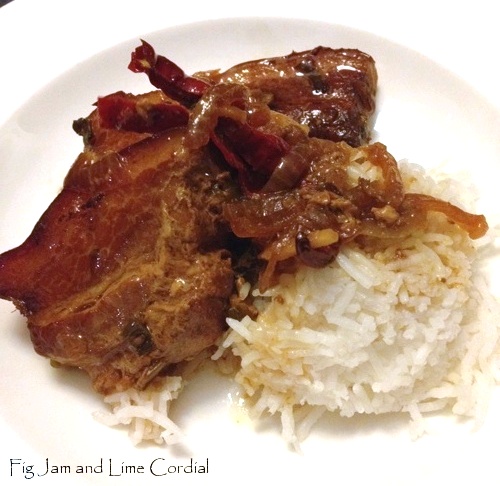
Nearly a year ago, I blogged about Ai-Ling’s fabulous clay pot belly pork. Since then, the dish has become a staple in our house – my boys love it and request it often.

Last week, I tried making a Römertopf version of this recipe and was delighted with the result. The sauce doesn’t thicken in quite the same way as it does when it’s cooked on the hob, but it’s rich and flavoursome nonetheless, and the meat is succulent and tender. Furthermore, like all Römertopf meals, the preparation and cooking process is very simple – all the ingredients are combined cold, laid into the pre-soaked pot, then popped into a cold oven to bake.

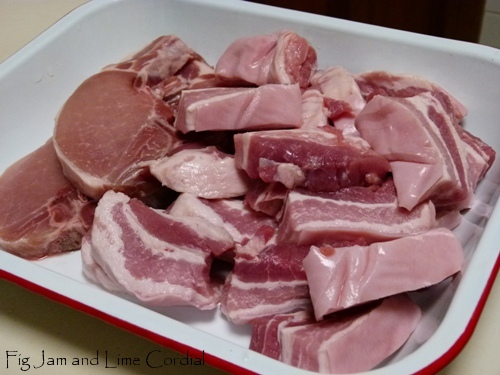
From the freezer, I excavated a slab of belly pork and four thin pork chops. Once the meat had defrosted, I put the Römertopf lid and base in a sink of cold water while I prepared the ingredients (the pot needs about 20 minutes soaking time).

After defrosting, the belly was cut into thick slices…

The other ingredients included:

  • a fat thumb of ginger, peeled and julienned
  • 1 Spanish onion, peeled, halved and sliced
  • 3 cloves garlic, peeled and chopped
  • 3 spring onions, chopped
  • 2 dried chillies, deseeded (Ai-Ling’s original recipe uses 10!)

For the sauce, I combined:

  • 3 – 4 tablespoons oyster sauce
  • 4 teaspoons dark soy
  • 2 teaspoons light soy
  • 3 tablespoons Shaoxing rice wine
  • 2 teaspoons sesame oil
  • good pinch white pepper

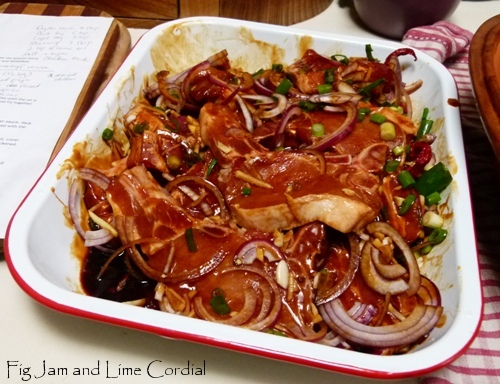
The sauce and other ingredients were combined with the meat…

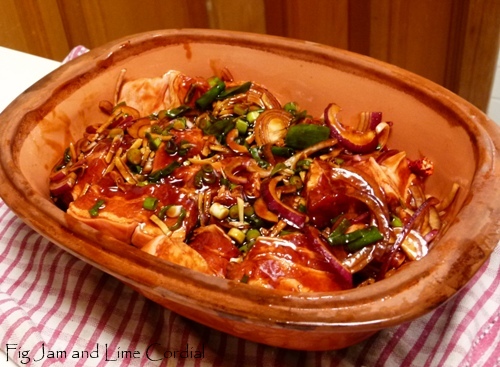
…then transferred to the wet pot. I placed the chops at the bottom to keep them moist, then layered the belly pork on top. Finally, I poured over two cups of homemade, lightly salted chicken stock (the photo below shows the filled Römertopf before the stock was added). I tried to make sure that as much of the meat as possible was submerged.

The lid went on and the pot went into a cold oven. The temperature was then turned up to 200C with fan.

I left it to bake for two hours in total, checking at the 90 minute mark to see if the seasonings needed adjustment. Ai-Ling suggests adding a little sugar and salt, but I didn’t feel it was necessary this time. If you’d like a thicker sauce, you could try adding a cornflour slurry at the point. I reduced the temperature for the final half hour to 180C with fan (on a whim, really). Remove the lid towards the end of the baking time if you’d like the braise to darken and reduce further (I didn’t), but watch it carefully if you do, as it can brown up very quickly uncovered.

We allowed the pot to rest on a wooden board (never put a hot Romy on a cold surface!) then defatted it slightly by gently mopping up the excess oil with absorbent paper towels (it’s surprising how effectively this works).

The boys loved this version of clay pot belly pork – Small Man went back for thirds!

Read Full Post »

« Newer Posts - Older Posts »