Feeds:
Posts
Comments

Archive for the ‘Recipes’ Category

Apple Butter

Our apple butter is a byproduct of pectin production – it’s never a preserve that we deliberately set out to make. For that reason, I’ve been reluctant to post our recipe in the past, because it’s such a loose construction – the few ingredients will vary depending on the type of apples we’re using and our mood on the day.

But…given the numerous kind requests I’ve had since posting our muesli cookie recipe, here is a rough guide on how we make it. Please understand that it’s not a fixed formula – if you use sweet apples, you might need less sugar, and the spice mix can be adjusted to suit your personal preferences.

We start with the pulp leftover from boiling apples to make pectin. If you’re not making pectin, you could peel, core and chop up the apples, then cook them in a little water until they go soft and mushy.  We try to use either green or Pink Lady apples – as I said, you might want to reduce the sugar if you’re using sweeter fruit.

In a large mixing bowl, combine together:

  • 4 cups of apple pulp
  • 1 cup white sugar
  • 1½ cups brown sugar
  • juice of 2 large lemons (about 150ml)
  • ½ teaspoon ground cinnamon
  • ¼ teaspoon allspice

Stir well, then pour the flavoured pulp into a large roasting pan – I use an Emile Henry clay one.  Spread the mixture out evenly with a spatula, then bake in a preheated 150C with fan oven for 2 – 3 hours.

Make sure you stir the mixture frequently (every 15 minutes or so), scraping into the corners of the pan to ensure it doesn’t catch.  Over the cooking time, the apple butter will darken and thicken – pull it out of the oven when it’s a little bit looser than you’d like, as it will thicken up in the jar.

Spoon the hot apple butter into clean jars, seal them tightly, and then process them in a hot water bath.  From our experience, jars of apple butter processed in this way keep well for at least a year.

Read Full Post »

My friend Lisa rang me to say that she couldn’t stomach reading another post about lard. So these rolls are for her – and my Pete, who absolutely adored them.

They’re a riff on the lardy cake recipe, substituting a reduced amount of butter for the fat. The revised ingredients list is as follows:

  • 500g bakers/bread flour
  • 8g fine sea salt
  • 200g active sourdough starter (at 80% hydration – see original post)
  • 250g water
  • 1¼ teaspoons dried yeast
  • 100g – 120g unsalted butter, cold
  • 125g – 150g caster sugar
  • dried fruit – I used a mix of currants and golden raisins
  • grating of nutmeg
  • extra caster sugar for topping

Note: I’ve made this recipe twice now – once with 120g butter and 150g sugar, and a second time with 100g butter and 125g sugar.  I didn’t notice a huge difference, so will probably bake the lower fat version in future.  The photos here though are from the higher fat batch.

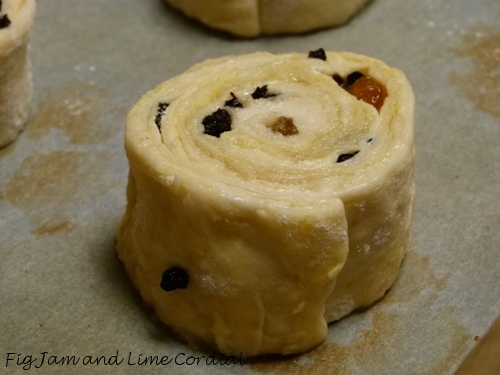
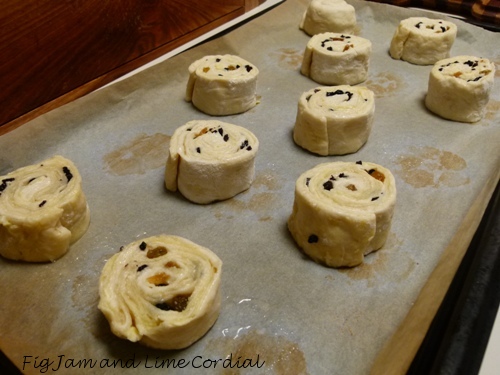
Follow the original instructions to make and shape the dough, substituting the cold unsalted butter for the lard.  When the dough has been rolled into a log, simply cut it into ten equal slices and lay them out on a lined baking tray to prove for an hour, covered with a tea towel…

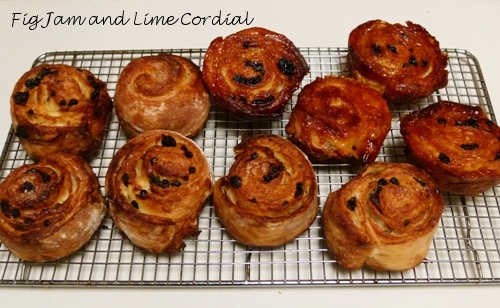
Sprinkle the tops of the proved rolls with extra caster sugar and a little grated nutmeg, then bake in a preheated 190C with fan oven for 15 minutes, followed by a further 20 – 25 minutes at 175C with fan.  Watch them carefully, to make sure they don’t burn.

Allow to cool on a wire rack, inverted if the sugar syrup on the base of the roll is still runny…

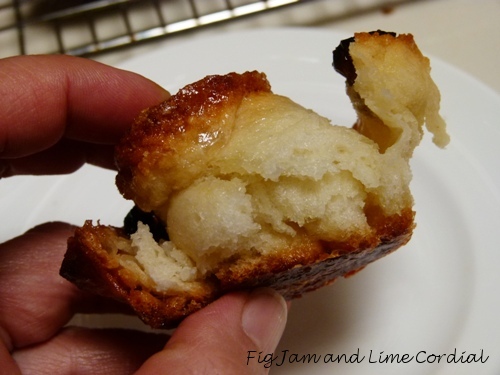
The finished rolls have a rich, buttery crumb and a crunchy exterior reminiscent of European pastries and sweet rolls. I froze half the batch or Pete would have eaten them all!

. . . . .

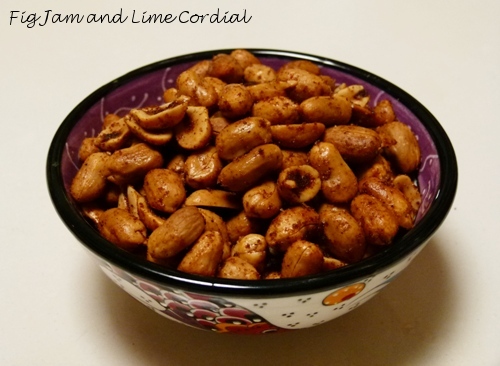
At 9pm last Wednesday night, I found myself (as I often do) nursing a hot cup of peppermint tea at Nic and PeteV’s house around the corner.  We were nibbling on incredibly moreish spiced peanuts, coated in jalapeño chilli and garlic powder.

As the following day was ANZAC Day, I had a little time to mess about with a recipe, and came up with this:

  • 750g raw peanuts
  • 3 teaspoons Maldon sea salt
  • 25g dark brown sugar
  • ½ teaspoon garlic powder
  • ½ teaspoon Kashmiri chilli powder
  • ½ teaspoon smoked paprika
  • 30ml cold-pressed peanut oil

Preheat the oven to 175C with fan. In a small bowl, whisk together the oil, salt, sugar, garlic powder, chilli powder and paprika. Pour the peanuts into a large mixing bowl, add the oil-spice mix, then massage it in well with clean hands.

Tip the nuts onto one or two parchment-lined trays, then bake for 30 minutes, giving them a good stir at the 15 minute mark.  Watch that they don’t burn! Allow the nuts to cool on the trays, during which time they’ll harden up and go crunchy. Season with extra salt if desired.

Nic and PeteV declared these to be better than the original nuts!

Read Full Post »

Kevin and Carol are amongst our oldest and dearest friends – we’ve known each other since 1983.  They live in our neighbourhood, just a few streets away, and between us we have five strapping sons, all of whom have attended the same school.

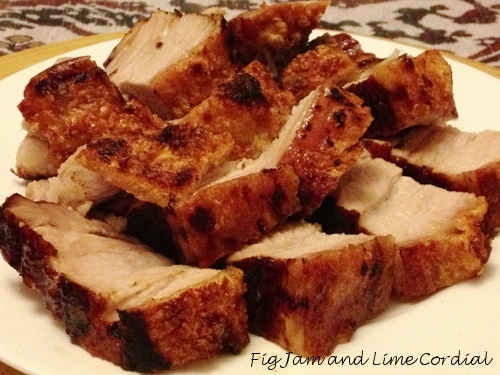
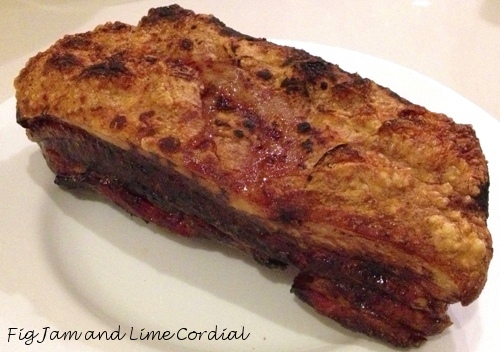
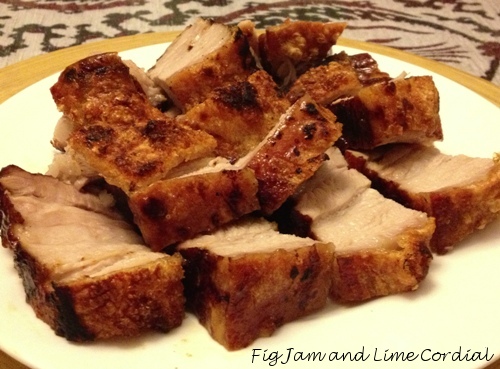
If you thought Big Boy and Small Man could put food away, you haven’t seen Carol’s boys eat. I’ll often watch in awe as they literally inhale a mountain of food into their lean frames. The last time we were over for dinner, Kevin roasted belly pork – the plate of tender meat and crackling had barely touched the table before an entire pack of starving teenagers fell upon it in a feeding frenzy. Needless to say, I had to ask for the recipe…

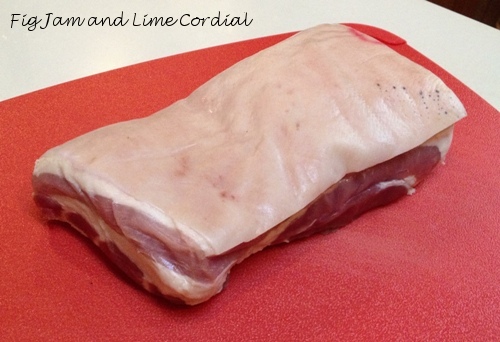
Begin with a nice piece of free range belly pork, preferably one that doesn’t have too thick a layer of fat. Dry the rind well with a paper towel, score it with a razor blade or sharp knife (I use a razor, as I find it hard to do with a knife), then rub with a little oil and fine sea salt.

Preheat the oven to 180C with fan.

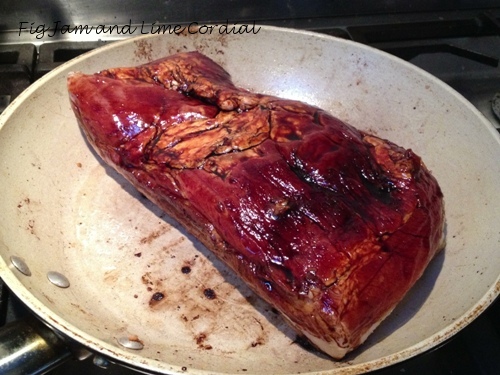
Place the meat rind-side down on either a hot frying pan (I used non-stick) or on the barbeque hotplate. The aim is to dry the skin out and to start crisping it up slightly before roasting – move the meat around to stop it sticking and burning.

When the rind has coloured up a little, brush the flesh with a mixture of dark and light soy…

Place the pork rind-side up on a wire rack over a lined oven tray (to make washing up easier). The photo below shows the meat ready to go into the oven…

Roast in the oven for 1 – 1¼ hours, depending on the thickness of your meat (mine took 1¼ hours). The best way to gauge when the pork is done is with a probe thermometer – according to Stephanie Alexander, when the internal temperature reaches 76C, it’s safe to eat.

Once the meat is cooked, turn the top (grill) element of the oven on, to crisp up the crackling. Watch it very carefully at this point, as it can burn in an instant.

Allow the pork to rest for about 15 minutes, then cut into bite-sized pieces with a large, sharp knife.  Plate it up, gingerly place it in front of starving wolves (maintaining eye contact at all times)…and stand back!

Read Full Post »

Muesli Cookies

I’ve always thought that one of the great definers of age is the time that you go to sleep at night.

For the very young, that can be early – as a small child, Pete remembers being sent to bed whenever the theme music for the ABC News came on at 7pm.  On the other end of the scale, I’m in my late forties, and I’ll often be sound asleep by 10pm.

Big Boy, who is now in his twenties, is currently keeping vampire hours, a sure sign of youth.  As a result, he’s routinely wide awake and completely alert six hours after we’ve had dinner, and will come stalking into the kitchen to forage for food.

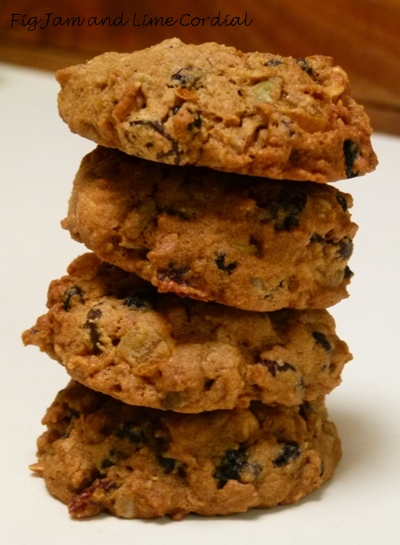
One morning, I woke up to find that he’d made a serious dent in my supply of Amedei Chuao chocolate. I invented these cookies that same day – they’re an amalgam of the two triathlon cookies I’d created for Marty a few years back (with less butter and brown sugar), and hopefully they’ll provide enough low GI energy to keep the starving wolf away from my chocolate stash.

If you’re missing any of the ingredients, you might want to consider the original triathlon cookie, or the updated version – both are filling and delicious. This version makes use of Pete’s muesli supplies, our neverending stash of apple butter, and the lovely Buratto flour that Tania gave us. The cookies aren’t particularly sweet, but they do offer a rich, complex mix of flavours.

  • 100g unsalted butter
  • 125g dark brown sugar
  • 75g apple butter
  • 1 large (59g) egg
  • 200g Buratto flour (or substitute plain/AP or spelt flour)
  • ½ teaspoon bicarbonate of soda (baking soda), sifted
  • ¼ teaspoon fine sea salt
  • 75g organic rolled spelt
  • 100g semisweet chocolate chips (I used Callebaut 54% dark callets)
  • 75g dried blueberries
  • 75g dried cranberries
  • 50g finely chopped candied peel
  • 50g blanched roasted hazelnuts, chopped
  • handful of pepitas and sunflower seeds (optional)
  • 1 teaspoon vanilla extract (I used homemade)

1. Preheat oven to 170C or 150C with fan.  In a medium bowl, whisk together the flour, sifted bicarbonate of soda, and salt.  Add the rolled spelt, chocolate, hazelnuts and dried fruit, and stir to combine.

2. In a large mixing bowl, beat the butter, apple butter and sugar until combined, then beat in the egg and vanilla.  Add the dry ingredients and mix until just combined.

3. Roll the dough into 4cm balls, and place them on a parchment lined baking tray.  Flatten each cookie slightly and bake for  20 minutes or until golden brown.

4. Allow to cool on a wire rack before storing in an airtight container for midnight munchies!

Read Full Post »

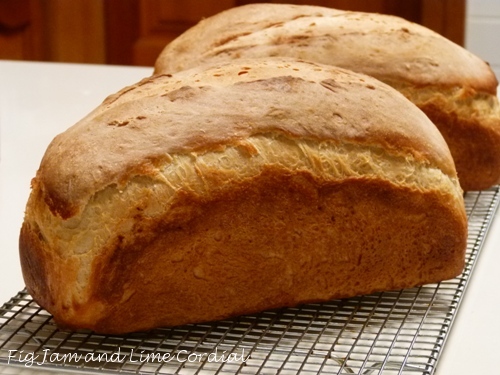
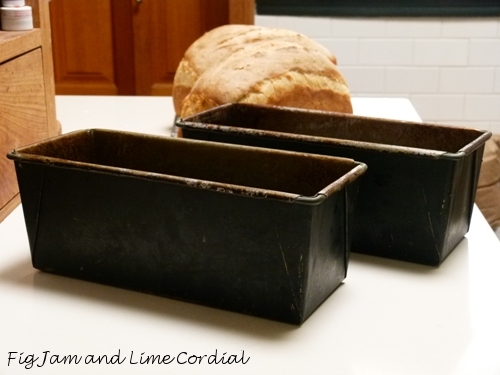
Most of my loaves are free-formed or shaped in a banetton, but it’s nice to occasionally bake a proper sandwich loaf in a tin!

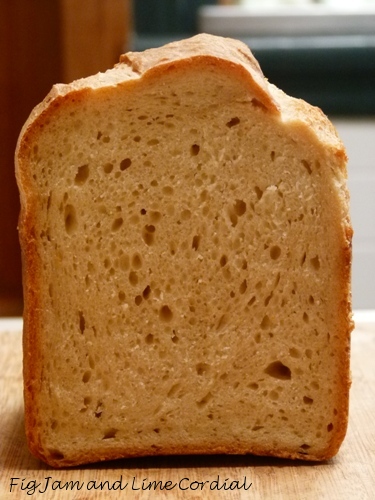
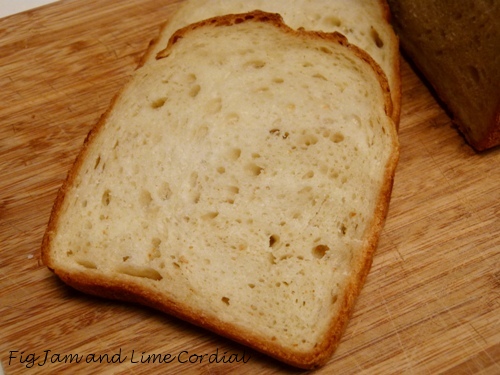
The boys certainly enjoy the variety, and I’ve recently had quite a bit of success with this formula – a sourdough adaptation of Joanna’s white toast bread.  I substitute half the bakers flour with Italian 00 flour, which gives the finished loaf a tender and white crumb.  Because I don’t knead much anymore, the crumb is still quite open  and a little holey.

The 00 flour is milled from soft wheat, and the one I’m using only has 10% protein (which makes it the same as plain/AP flour).  This is particularly noticeable in the crust – it’s harder to shape a strong gluten coat, and as a result the top of the bread is always a little ragged.  The quantities listed below are for a single large loaf (although the photos show the double batch that I made)…

  • 200g active sourdough starter (166% hydration, ie. fed at a ratio of one cup water to one cup flour)
  • 350g bakers/bread flour
  • 350g Italian 00 flour
  • 375g water
  • 15g extra virgin olive oil
  • 13g fine sea salt
  • 10g brown sugar

1. In a large mixing bowl, mix all the ingredients together to form a shaggy dough, then allow to rest, covered, for 30 minutes.

2. Give the dough a quick knead in the bowl, then cover again and allow to prove until roughly doubled in size. This could take anywhere from 4 to 10 hours, depending on how active your starter is, and the temperature of your kitchen.  Spray one large or two small loaf tins with oil.

Edit: my heavy duty large loaf tins are 28cm x 11½cm (11″ x 4½”).

3. Scrape the proved dough onto a lightly oiled surface and shape it into a loaf.  Place the dough seamside down into the prepared tin – it should fill the tin to about halfway. Cover with cling film and allow to prove until the tin is approximately three-quarters full.  Preheat the oven to its maximum temperature.

4. When the dough has had its second rise, slash the top with a serrated knife or razor blade, spritz it with a little water, and put it in the oven to bake, reducing the oven temperature to 220C with fan at the same time.  Bake for 20 minutes.

5. At the end of 20 minutes, the loaf should be quite brown – carefully tip it out of the tin, and place it directly on the oven rack to finish baking.  Reduce the heat to 175C with fan and bake for a further 20 – 30 minutes until well browned and hollow sounding.  Allow to cool completely on a wire rack before slicing.

Like all sourdough loaves, this one freezes well.  I usually cut it in half before freezing though – otherwise the wolves defrost and eat an entire 1.3kg loaf in a single sitting!

Read Full Post »

« Newer Posts - Older Posts »