Feeds:
Posts
Comments

Archive for the ‘Recipes’ Category

Tromboncinos

trom1

When I mentioned to the lovely Linda that we were having difficulty growing zucchini, she suggested that we try tromboncinos instead. Then, because she’s so nice, she sent us some seed.

We’ve planted them  in the back of the garden, on a fallow bed usually reserved for the chook dome when it’s out of rotation.  The tromboncinos are supported by an unmeshed dome which we’d originally planned to use for shade, and they’ve very quickly climbed to the top of the structure…

troma

The plants quickly grew huge leaves and twirly vines, but the fruit and flowers didn’t show up for quite a while.  Eventually though, they did…

tromb

To ensure a decent crop, we hand pollinate the female flowers every morning. Once pollinated, the fruit grows at an astonishing pace.  This one is well over half a metre (20″) long…

We have four plants in total – three with light green fruit, and one with a darker skin variant (shown below with one of our Lebanese zucchinis, which also seem to be thriving in the garden this year)…

trom2

Each tromboncino will produce an enormous quantity of edible material if you let it.  Linda and Jane both recommend picking them young, but we couldn’t resist letting the first couple grow quite large. The huge green squash in the photo above fed three families tonight!

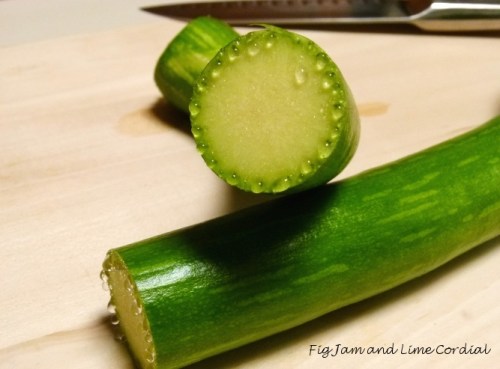
I cut it into sections – the neck was divided into two large pieces…
trom3

All the seeds are in the bulbous base…

trom4

…which was cut into wedges and fed to our family of chickens (it’s one of their favourite meals)…
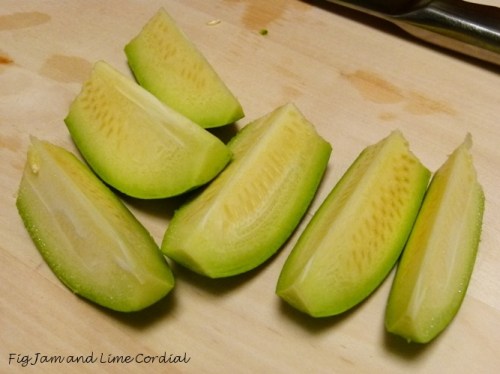
trom5

The first half of the neck was turned into a zucchini slice for our neighbour Ellen, who is down with the flu…

The second half of the neck was chopped…

trom6

…and stir fried with free range pork mince, onion, garlic, and yellow bean paste, then served with Basmati rice…

trom7

Voilà! One giant tromboncino: three meals. Granted, one of the meals was for the chooks, but I was delighted not to have to waste any of this fabulous bounty.

Linda commented that if the food apocalypse ever happens, we can all survive on tromboncinos. I’m pretty sure she’s right!
Read Full Post »

Feasting

Pete and I have been together so long that his family has become my family too – I’ve known them since his youngest siblings were just ten years old (they’re now nearly forty).

They’ve all been here this weekend (with the exception of his youngest brother Greg), and we’ve been feasting. This morning, their cousin Emma and her family joined us for brunch, and in an hour or so, our friends Kevin and Carol will be dropping by.  It’s a busy, joyous time of the year, which we’re enjoying enormously after a couple of long, hard months.

I haven’t been online very much, but wanted to pop in quickly to say hi, and to share with you some of the glorious food we’ve been eating…

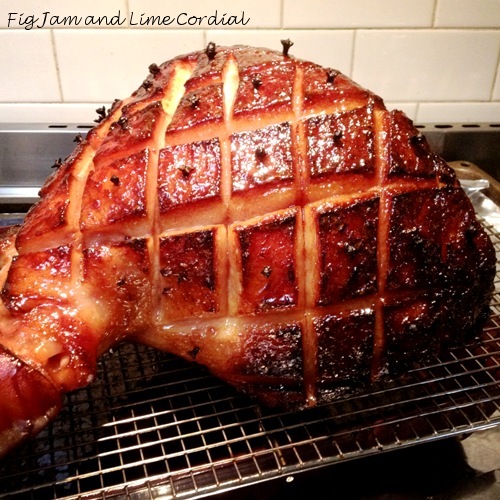
As I mentioned in my last post, we glazed a large leg of ham.  This year we just melted a jar of Pete’s quince jelly with a few tablespoons of dark brown sugar to form the glaze.  The fat was scored and studded with cloves, and then half the glaze was painted on. The leg was baked on a rack over a pan of water at 240C with fan for 20 minutes, then removed from the oven and coated with the remaining glaze, before returning to bake for a further 20 minutes at 200C with fan.

My brother-in-law Ray declared it to be the best ham he’d ever tasted…

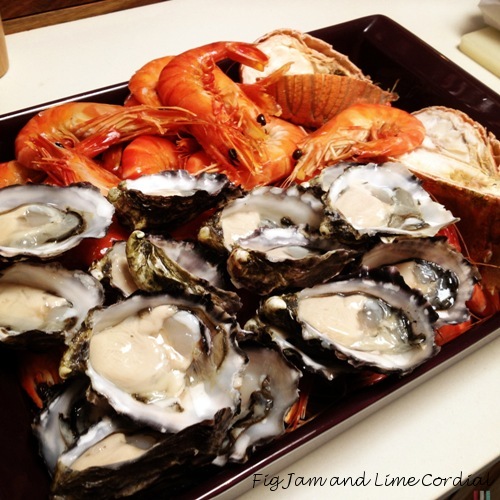
On Saturday morning, Penny, Ray and I took an early morning trip to the Sydney Fish Market.  We came home with Pacific oysters, scallops on their shells, calamari rings, prawns, Moreton Bay bugs and rainbow trout.

The trout was baked in foil bags, the calamari was crumbed and deep fried, and the scallops were topped with a little garlic chive butter, then cooked on a hot griddle for five minutes until tender…

I was up early this morning to finish baking these ciabatta loaves – I’d mixed up the dough last night and left it on the kitchen bench, so all I had to do this morning was to shape the loaves and bake them…

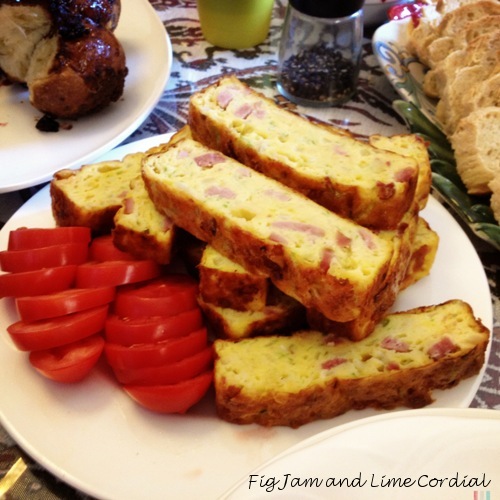
I made a zucchini slice, using our Lebanese zucchinis, leg ham, eggs, onion and King Island cheese. It’s a really easy recipe to have on hand for this busy time of year, and it never fails to please…

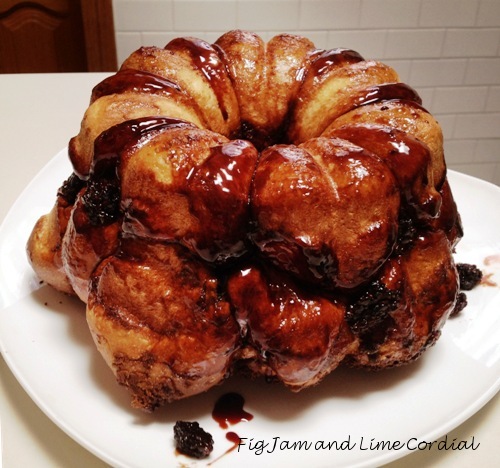
Penny and I assembled this blackberry crown together…

x6

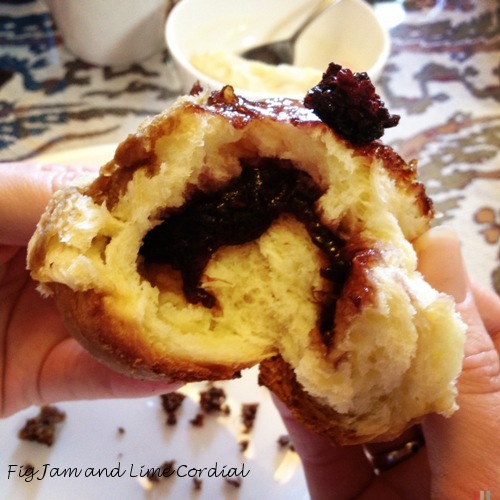
Each ball of dough was filled with Pete’s rhubarb and blackberry jam…

I must fly – have to bake some kifli before Kevin and Carol arrive.

Lots of love. xx

Read Full Post »

Rosemary and Duck Fat Focaccia

Focaccia is a regular weekend treat at our place, and I usually bake a gigantic tray for sharing with the neighbours.

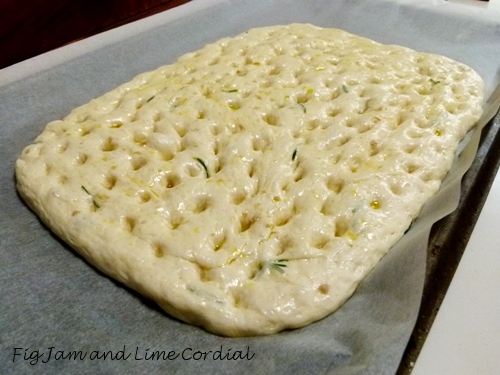
Last week, a bowl of leftover duck fat and a rampant rosemary bush inspired me to try something different.  This savoury loaf was absolutely delicious, and made for a quick and easy Sunday lunch…

  • 200g low hydration sourdough starter (80% – fed at a ratio of 80g water to 100g bakers flour). Starter should be ripe and bubbly before you start.
  • 330g water
  • 50g duck fat (if you don’t have duck fat, substitute 50g extra virgin olive oil)
  • 30g extra virgin olive oil
  • 500g bread/bakers flour
  • 2 sprigs rosemary, leaves only
  • ¾ teaspoon dried yeast
  • 10g fine sea salt
  • Extra virgin olive oil, for drizzling
  • Rosemary salt (or other flake salt) for scattering on top

1. In a large wide mixing bowl, mix together the starter, yeast, water, duck fat and olive oil. Add the flour, salt and rosemary leaves.  This is a very wet dough – just squelch it all together well, don’t try to knead it.  Scrape off your fingers and cover the bowl with cling film or a shower cap.

2. After an hour, come back and give the dough a few folds, leaving it in the bowl.  Repeat this twice more over the next two hours (at roughly 45 minute intervals). I usually let this dough rise for three hours in total (a bit longer in winter), by which time it should be puffy and well-risen.

3. Line a baking tray with parchment paper and scrape the dough onto it. Oil your hands and flatten out the dough to a 40 x 26cm (16 x 10″) rectangle.  You will probably need to get your fingers under the ends of the dough and give it a gentle pull to get it into shape.

4. Preheat fan-forced oven to 240C (460F).  Drizzle olive oil over the dough and spread it with your fingers, then scatter on the rosemary salt.  Allow the dough to rest for a further 15 minutes or so while the oven heats up.

5. Dimple the top of the dough with your fingers, pushing all the way down to the bottom. Reduce the oven temperature to 220C (425F) with fan and bake for 25 – 30 minutes, until golden brown.  Transfer to a wire rack to cool (if you can – otherwise, scoff it warm).

. . . . .

If sourdough isn’t your thing, you might like to try our simple yeasted focaccia, or one of the filled versions:

Pete always refers to focaccia as “homemade junk food”, and in a way he’s right – it’s like a cross between fried bread and hot chips.  We tend to eat it plain or dipped in a good olive oil, but it also makes delicious filled sandwiches for school lunches.

It’s the perfect bread for festive season entertaining!

Read Full Post »

Racines Cake

Pop!

Oh no…

Pop! Pop!

Oh no oh no oh no…

POP!

Bugger.

I had the batter in the cake tin when the fan elements in the oven blew.

I’d wanted to try this David Lebovitz recipe for the longest time – ever since reading about it in his Ready for Dessert cookbook. After all, how can one resist a recipe that was copied off the wall of the men’s restroom? And could such a thing possibly exist anywhere other than in Paris?

I’d carefully folded the light and airy six-egg batter together, gingerly poured it into the springform tin…and then the oven blew. So I had to reheat the oven using the top and bottom elements. Since the bottom element was covered with baking stones and trays (which were too hot to get out by this stage), it didn’t really bake as evenly as it normally would. And, of course, the batter sank as it sat on the bench, and the finished cake came out flat and a little squashed.

I was seriously tempted not to blog about it, and then I ate a slice. And then I ate another. It was very dark and moreish, with a silky, creamy texture.

The cake uses six eggs, a bucketload of chocolate, just half a cup (125g) of butter, and a relatively small quantity (85g) of sugar.  It’s topped with chocolate nibs (optional), which adds crunch and a slight bitterness to the finished product. It’s not particularly sweet – it’s almost a little savoury – and I find it absolutely irresistible. As an added bonus, it’s gluten-free as well.

I substituted instant coffee for the espresso, unsalted butter for the salted (as it was all I had), and used a mix of bittersweet and semisweet chocolate…

  • 140g (5oz) semisweet (dark) chocolate (I used Callebaut 811 54%)
  • 140g (5oz) bittersweet (dark) chocolate (I used Callebaut 70%)
  • 125g (½ cup) unsalted butter
  • a pinch of fine sea salt
  • 1 Tablespoon strong coffee (I used instant, Lebovitz recommends espresso)
  • ½ teaspoon vanilla extract (I used homemade)
  • 6 large (59g) free range eggs, separated, at room temperature
  • 55g (¼ cup) white sugar, plus 30g (2 Tablespoons) white sugar
  • 20g (2 Tablespoons) cacao nibs (optional)
  • Icing sugar for dusting the cake (optional)

1. Preheat the oven to 175C (350F) or 160C (320F) with fan (if your fan force element is working!).  Spray a 23cm (9″) springform time with vegetable oil and line the base with a circle of parchment paper.

2. In a large pyrex mixing bowl, melt together the chocolate, butter and salt in the microwave. Use short bursts on high, stirring well after each one.  Stir in the coffee and vanilla.

3. Using an electric mixer, beat together the egg yolks and 50g (¼ cup) sugar until creamy, which should take about a minute.  In a clean mixing bowl, beat the egg whites until they start to puff up, then add the remaining 30g (2 tablespoons) of sugar, and beat on high until the egg whites form soft peaks.

4. Fold the egg yolks into the chocolate mixture. Next, stir in a large spoonful of egg white, then gently fold the remaining egg white into the batter, being careful not to bash the air out of the mixture.

5. Pour the batter into the prepared tin and scatter over the cacao nibs.  Bake until just set in the middle, about 25 minutes.  Be careful not to overcook the cake.  Allow to cool completely before removing the springform ring. Dust with icing sugar if desired.

Cakes of this nature often fall into the trap of tasting a little eggy. Surprisingly, despite the large number of eggs in this recipe, that isn’t the case here.

Lebovitz recommends serving the cake with whipped cream or ice cream, but I’ve found it very addictive just as it is, with a hot cup of tea.

PS. The oven’s been repaired – had to get it fixed asap with Christmas just around the corner!

Read Full Post »

Chocolate Oatmeal Cookies

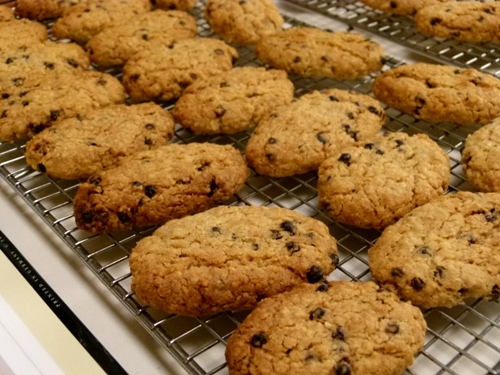
These wholesome cookies are very popular at our house!

They come together quickly in the food processor, and the chocolate finish is optional, but delicious. The recipe comes from Jacques Pépin Celebrates and was also featured in one of his television programs.

  • 125g (½ cup) unsalted butter, slightly softened
  • 55g (¼ cup) white sugar
  • 1 teaspoon baking powder
  • 100g (2/3 cup) plain (AP) flour
  • 85g (1 cup) rolled oats
  • 60g (1/3 cup) dried currants
  • tempered or melted dark chocolate

1. Preheat the oven to 180C (360F) with fan. Line a baking pan with parchment paper.

2. In the large bowl of the food processor, blitz together the flour, baking powder, sugar and butter until it just starts to form a ball.  Tip into a large mixing bowl, and squish in the oats and currants until well combined.

3. Roll small pieces of dough into 7.5cm (3″) logs and place them on the lined tray.  Flatten each log slightly to create oval shaped cookies,  then bake for 18 – 20 minutes until golden brown. Transfer to a wire rack to cool.

4. Temper a small bowl of dark chocolate (or simply melt it very gently), and spread the flat side of each cookie with a small quantity. Place the cookies, wet chocolate side down, onto a flat tray lined with parchment paper, pushing down firmly to flatten out the chocolate coating.

5. Allow the cookies to set (Pépin suggests putting them into the fridge or freezer for a few minutes), then store in an airtight container.

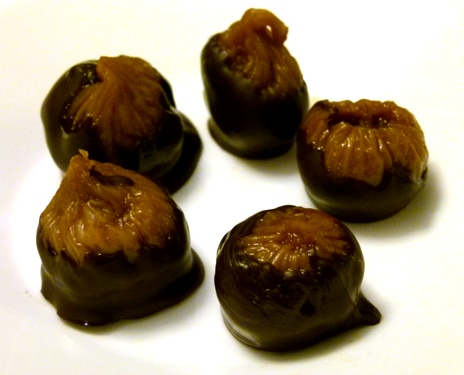
I always end up with more tempered chocolate than planned, so I used the excess to dip my rum soaked Persian figs.  They’re the perfect nightcap!

Read Full Post »

« Newer Posts - Older Posts »