Feeds:
Posts
Comments

Archive for the ‘Recipes’ Category

Italians are tough.

When I mentioned to one recently that I’d watched Stefano Manfredi make pasta from scratch in fifteen minutes, she replied, “Fifteen minutes?  He took five minutes too long!”

This astounded me, because pasta has always been our culinary bugbear.  Pete and I have tried to make it on several occasions, and always ended up with a kitchen covered in flour and a pasta machine clogged up with dough.

It now seems that (surprise, surprise) we’ve been overthinking the whole process.  We’ve tried with continental flour, then remilled semolina flour, then added oil, boiling water and so forth, and each time we’ve ended up with a clumpy mess.

So we decided to try again using Steve Manfredi’s method. After all, it’s hard to argue that something is impossible when we’ve witnessed it with our own eyes.

I tipped 400g of plain (AP) flour into a large mixing bowl and cracked in four fresh eggs.  The amount of flour will depend on the day – factors such as humidity, the hydration of the flour and ambient kitchen conditions will all impact on the finished dough.  Manfredi suggests starting with slightly less flour and adding more as needed (I, of course, forgot that bit).

I squelched the flour and eggs together until combined, but didn’t knead it.  Then I cut the dough into quarters and started feeding it through the thickest setting on the pasta machine.  This kneads and conditions the dough – feed it through the rollers, fold it in half and feed it through again, and keep repeating until the dough is smooth and pliant. Fold the dough in whichever way is necessary to fit your pasta maker – our machine is small, so we alternated between folding it lengthwise and crosswise. Dust with flour if necessary to stop the dough sticking, and resist the urge to narrow the rollers before the dough is well kneaded.
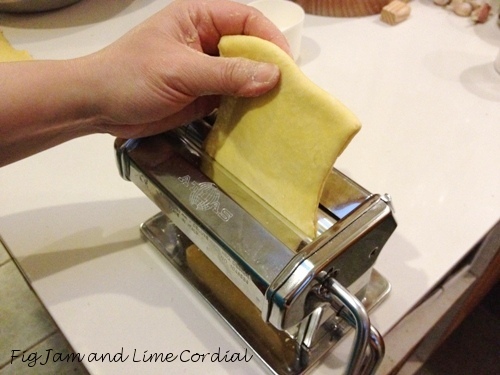
Once the dough is flexible and smooth, start reducing the roller setting and feed the pasta through until it reaches the thickness you’re after.  Keep dusting with flour as you go.  We put ours through until it reached the number “6” notch on our machine.

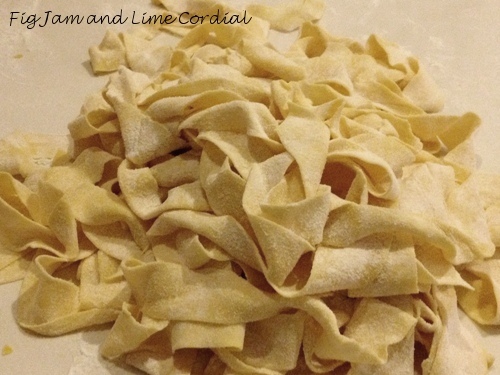
We found this easier to do with two sets of hands – Pete cranked the handle and I manoeuvred the dough as it grew longer and longer with each pass. The finished sheet was dusted with flour, rolled up loosely, and cut into thick tagliatelle.

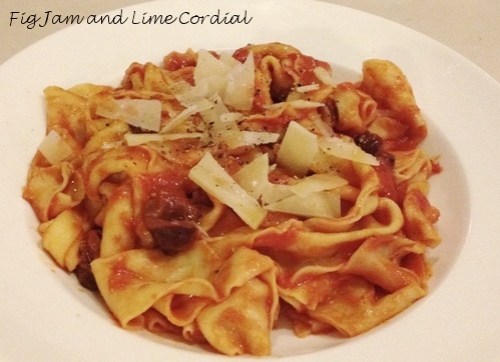
We cooked the pasta immediately – no drying or resting time required – and as it was so fresh, it only needed a minute in salted boiling water (Manfredi suggests just thirty seconds!). We served it with a simple black olive and tomato sauce, and it was sublime

The whole process was ludicrously easy and surprisingly tidy.  Plain (AP) flour was much easier to work with than the stronger semolina or continental flours.  However, we didn’t manage to put dinner on the table within the prescribed thirty minutes – I think it was closer to forty and it took the combined efforts of both of us.

Just as well we’re not Italian!

Read Full Post »

I adore taramosalata.

I’ve always made a version with potatoes instead of breadcrumbs, but my original recipe makes an enormous quantity – far more than should be eaten at the one time.  And that’s  the problem with taramosalata – it’s hard to stop eating it until it’s all gone.

Over the years I’ve fiddled with the recipe, reducing the added oil as much as I can without compromising the flavour too much.  I’ve also increased the lemon juice, as I find the acidity helps cut through the richness of the fish roe.

These days I make a small batch of taramosalata, just for me.  It’s the right amount to satisfy a craving!

  • 1 large white-fleshed potato
  • 50g tarama paste (roe)
  • 2 tablespoons (8 teaspoons) extra virgin olive oil
  • 2 teaspoons lemon juice
  • 1 teaspoon white vinegar
  • ½ small white onion, chopped
  • Boiling water

1. Peel the potato, cut it into chunks and microwave until tender (this should only take a few minutes).

2.  In the small bowl of the food processor, blitz together the onion, tarama paste, lemon juice, white vinegar and olive oil.  Pulse until relatively smooth.

3. Add the potato chunks, a few at a time, adding a little boiling water as you go, pulsing to combine. Add the rest of the potatoes and as much boiling water as needed to ensure the finished dip is smooth and quite runny – it will firm up a little in the fridge.  The amount of water needed will depend on the type of potato you use – some absorb more liquid than others.

Note: the original recipe used twice as much olive oil as water, which definitely made for a more luscious dip!  These quantities make approximately a cup and a half of taramosalata.

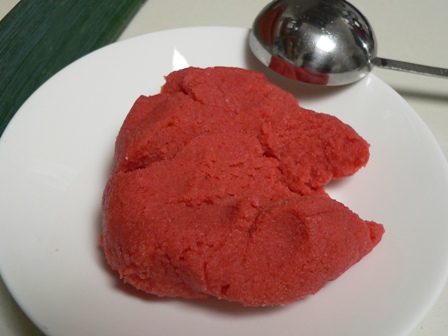
PS. For all the folks who have asked below, here’s what the tarama roe looks like. Over here, it’s usually available at Greek or Continental delis…

Read Full Post »

This year’s plum brandy is mighty fine.

It’s really more of a liqueur than a brandy, and we make it whenever we can get our hands on some President plums

The process is simple – the halved and pitted plums are added to vodka, brandy and sugar, then left to brew in a dark cupboard for two months.

We’re supposed to let the moonshine mature for an extra month after it’s been filtered, but it was so good this year that we’ve been dipping into it early.  It’s a sweet, smooth, quite alcoholic brew that is just a little too easy to drink.  I like it neat or on ice, but our friend Dredgey prefers his with soda.

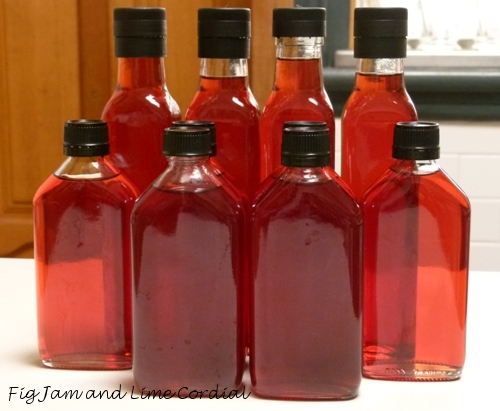
Pete swears by it as a sore throat cure. A couple of years ago when the whole street was down with the flu, we were distributing it in little bottles, strictly for medicinal purposes, of course.

We ended up with three litres this year, but given that a third of that has already been drunk or given away, we might need to ramp up production next time!

The original recipe comes from the Drink Mixer website – here is our slightly adapted metric version, which can be scaled up accordingly:

  • 1 kilogram President plums, halved, pits removed
  • 440g (2 cups) white sugar
  • 500ml (2 cups) vodka
  • 125ml (½ cup) brandy

1. In a large glass container, combine all the ingredients.  Give them a good stir with a chopstick. Seal and store in a dark place for two months. Stir occasionally if you remember, and admire the colour as it develops. The sugar will dissolve completely into the liquid over time.

2. After two months, strain out the plums and decant the liquid into clean bottles.  Seal them up and let them mature for another month if you can (we only lasted two weeks).  Then share with people you love!

Note: the President plums are quite tart – you might want to reduce the quantity of sugar if you’re using sweeter plums.

Have a great weekend, folks!

Read Full Post »

This lovely recipe by the divine Ms Dupleix appeared in our local newspaper recently.

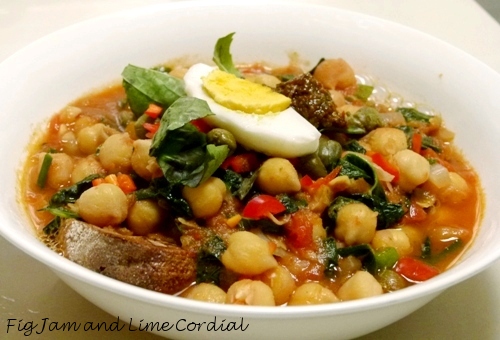
And although I couldn’t eat it for breakfast, it made a wonderful lunch for Maude and I last week.  I used cavolo nero (kale) from Maude’s garden, as well as basil, leeks, kale and nasturtium leaves from our backyard.  The cooked chick peas and pork stock came out of the freezer, and the spelt and walnut sourdough added a delicious nuttiness to the dish.  Topped with salty capers and homemade harissa,  it was delicious and very, very filling!

The soup could easily be made totally vegetarian by substituting the meat stock with a vegetable one. It’s a versatile dish, easily adaptable to whatever greens we can forage from our gardens, and quick to assemble, particularly if tinned chick peas or packaged stock are used. The recipe is here, and it’s definitely worth trying!

Read Full Post »

Oh blessed pound cake recipe, is there no end to your possibilities?

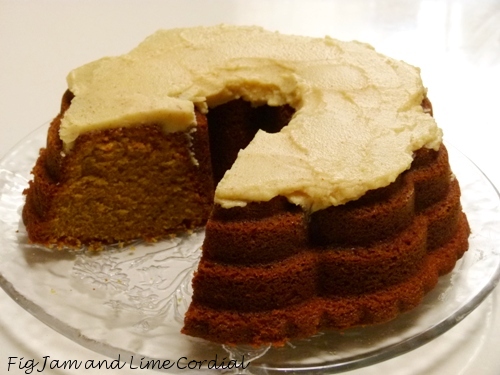
Here’s my latest attempt, a caramel cake with browned butter frosting. I baked it in a Wilton bundt pan, but given that the frosting was quite stiff and the batter reasonably sticky, it probably would have worked better in a 20cm (8″) springform pan.

Cake batter:

  • 250g (8oz) unsalted butter
  • 250g (8oz) dark brown sugar
  • 175g (5½oz) self raising flour
  • 75g (2½oz) blanched almond meal
  • 1 teaspoon vanilla extract (I used homemade)
  • 4 large (59g) free range eggs

Icing:

  • 100g (3½oz) unsalted butter
  • 150g (5¼oz) icing sugar mixture (confectioner’s sugar)
  • ½ teaspoon vanilla extract

Please have a look at our original food processor pound cake post here.

1. Have all the ingredients at room temperature before starting.  Preheat the oven to 160C (320F) with fan. Spray a 10-cup bundt pan was oil, or grease and line a 20cm (8″) round springform tin.

2. Using a coarse sieve, sift together the almond meal and flour.

3. In the large bowl of the food processor, pulse together the butter and sugar until well combined and light in colour.  Scrape down the bowl.

4. Add the vanilla extract, followed by the eggs one at a time. Continue pulsing to combine. Add a spoonful of the flour mixture each time (if required) to stop the batter from curdling.  Then add the remaining flour and almond meal, pulsing until just combined (do not overmix).

5. Scrape the batter into the prepared tin. If using the bundt pan, bake for about 50 minutes; the springform tin will probably take about an hour (start checking at the 50 minute mark). The cake is cooked when it has shrunken in from the sides slightly, and a cake tester inserted into the thickest part of the cake comes out cleanly. Allow to rest in the tin for 10 minutes before turning onto a wire rack to cool completely.

6. Icing: In a medium sized saucepan, melt the butter over a medium heat until it browns – be careful not to burn it.  Allow to cool.  Sift the icing sugar mixture, then gradually whisk it into the butter to form a thick frosting. Whisk in the vanilla extract.  Add more icing sugar if needed.  Spread the frosting over the cake and allow to set before serving.

I wanted to take a pretty picture of the whole cake for you, but this is what it looked like when I got up the next morning…

And here’s a close-up of the frosting – I love the specks of browned butter in it!

Read Full Post »

« Newer Posts - Older Posts »