Feeds:
Posts
Comments

Archive for the ‘Recipes’ Category

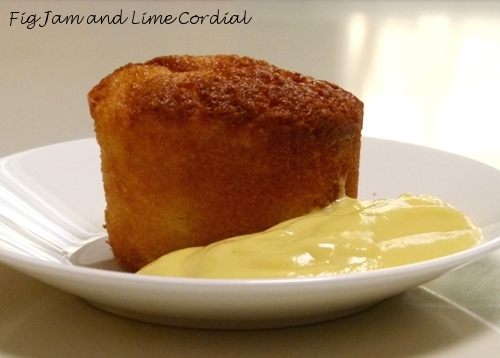
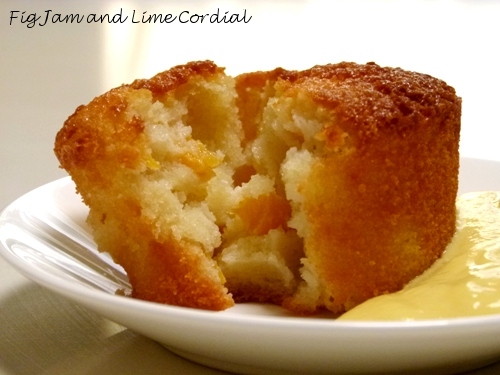
We always make friands and custard at the same time – the friand recipe uses four egg whites and the custard uses up the yolks.

Last week Pete asked me to make friands with a leftover tin of peaches that we’d uncovered in the pantry. The result was a delightfully gentle and subtle cake – quite different from the berry and chocolate version we usually make.

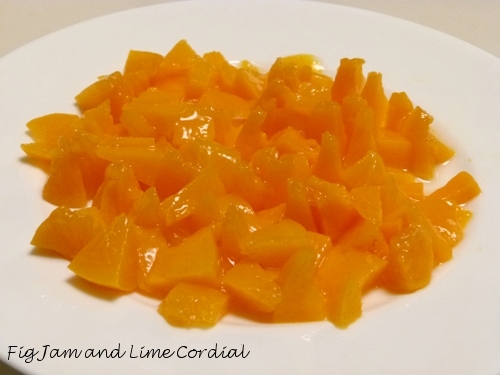
The peaches should be cut into small pieces – probably smaller than the ones below..
  • 100g unsalted butter, melted and cooled
  • 4 large egg whites
  • 45g plain flour
  • 140g icing sugar mixture (or plain icing sugar)
  • 85g almond meal
  • 150g diced tinned peaches, drained in a sieve to remove excess syrup

1. Preheat the oven to 190C or 175C with fan.  Sit six sturdy cupcake liners on a tray and spray the insides of them lightly with oil.  Alternatively, use a friand pan or muffin pan.

2. In a separate bowl and using a coarse sieve, sift together the flour, icing sugar and almond meal.  I’ve found that sifting all three results in a lighter texture, but if you’re feeling lazy, just sift the icing sugar and stir it together with the flour and almond meal.

3. In a separate mixing bowl and using a hand whisk, beat the egg whites for about a minute until they’re frothy, but not stiff.
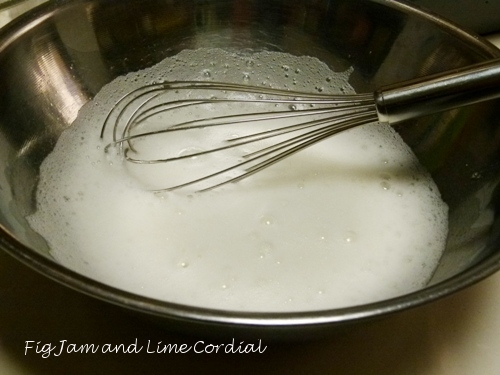
4. Quickly but gently fold in the dry ingredients, then add the cooled melted butter. Stir until just combined. Add the diced peaches to the mixture and stir gently to incorporate.

5. Spoon the mixture evenly into the six paper liners. Bake for 25 – 30 minutes, rotating the tray once during the baking time.  The finished friands will be well risen and  golden brown in colour. Allow to cool on a wire rack before serving with a dollop of microwave custard (recipe below).

. . . . .

I know I post my microwave custard recipe all the time, but then again, I make it all the time.  Here it is again, to save anyone having to search for it…

  • 2 cups (500ml) full-cream milk (I used UHT)
  • 1 tsp homemade vanilla extract
  • 4 egg yolks (from 59g eggs)
  • 1 Tbsp (4 tsps) cornflour (cornstarch)
  • ⅓ cup (70g) caster (superfine) sugar (or substitute vanilla sugar for the sugar and extract)

1. In a large pyrex mixing bowl, whisk together the milk, extract, cornflour and caster sugar until smooth. Microwave on high for 2 minutes until hot (my microwave is 1100 watts).

2. In a separate bowl, whisk the egg yolks until smooth. Pour the egg yolks through a sieve into the bowl of heated milk, whisking constantly as it ribbons into the hot mixture to ensure it doesn’t curdle.

3. Heat the eggy milk in the microwave on high for 1 minute, then whisk.  Heat for another 30 seconds, then whisk again.  Continue heating in 30 seconds bursts, whisking well after each, until the custard has thickened to your liking. Use immediately, or refrigerate until needed, with a piece of clingfilm pressed to the surface to stop it skinning.

Click here for a printable version of this recipe
Read Full Post »

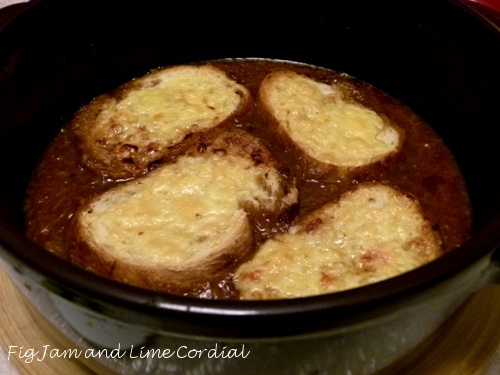
Our French onion soup needs three things – a really flavoursome homemade beef stock, a food processor and lots of patience.

  • 1 kilogram brown onions, peeled
  • 1 litre homemade beef stock (we used our beef brisket stock)
  • salted butter
  • vegetable oil or olive oil
  • thick slices of sourdough bread
  • grated cheddar cheese (we used King Island Surprise Bay Cheddar)
  • 1 clove garlic
  • salt and pepper to taste

1. Cut the onions in half and put them through the slicer attachment of the food processor.  If you don’t have access to this, you could always slice the onions using a knife or mandoline.

2. In a heavy based ovenproof pot (I used my Emile Henry round pot), heat a generous knob of butter with a slosh of oil and add the onion.  Stir over a medium heat until glossy, then reduce the heat to low and cover.  Cook for about 45 minutes, stirring occasionally. Once the onion has completely wilted, remove the lid, increase the heat slightly and cook until the onions are a dark brown and just starting to catch at the bottom of the pan. Stir frequently during this stage. All up it took over an hour to cook the onions to a colour that Pete was happy with.

3. Add the beef stock, and bring the soup to a boil. Season with salt and pepper to taste.

4. Cut the garlic in half and rub it over the sourdough slices, then pile grated cheese onto each slice. Preheat the top element of the oven. Carefully float the bread slices on top of the soup, then put the pot in the oven and grill (broil) until the cheese is melted and golden.

This is a simple dish, made sublime by the sweetness of the slow cooked onions and the depth of the homemade stock.  We’ve tried it before with purchased stock but found the results to be quite disappointing. It’s definitely a good incentive for making your own stock!

Read Full Post »

Run, run, run as fast as you can
You can’t catch me, I’m the Gingerbread Man…

Everyone has their own recipe for Gingerbread Men – ours uses Date Molasses and Muscovado sugar.  The dough is quite sticky and hard to work, so be sure to chill it well before rolling out.

  • 500g plain (AP) flour
  • ½ teaspoon bicarbonate of soda (baking soda), sifted
  • ¼ teaspoon fine sea salt
  • 1 teaspoon mixed spice (we use one from Herbie’s Spices)
  • 2 teaspoons ground ginger
  • 250g unsalted butter
  • 160g Muscovado dark brown sugar
  • 1 large (59g) free range egg
  • 160g date molasses
  • 100g icing sugar mixture, sifted
  • 2 – 3 teaspoons water

1. In a medium bowl, sift together the flour and bicarbonate of soda.  Stir in the sea salt, mixed spice and ginger.

2. In a large bowl with an electric mixer, cream the butter and sugar together, then beat in the egg and date molasses.

3. Beat in the flour mixture until just combined. Refrigerate the dough until well chilled and firm – at least a couple of hours and preferably overnight.

4. Preheat the oven to 160C with fan. Lightly spray two large sheets of parchment paper with oil.  Additionally, line two baking trays with ungreased parchment paper.

5. Using a third of the dough at a time, roll it out between two sheets of greased parchment until approximately 5mm thick. Remove the top sheet and, using well floured (or oiled) cutters, cut out the Gingerbread Men.  Transfer carefully to the lined trays. The leftover dough can be gathered up, re-chilled and used to make more cookies.

6. Bake the cookies for 10 – 13 minutes, or until just firm – do not overbake.  Allow to rest on the trays briefly before transferring to a wire rack to cool completely.

7. To prepare the icing – sift the icing sugar mixture into a large bowl, then gradually whisk in the water to firm a thick, spreadable mix.  Transfer to a small piping bag and decorate the cooled cookies as desired.

This recipe made two dozen large Gingerbread Men, and kept all the big and little kids on the street very happy!

Click here for a printable version of this recipe
Read Full Post »

Inspired by Hugh Fearnley-Whittingstall’s spiced nut recipe, I’ve come up with a simple method for making fat free potato wedges…

Whisk an egg white until frothy, then whisk in salt and any other desired flavourings.  Peel the potatoes and cut them into wedges, then toss them in the egg white.  Sprinkle in a generous quantity of polenta or cornmeal and toss the potatoes to coat them.

Tip the wedges onto a parchment lined baking tray and bake in a preheated 200C with fan oven until golden and crispy. Season with extra salt before or after baking if desired.

The wedges end up crunchy on the outside and fluffy in the middle. My boys really liked these, although they’re not quite as moreish as the ones baked in oil. Having said that, it’s always good to have a healthier option!

Read Full Post »

♥ A recipe for my friend C at Cake, Crumbs and Cooking

When I was growing up, my mother didn’t bake cakes.

She was a fabulous cook but, being Chinese, she hadn’t grown up with baked goods as a household staple. So the cakes we ate were usually bought from the supermarket. My sister and I loved the little jam rolls, but mum’s favourite was the Madeira cake which she bought from either Woolworths or Coles. It was always rectangular, with a dense, squishy crumb.

I felt quite nostalgic when I spotted the Madeira cake recipe in Pam Corbin’s Cakes.  Unfortunately, my first attempt at the recipe was quite disappointing – heavy and brick like, although rescued somewhat by the addition of a jam filling and lots of icing.

I rejigged the recipe – increased the total batter size, reduced the quantity of lemon zest, increased the proportion of baking powder, and switched the granulated sugar to caster sugar. I was pretty happy with the amended version!

This isn’t a soft, fluffy cake. It has a distinctly old-fashioned feel to it – it’s not overly sweet and its firm, close crumb definitely needs icing or jam (or both) to finish it off. I think it would make an ideal base for petit fours or jam sandwiches, or served simply for afternoon tea with a glass of Madeira, as was originally intended…

Madeira Cake
(adapted from a recipe in Pam Corbin’s Cakes)

  • 250g plain (AP) flour
  • 1½ teaspoons baking powder
  • 185g unsalted butter, softened
  • 185g caster sugar (superfine sugar)
  • finely grated zest and juice of one lemon (about 40ml juice)
  • 5 large free range eggs
  • 200g icing sugar mixture (confectioner’s sugar)
  • additional lemon juice (for icing)

1. Preheat the oven to 175C (350F) with fan. In a medium sized bowl, whisk together the flour and sifted baking powder.

2. In a large bowl and using an electric mixer, beat together the butter, lemon zest and caster sugar, stopping frequently to scrape down the bowl.  Beat until the mixture is light and fluffy.

3. Add the eggs one at a time and beat until combined after each addition. Add a little of the flour if the mixture starts to curdle.  Using a folding action and a wooden spoon or spatula, gently stir in the remaining flour, followed by the lemon juice.  Scrape the thick batter evenly into a greased and lined loaf tin measuring 22cm x 11cm (8½” x 4½”). I used the Tala tin liners I found last month.

4. Bake for approximately 50 minutes (start checking after 40 minutes) or until the top is well risen and brown, and a cake tester inserted into the thickest part of the cake comes out cleanly.  Allow to rest for ten minutes in the tin, then remove and cool completely on a wire rack.

5. Icing: Sift the icing sugar mixture (you really do have to sift this time, or you’ll end up with lumpy icing) into a large bowl and gradually whisk in the additional lemon juice until it forms a thick paste.  Spread over the cooled cake and allow to set before serving.

Click here for a printable version of this recipe

. . . . .

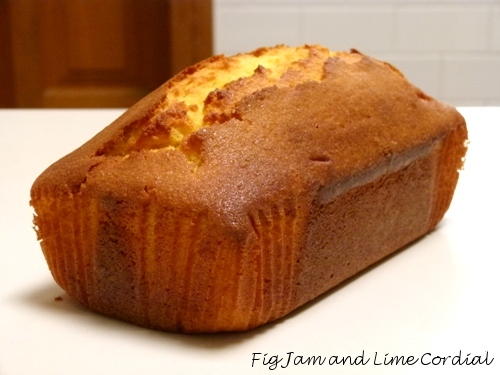
This sturdy cake would be an ideal lunch box treat or after school snack…

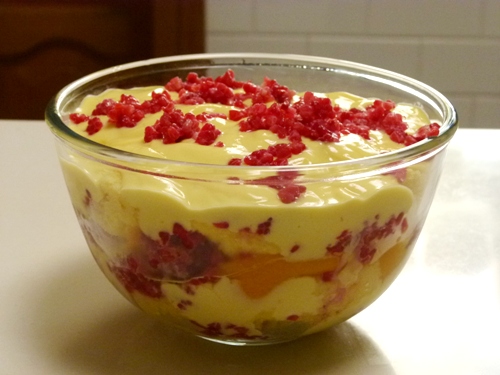
It was also a wonderful base for our raspberry and peach trifle!

Read Full Post »

« Newer Posts - Older Posts »