One of the great joys in my crafting life is finding a way to rescue something that everyone else has given up on.
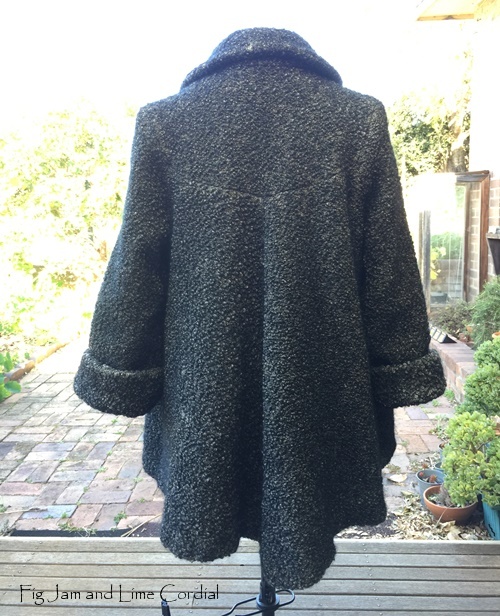
I refer to them as my Phoenix Projects – firstly because they’re items which are being transformed into something new, and secondly because I’m rescuing things which most people would be happier to burn. I thought it might be fun to share some of these with you over the coming months, in the hope that they might inspire you to look at your discards in a different light. You’ve seen some of them already – like the vermin-eaten 1950s opera coat that nearly made me throw up while I was restoring it last year…
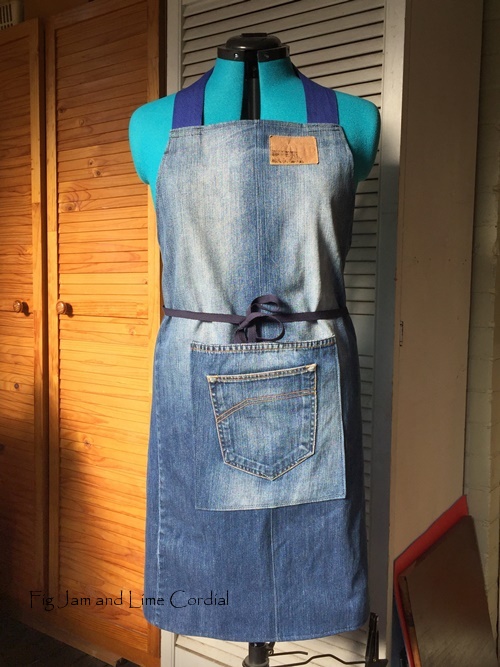
…and the roadkill denim apron I made from jeans that I found under a car outside our house…
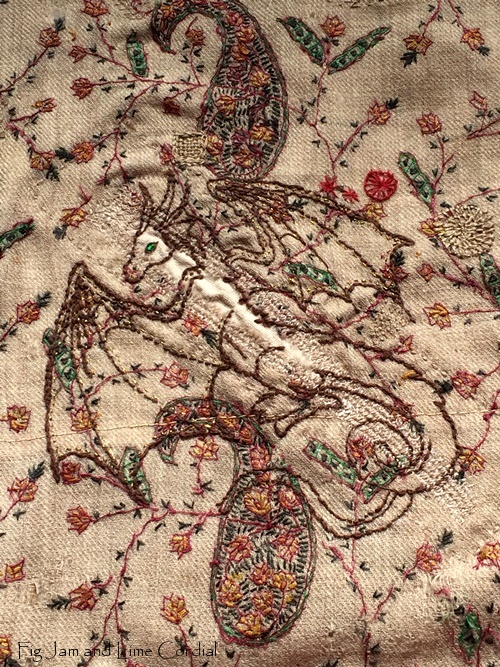
And of course, there’s my Penny shawl…
. . . . .
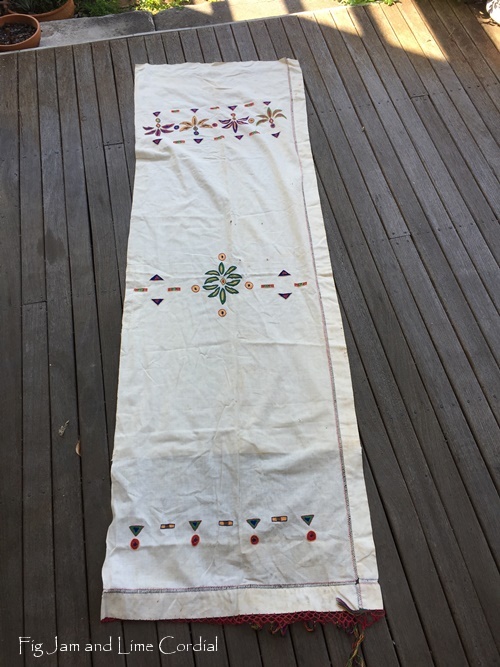
My latest project has involved this intriguing vintage textile I found at the Sewing Basket in Balmain. It was badly stained and torn, and its length made it hard to photograph. Pauline let me have it for $5 and I brought it home to try to clean it up. If anyone has a suggestion as to what it might have originally been used for, I’d love to hear it – for the life of us, we can’t figure it out. One friend suggested it might have been an altar cloth, but the fringing on just one short end rules that out, as does the lack of any religious symbols.
There is (now broken) pulled thread work down just one long edge and what appears to be shadow embroidery handstitched using rayon thread. We’ve debated whether it’s European or South American or Pacific Islander in origin. In a previous life, it had been used as a curtain, because there were rings sewn into it for hanging (sadly, these destroyed the fabric where they were attached), and although it was in a pretty grotty state, Napisan shifted some of the stains. If you ever need tips on restoring old fabrics, pop in to the Sewing Basket Balmain on a Saturday and chat to the wonderful Mark…
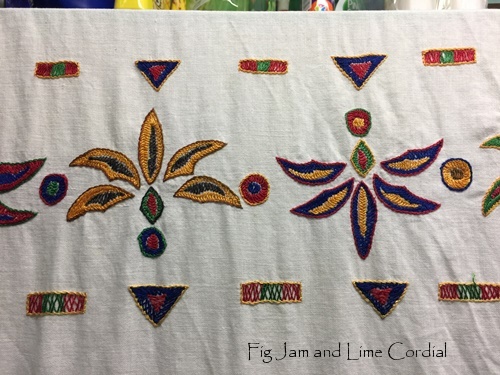

Then…(bear with me, this story gets better)…the following week, lovely Pauline texted me and said “Come back Celia, we’ve found its twin”.
So I went back to the store and there was another one of whatever these are, only in a much worse condition. A much stinkier, more torn, more stained condition. I offered Pauline another $5 but she refused to take it – from the way she was handing it to me at arm’s length, I think she was just happy for it to be out of her shop. I was pretty excited!
I think what I love most about a Phoenix Project is that it comes with absolutely no expectations, so the only possible outcome is a good one. Even if only a small scrap of it can be saved, that’s already better than the whole thing going to landfill. And this old piece, whatever it once was, had been dearly loved, because someone had gone to a great deal of effort to mend it by hand. I followed Mark’s advice and gave it a careful Napisan soaking, which disintegrated some of the fabric (a product of the dirt and water more than the Napisan, I suspect) but removed some of the stains.
Then I cut the fabric into 12 inch panels around the embroidery, using the secondhand quilter’s square I’d also picked up from Balmain. I tried to save as much of the previous mending as I could…

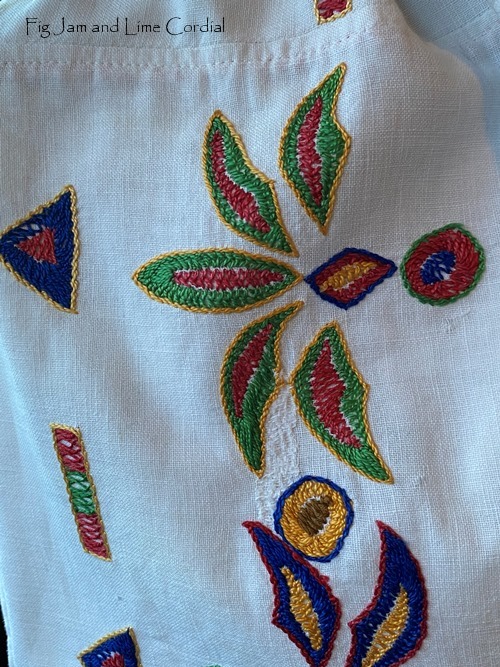
I love, love, love the carefully hand-mended patches…
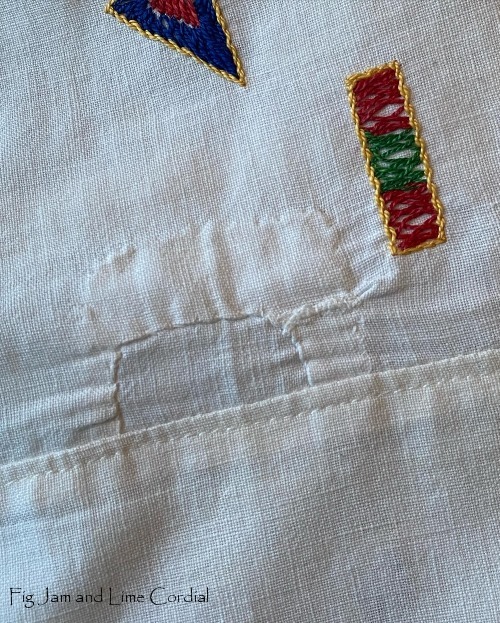
I ended up with four embroidered panels and enough “clean” white fabric to make a double-sided scarf. I crossed my fingers and removed the rayon fringing, cut it in half and finished the edges, then reattached it to the ends of the scarf. It was still quite badly marked, so the finished piece then had another overnight soak in Napisan – the second round removed almost all the remaining yellow stains.
Voila! I now have a new scarf for winter! One that is completely unique and carries a backstory, even if I don’t know what it is, and a treasured vintage textile has been given a second lease of life. Phoenix Projects really are the best things ever – they cost almost nothing, they challenge me creatively, they respect the history of the textile, they give new life to existing materials, and they keep precious resources out of landfill. They’re a sustainability win! ♥








 Fig Jam and Lime Cordial