Feeds:
Posts
Comments

Tortillas!  That was the next thing Pete wanted to make with the Sorj.

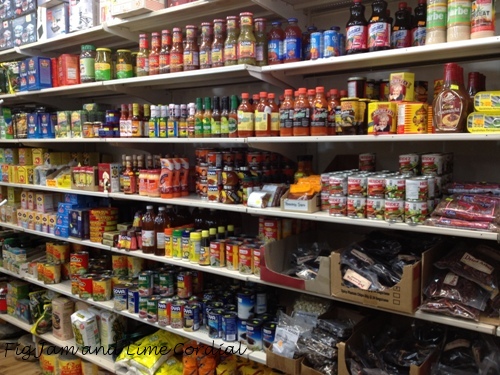
So we took a trip to Fiji Market in the inner-Sydney suburb of Newtown.  I hadn’t been there for years, and it was interesting to see how things had changed.  In addition to their mostly Asian and Islander ranges, they now also stock a wide variety of Mexican ingredients…

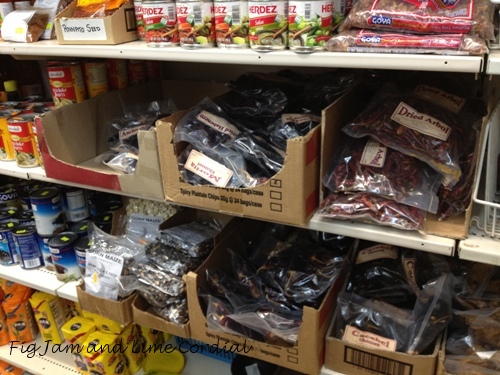
…including an assortment of dried chillies, all very reasonably priced…

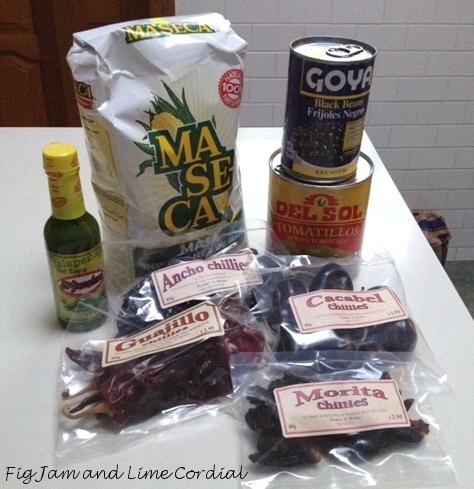
We came home with masa harina flour (cornmeal), tomatillos, black beans, jalapeño hot sauce and four packets of chillies…

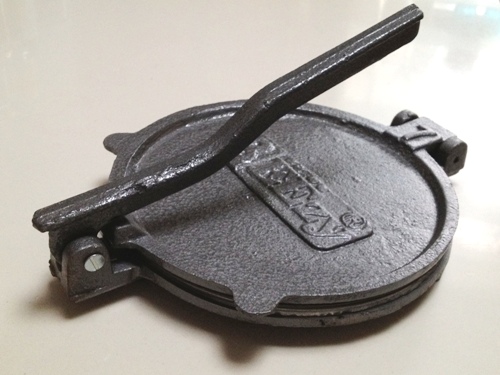
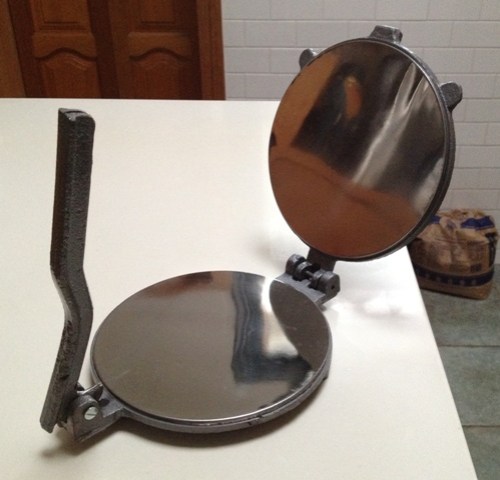
We also returned with a tortilla/chapatti press from Chefs’ Warehouse. It works brilliantly…

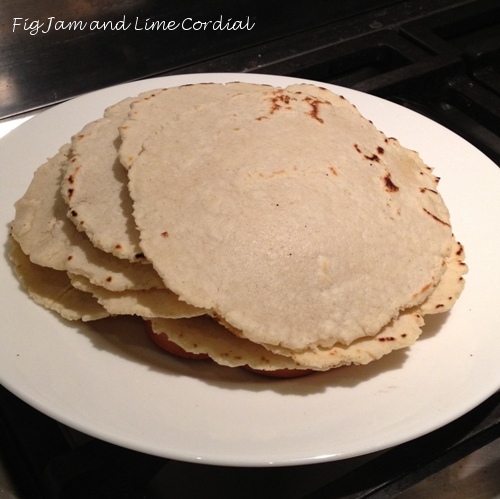
Corn tortillas were a doddle to make using the press and chapatti pan. (Note to SK’s husband: Andy, she needs these!)

Following the recipe on the packet, I kneaded together 2 cups of masa flour, a pinch of salt and 1¼ cups of water.  The dough was then divided into 16 balls and flattened between two sheets of plastic inside the tortilla press. These needed less than a minute on each side in the hot pan to cook to perfection.

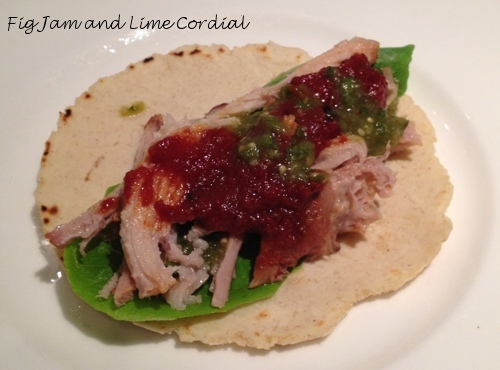
We filled them with a little cos lettuce from the garden, slow roasted belly pork, a reduction of the tomato passata and red wine that the meat had been cooked in, and a green salsa made from tomatillos, jalapeños and fresh coriander (salsa recipe is here).

It was incredibly tasty, made completely from scratch, and not a skerrick of cheese or sour cream in sight!

. . . . .

Fiji Market
591 King Street 
Newtown NSW 2042
(02)  9517 2054

Remember our experiments last year with the indoor tomatoes?

You might recall that they were a great success in the end, and we ended up harvesting several dozen delicious toms from the plants growing in our north-facing enclosed verandah (which subsequently became known as the conservatory).

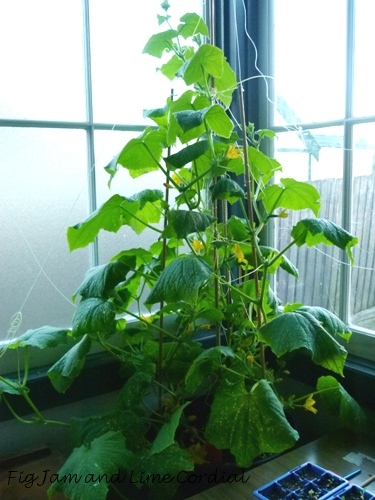
This season, Pete thought we’d try with Lebanese cucumbers. I wasn’t convinced they’d grow indoors, and if they did, that they wouldn’t take over the entire room!  Undeterred, my husband planted three seedlings into a large self-watering pot in the corner.  We had been fastidiously hand-pollinating the flowers and…

…all of a sudden…

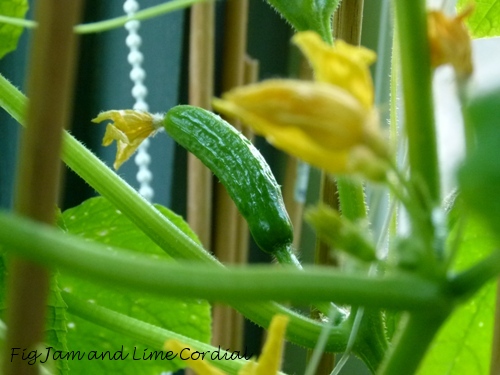
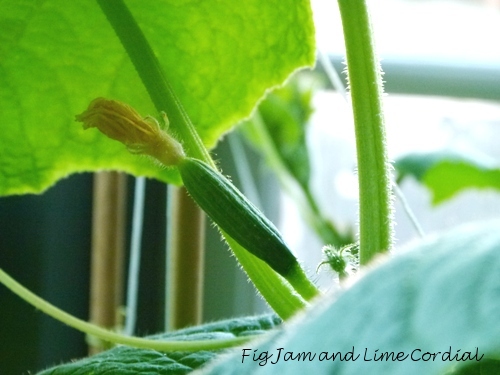
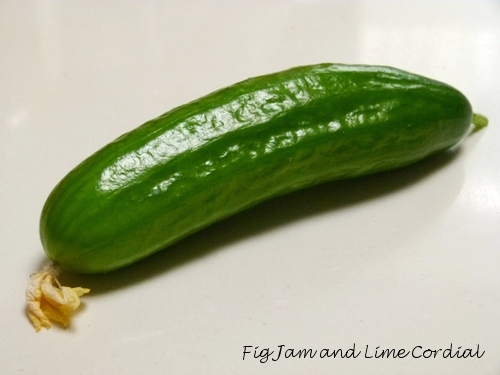
…we had cucumbers!  I took this photo a week ago – at the time, this was our largest one. It was just 6cm (2½”) long and as thick as my finger…

There were also several tiny babies starting to develop…

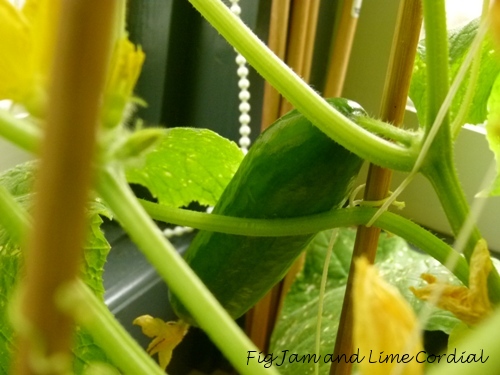
Fast forward a week, and the first one had grown to a very respectable size…

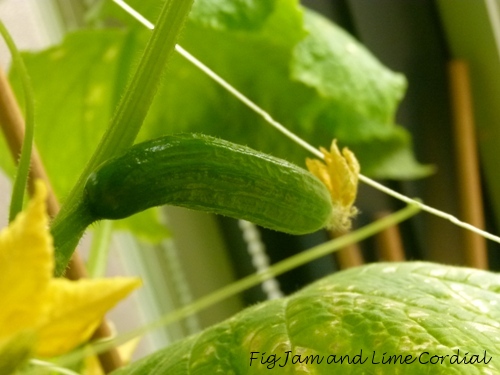
The babies we had managed to pollinate were growing as well…

These plants are extremely thirsty – they’re consuming about a litre of water a day!

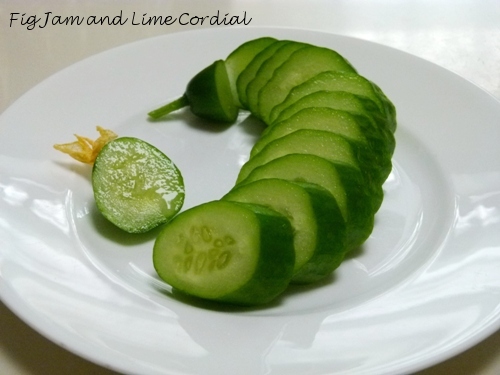
We picked the largest cucumber this afternoon to see how it tasted.  We were probably a little too early, as the fruit was still a touch under-ripe, but it was very nice nonetheless – extremely crunchy with a mild, fresh flavour, and not the least bit bitter (which had been my main concern).

Best of all, we were eating just picked, homegrown cucumbers at the beginning of winter.  How cool is that!

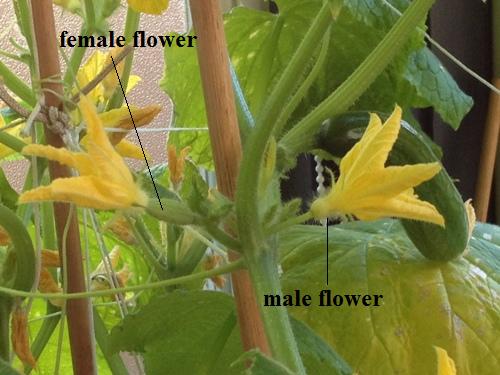
PS. In case anyone is thinking of trying this out, Pete thought we should let you know how we pollinate the plants.  We remove the male flowers, strip off the petals, and then push the little brush of stamens that remains into the female flower and give it a twist.  There isn’t a huge amount of pollen produced by the male flowers, so we usually try and repeat the process a couple of times with each female flower.  In the absence of bees and other insect pollinators, this is an essential process – the flowers we missed haven’t developed any fruit at all.

What I really wanted … was a sorj.

Pete said no.

A sorj is a metal pan used for cooking Lebanese flatbreads.  It’s shaped like a gigantic inverted wok. We found one at Harkola in Auburn for a very reasonable price, but I suspect Ray’s description of how it was to be used put my husband off. It was either that or the sheer size of the thing, which was nearly a metre (3′) in diameter (Wiki has a photo here).

According to Ray, the process begins with an oil drum full of burning wood. The sorj is seasoned by burning it over the fire, dome-side up, until it’s completely blackened – only then is it ready for cooking bread. I was really quite keen, but…

Pete said no.

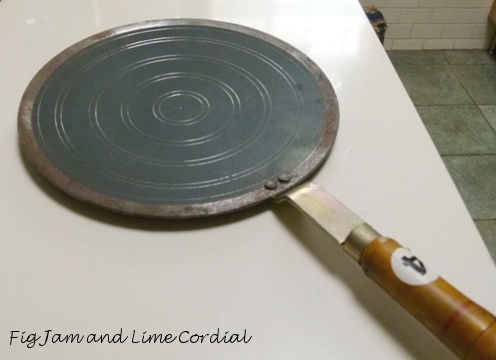
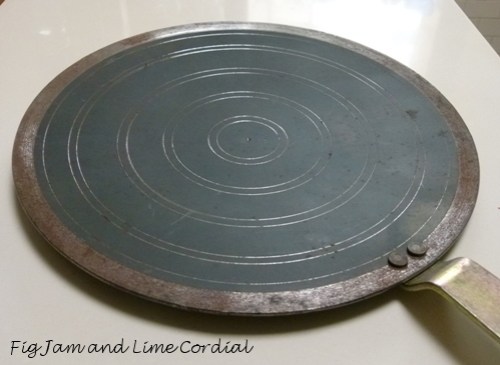
So when I picked up this chapatti pan at Chefs’ Warehouse, my husband didn’t complain at all.  It cost just $22 and is made of heavy cast iron.

Perhaps that’s the secret to successful negotiation: ask for a sorj, settle for a chapatti pan.

Pete even suggested that we call our new pan “The Sorj” and he offered to help me season it.  We washed it in soapy water, then heated it over the middle gas burner until it was a red hot 370C (according to our infrared thermometer).  As it heated and turned black, we used a wadded up paper towel to wipe over the surface several times with oil.  At the end of the process, it looked like this…

Now, has anyone ever used one of these things?  I’m hoping that it will work for all sorts of flatbreads, as well as the traditional Indian style ones.  I’d love any suggestions you might have!

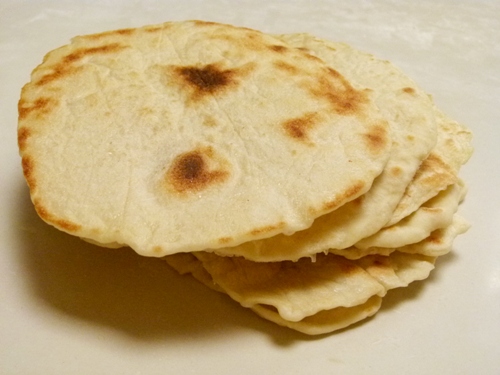
Edit: I’m up early this Sunday morning – here’s our first attempt:

In my kitchen…

…is an elephant tea caddy, a gift from my dear friend Tezza some years back.  It now holds all my herbal tea bags…

In my kitchen…

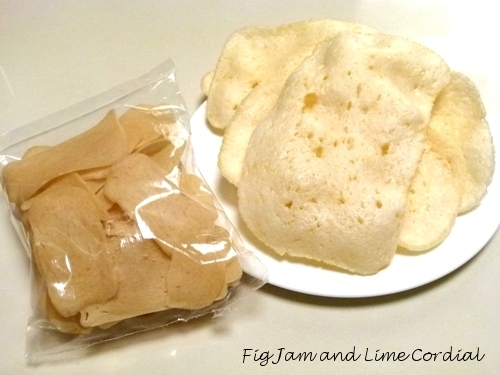
…are authentic Malaysian prawn crackers, brought over by my cousin Doreen on her last visit.  They’re completely different to the little coloured ones that come with crispy skinned chicken in Chinese restaurants.  And believe it or not, the small dried crackers on the left expanded to the huge ones on the right when deep fried…

In my kitchen…

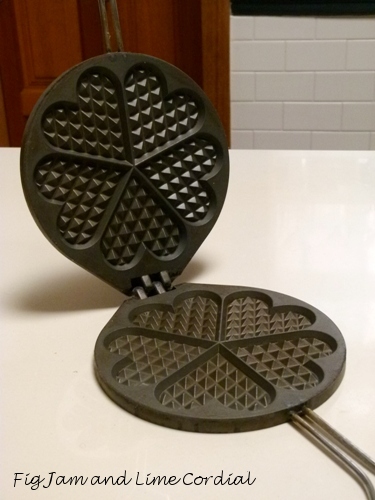
…is our old cast aluminium waffle iron. There is so much history in this piece of kit.  When we were twenty-one, Pete and I were living in a small apartment and we didn’t have any cookware.  What we did have was $100 to buy some stainless steel pots.  I was busy that day, so Pete went to the kitchenware store on his own … and came back with the waffle iron.

He was so excited!  It cost a fortune even back then, but he insisted it would last forever (and it has).  It had languished on the shelf for so long that the woman who owned the shop gave him a stainless steel saucepan for buying it. To this day, whenever we use it, I just smile and shake my head…

In my kitchen…

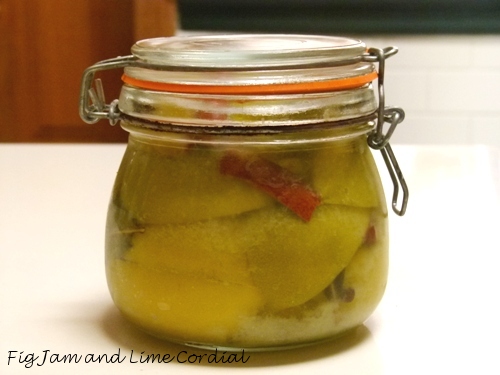
…are preserved limes.   They’ve been in salt for six weeks…

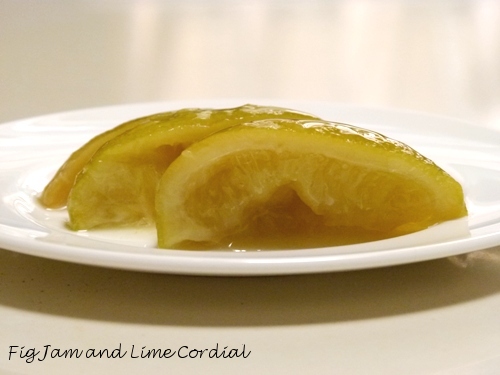
…and are now glossy and translucent.  I’ve figured out that I only need to make a small batch each time – I never get through more than a jar every few months…

In my kitchen…

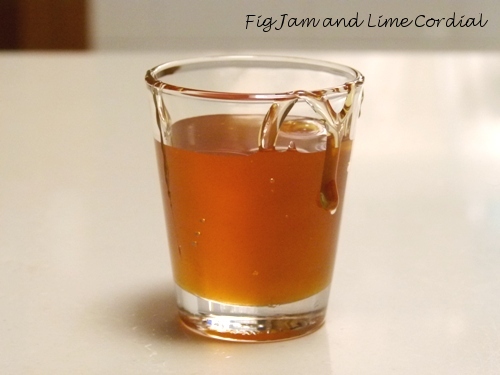
…is Australian Bloodwood honey, bought recently from Richard the Bee Whisperer at Flemington Markets. It’s dark, tangy and not overly sweet…

In my kitchen…

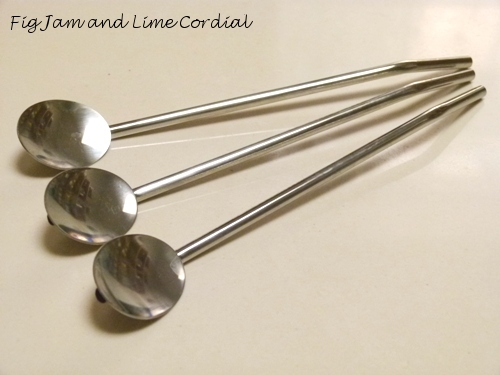
…are straw spoons, a new find from Chefs’ Warehouse.  I love sipping hot chocolate through them, although I have to be careful not to burn myself. Pete thinks sucking hot liquids through a metal tube is an idiotic idea, but I think it’s great fun…

In my kitchen…

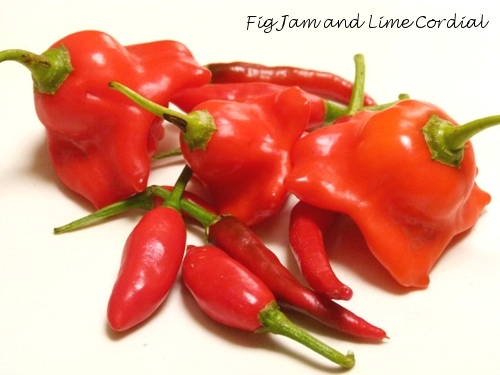
…is today’s harvest of chillies, waiting to be turned into harissa sauce

In my kitchen…

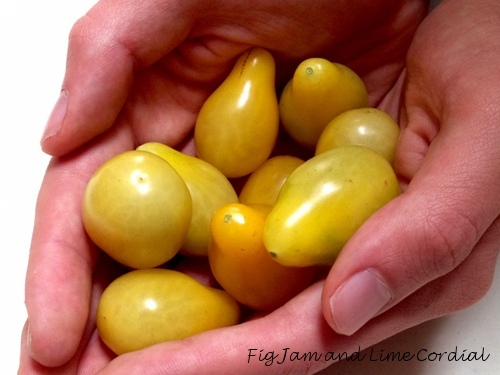
…are self-sown yellow pear tomatoes, grown from seed which originally arrived as a gift from Chris at Slow Living Essentials.  They’re nestled in the beautiful, long fingered hands of our firstborn…

  . . . . .

Tell me, what’s happening in your kitchen this month?

If you’d like to do an In My Kitchen post on your own blog, please feel free  to do so. We’d love to see what’s happening in your kitchen this month!  Please link back to this blog, and let us know when your post is up, and we’ll add it to our monthly listing.

. . . . .

Here are this month’s posts…

Amanda @ Lambs’ Ears and Honey

Christine @ Invisible Spice

Pam @ Grow, Bake, Run

Shelley @ All Litten Up

Misky @ Misk Cooks

Christine @ Food Wine Travel

Sue @ Sous Chef

Sally @ Bewitching Kitchen

Claire @ Claire K Creations

Shirley @ The Making of Paradise

David @ Cookbooks Anonymous

Pamela @ Spoon Feast

Heidi @ Steps on the Journey

Anne @ Life in Mud Spattered Boots

Cecilia @ The Kitchens Garden

Lizzy @ Bizzy Lizzy’s Good Things

Jane @ The Shady Baker

Tandy @ Lavender and Lime

Mandy @ The Complete Cookbook

Barbara @ Winos and Foodies

Glenda @ Passion Fruit Garden

…..


I believe the true secret of successful cooking lies not in ingredients and recipes, but rather in experience and practice.

And having made such a sweeping generalisation, let me backtrack a little to explain how this topic came up in conversation yesterday.

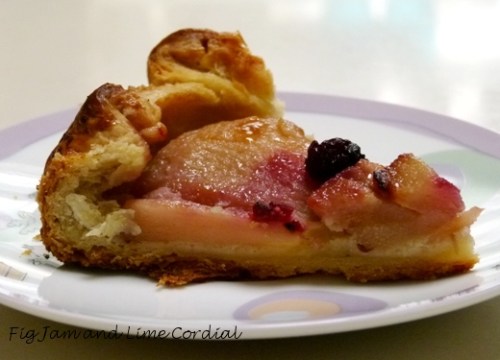
Our dear friend Craig is an extremely talented baker. He popped in for a meal last night, and brought with him a pear and berry galette that he’d “thrown” together that afternoon.  The pastry in the tart was fabulous – flaky, crisp and delicious. I’ve never been able to make anything like it. Craig explained that it was the simplest of recipes, comprising only flour, butter and water.
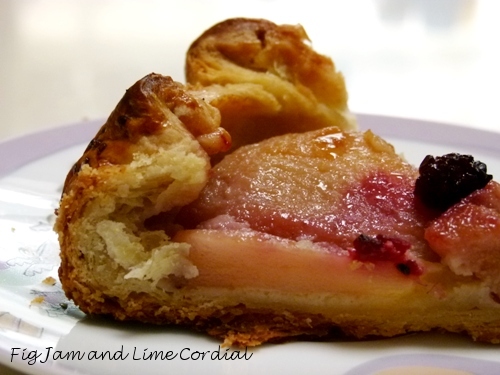
Now, I can take flour, butter and water and end up with a perfectly acceptable shortcrust pastry, but I have no idea how to make pastry that flakes away in sheets.  Craig, on the other hand, has spent countless hours perfecting his craft, and can turn exactly the same ingredients into something completely different.

My elderly Hungarian neighbour is another great example – her vanilla kifli recipe has only a handful of ingredients, but years of experience and literally hundreds of batches have given her the necessary skill to produce cookies that are unparalleled.  I’ve had the benefit of her expertise, which has allowed me to circumvent a decade or so of practice, but even after a couple of years of baking her recipe, I still can’t touch her offerings, which are known up and down our street as “June bikkies”.

The 21st century moves so rapidly that we’ve lost the patience to persevere.  We want to be instantly good at all things, including cooking.  We want recipes that will work perfectly each and every time – when they don’t, we’re inclined to dismiss them as faulty, or poorly written.  Some skills, though, can only be attained through trial and error – everyone will burn caramel the first few times they try to make it, until they’ve learnt to recognise the exact shade the melted sugar turns just before it needs to come off the heat.

Modern society is intolerant of failure.  It’s viewed with derision and contempt, rather than as the necessary learning process that it actually is. We forget that nearly every task becomes easy with sufficient practice, and every failure brings with it new knowledge.  To never fail is to never improve.

We believe that we should celebrate our failures, because each and every one of them offers an opportunity for growth – they’re all stepping stones towards the final goal.

Let me give you a personal example – our very first loaves of sourdough bread were difficult to make and barely edible – we watched the clock to ensure the exact proving time, fussed about the hydration of the dough and measured the ingredients down to the last gram.

Now, after five years of weekly breadmaking, the process has become automatic – I mix together flour, water and starter in the morning, ignore it all day, and come back late in the afternoon to shape and bake it.  I know instinctively when the dough is ready, and can intuitively adjust hydration levels and oven temperatures to suit fluctuations in flour quality and the responsiveness of my starter.

Along the way, I’ve had some spectacular disasters, with the occasional loaf that even the chickens wouldn’t eat (thankfully, the worms would).  And whilst I’ve been disappointed when things have gone pear-shaped, I’ve always been grateful for the lessons learnt as a result of the stuff-ups.  Without them, it’s unlikely my breadmaking would have progressed beyond its initial stages.

So, let me encourage you not to be disheartened when things don’t go exactly as planned in the kitchen.  There is nothing “wrong” with what you’re doing – it really is just part of the learning process.  You’re unlikely to repeat the same mistakes (although you’ll possibly make new ones), and eventually you’ll develop such mastery over your craft that, like Craig and June, you’ll be able to turn out magnificent creations on a whim!