Feeds:
Posts
Comments

Archive for August, 2010

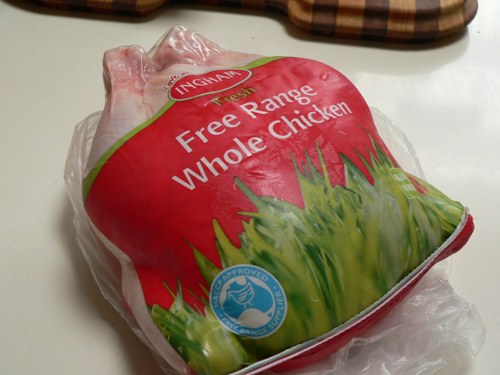
Now that we have our own chickens, it’s suddenly become more important to me that the chickens we buy for meat have had a reasonable quality of life.  They’re such interesting, intelligent birds, and while our girls haven’t quite made a vegetarian out of me yet, I am now looking more closely at the meat we’re buying.

We haven’t bought a non-free range chook for years, but recently I’d read a couple of articles which suggested that the way some free range chickens are kept is cruel, as they aren’t used to being in large flocks and tend to peck at each other mercilessly.  There have also been stories about free range birds being de-beaked and de-spurred in at attempt to stop them killing each other.

To try and understand this all a bit better, I rang FREPA and made some enquiries.  FREPA stands for Free Range Egg and Poultry Australia – a not-for-profit company which accredits free range poultry farmers in Australia.  Do have a look at their standards – they’re an enlightening read.

Here are some of the things I found out:

1. In Australia, FREPA certified meat chickens are not  mutilated in any way – beak trimming, toe trimming and de-beaking are not permitted.  According to the lady I spoke to, this is because it isn’t necessary – our meat birds have been bred to be non-aggressive, although this isn’t the case in all countries.  Roosters and laying hens are more inclined to peck, but this isn’t an issue with the birds raised in Australia specifically for meat.  The standard for meat birds is available here; the comparable one for egg laying chickens is here.

2. FREPA standards do not allow de-beaking of free-range laying hens. De-beaking involves cutting the top beak to be shorter than the bottom one.  However, beak trimming is permitted I’ve been advised that this involves taking less than 1mm off the beak when the chick is a day old, before its pain receptors have developed.  This process is carried out to stop the birds from cannibalising each other.

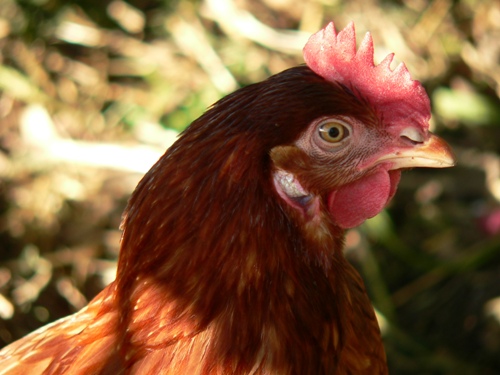
I was most surprised when Meg from FREPA had a look at the photos of our chickens and advised me that our birds had been beak trimmed!  She said the trimming done on our hens was the maximum permitted by FREPA.
3. FREPA have in place a regulation which prevents free range egg producers from artificially lighting enclosures for extended hours to force the birds to lay continuously.  According to the standard, artificial lighting is only allowed where the combination of natural and artificial light doesn’t exceed 15 hours per 24 hour period.

4. Contrary to what most people think, organic does not automatically mean free range.  Organic refers only to the food the birds are fed, free range refers to the way they’re raised.  Of course, the reverse is also true, and free range birds aren’t usually fed organic feed, but they do have the option of foraging for some of their food outdoors.  This is a big issue – with organic birds often retailing for nearly $30 each here in Australia, it makes sense to check that the bird is both organic and free range.  And personally, if I had to make a choice, I would always choose free range over organic – our primary concern being the animal’s welfare.

5. Slowly, slowly, the country is undergoing a revolution – Red Rooster, one of our largest fast food chains, is currently trialling free range birds in Western Australia.  If the move is successful, it will be rolled out across the country.  How cool will it be when our takeaway roast chickens are all free range?

6. Free range birds grow at a slightly slower rate than battery chickens, but in a far less stressful environment.  The difference in flavour may be attributed to this lack of stress.

7. In Australia, we are blessed with space, which means we have plenty of room to allow our free range chickens to roam about.  This is a limiting issue in many countries, particularly in parts of Europe.  We are fortunate to live in a country where lamb and beef are also grazed rather than intensively farmed, although that’s often not the case with pork unless it’s specifically marketed as free range.

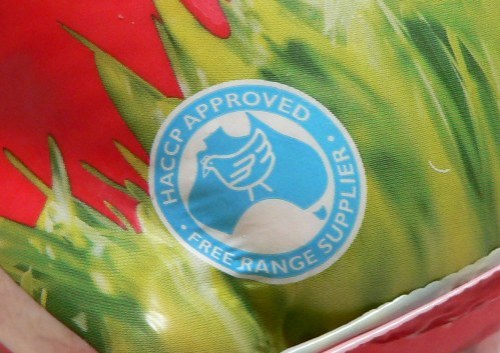
If you’re an Aussie, and you want to choose a chicken (or eggs) from an accredited FREPA farm, look for the FREPA logo.  It’s a line drawing of a chicken on a silhouette of Australia, and is a guarantee that the bird you’re buying has lived a decent free range life!
Read Full Post »

Yet another recipe from my wonderful Ottolenghi cookbook, and this one is an absolute winner.

If, like me, you’re a florentine fan, this is a very easy version which results in a crisp, delectable cookie.  I’ve modified the methodology just the tiniest bit, added a little Kirsch and omitted the orange zest – simply because I didn’t have any on hand.  I also measured everything in cups as I went along for my friends in the US.

  • 2 free-range egg whites
  • 100g (¾ cup)  icing sugar mixture (confectioner’s sugar)
  • 260g (3 cups) flaked almonds
  • splash of Kirsch (optional)
  • 70% dark chocolate, tempered (optional)

1. Preheat the oven to 150C (300F) with fan.  Line a couple of baking trays with parchment paper, then spray the paper with a little vegetable oil (I used canola oil).

2. Whisk the egg whites gently for about 30 seconds (just to break it up a bit, not to get it whipped up or aerated), then sift in the icing sugar mixture and  optional Kirsch and whisk gently to combine.  Now using a spatula, carefully stir in the flaked almonds until well coated.

3. Spoon small mounds of the mixture onto the prepared baking trays – you want to end up with about 20 in total.   Leave room between each mound.  Now, with a wet fork and a wet hand, gently flatten out each mound as thinly as possible without too many gaps between the almond flakes (or they’ll fall apart).

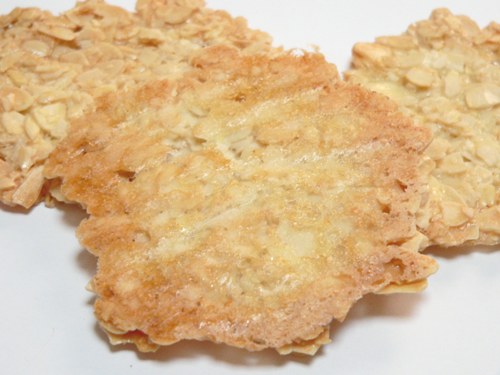
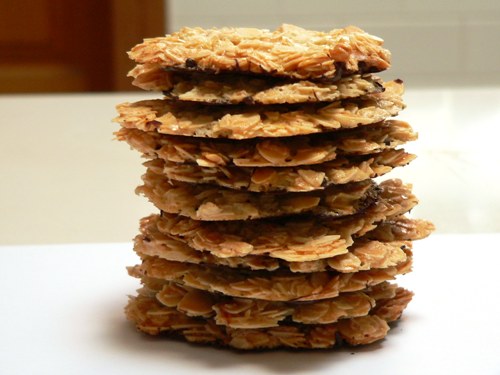
4. Bake until the florentines are golden brown – the original instructions recommend 12 minutes, but my three batches took 15, 18 and 14 minutes respectively.  All I can suggest is that you keep a close eye on them after the 12 minute mark, as the cooking time will depend greatly on how flat you’ve managed to get the mixture before baking.  What you want to achieve is a well cooked bottom, so once the tops appear done, take the trays out and carefully spatula one over to check.  It should look like the photo below, without any soft bits on the base.

5. The florentines will harden as they cool on the trays, after which time they can be removed to finish cooling on a wire rack.  If you find that some of the bases are still a little undercooked when you start removing them from the parchment, turn those particular florentines upside down and put them back on the trays, and bake for a few more minutes in the oven (I like these really crisp!).

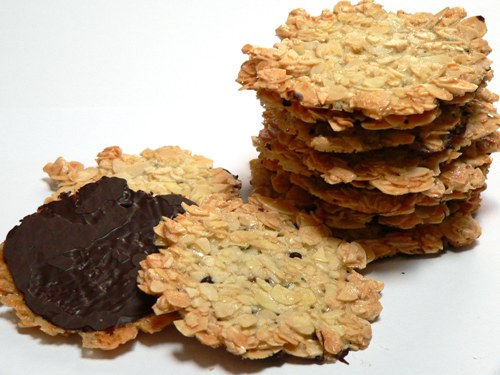
6. The florentines can be left plain, or they can be coated with tempered chocolate.  I spread it over the bottom of each cookie, and then place them chocolate side down onto a sheet of parchment to set.

Click here for a printable version of this recipe

Read Full Post »

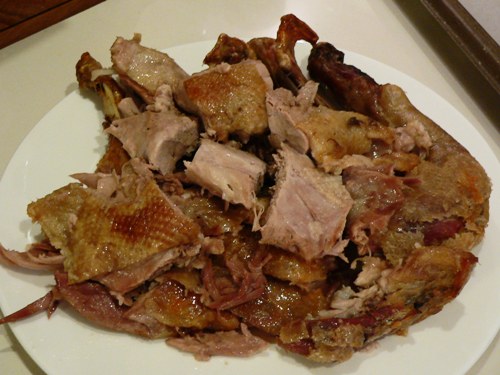
On a whim yesterday, we bought a duck during our visit to the butchers. We’d never cooked a duck before, and thought it might be fun to try. Pete suggested that we roast the bird in our Römertopf clay baker, and it worked brilliantly!

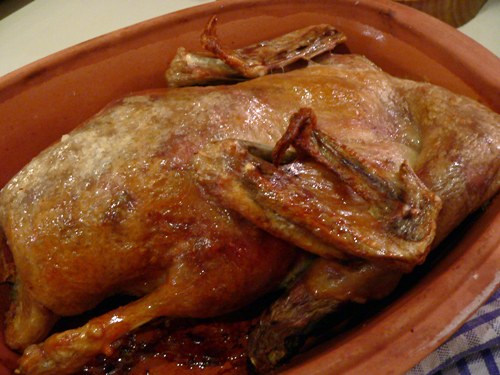
We began by washing the bird under running water and removing any loose fat.  It was dried and rubbed with a little Maldon salt, then laid in the presoaked clay baker and covered with the lid.  The Römertopf baker needs to be submerged in cool water for at least 15 minutes before use, and it needs to go into a cold oven to ensure it doesn’t crack.

Once the pot was in the oven, the temperature was set to 200C with fan, and the duck was left to bake for two hours with the lid on.  We took it out a couple of times during the cooking process and carefully poured the excess fat and liquid into a bowl.  After the initial two hours, the bird was given an additional half an hour with the lid off to brown.

Edit July 14: we now bake the bird for 40 minutes at 200C with fan (lid on), followed by 2 hours at 150C with fan (lid on), then finish at 175C with fan (lid off) to brown and crisp. The fat and stock are poured off at both the 40 minute mark and when the lid is removed near the end. This results in a super tender duck!

Despite the long oven time, the meat was very tender – possibly a product of the clay baker, which effectively steamed the bird as it was roasting.  And because we’d poured the excess liquid off, the end result wasn’t particularly fatty, which was somewhat surprising.

We served the roast duck with our homemade plum sauce, steamed rice and a side of stir-fried green vegetables.

. . . . .

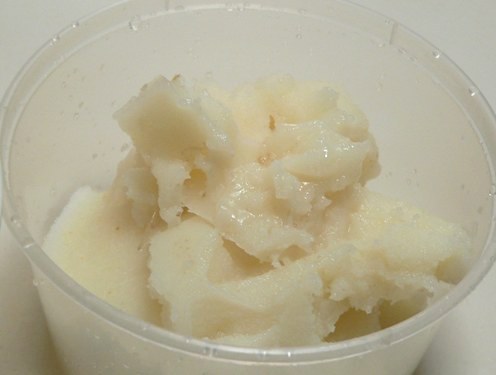
The bowl of liquid we’d drained off as the duck was roasting was left overnight in the fridge, during which time it separated and set.  This morning I was able to stash into my freezer a container of duck fat, which will be perfect for very naughty roast potatoes…

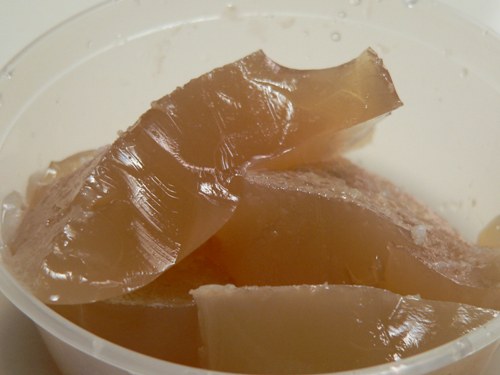
…and a container of the most wonderfully concentrated duck stock.  It set to a solid jelly – an indication of the high gelatin content.  It will form the basis of a delicious mushroom risotto in the near future.

We always roast chickens (and now ducks) in the Römertopf baker.  There are several reasons for this – the oven stays clean (notice how that was my first consideration?), and because the pot is presoaked, the cooked meat is moist and flavoursome.

However, the real bonus is that we end up with a small container of fantastically concentrated stock, which forms the basis of a second meal.  I believe that if we’re going to eat meat, then we have a responsibility not to waste any of it, so being able to extend it just that little bit further makes me very happy!

Read Full Post »

« Newer Posts