Feeds:
Posts
Comments

Archive for the ‘Frugal Living’ Category

kdc1

Did you all have a wonderful Easter? I hope so!

After a hectic (but very enjoyable) week of baking and tempering, I put my feet up yesterday. Easter Monday is a holiday in Australia, and I spent the day watching television, messing about in the kitchen, and knitting.

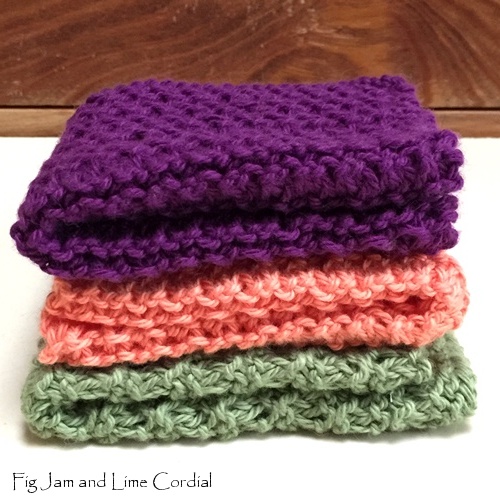
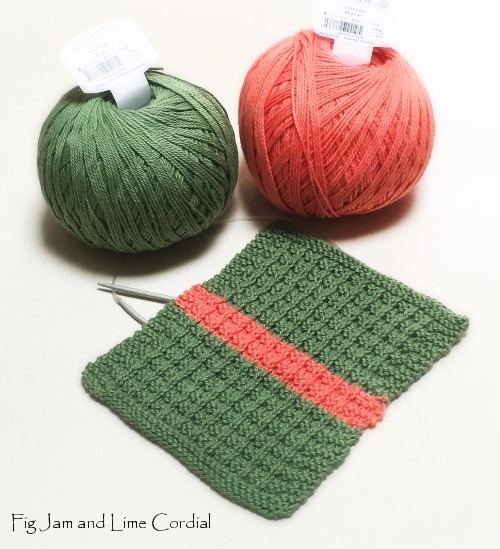
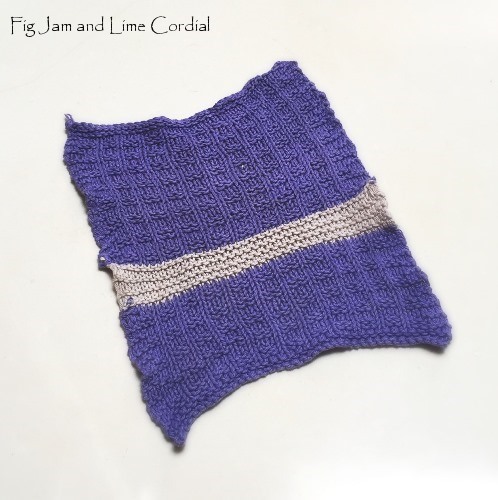
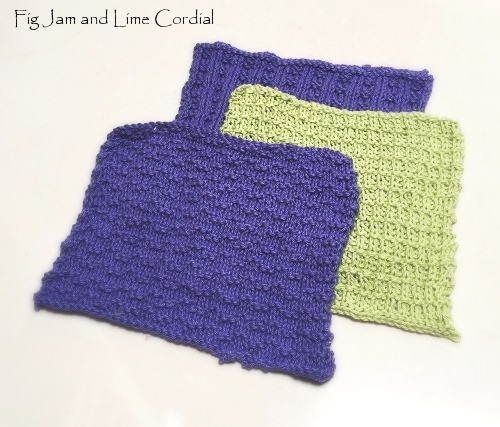
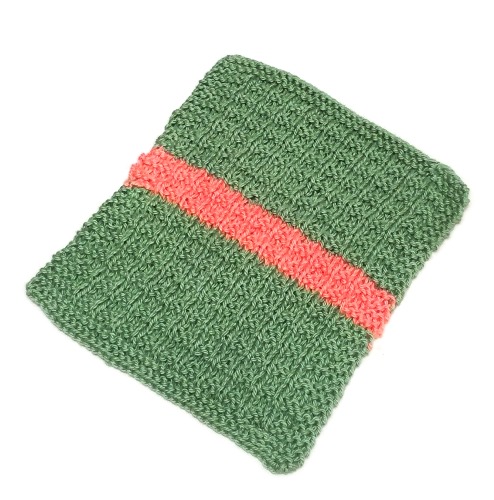
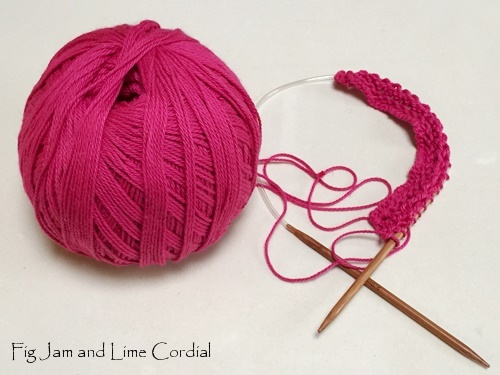
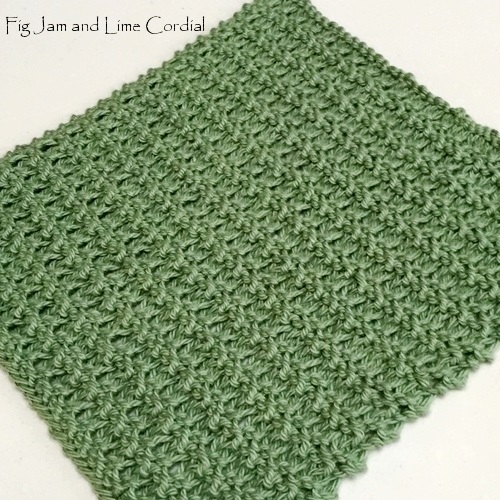
After a hiatus of a couple of months, I’ve knitted another cotton dishcloth. I’ve tried several patterns now, and this one is my firm favourite – it doesn’t involve any purling and even though I’m a very slow knitter, the cloth comes together quite quickly.

I had to search out the pattern again though, so I decided I’d better write it up here for next time!

kdc3

Knitted Cotton Dishcloth (adapted from this pattern)

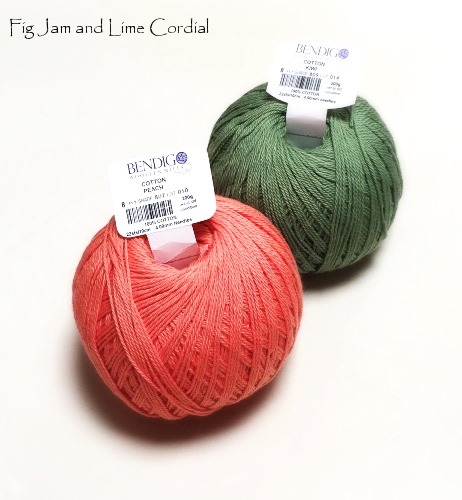
8 ply cotton
5.00mm needles (I use round bamboo needles I found on ebay)

  • Cast on 46 stitches and knit one foundation row (slip the first stitch – it results in a prettier edge).

Begin pattern:

Row 1: Slip 1, Knit to the end.
Row 2: Slip 1, Knit 2 stitches together 22 times, Knit 1.
Row 3: Slip 1, Knit through the front and back of the next stitch (increase by one stitch) 22 times, Knit 1.
Row 4: Slip 1, Knit to the end.

  • Repeat until the cloth is square in shape.
  • Cast off in knit, then weave in all the loose ends.

. . . . .

These dishcloths wash like a dream – most of mine have now been through a hot wash cycle dozens of times. I line dry them, as I think the tumble dryer could shrink them to postage stamp size. This particular weave rinses out well, but has enough texture to withstand a bit of bench scrubbing!

kdc2

Read Full Post »

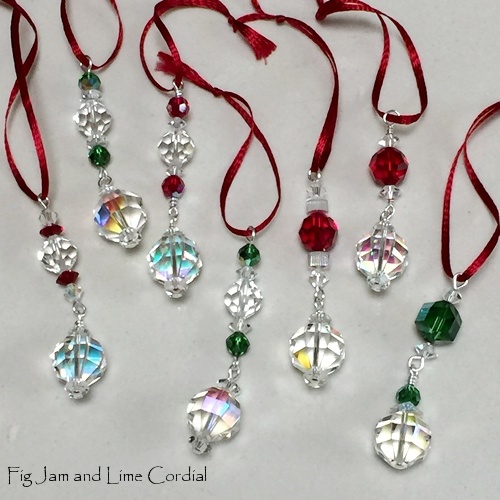
Christmas bling is well and truly happening at our house!

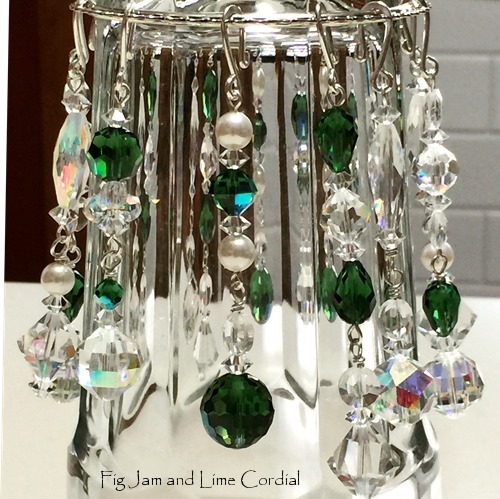
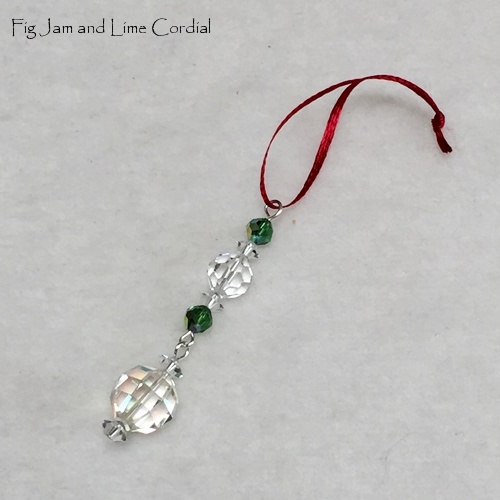
I thought you might enjoy making these crystal decorations. Their gorgeousness belies their simplicity, and they make a stunning homemade gift.

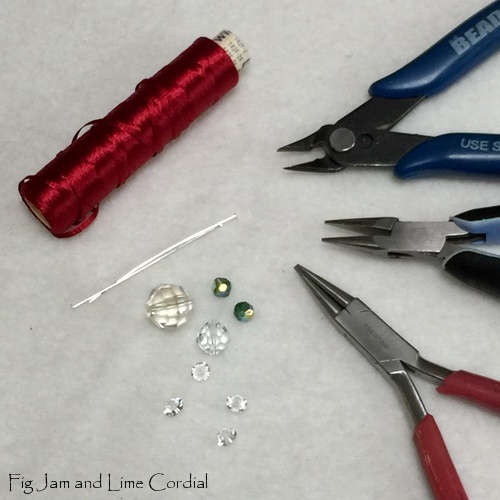
For each decoration, you’ll need:

  • 1 large 12-14mm large clear crystal*
  • 1 large 8-10mm medium clear crystal*
  • 2 small 6mm small crystals in either red or green
  • 4 small flat spacer crystals
  • 2 x 2″ silver plate headpins
  • hanging ribbon or hook
  • round-nosed pliers
  • flat-nosed pliers
  • wire cutter

Note: the 10mm – 14mm crystals can sometimes be tricky to track down. Please substitute freely depending on what you can source. I used vintage Swarovski from my personal stash.

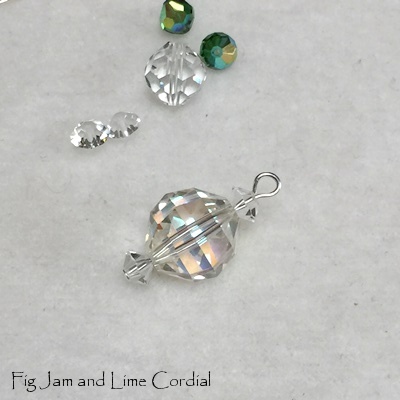
Step 1: Onto one head pin, slide a spacer, followed by the largest crystal, then another spacer. Bend the top of the head pin into a loop following our earlier instructions here (follow the directions for the green earrings in the second half of the post)…

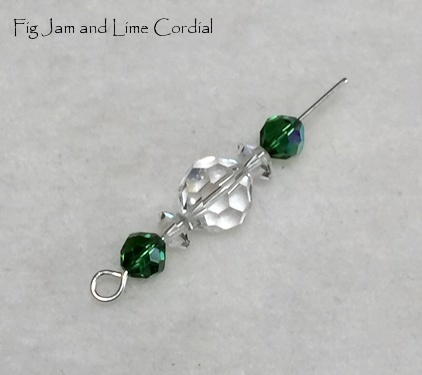
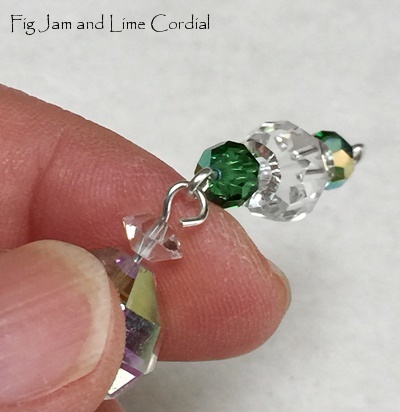
Step 2: Using the cutters, carefully trim away the head of the second pin. Turn one end of the wire into a loop. Thread on in this order: coloured crystal – spacer – medium crystal – spacer – coloured crystal. Carefully turn a loop at the other end.

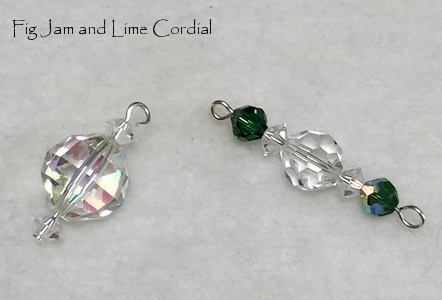
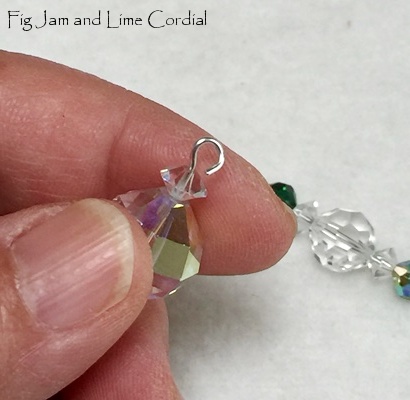
Step 3: Open the loop on the large crystal by twisting it slightly to the side. Never open a loop by uncurling it, as that weakens the wire…

Step 4: Add the second piece, then close up the open loop by twisting back gently…

Step 5: Add a hanging ribbon or hook…

Finished! I like to give these away in small organza bags, but they also make a nice addition to the wrapping of a larger gift. I’m currently working on a way to hang these from our dining room light fitting – I’ll let you know how I go!

Read Full Post »

Kindle Bargains

A quick (un-sponsored!) heads-up on some great Kindle cookbooks currently available at Amazon.com…

. . . . .

Alice Medrich is one of my favourite cookbook authors of all things sweet.

I’m more than happy to pay full price for her books, so when these ones popped up on Amazon this morning for less than the cost of a takeaway coffee, I didn’t even bother trying to resist.

Workman Publishing heavily discount a few titles every month, and November was Alice’s turn. Her Pure Dessert has a print price of US$35.00 but is currently on sale in Kindle format for US$2.84…

Chocolate Holidays, print price US$15.00, Kindle price this month US$2.80…

Finally. this James Beard Award winner on baking with gluten-free and alternate flours is now just US$2.06 (print price US$35.00)…

I bought all three (of course!) and whilst I haven’t made anything from them yet, they all read well on my iPad. And I know from past experience that the recipes will be fabulous!

. . . . .

We’re huge Hugh Fearnley-Whittingstall fans.

Watching River Cottage many years ago kickstarted our drive towards urban self-sufficiency. So when I saw this cookbook for just US$4.18, I didn’t even think twice before buying it.

I wasn’t sure I’d love it – the notion of limiting each recipe to just three main ingredients seemed a little forced – but it’s actually brilliant. The dishes are simple, and in many cases, I have the ingredients readily on hand.

Hugh’s red lentil, bacon and onion soup took no time at all to make and was wolfed down enthusiastically by Pete and Big Boy…

  • light olive oil for the pan
  • bacon (recipe says 4 slices – I used some nitrate-free bacon offcuts we had in the freezer)
  • 1 onion, chopped
  • 200g split red lentils, well rinsed
  • 1 bay leaf
  • salt and black pepper

Heat a little oil in a medium saucepan and fry the chopped bacon until the fat starts to melt. Add the onion and fry over a medium heat until soft and lightly coloured, stirring constantly.

Stir in the lentils, bay leaf and 800ml water. Simmer gently for about 15 minutes until the lentils are soft and breaking down. Remove the bay leaf, then blitz with a stick blender until smooth, adding water if necessary. Season to taste.

I could have dressed the photo up a bit better (sorry), but the soup was absolutely delicious. Definitely one we’ll make again!

. . . . .

Finally, my last purchase of the day was this little US$2 gem. After all, it’s nearly Christmas…

. . . . .

As you know, I love everything about e-cookbooks.

I love that they don’t cost the environment in trees and energy, I love that they don’t create storage issues, I love that they’re portable, I love that they don’t get dusty and torn. I love not paying for postage. And because they have no built-in production costs, they’re often available at amazing prices. Surely that’s a win for everyone!

Read Full Post »

Knitted Cotton Dishcloths

“Celia, it’s just a dishcloth…”

It was all  my friend Maude could do not to roll her eyes at me.

Ok. I do get a bit excited sometimes. But honestly, these cotton dishcloths are ridiculously good.

They first arrived in the mail a couple of years ago, a gift from my blogging friend (and avid knitter) Rose. Here’s the photo I took in 2013, when they were brand new…

They are totally brilliant – they absorb well, rinse out completely, and go straight into the washing machine. This one has been washed at least 30 times. It’s outlasted most of my tea towels…

Rose, bless her kind heart, sent me a refresher pack earlier this year…

Now, I haven’t knitted for over 20 years, but I was inspired to give these a go. Rose sent me the link to her blogpost, which led me to this pattern at Homespun Living. I ordered some magnificent Australian cotton from Bendigo Mills (8ply, 200g balls) and borrowed a pair of 4mm circular needles from Maude (I find circular needles are easier on my slightly arthritic fingers than straight ones). Edit: I’ve since made another one using 4.5mm needles and found that they produce an even better result!

Tah-dah!  I’m seriously chuffed with how well this turned out…

Rose, thank you so much for all the time and effort you put into making these for me! Having now made one, I know just how long each dishcloth takes (a couple of hours for me, but I’m quite a slow knitter). Having said that, I’m definitely going to make some more, because they’re beautiful, work brilliantly and make me happy!

Read Full Post »

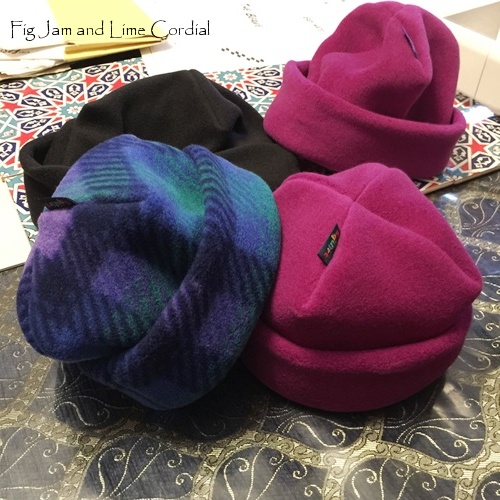
This is the last polarfleece post for winter, I promise!

Over the years, I’ve made more than five hundred of these beanies. I started in 1996 when Big Boy was in preschool, making them to sell at the school fete. Back then, polarfleece was Polartec, and it was expensive and high tech and hard to come by. I bought the fabric online from the US, turned it into kids’ hats, and sold one to every parent who walked by that cold winter’s morning.

A few years later, a handful of sewing friends and I turned these out by the truckload and donated them to charity. They were lightweight, soft and extremely warm – the perfect thing for someone sleeping rough.

Last week, I decided that young Evan desperately needed a hat, so I set up the sewing machine, rummaged around to find the pattern, and sewed one for him. And then I was off! My dear friend Peter Bryenton asked me if I had a beginner’s pattern he could use, so I tracked down the guide I’d written for the charity sewing and sent it to him.

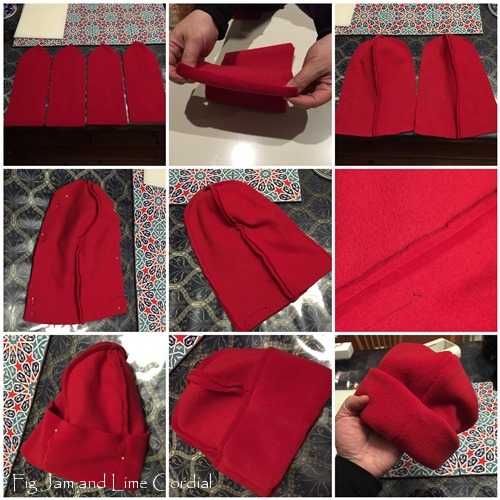
To make it easier to understand, I made up a sample and took a few photos to send to him as well. These were taken at 10pm, so they’re not terribly polished, but I thought I’d write them up anyway in case anyone else is interested.
. . . . .

Click here to download the pattern: Adult Polarfleece Beanie. It’s sized to print out on A4 paper, and the pattern piece should be 42cm (16½”) from the point to the base. Again, apologies for the lack of polish  – it was written a long time ago!

1. Buy half a metre of decent quality polarfleece (200 weight is great, if you have a choice). This should give you enough for two hats. Cut out four identical pattern pieces, all with the stretch going ACROSS the piece (not up and down – this bit is important).

2. A note on polarfleece, it curls to the WRONG SIDE when pulled across the stretch. It doesn’t fray, so it won’t need any edge finishing. With a piece of tailor’s chalk or a bit of sticky tape, mark the wrong sides so you don’t get confused.
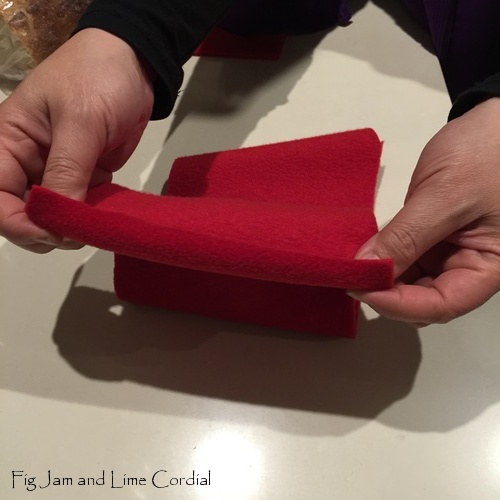
3. Place two pieces RIGHT SIDES together. Stitch from the point to the base down one side. I use the width of my half my pressure foot as the seam allowance (about 6mm) and sew with a long (say 4mm) straight stitch. Repeat with the other two pieces. My sewing machine has automatic tensioning, but if you’re using one with a manual tension, you might need to loosen it a little to handle the thicker fleece.
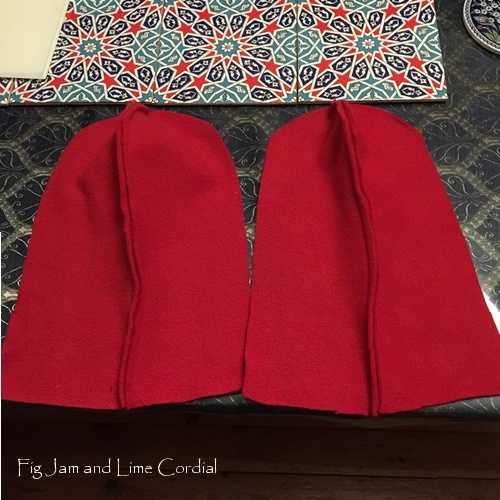
4. Place the two halves RIGHT SIDES together. Pin.
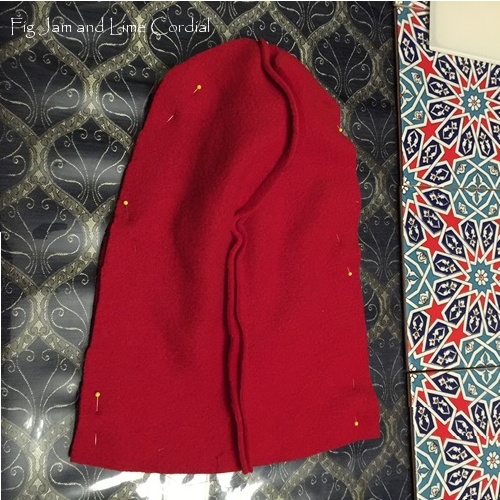
5. Stitch from one side all the way up in a long arc through to the other side. Use the long straight stitch again and the same seam allowance. When you get to the bit in the middle where the seams meet, open the seam allowances out flat and sew across carefully.
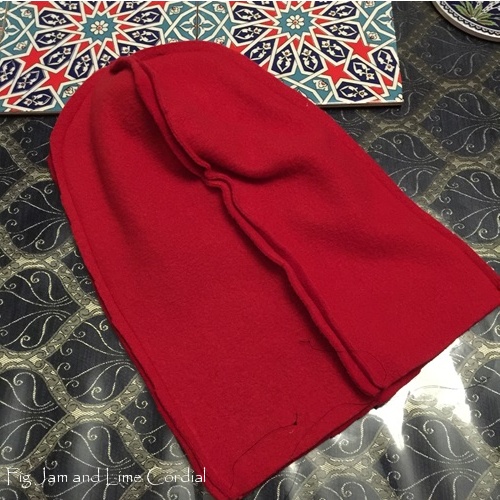
6. Flatten out the seams with your finger – they should press quite flat. Never use an iron on polarfleece or it will melt. And really, this isn’t precision sewing! Trim all your end threads off neatly as you go, even though I didn’t. (Well, I did, but after I took this photo.)
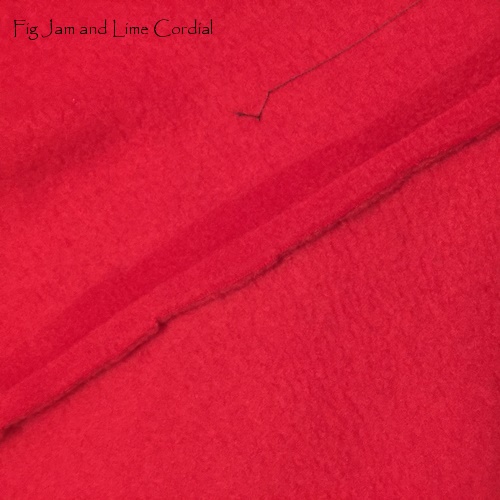
7. With the WRONG SIDE out, fold up a cuff of 12cm (4.75″). Pin in place. Try to open out and flatten the seam allowances to make them easier to sew. I think this is the only really fiddly bit of the whole process.
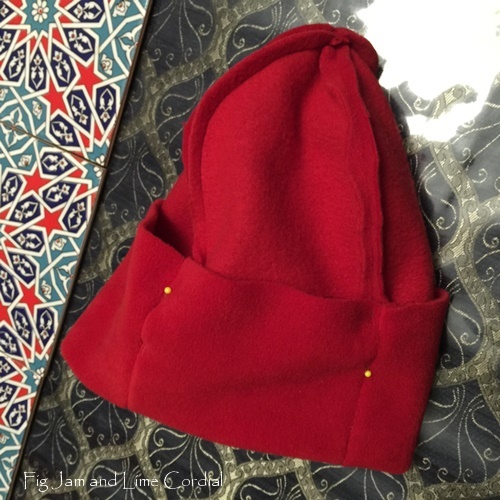
8. Using the free arm of your machine, stitch the cuff up using a long zigzag. I use a 3mm wide, 4mm long setting.
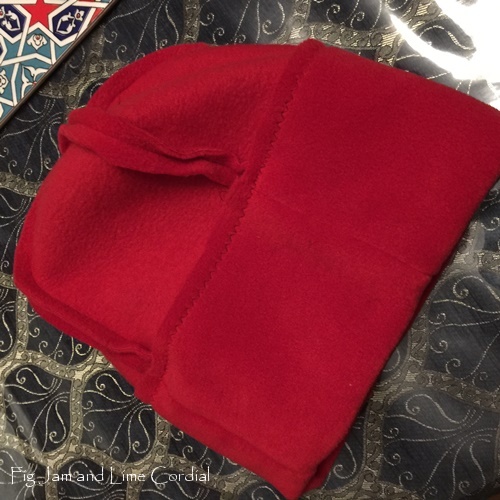
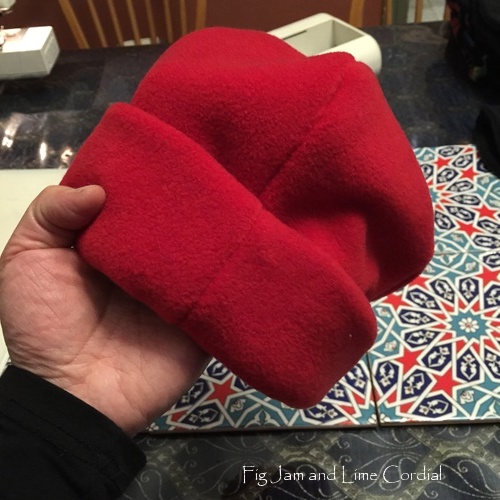
9. Turn it RIGHT SIDE out, fold up the cuff and voila!
. . . . .

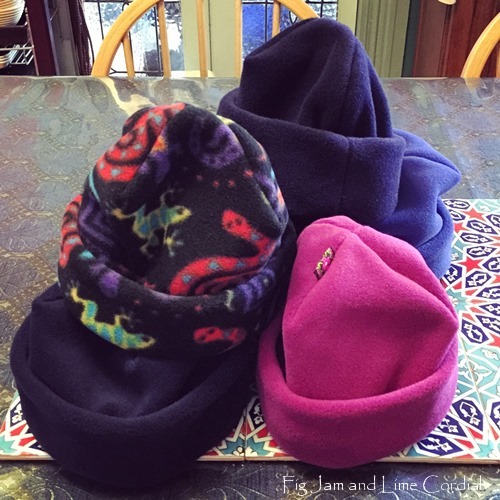
I’ve been cheerfully sewing up beanies for the neighbourhood littlies. The snake hat was for my friend Beej

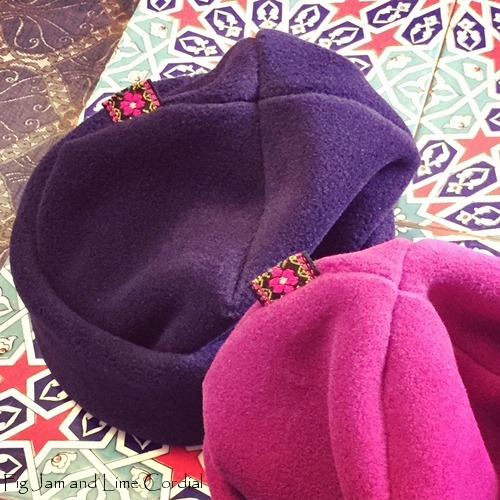
For Lucia’s and Rosie’s hats, I’ve added small pieces of folded ribbon, taken from the treasure bag of trim that Nancy sent me earlier in the year…
The pattern I’ve provided with this tutorial is for a medium to large adult sized hat. If anyone needs me to trace and scan a small (toddler) or medium (child or small adult) sized piece, please let me know. Stay warm folks! ♥

Edit: As requested, here are the smaller sized patterns:

Beanie pattern: Small and Medium

. . . . .

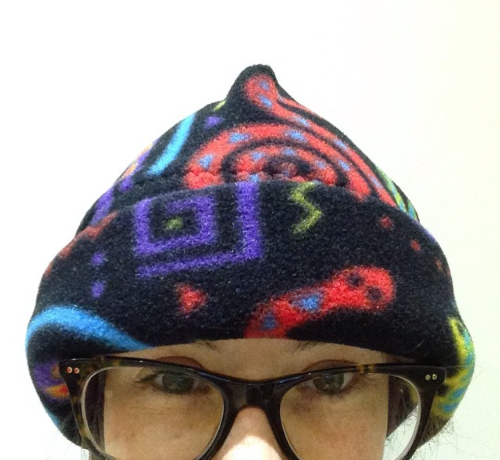
My friend Beej just sent me this photo. She put her beanie on to catch the bus this morning and hasn’t taken it off yet!
Read Full Post »
« Newer Posts - Older Posts »