Feeds:
Posts
Comments

Archive for the ‘Recipes’ Category

Christina’s brother James is one of the nicest, most interesting people you’re ever likely to meet.

While we were chatting at Christina’s birthday party (themed 1970’s, so James was in a Luke Skywalker t-shirt and I was in a bright orange kaftan), he mentioned that he was planning to make blackberry jam for his wedding.  As a present. For every one of the sixty guests.

And James isn’t one to do things by half measures – first he was going to make pectin from scratch (using his dad’s homegrown apples), and then he was planning to spend a weekend blackberry picking to gather enough fruit for the jam.  His ever patient bride-to-be Suzanne just smiled as we discussed the intricacies of jar sizes and hot water processing.

A week or so later, Chris’ hubby Steve dropped around a jar of the  aforementioned blackberry jam.  I was both excited and somewhat surprised at  how quickly the whole plan had been put into action –  when James sets his mind to something, he clearly doesn’t procrastinate!
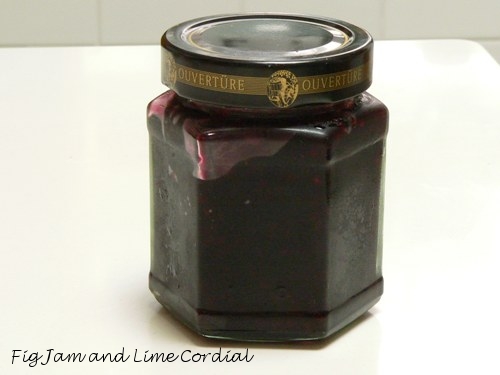
Serendipitously, the following day, Diana gave me frozen blackberries from her farm.  I couldn’t resist combining the two into a sweet weekend treat.
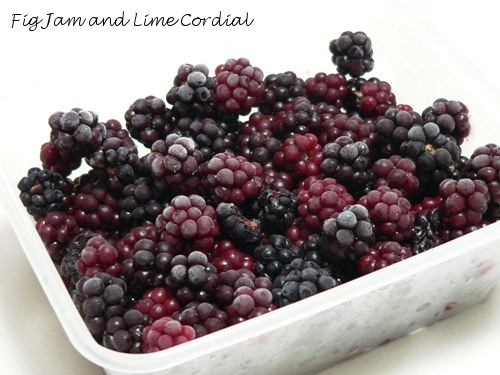
Inspired by the Blackcurrant Crown recipe in Dan Lepard’s The Handmade Loaf, I made a version using our pain viennois dough (the step by step instructions are here), Di’s frozen blackberries, and James’ blackberry jam. It was an absolute treat – buttery, briochey and filled with oozing fruit.

  • 1 batch pain viennois dough
  • blackberry jam
  • 100g fresh or frozen blackberries
  • 100g brown sugar (I used rapadura sugar)

1.  Prepare the dough and allow it to rise in the mixing  bowl until doubled in size.  In the meantime, grease a 10 cup bundt pan well.

2. In a separate bowl, stir together the brown sugar and blackberries.

3. Turn the risen dough out onto an oiled bench and divide it into 18 x 50g pieces.  Shape each piece into a ball.
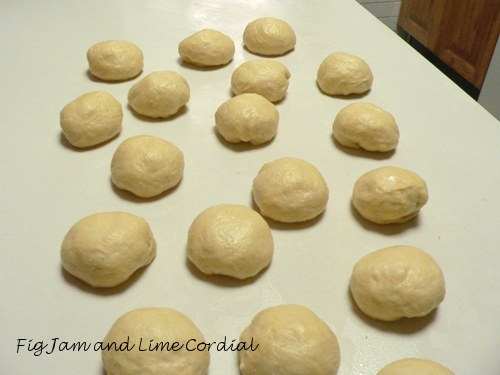
4.  Turn each ball seam-side up, and flatten it out.  Spoon a scant teaspoon of blackberry jam into the middle of the circle…
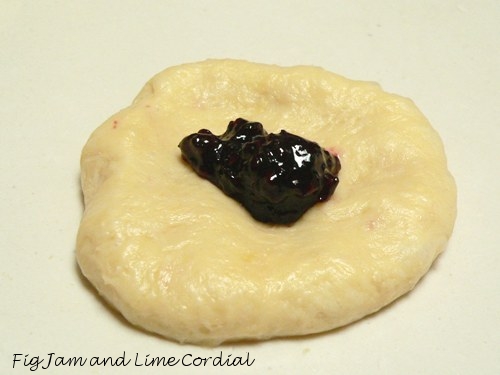
…and then gather the edges together to enclose the jam completely.

5. Layer the filled balls into the bundt pan, sprinkling with the blackberries and sugar as you go.  Don’t squash them in too tightly.

6. Once all the balls are layered into the pan, cover and allow to rise in a warm spot until puffed up (Dan’s recipe specifies letting the dough rise until doubled in size, but mine didn’t rise that much).  Preheat the oven to 200C with fan.

7. Bake the crown in the oven for 10 – 15 minutes at 200C with fan, then reduce the heat and bake for a further 20 – 30 minutes at 175C with fan.  The top of the crown went very brown in my oven, so I dropped the heat after 10 minutes.  Do keep an eye on this – particularly if you’re using a cast aluminium bundt pan as I was – as it can colour up very quickly.  I let mine cook an extra few minutes to dry up the berry juices.

Edit: Living Delilah made this recipe, and found that the brown sugar burnt during baking.  Do watch out for that and if your oven runs hot or you’re using cast aluminium, you might want to lower the starting temperature by 10 degrees or so, or reduce the initial baking time at the higher temp.

8. Rest the pan for five minutes before carefully turning it onto a plate (watch out for the hot syrup).  Serve the crown warm, with a hot cup of tea!

Click here for step by step instructions for the pain viennois dough.

Click here for a printable version of this recipe.

Read Full Post »

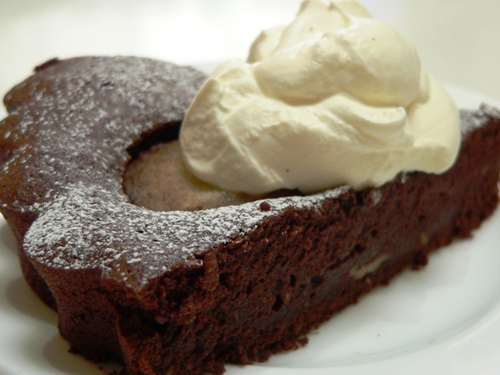
Some time ago, Michelle gave me a recipe for an easy pear, brandy and chocolate torte (thanks again, Michelle!).

This rich, dense dessert is a perfect way to use up leftover egg whites – in this case, the surplus from our shortbread cookie dough.  Please excuse the slightly tragic arrangement of  pears on top – I’ve always been a little design-challenged.  I also baked the torte in a 25cm/10″ flan dish with a removable base rather than the smaller springform specified, so I probably should have used more fruit.

  • 250g fresh pears (use tinned if fresh are not available)
  • 4 tbsp brandy
  • 25g cocoa powder (I used Dutched)
  • 100g dark chocolate, preferably 70% cocoa, in pieces
  • 50g unsalted butter
  • 175g caster sugar
  • 100ml hot water
  • 4 large (59g) egg whites
  • 85g plain (AP) flour
  • 1 tsp ground cinnamon (optional)

1. Peel and core the pears, cutting each pear in half. Place the pears and brandy in a small bowl and allow to steep for about 30 minutes until most of the brandy has been absorbed.

2. Preheat the oven to 190C/170C with fan.  Grease a 23cm/9in loose-bottomed cake tin or springform tin. Put the cocoa, chocolate, butter, hot water and 140g of the sugar in a small saucepan.  Whisk gently over a low heat until the mixture is smooth. Leave to cool slightly.

3. Whisk the egg whites to soft peaks, then gradually whisk in the remaining 35g sugar. In a separate bowl, sift the flour and cinnamon together.  Sprinkling in a little at a time, gently fold the flour into the egg whites with a metal spoon, until almost combined. Add the chocolate and fold in until evenly combined, being careful not to overwork the mix.

4. Pour the batter into the prepared tin and arrange the pears over the top (they will sink into the torte during baking). Sprinkle over any remaining brandy and bake for about 40 minutes until just firm. Serve warm with a generous dollop of homemade vanilla icecream or, in our case, softly whipped vanilla cream (made by whipping a little vanilla syrup into heavy cream).

Click here for a printable version of this recipe

Read Full Post »

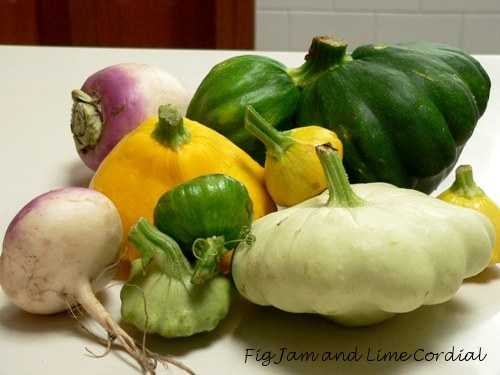
My dear friend Diana dropped over for a cup of tea last week.

She brought with her a bag full of large squashes from her farm garden, with a couple of turnips thrown in for good measure.  Aren’t they magnificent?  I was a little tempted to keep them as a table decoration.

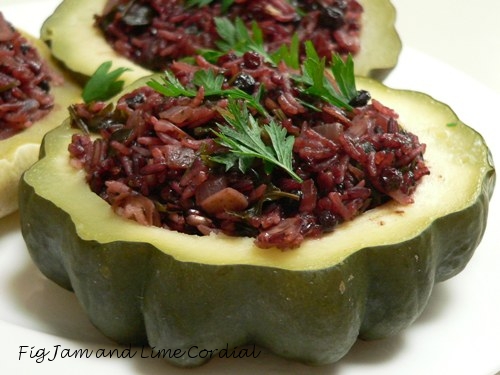
Instead, I stuffed the two large ones with rice, using the purple rice I’d bought at Alfalfa House and following this recipe from Yotam Ottolenghi’s Plenty

It was particularly good served at room temperature with Pete’s homemade Greek yoghurt!

The remaining squash were grated and baked into Genie’s zucchini slice

This savoury slice recipe is one of the most popular on our blog, and with due cause – Genie’s recipe is incredibly simple and absolutely delicious. We ate it for dinner last night, and then Big Boy demolished the leftovers for breakfast this morning.

Instead of zucchini, I used Di’s squashes (skin and all) and substituted  diced uncooked pancetta for the fried bacon.  Combined with fresh eggs from our chooks, and a mix of fresh mozzarella and Picasso sheeps’ cheese, it made for a very simple and delicious  dinner!

Read Full Post »

bagl 004

I was reading some of the comments to yesterday’s post, and it made me reflect on my first attempts at sourdough baking.

If you’re new to baking with a sourdough starter, please let me reassure you – it isn’t scary.  Don’t be put off by all the numbers and detailed instructions out there, adhering to them really isn’t as critical as some of the more diehard bakers will have you believe.

Let me explain.

A lot of sourdough bakers take it all very seriously – they measure their ingredients to the last gram, set up spreadsheets to crunch numbers to determine hydration percentages, measure the dough temperature and the ambient room temperature, control the amount of steam during the baking process – and so on.

This makes a great deal of sense in a commercial bakery situation – loaves need to be consistent in size and shape, and even the slightest variation in a batch can impact on quality and profit.

But if, like me, you’re just baking at home, for fun, sourdough baking can be an adventure.  Even after nearly five years of breadbaking, my loaves will still turn out a little bit differently each time.  That’s because I’m not overly concerned about exact quantities, my ambient kitchen temperature changes with the seasons, and my proving times vary depending on whatever else is happening in our lives.

My preferred dough is at 74% hydration purely because that lets me work in round numbers for the ingredients.  It doesn’t really matter or make a great deal of difference (and I probably wouldn’t notice) if the finished dough was 72% or 76% – the baked loaves would still be delicious and my sons would still devour them.

So please don’t be put off by the thought that sourdough baking is an overly technical exercise.  It really doesn’t have to be, and it’s great fun to play around with quantities and ingredients to see what works and what doesn’t.

Let me try to explain what I do in simple terms, so that those of you who are considering it can get a clear picture of the process in your mind:

Step 1: feed your starter on flour and water.  Make sure to use a good bread or bakers flour, which is higher protein than plain (AP) flour.  Keep feeding your starter and giving it time to digest its food.  You’ll know it’s ready when it’s all bubbly and frothy.

Step 2: in a large mixing bowl, mix together the starter, water, flour and salt.  I add oil to the dough because I like the taste it imparts on the finished loaf.  Let it rest for about ten minutes, then turn it onto an oiled bench and give it a knead.  Now turn it back into the mixing bowl (which has been scraped out and oiled), cover it and allow it to rise.  This might take three hours, or it might take thirteen.  With experience, you’ll instinctively know when the dough is ready, but to start with, let the dough rise until it’s almost doubled in size.

Step 3: turn the risen dough onto an oiled bench, divide it up, and shape it however you choose.  This is the really fun part, where you can turn the dough into almost anything – from pizza to epi to loaves.  You could make stuffed rolls like I do every week, or work the dough into a tray and dimple it into foccacia.  Let it rise again while you preheat the oven.

Step 4: bake the dough.  Once it’s baked, let it cool, and then scoff it blissfully!

Lastly, don’t be afraid to stuff up. Every time you bake a loaf which is a bit ordinary, you’re one step closer to baking one that is perfect!

Read Full Post »

Lyn just left me a comment asking for my basic sourdough recipe, and I realised that I’ve never posted it here before!  Just for reference, here are formulas I use for almost all my sourdough baking.

Starter

I bought my sourdough starter from the US, and it arrived as a small envelope of white flakes. These were rehydrated by mixing the flakes with flour and water over a period of several days.

Now that it is mature, I feed my starter at a ratio of one cup of water to one cup of flour.  I’ve often thought about changing it to equal water and flour by weight (ie. 100g flour to 100g water), but I started with the former ratio, and it would be difficult to change all my formulas now.  In addition, my very liquid starter has never blown its top or grown out of the bowl it was being fed in.

Hydration

Most of the bread I bake uses a high hydration dough.

A quick explanation (with apologies to all my breadbaking friends who already know this) – the hydration of the dough refers to the percentage of total liquid to flour.  So if a dough has 750g of liquid (water, oil, milk etc) to 1kg of flour, the hydration of the dough would be 75%.  This is slightly more complicated with sourdough, as the amount of water and flour in the starter needs to be taken into account as well.

Higher hydration doughs are wetter and can therefore be harder to manipulate and knead.  I use the flip and fold kneading method for wet doughs (as described here), whereas lower hydration doughs require an old-fashioned pummelling.

Here is my standard formula for almost all the sourdough breads I’ve posted here – loaves, baguettes, scrolls, epi and more.  The sourdough focaccia is an exception, as it uses both starter and yeast, and follows the Dan Lepard recipe that Joanna posted on her blog recently.

. . . . .

Celia’s Sourdough Formula (74% hydration)

  • 200g starter (fed at a ratio of one cup water to one cup bakers flour)
  • 400g water
  • 50g olive oil
  • 700g bakers (bread) flour, or combination of flours
  • 10g fine sea salt

I routinely use a mix of flours in this recipe, and will often make the following variations:

  • half spelt flour, half bakers flour
  • 10% dark organic rye flour, 90% bakers flour
  • 500g bakers flour, 200g chestnut flour (see more here)

In conjunction with my starter (and so much of the look and taste of the finished loaf is determined by the starter), this 74% formula will produce a well risen, holey loaf with a chewy texture that my family loves.

. . . . .

When I need a lower hydration dough – useful if I’m trying to create a finished loaf that holds its shape or slashes – this is the formula I use.  It’s the dough I make when I’m shaping cottage loaves – a wet dough won’t work in that instance, as the two storeys simply prove into one amorphous blob.

Celia’s Sourdough Formula (60% hydration)

  • 300g starter (fed at a ratio of one cup water to one cup bakers flour)
  • 1kg bakers (bread) flour
  • 430g water
  • 50g oil
  • 15g fine sea salt

This lower hydration dough requires a more traditional kneading method, as it’s too firm to flip and fold.  It is a much easier dough to handle, and therefore a good formula to begin baking sourdough with, although it will produce quite a closed, tight crumb rather than a holey one.

One final note – out of personal preference, I’ve reduced the amount of salt in my sourdough breads.  The usual quantity of salt added is 10g per 500g flour, but I’ve reduced that to 7g. I thought it prudent given the large quantities of bread my sons eat every day!

Please feel free to ask any questions – I have so many wonderful breadbaking friends who check in here, so if it’s something I don’t know the answer too, I’m sure one of them will be able to help!

Edit: At Lyn’s request, here are brief instructions I wrote some time ago on how I make my 74% hydration sourdough.   They’re a little rough, but I don’t have time at the moment to edit them, so I hope you’ll excuse the lack of polish.  The instructions were written for a friend who was starting with dried starter – obviously if your starter is already active, it’s not necessary to feed it up for several days before using it.

Basic instructions for sourdough (74% hydration dough)

Read Full Post »

« Newer Posts - Older Posts »