Feeds:
Posts
Comments

Archive for the ‘Recipes’ Category

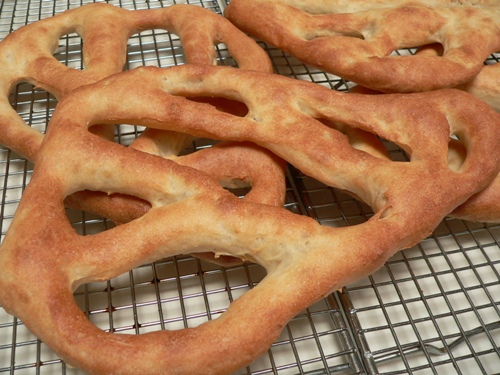
Fougasse was one of my earliest breads – the shape being the first one taught in Richard Bertinet’s Dough.  It’s very quick to make with yeast, as it doesn’t require a second rise, although I’ve only had limited success making it with sourdough.  Like many flatbreads, it seems to rely on the speed of bakers’ yeast to give it a quick spring in the oven.

(more…)

Read Full Post »

Here are some variations on the fig and walnut paste that we’ve been experimenting with, using the same methodology (original recipe is here):

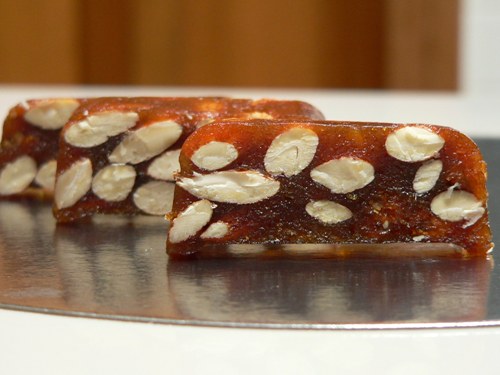
Apricot and almond bar

  • 300g dried apricots
  • 200g whole unblanched almonds
  • 20ml pomegranate molasses
  • 75g brown sugar
  • splash of water at the start to help the sugar dissolve

. . . . .

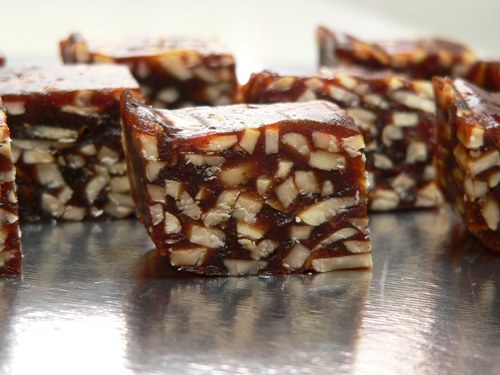
Date and almond bar

  • 300g dried dates, soaked briefly in hot water, then well drained
  • 200g slivered almonds
  • 75g brown sugar
  • 20ml date molasses
  • 20ml lime juice

. . . . .

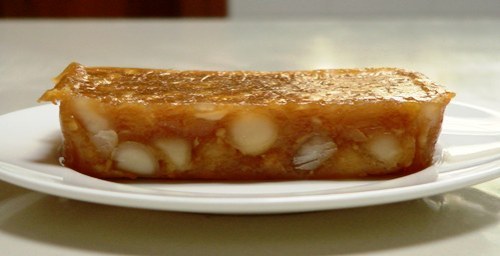
This is such a versatile recipe and we’ve had great fun playing around with it.  Please do let me know if you come up with any clever combinations – my friend Maude is going to try a batch with macadamias and dried mango!

Edit: Maude brought one over for me to photograph this afternoon…

Read Full Post »


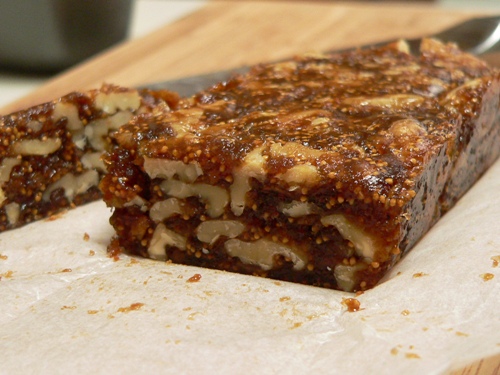
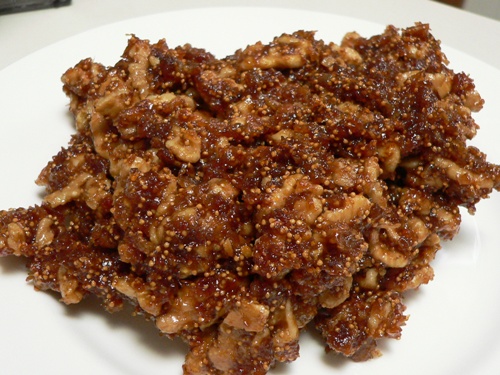
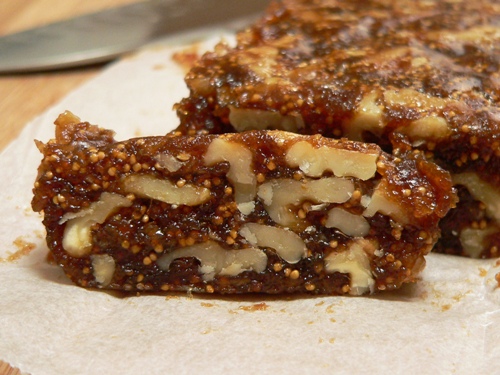
Moo recently gifted us a log of fig and walnut paste, which I became hooked on immediately.  As it’s a big ask to expect him to ship to us regularly from Adelaide, I thought I’d try to find a way to make this at home.

I’ve created my own recipe for this (and am feeling quite chuffed with how well it turned out!), influenced in part by Mark and Bruce’s Fig Cookie filling and in part by our previous attempts at making nougat.  The end result is delicious – slightly softer than the commercial product and in Pete’s opinion, better tasting…

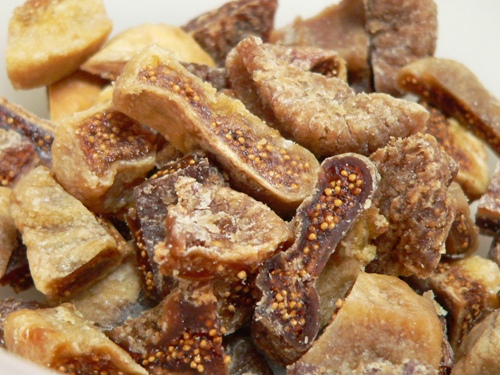
  • 300g (1¾ cups) Turkish figs
  • 200g (2 cups) walnuts pieces
  • 25g (5 teaspoons) lemon juice
  • 75g (1/3 cup) brown sugar
  • 50g (2 US tablespoons or 30ml) honey

1. Chop the figs up coarsely, removing the stems.  Place them into the bowl of a food processor and blitz until they form a sticky paste.

2. Scrape the paste into a heavy-based non-stick frying pan and add the lemon juice, brown sugar and honey.  Stir for a couple of minutes over a low heat until the sugar dissolves.  Add the walnuts and continue stirring over a low heat until all the liquid has evaporated and the walnuts have coloured slightly.  You want to keep stirring and turning the mixture over until it forms a thick, sticky paste – cook it as long as you can without burning, to allow the sugars to caramelise just slightly.  Watch this carefully, we’re only talking about minutes of cooking time, not hours.

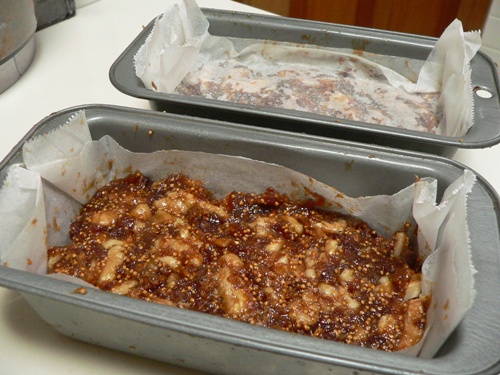
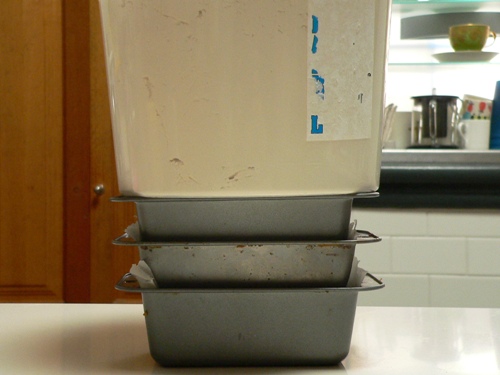
3. Line two small loaf tins with parchment paper (although it probably doesn’t matter what you shape these into).  Scrape the  mix evenly into each tin, flattening out the top with a spatula.  Press a sheet of parchment onto the surface, then place an empty loaf tin on top and a weight on top of that to help flatten out the paste.  In the photo below, I’ve stacked the first tin into the second, then topped them with an empty third, and weighted it all down with my tub of flour.

4. Allow to cool for several hours, until firm. Remove the parchment paper and slice with a sharp knife.  I have my paste wrapped in thick plastic and stored in the pantry, although it would probably keep longer in the fridge.

I adore this fig and walnut paste with a little Picasso sheeps’ cheese and some Italian prosciutto on sourdough bread. Pete has taken to eating chunks of it straight, like a fruit and nut bar.  It is indeed quite healthy – basically figs and nuts held together with a little sugar and honey!

Click here for a printable version of this recipe

. . . . .

Edit: Pete asked me to make an apricot and almond version for him to eat as a bar.  These are the ingredients I used, and he was happy with the result.  Same methodology as above.

  • 300g dried apricots
  • 200g almonds
  • 20ml pomegranate molasses
  • 75 brown sugar
  • splash of water at the start to help the sugar dissolve

Read Full Post »

Every weekend, I bake two large trays of sourdough bread rolls specifically for school lunches.

I make these using a simple folding and cutting technique, which I find much easier than more traditional methods for shaping individual rolls.  The end result is a flat, oval roll which will hold a substantial amount of filling and withstand the rigours of a tossed backpack.

After baking, each roll weighs between 95 – 105g, the equivalent of three slices of bread.  Filled with ricotta and smoked salmon, or in Small Man’s case, Vegemite, they’re the perfect size for school lunches.

. . . . .

After the dough has had its first rise, knock it back and stretch it  out on a lightly oiled surface into a rectangle.  The piece below weighed 1200g.

Fold one side of the dough in as shown…

…then fold the other side in over the top.

Using a serrated knife or a dough cutter, slice the dough into pieces.  I cut 10 rolls from my 1200g of dough, judging the size of each piece by eye rather than bothering to weigh them.

Lay the rolls out on a lined baking tray. Place a sheet of parchment paper over the top of the rolls, and then cover with a tea towel.  Allow to prove.

Before baking, I give each roll a single slash with my lame.  I’m not convinced it makes any difference, given that my dough hydration is quite high, but it does make me feel like a proper baker when I get to wave my razor blade around.

These rolls freeze beautifully, which means I can bake a large batch once a week.  And the boys love them – Small Man has already eaten two rolls off the cooling rack!   Better get them in the freezer now, or I’ll have to bake another lot tomorrow…

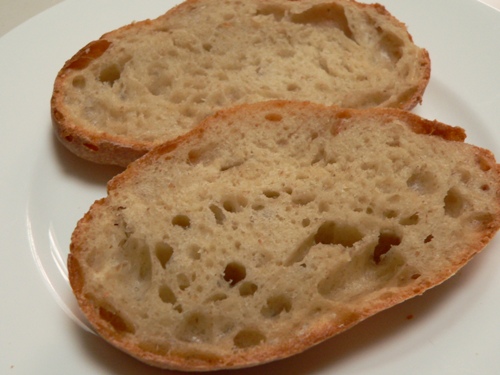
Edit: a crumb shot for Sally!

Read Full Post »

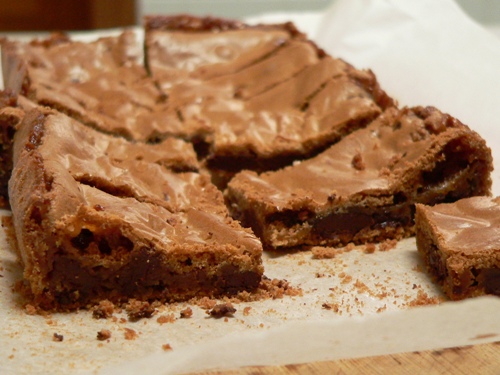
These butterscotch brownies have many things going for them, but good looks isn’t one of them.

They are, however, ridiculously easy to make, only use one saucepan, and have a delicious caramel flavour that makes them difficult to leave alone.  I baked two trays today – each took me less than 10 minutes to knock up, and under half an hour to bake in the oven.  That’s hard to beat!

The batch above has a mix of walnuts and chocolate chips, whereas the one below has extra chocolate in place of the nuts (as Small Man is nut allergic) and as a result is gooey and flatter, but equally moreish.

I’ve substituted unsalted butter for the vegetable shortening in Beth Polazzo’s original recipe, and I’ve also omitted the specified ½ teaspoon of salt.  That’s our personal preference – we’re not big fans of the salt-sugar combination that seems to be so popular in the US.
Butterscotch Brownies
(adapted from  Beth Polazzo’s Butterscotch Brownies in Molly O’Neill’s New York Cookbook)

  • 75g (½ cup) plain (AP) flour
  • 1 teaspoon baking powder
  • 65g (¼ cup) unsalted butter
  • 215g (1 cup, packed) brown sugar
  • 1 large (59g) egg
  • ½ teaspoon vanilla extract (I used homemade)
  • 55g (½ cup) chopped walnuts OR extra 90g (½ cup) chocolate chips
  • 90g (½ cup) semisweet chocolate chips

Note: for the all chocolate version, I used 90g broken Callebaut bake-stable sticks (44% cacao) and 90g Callebaut 811 callets (54% cacao).

1.  Preheat the oven to 175C/350F or 160C/320F with fan.

2. Line a  20cm/8″ square pan or a 31 x 14cm/12 x 5½” biscotti pan with parchment paper.

3. In a small bowl, combine the flour and baking powder and stir together with a fork.

4. Melt the butter in a small saucepan over a low heat, then add the brown sugar and stir briefly until softened and moist.  Remove from the heat and allow to cool for 5 minutes (this bit is important – or you’ll end up with scrambled eggs and melted chocolate).

5. Using a wooden spoon or spatula, quickly stir in the egg and vanilla until incorporated.  Add in the flour and baking powder, and stir vigorously to combine.  Gently mix in the walnuts and chocolate.

6. Scrape the batter into the prepared pan and gently work it into the corners.  There’s not a lot of batter, so expect a fairly thin coverage over the base of the pan.  Bake for 20 – 25 minutes until the top feels just firm.  The original recipe said to test with an inserted toothpick, but there’s usually so much chocolate in mine that it’s hard to judge.

Remove from the oven and allow the brownies to rest in the pan for at least half an hour before transferring them to a wire rack to finish cooling. The brownies will sink a little as they cool.

Expect these to be flat and ugly, and to crack as they’re sliced (use a sharp, thin knife).  Also expect them to be deliciously moreish with a brown sugar caramel flavour and a fudgy, gooey centre.  Enjoy!

Click here for a printable version of this recipe

Read Full Post »
« Newer Posts - Older Posts »