Feeds:
Posts
Comments

Archive for the ‘Recipes’ Category

Who would have thought that rotting fruit could make such a beautiful jelly?

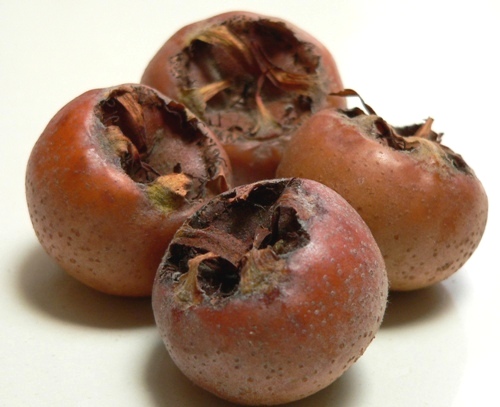
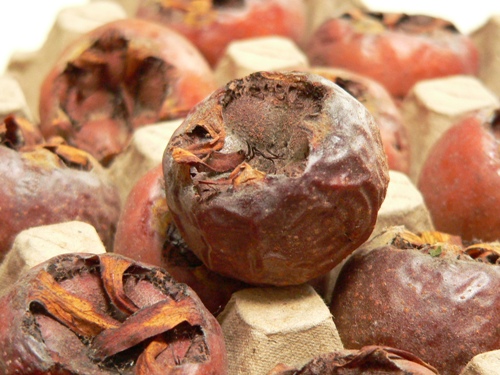
Pete made four jars from the medlars Diana bought us recently.  We let them blet for a couple of weeks, during which time they went from this…

to this…

We followed this recipe of Hugh Fearnley Whittingstall’s, but also added a jar of homemade pectin, as the jelly was struggling to set up.  It was the perfect opportunity to use our baby crabapples, although we only had four, so we added some Pink Lady apples as well.  The crabapples had the most gorgeous rosy centres…

The jelly is a deep orangey-red, crystal clear and well set. We’re looking forward to trying it with roast lamb!

Read Full Post »

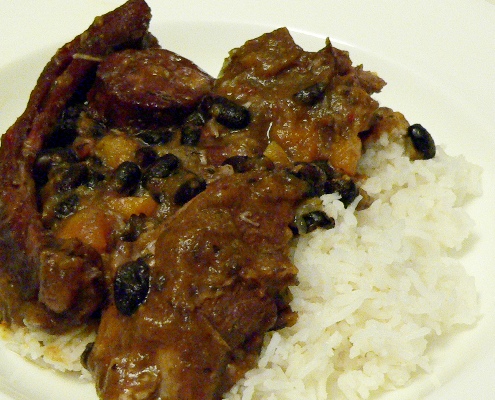
While dining at Gloria’s Portuguese restaurant recently, Pete and I tried a wonderful traditional dish known as feijoada.  It was a rich smoky combination of fresh and salted meats, slow-cooked with beans.

I was keen to try making it at home, but most of the recipes I found online were for Brazilian feijoada, which is apparently quite different to the Portuguese version.  In the end I settled on this recipe and adapted it to the ingredients I could find locally.  It was a roaring success, with the boys asking me to make it again as they were eating it!

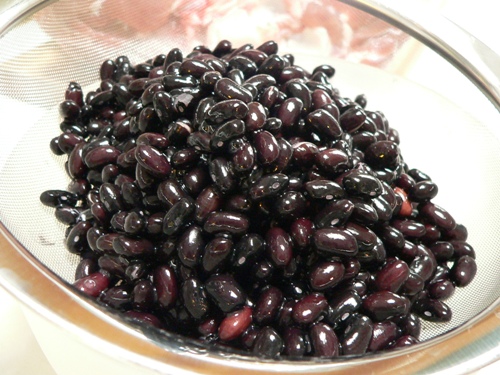
  • 1 cup black beans, soaked overnight
  • 1 can beans, drained and rinsed (kidney beans would be good, I used butter beans)
  • 2 bay leaves
  • 2 crushed cloves garlic
  • 1 tomato, chopped
  • 3 onions, finely chopped
  • handful fresh parsley, chopped
  • 3 carrots, peeled and finely chopped
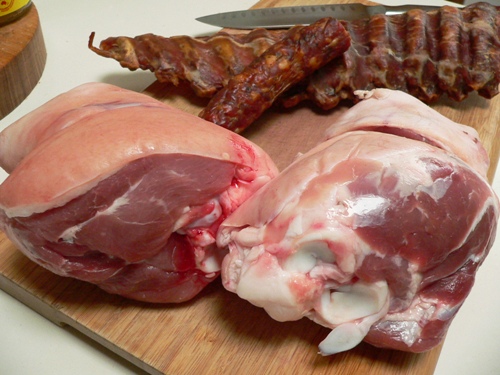
  • 1 chorizo, sliced
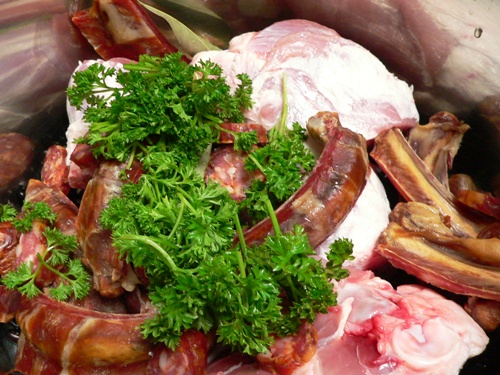
  • 1 rack smoked ribs, cut into riblets
  • 2 pork hocks, rind removed
  • vegetable oil
  • 1 cup tomato passata
  • salt and pepper (optional)

Note: the original recipe quite charmingly advises to use “Assorted meat of personal choice (universally it is pork knee, pork sausage and salted dry beef)” . I think some smoked or cured meat is required to give the dish its unique flavour.

Also, I only added canned beans because I felt halfway through that the dish needed more beans.  When I make this again, I’ll double the quantity of dried black beans and omit the tinned.

1. Drain the black beans and put them into a large stock pot.  Add the meat, bay leaves and parsley.  Add enough water to generously cover the meat, then put the lid on and bring the pot to a boil.  Reduce the heat and simmer very gently for a couple of hours.

2. In a separate pan, heat the oil and fry the onion, garlic, carrots and fresh tomato until soft.   Ladle some liquid and softened black beans from the stockpot  into the fry pan and mash the vegetables and beans together. Pour this all back into the stock pot, along with the drained canned beans (optional) and tomato passata.  Continue cooking for at least an hour longer, or until the pork is tender and falling off the bone.  Taste and adjust for seasoning (I didn’t have to add anything).

3.  Accompany this with steamed rice, napping the meat with extra sauce before serving.

This is the first time I’ve tried to make feijoada, and I’m certainly not holding this recipe up as authoritative.  It’s really more a record of our attempt. If you have any tips on how we can improve our version or make it more authentic, please let me know!

Read Full Post »

You know what?  I’d never stuffed a chicken before.

As I’ve mentioned previously, my Chinese mother used her oven for storing plates, so we never had roasts or homemade cakes.  That certainly isn’t a complaint, as mum more than made up for it with the most amazing meals.  But a roast chicken, well, it just wasn’t culturally congruous.

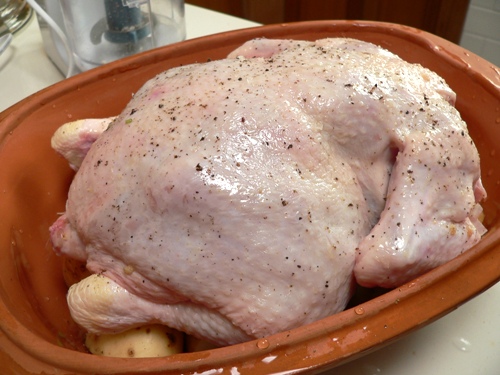
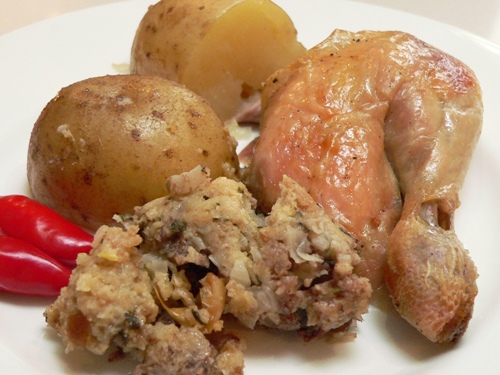
So despite my friend Ellen’s misgivings (“you can’t blog about stuffing a chook!”), here is my first attempt. We roasted the chicken in our Römertopf baker and, as always, were completely delighted with the results.

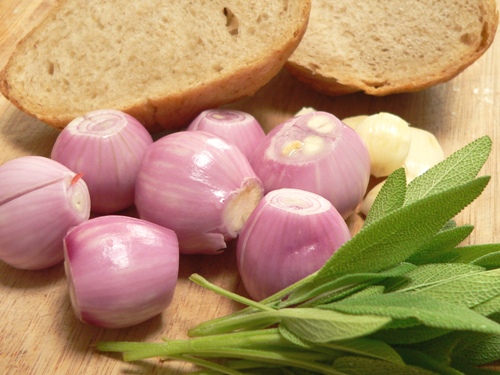
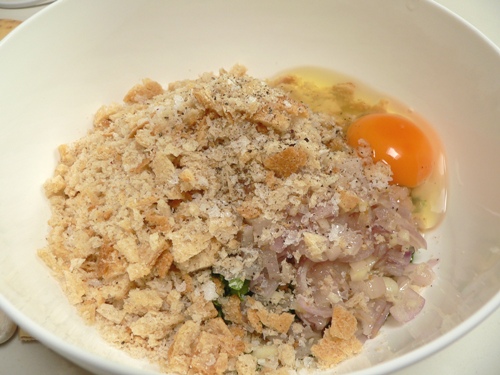
Ingredients: shallots (you could use onions, I just had these on hand), organic garlic, fresh sage leaves from the garden and leftover sourdough bread…and an egg.

1. Soak the clay pot in a sink full of cold water for at least 15 minutes. Tear the bread into large pieces and food process into large crumbs.

2. Chop the shallots and garlic, then fry them briefly in a little oil to soften.  Add them to the breadcrumbs, finely chopped sage and egg, and mix the stuffing together to form a moist paste.  Season with a little salt and pepper. You might need to squelch it together with a clean hand.
3. Loosely stuff the cavity of a prepared chicken – ours was a large free-range bird, weighing in at about 1.6kg.

4.  Lay scrubbed and halved potatoes over the base of the presoaked baker. Scatter over some extra garlic cloves and any leftover stuffing.

5. Remove any excess fat, then rub the chicken all over with a little olive oil,  a little caramelised balsamic vinegar (optional), salt and freshly ground black pepper. Sit it breast side down on top of the potatoes.  You might need to adjust the spuds a bit, depending on the size of your bird.  The nice thing about the clay baker is that you really only need to add the tiniest bit of oil – the chicken will mostly baste in its own juices, flavouring the other ingredients as it does so.

Note that the potatoes will boil and bake in the rendered fat and juices, so don’t be surprised if there’s a lot of liquid at the base after the chicken is cooked.  And don’t panic, it’s not all fat, most of it is chicken stock which hasn’t evaporated because the pot is sealed.  Just lift the cooked potatoes out with a slotted spoon at the end.

6. Put the lid on the clay baker, and place it into a cold oven.  Turn the temperature to 200C with fan and allow the pot to bake for one and a half hours.  Remove the lid and allow it to roast for another half an hour or until golden brown and cooked through.
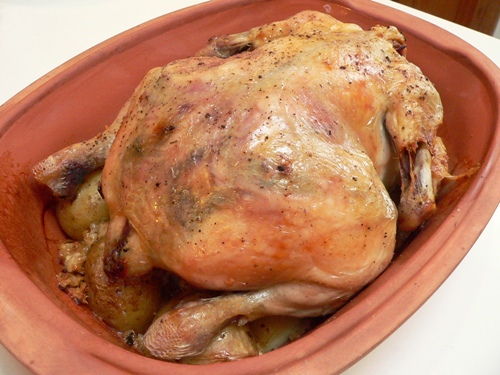
One roast chicken comfortably feeds all four of us, with nothing left over. Small Man eats the drumsticks and wings, Big Boy eats the thighs and a little of the breast meat, Pete eats the rest of the breast and I get the wonderfully bony backbone with all the bits of offal stuck to it!

Read Full Post »

During a recent freezer cleanout, I uncovered two packets of frozen giant marshmallows.

I turned one packet into marshmallow cookies – a favourite of Big Boy and his friends, although this time they were reasonably sized rather than ludicrous, as I had the foresight to cut the white pillows in half before encasing them in chocolate cookie dough.

Feeling lazy, I decided to try and make a slab with the remaining packet (wrapping dough around 25 marshmallow pieces had taken a looong time).

I made the same dough again, albeit with fewer added choc chips, and worked a thin layer over the bottom of a lined tray.  I topped this with whole marshmallows, and then tried to mould the remaining batter over the top.

The dough was very stiff, and in the end, it was just as fiddly as making the cookies (sigh) but the  result was this slightly mad bumpy terrain of marshmallow filled hills.  I had to stop Pete, who thought he could break them apart “like scones”.  (Edit: I think I’ll rename this dish Sheep in a Blanket.)

My mother always told me not to play with my food, but I don’t think she ever realised how much fun it could be!

Read Full Post »

Oh, these are so delicious.

Loathe to waste the six egg yolks leftover from our Mother’s Day pavlova, I used them to make two batches of our shortbread freezer cookie dough. I froze seven of the eight logs, but left one in the fridge to experiment with.

The following morning, I let the roll come to room temperature, then kneaded some very finely chopped crystallised ginger and bake-stable chocolate pieces into the dough.  I tried to make the inclusions as small as possible, to allow for a cleanly sliced cookie.  The dough was then reshaped into a log and popped back into the fridge to firm up, before slicing and baking in a 160C (fan) oven for 18 minutes.

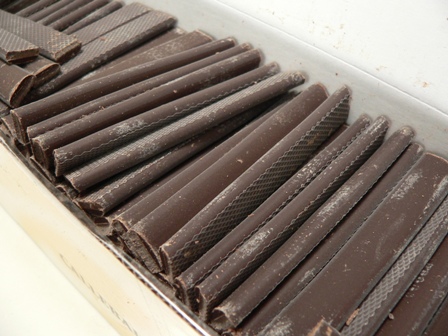
The end result is a moreishly crisp shortbread, with distinguishable bursts of flavour.  The bake-stable chocolate – the Callebaut baking sticks shown below – hold their shape in the oven, and as a result the cookies kept their variegated appearance, rather than being dotted with oozing melted chocolate chunks (which is usually a good thing, but not what I wanted in this case).

If you haven’t tried the shortbread cookie dough, I hope you’ll give it a go.  The original post  is here, and I’ve updated it to include cup measures and a printable version.

The shortbread is quite easy to make, providing you have a large mixer, and the frozen logs are a useful standby to keep in the freezer.  The dough is endlessly adaptable and makes a fantastic emergency gift or treat – you can have freshly baked cookies on the table within half an hour!

Read Full Post »

« Newer Posts - Older Posts »