Feeds:
Posts
Comments

Archive for the ‘Recipes’ Category

Here’s how the conversation started on Friday afternoon…

“MJ, I’m boiling a leg of lamb tonight, would you like to come over? Ummm…I should mention that I have no idea how it’s going to work out, but since you’re family, I’m sure you won’t mind if it’s a disaster and we have to order Thai takeaway…”

Pete’s cousin later recounted that the first thing that came to her mind was..“Boiling lamb? For goodness sake, just don’t!”

This recipe, inspired by an episode of Rick Stein’s Food Heroes of Britain, is an absolute winner and quite different to anything I’ve ever cooked  or eaten before.

In Australia, a leg of lamb is almost always baked or, in recent years, butterflied and barbequed.  But it wasn’t something I grew up eating at all – being Chinese, the only thing my mum ever did with her oven was use it as a cupboard to store plates in.  For years, I never understood why people actually needed to clean their ovens…

Anyway, this recipe is apparently not uncommon in the UK, and it’s a really delicious way to cook lamb.  The meat is tender and moist, and you have the added bonus of some wonderful brown stock to stash in the freezer at the end of the cooking process.  It’s traditionally made with mutton, but that’s hard to source from our local butcher.  The quantities are pretty flexible, as is often the case with this style of cooking.

When I went to prepare the dish, I found that the lamb didn’t fit into the pot, so I drove back to the butcher to ask him to cut the shank off for me.  He laughed and showed me a joint half-way up the leg, then cut through it with his large knife and bent the shank over.  If you’re buying a leg of lamb or mutton for this purpose, you might want to ask your butcher to nick that joint for you – it’ll make it much easier to manoeuvre the big bone into the pot.

  • 1 large leg of lamb (or leg of mutton) – mine was about 2.7kg
  • lots of carrots and onions, peeled and chopped
  • peppercorns
  • sprig of fresh or good pinch of dried rosemary
  • generous amount of salt to season
  • butter and/or olive oil
  • ¼ cup plain flour
  • 2 heaped teaspoons capers

1. Sit the lamb in a large cast iron cooking pot (I used a 30cm Le Creuset dutch oven) and cover it with the carrots, onions, and peppercorns.  Place the sprig of rosemary on top, or scatter with the dried rosemary.  Scatter over the salt, then add enough water to just barely cover the meat.

2. Cover with the lid and cook on the hob over a medium heat until just boiling, then reduce the heat to low and simmer gently for 2 – 3 hours, depending on the size of your lamb and how you prefer your meat  to be cooked.  Carefully turn the joint over about half way through the cooking time, and top up with a little extra water if needed.  Taste the stock for seasoning and adjust if necessary.

I used a probe thermometer to check the meat – 65C for medium or 80C for well done – and removed it from the pot once the internal temperature exceeded 70C.  It continued to cook further as it rested.

3. With a ladle, scoop out some of the stock and pass it through a sieve into a separate bowl. Melt some butter and olive oil in a small saucepan, then add the plain flour and cook it through, but don’t allow the roux to brown.  Add the strained stock and heat gently until thickened, then stir in the capers.  Plate up the sliced meat with some of the cooking vegetables and the caper sauce.  We served the dish with King Edward potato wedges (just to keep it all very British!).

Read Full Post »

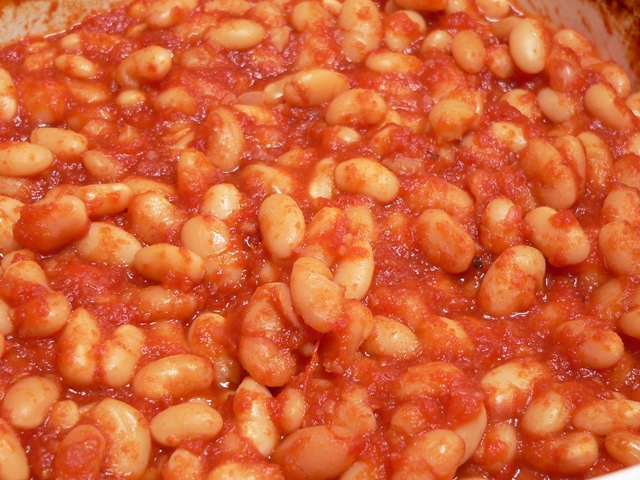
Have you ever made your own baked beans?

It’s easy to do and Big Boy absolutely loves them (Small Man still prefers the ones that come out of a tin, but we’re working on him).  They’re also very economical – today’s batch cost us less than $3.

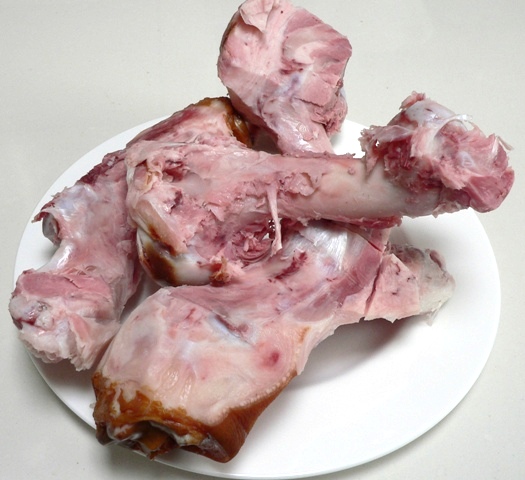
My friends at Paesanella always save their ham bones for me, and they add a delicious flavour to the beans. You could use smoked bacon ribs for this recipe, although the dish will be slightly saltier, so you might need to adjust your seasonings accordingly.

Homemade Baked Beans
(inspired by a recipe in Old Food, by Jill Dupleix)

  • 500g dried beans (I used Great Northern Beans)
  • 1 ham bone
  • 500ml tomato passata (we used Pete’s homemade version)
  • 2 Tablespoons brown sugar
  • 1 – 2 teaspoon salt (to taste)
  • 500ml  (2 cups) water
  • 1 Tablespoon Worcestershire sauce
  • 1 bay leaf

1. Soak the beans in plenty of cold water overnight.  The next day, drain well and put them into a large pot with fresh water.  Boil until just tender.  This took about half an hour, but will vary according to the type of beans used.  You could cook these in a pressure cooker, but I’ve never managed to do this successfully – I always end up with mushy beans and lots of foam.

2. Drain the beans in a colander and rinse them under cold water to stop them cooking any further.  Preheat oven to 150C with fan.

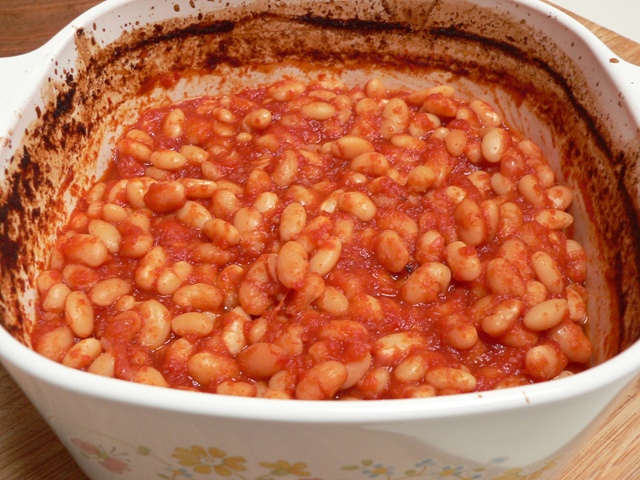
3. In a large ovenproof pot (I used a Corningware casserole with lid), place the bone and the drained cooked beans.  Whisk together the passata, sugar, salt, Worchestershire sauce, bay leaf and water.  Taste the sauce, and adjust seasonings if necessary.  Pour over the bone and beans.

4. Bake covered for 1½ – 2 hours, then remove the ham bone and strip any meat off them.  Discarding the bone, add the meat back into the pot (if you wish) and give it a good stir, then put it back in the oven and bake for a further hour or so, uncovered, or until the beans are cooked to your liking.  Add a little more water if the beans get too dry. Taste again for seasoning and adjust if necessary.

We froze our baked beans in small containers, but they will also keep for a few days in the fridge.  The boys had baked beans on sourdough toast for lunch today!

Read Full Post »

This is so simple that I’m a bit embarrassed to be blogging about it!

After watching Willie’s Wonky Chocolate Factory – a television series about Willie Harcourt-Cooze and his attempt to establish his line of chocolate in the UK – I was inspired to try my own version of his chocolate shot recipe.

The beverage he prepared appeared to be nothing more than 100% cacao chocolate dissolved in boiling water.  As we can’t get 100% here in Australia, I tried using my Callebaut 70% callets.  What I ended up with is a deliciously dark hot chocolate – reminiscent in some ways of an espresso coffee.  It’s won Pete the non-coffee drinker over, and is certainly a nice way to get your daily chocolate antioxidants!

It’s dead simple to prepare, simply dissolve 40g of dark chocolate in two-thirds of a cup of boiling water (this makes enough for two espresso sized cups).  You’ll need a little whizzer to mix it all together – the Callebaut callets melt away easily. If you don’t have one, try using a small whisk, or dissolving the chocolate and water together in a saucepan over a low heat.  Simply stirring with a spoon doesn’t seem to work, as you end up with sludge at the bottom of the cup.

I’ve also tried this with 85% Lindt, but found it too sour for my liking.  It’s an interesting way to compare pure chocolate flavours!

Read Full Post »

Two last minute items that we’re making – both of which will be included in our mini Christmas hampers!

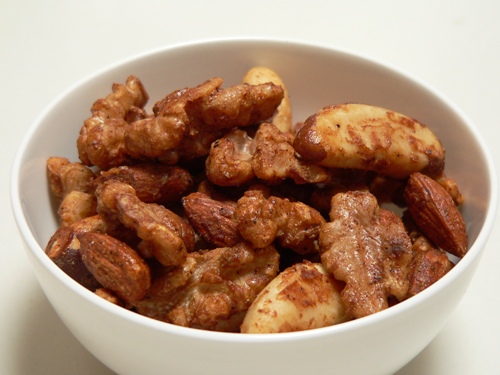
Hugh Fearnley-Whittingstall’s Spiced Nuts were a perfect way to use up the leftovers from our Fruit and Nut cakes (thanks for sending me the recipe, Joanna!). The instructions are here, and the only changes I made were to omit the five spice powder, which I didn’t have on hand, and to replace the muscovado sugar with regular brown sugar (I’m not going anywhere near the shops today!).

. . . . .

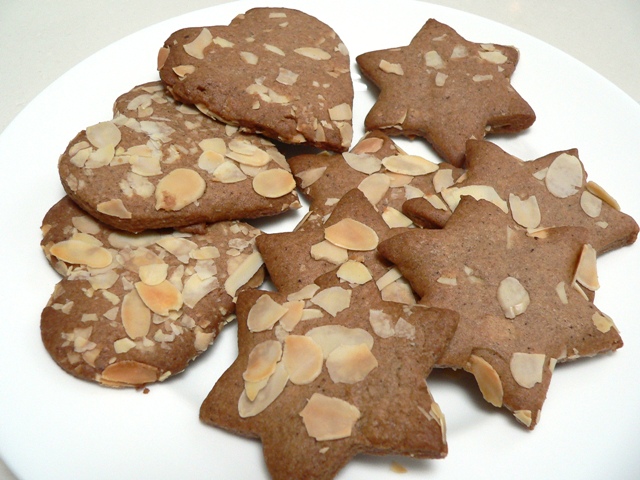
These are my attempt at Speculaas, a Dutch spice cookies similar to gingerbread. I know it’s tragically corny, but we’ve been referring to them as “Spectacular Speculaas”.

My friend Maureen emailed me her recipe a week ago, and I’ve made two batches – the first batch rolled thinly with flaked almonds scattered over the surface, and the second with the almonds worked into the dough.  The latter are thicker, with a small hole in each, allowing the cookie to be hung on the Christmas tree.

  • 500g plain flour
  • 250g cold unsalted butter, cut into small pieces
  • 250g brown sugar
  • 1/4 teaspoon salt
  • 2 teaspoons baking powder
  • 3 teaspoons cinnamon
  • 2 teaspoons nutmeg
  • 1 teaspoon ground cloves
  • 1 teaspoon ground ginger
  • 1 teaspoon ground anise seed
  • 150 g flaked almonds
  • 2 large (59g) eggs, lightly beaten
  • 2 teaspoons vanilla essence (we used homemade)

1.  In a large mixing bowl, whisk together the flour, baking powder, sugar, salt and spices.  Add the butter and rub it in until the mixture resembles coarse breadcrumbs.

2. Add the eggs and vanilla and work the mixture together to form a dough.  You can gently add in the almonds at this point if you wish, although it does make the dough more crumbly and therefore harder to roll out.  Wrap well and refrigerate for several hours or overnight.

3. Remove the dough from the fridge and allow it to soften slightly.  Preheat the oven to 180C (or 160C with fan).

4. On a large sheet of parchment paper, roll out half the dough using a floured rolling pin. Roll to a thickness of approximately 3mm, or slightly thicker if you’re planning to use the cookies as ornaments.  If you haven’t already worked the almonds into the mix, scatter half of them over the surface of the dough now, then cut with cookie cutters into Christmassy shapes.  Use a drinking straw to add a stringing hole if desired.  Repeat with the  remaining dough.

5. Place the cookies on a baking sheet lined with parchment paper and bake for 12 – 15 minutes.  Allow to cool on a wire rack.

Read Full Post »

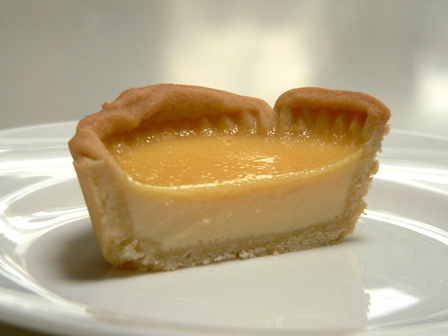
Dan the Man (aka Dan Lepard) created this recipe for bay custard tarts several months ago, and I’ve been wanting to try it ever since.  Today was the perfect opportunity – I had leftover shortcrust pastry (June’s recipe) in the fridge, and an abundance of eggs.

The tarts are very moreish, and a little too easy to eat!

Read Full Post »

« Newer Posts - Older Posts »