Feeds:
Posts
Comments

Archive for the ‘Recipes’ Category

040409-022

In hindsight, my first attempt at poppy seed beigli was a little sad.  Not really knowing what I was doing, I used a tinned poppy seed filling which, as June gently scolded, was spread too thin. (Actually, I think the word she used was “stingy”, but in the nicest possible way).

040409-010

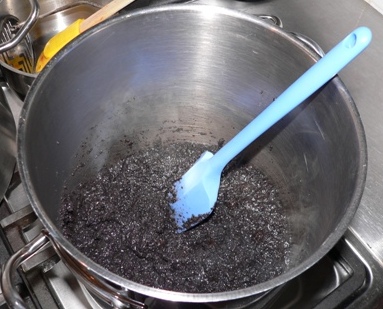
Yesterday, determined to try again, I dug out my beautiful new spice grinder, bought from Herbie’s Spices with my birthday money, and proceeded to grind the poppy seeds required to make the filling from scratch.  I followed the recipe I’d posted earlier, but doubled the amount of filling (I’d hate to be thought of as stingy!).  Poor June – I rang her frantically at 8.15am to ask her what consistency my filling needed to be and she explained that it had to cook until it was “crumbly”.  If you do make this recipe, be aware that you need to watch the filling while it’s on the stove to ensure it doesn’t burn and stick – it’s a very thick paste before you even start.

040409-0111

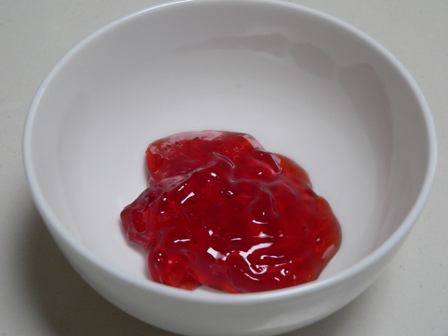
The other difference was the addition of some homemade apricot jam, which lifted the sweetness a notch and made the rolls just that little bit richer.

I’m pretty happy with these now – as were all the friends whom I delivered rolls to yesterday afternoon!

Read Full Post »

Quinces

050409-0511

The wonderful Dot, chef extraordinaire, dropped around a bag of ripe yellow quinces last week.  Pete and I were pretty excited – we’ve bought lots of quince paste in the past, but had never attempted making our own.

After some research, we decided to try our hand at quince jelly – a process which involved washing and chopping up the whole fruit, then boiling it down to mush in water.  Like apple jelly, the whole lot is then drained through calico and allowed to drip through.  We were surprised by how viscous the quince juice was – it didn’t drip much at all – and the calico was probably too thick for this purpose.  We weren’t able to squeeze the fruit pulp, as that creates cloudy jelly, so Pete reboiled the quinces in more water and let them drain a second time to get more liquid out of them.  The quinces produced a wonderful aroma on cooking – a gorgeous, sweet, floral scent which lingered in the kitchen for ages.

The drained juice was boiled up, lemon juice, sugar and homemade pectin added and this gorgeous red jelly was the end result.

050409-050

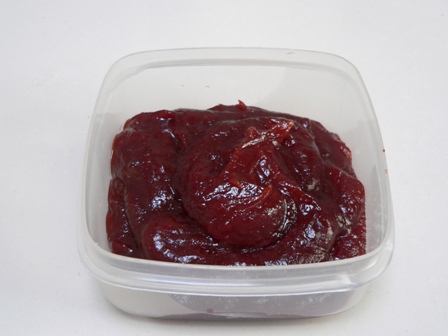
I’d read on the internet that it was possible to reuse all the pulp to make quince paste, so I dutifully dug out the food mill and processed all the leftovers, discarding the seeds and skins.  What I hadn’t read was how gritty the pulp actually is – I ended up having to sieve the puree before putting it all into a large baking tray, with sugar, and allowing it to bake for several hours in the oven until thick.  The quince paste is delicious and worth the effort (just), but I can see why people pay lots of money to buy it!

050409-058

It’s astonishing how much flavour the quinces had to offer.  We were able to use every last bit of them to produce nine jars of jelly and four jars of paste!

Read Full Post »

cake-002

This is based on a recipe I tore out of a cooking magazine ages ago.  The ingredients are great, but the original methodology was daft – it involved throwing everything into the food processor and whizzing, which didn’t cream the butter and sugar at all.  I reworked it using more traditional techniques and it’s become a recipe that I make all the time – simple to put together and easy to eat, without being heavy or cloying. It’s a good keeper too – the buttermilk helps it to stay moist for several days.

Buttermilk freezes very well, which is handy as I rarely get through an entire carton before it expires.  I portion it out into ziplock bags and freeze it, usually in one cup serves.

I bake this recipe in a cast aluminium bundt pan and dress it with a simple dusting of icing sugar.

  • 1 and 1/3 cups (200g) self raising flour
  • 150g almond meal
  • 200g caster (superfine) sugar
  • 175g unsalted butter, softened
  • 150ml buttermilk
  • 3 large free-range eggs
  • 1 tsp vanilla extract
  • finely grated zest of 1 lemon (optional)
  • jam/lemon curd

1. Cream together butter, sugar and zest, then mix in eggs and vanilla, beat well. Scrape down sides of bowl.

2. Stir together flour and almond meal in a separate bowl.

3. Into the butter/sugar/egg, mix in half the flour/almond, then the buttermilk, then the rest of the flour/almonds, mixing well after each addition.

4. Spoon half the mix into a well-oiled bundt pan, add some jam or lemon curd, then top with remaining mix, and bake in a preheated oven at 175C  for 40 – 45mins.

5. Allow to cool in pan for 10 minutes, then turn onto wire rack to cool completely.  Dust with icing sugar before serving.

If you’re using a cast aluminium bundt, you’ll need to drop the oven temperature to about 160C.  Also, the jam is optional and it may occasionally fall through to the bottom of the pan.  The cake should work well unfilled – we just have so much jam that we’re always looking for ways to use it!

Read Full Post »

040409-020

This recipe is a family standby.  It is almost universally loved and yet so very easy to throw together.  I make it as a lunch treat, send it in with Big Boy for “Feed the Friends Friday”, and every year bake enough to feed the school orchestra before their major performances.

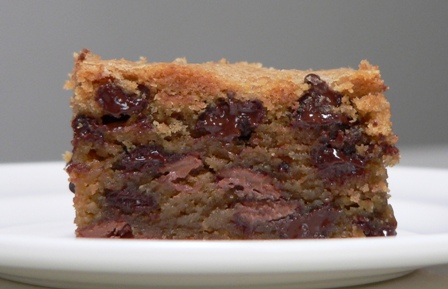
As Small Man is allergic to walnuts and pecans, we’ve excluded the nuts specified in the original Mrs Field’s recipe and substituted more chocolate instead.  I have to admit that I do get a little obsessive about the chocolate in my butterscotch bars.  I like to have at least three different sorts in the mix, and have occasionally had as many as five.  It has to be the best chocolate you can manage – that’s what elicits the oohs and ahhs on tasting.  These days we always use Callebaut chocolate, but I’ve also used chopped up bars of Lindt with great success.  One year I had a large supply of Lindt Christmas balls, which went in whole, producing round orbs of milk chocolate within the finished bar.  I always use a mix of dark and milk chocolates, but never white (I’ve tried it, but the end result is too sweet for our tastes).  Often I’ll use three different sorts of dark chocolate – broken up baking sticks (which don’t melt in the oven), 54% callets (which do melt) and 70% callets (which give the bars an extra depth of flavour).  It does get a little over the top at times…

040409-015

  • 2 cups (300g) plain (AP) flour
  • ½ tsp bicarbonate of soda (baking soda) – sifted
  • 1 cup (215g) dark brown sugar, firmly packed
  • 1 cup (250g) unsalted butter, softened
  • 1 large (59g) egg
  • 2 tsp pure vanilla extract
  • 2½ cups (360g) mixed chocolate chips (I use Callebaut dark and milk)

1. Preheat oven to 150 C (300F) with fan. Grease or line an 8″ (20cm) square pan with Bake.

2. Combine flour and soda in a medium bowl, stirring well with a wire whisk.  Add the chocolate chips, and stir to combine.

3. In a large mixing bowl, blend the butter and sugar together using an electric mixer, then add the egg and vanilla.  Beat until light and smooth.  Scrape down the bowl, then add the flour and chocolate chips.  Blend at low speed until just combined – do not overmix.

4. Spoon the finished mix into the baking pan and level the top off.  Bake for 35 – 45 minutes or until a thin sharp knife inserted into the centre comes out clean of cake mixture (ignore the melted chocolate).  Do not overbake.

040409-016

5. Leave the bars in their pan and cool the whole thing on a wire rack.  When cool, cut into bars and serve.  These freeze very well and defrost perfectly by lunch time, making them an ideal school treat.

Click here for a printable version of this recipe

040409-017

Read Full Post »

Hot cross buns…one a penny, two a penny…hot cross buns…

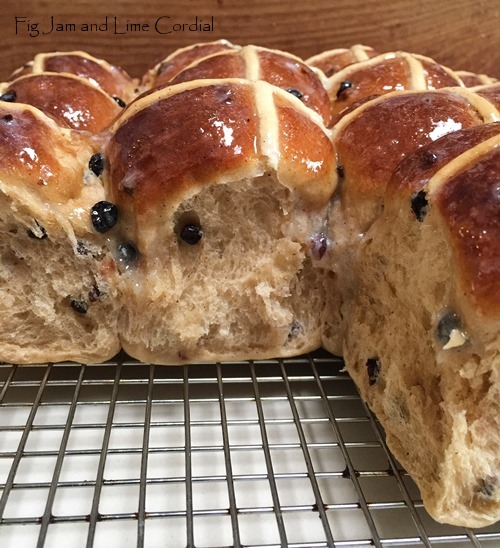
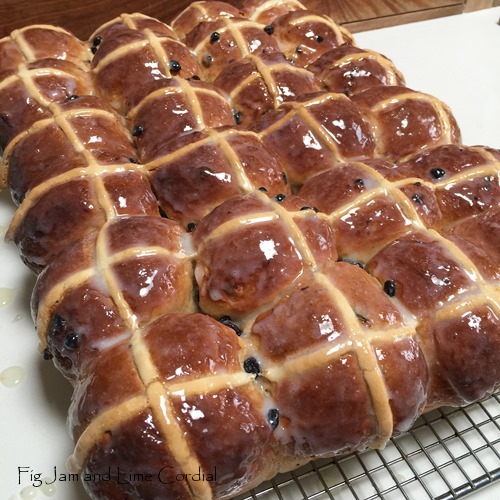
I’ve baked 48 hot cross buns in the last 48 hours and now have two recipes that I’m happy with. The first recipe is a sourdough one and it’s Pete’s favourite, but it takes a lot more time and a bit more effort.

The second recipe is far easier (and Small Man’s bun of choice) and uses commercial yeast, so it’s much quicker to make.  It’s loosely based on Richard Bertinet’s sweet dough recipe, which we’ve changed up quite a bit over time. I wrote a detailed tutorial on our version here.

Dough

  • 500g bread flour
  • 10g instant yeast
  • 8g fine sea salt
  • 40g brown sugar
  • 60g unsalted butter
  • 2 large eggs
  • 2 tsp mixed spice
  • 75g currants
  • 250g full cream milk, heated gently and then cooled to blood temperature, or UHT milk, unrefrigerated

Cross

  • 3 Tbsp self raising flour
  • 2 Tbsp cold water

Glaze

  • 2 Tbsp milk
  • 2 Tbsp caster (superfine) sugar

(Update 11th April 2017) I’ve simplified the instructions for making the dough – after quite a lot of testing, we’ve found that the extended kneading process really isn’t necessary.

The dough can also be made in a stand mixer using a dough hook. In that case, melt the butter first and add it with the wet ingredients. Mix to form the dough, then turn off the machine and let the dough rest for half an hour or so, covered with a tea towel (I just leave the splash guard on). Then turn the machine on again and knead for a few minutes more. Scrape the hook clean, then proceed from step 4 onwards.

1. In a large mixing bowl, whisk together the bread flour, yeast, mixed spice and sea salt. Rub in the butter. Stir in the brown sugar and currants, then add the eggs and milk.(Note: I use UHT full cream milk, unrefrigerated and straight out of the carton)

2. Mix well with a spatula or a clean hand until it forms a shaggy dough. Allow the dough to sit in the mixing bowl, covered with a clean tea towel or clingfilm, for about 20 minutes.

3. Uncover the bowl and give the dough a brief knead. I usually fold the dough onto itself a few times using a scraper.

4. Cover the bowl with clingfilm and allow to rise on the bench until doubled in size (about 1 – 1½ hours, depending on ambient temperature – don’t rush it).

5. Turn the risen dough onto a floured bench and give it a couple of gentle folds, then divide into 12 equal pieces (about 86-90g each). Shape each piece into a small ball, trying to keep the currants inside the ball as much as possible (currants on the outside tend to burn). Place them side by side in a lamington tin which has been lined with a sheet of parchment paper (four rows of three, not quite touching – they’ll rise into each other). Allow to rise, loosely covered with a tea towel, until doubled in size (mine took about an hour, don’t rush this bit either, let them get good and puffy). Preheat oven to 220C with fan.

6. Mix the SR flour and water together to make a paste and spoon that into a plastic freezer bag or small piping bag. Clip off the very end of one corner. Pipe crosses over the top of the buns, doing all the lines in one direction first, then the other. Spritz the tops with water.

7. Turn the oven down to 200C with fan and put the buns in. After 10 minutes, turn the buns around and bake for a further 8 – 10 minutes, or until golden brown.

8. When you’ve rotated the buns, start making the glaze. Heat the milk and caster sugar together in a small saucepan until thick and syrupy. Stir constantly and keep an eye on it to make sure it doesn’t boil over. When the buns are finished, pull them out of the oven and glaze the hot buns with two coats of glaze. Allow to cool on a wire rack before scoffing.

Enjoy!
If you’d like to try a sourdough version of these, the recipe is here.

Read Full Post »

« Newer Posts - Older Posts »