Feeds:
Posts
Comments

Archive for the ‘Recipes’ Category

bread-making-3-025

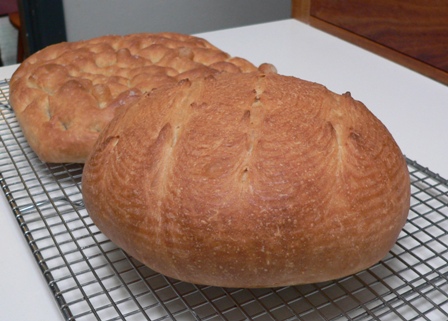
Baking your own bread is one of the most rewarding things you can do.  If you’ve never tried before, or you’re daunted by the prospect of it, please let me assure you that it’s a relatively simple process.  You can have a decent loaf of bread from start to finish in two to three hours (depending on the ambient temperature) and for most of that time the bread is simply rising or baking on its own while you get on with other things.  We’ve been making all our own bread for years now, and this is where we started (although we’ve since moved to sourdough rather than yeast).

The most important thing to know is this – the quality of your bread and how much it rises is almost completely contingent upon the flour you use.  If you can’t get a decent high-protein bread flour, then wait until you can, because if you make bread with plain flour, you’ll be disillusioned and won’t try again.  The gluten protein in the flour must be high enough for the yeast to make the bread rise.  Fortunately, bread flour, also known as bakers flour, is now readily available in most supermarkets.  Here, with lots of photos and videos, is how I make basic yeasted bread.  The recipe is based on Richard Bertinet’s olive dough and it’s very versatile – you can shape it into rolls, loaves, epi, stuff it with interesting fillings, or spread it out flat and make pizza (it actually works brilliantly as pizza dough).

  • 500g bread or bakers flour
  • 10g dried yeast (or one sachet)
  • 8g fine sea salt
  • 320g water (weigh it if you can, as you’ll get a more accurate result. If not, use 320ml)
  • 50g olive oil (I use extra virgin)

Bread #101 – A Basic Tutorial continues here…

Read Full Post »

080409-003

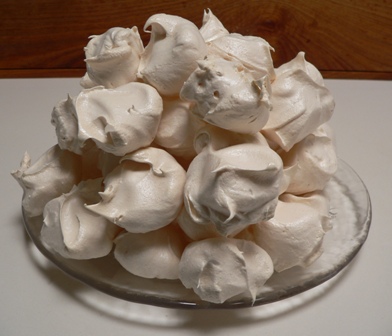
Can you believe this mountain of meringues was made from just four egg whites?  They were leftover from Pete’s pasticcio and I was loathe to waste them.  I’ve frozen half of these meringues and left the remainder in the cookie jar for emergency sugar hits.

Meringues are the easiest thing ever – for each egg white, you’ll need 60 grams  (2oz) of caster (superfine) sugar and a tiny bit of vanilla.  My batch of four whites used 240g caster sugar and ½ teaspoon of vanilla.

Preheat the oven to 150C (300F).  Beat the egg whites with an electric mixer until stiff, then gradually (a spoonful at a time) beat in the sugar.  Add the vanilla and continue beating, until your mixture is thick and glossy.

Drop dessertspoon dollops of the mixture onto baking trays lined with parchment paper.  You should have enough to make a ludicrous number of meringues.  Put the trays into the oven, and immediately drop the oven temperature to 110C (230F) or 100C (210F) with fan.  Allow the trays to bake until the meringues are light and crisp, about 65 – 75 minutes.  This makes a dry, crunchy meringue that will keep well – if you want a more marshmallow centre, you’ll need to bake them for less time on a slightly higher heat.  It’s worth playing around with small batches until you’re happy with them (after all, it’s only a couple of egg whites and some sugar).

Once the meringues are cooked, allow them to cool in the oven with the door slightly ajar.  This will give them a chance to dry out properly, without getting too sticky on the outside.  For some reason it’s quite hard to make meringues on a humid day – the end result is often a bit gummy and soft.  Enjoy!

. . . . .

Edit: You can also make swirly meringues – a very girly party favourite!

Read Full Post »

080409-017

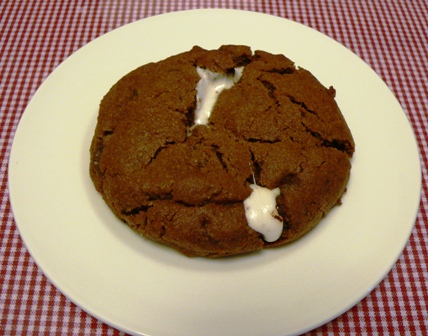
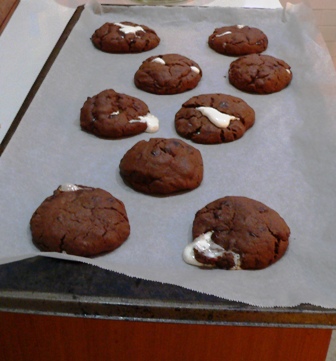
Please forgive me for being cocky, but these cookies are a work of art.  They are the most wickedly delicious sweet treat ever.  Basically they’re a classy Wagon Wheel or S’more – with a marshmallow centre encased in chocolate cookie dough. These are huge, weighing in at about three times the size of a normal cookie. (By the way, that’s a side plate in the photo above, not a dinner plate.)

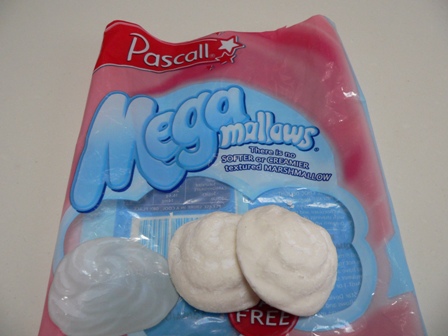
The original Mrs Field’s recipe involved wrapping the dough around mini marshmallows, but I found that far too annoying, so I now use a frozen mega marshmallow instead.  It does mean that instead of the recommended 42 cookies, I’m lucky to get 18 out of the same batch of dough.  There’s a lot of finesse to the baking of these cookies – right near the end you have to watch them like a hawk, as an extra minute can turn them from elegance to mush.  As you can probably see from my photos, I was about 30 seconds too late – you really want to pull them out just as the first one starts to ooze melted marshmallow.  Having said that, it doesn’t make much difference – they’ll be gooey and sticky no matter what you do – and that’s a large part of their charm.

  • 450g (3 cups) plain (all-purpose) flour
  • 75g (2/3 cup) unsweetened cocoa
  • ½ tsp bicarbonate of soda (baking soda)
  • 220g (1 cup) white sugar
  • 215g  (1 cup, packed) brown sugar
  • 250g (1 cup) unsalted butter, softened
  • 2 large (59g) eggs
  • 2 teaspoons vanilla extract
  • 1 pkt (about 18) Pascalls Mega Marshmallows, frozen
  • 350g (12oz) dark chocolate chips (we used Callebaut callets)

1. Preheat the oven to 175C (350F) with fan.  Leave the marshmallows in the freezer until after you’ve made the dough.

090409-002

2. In a medium bowl, whisk together the flour, sifted cocoa (if you don’t sift, you’ll get bitter lumps in the finished cookie) and sifted bicarb soda.

3. In a large mixing bowl, cream together the butter and sugars with an electric mixer.  Scrape down the sides of the bowl.  Add the eggs and vanilla, and beat at medium speed until combined.

4. Add the flour mixture and choc chips and mix at low speed until combined.  The batter will be stiff – do not overmix – just run the machine until there’s no more dry flour visible.

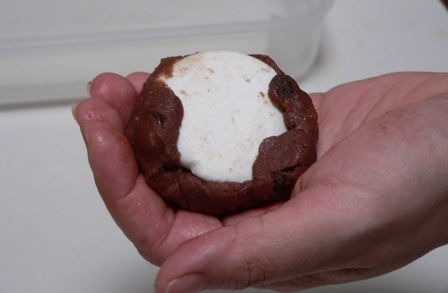
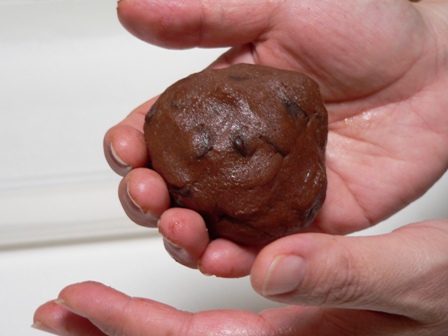
5. Wrap the mix around a frozen marshmallow as shown – you want to pat them a bit flatter than the photo below, so that they form a thick disc rather than a small cricket ball.  I realise it’s a ridiculous amount of cookie mix; I think that every time I make these.  Put all the finished cookies (I always get between 16 – 18 cookies) onto a tray and pop them into the freezer for about 30 minutes.  This refreezes the marshmallows and increases your chances of getting intact finished cookies.

080409-005

080409-006

6. Place the cookies on baking trays lined with parchment paper.  Leave lots of room between them, as they’ll spread quite a lot.  Bake for 10 – 13 minutes, depending on how frozen your dough was.  Don’t leave the kitchen, sit there and watch them for the last half of the baking time, as you want to pull them out the second the first one looks like it’s going to ooze its marshmallow guts.  You might want to reverse the trays halfway through the specified time, to ensure even baking.

7. Take the cookies out and let them cool for 5 minutes on the tray, before transferring them to a cool flat service.  I usually drag the whole sheet of Bake onto the stone bench rather than bothering with a rack, as they’re so sticky that the racks get covered in melted marshmallow.  Handle them with care – they’ll sink a bit as they cool and become easier to manage.  The marshmallow cools to a sticky glue, so feel free to push any deformed cookies back together while they’re still warm (don’t burn yourself!).

080409-012

Big Boy took these to school for Easter, individually wrapped in greaseproof paper. They really are a special occasion cookie – you just couldn’t eat these every day!

Click here for a printable version of this recipe

Read Full Post »

pasticcio-005

We hadn’t seen Moo in seven years.  So when he rang a few days ago and asked what we were doing the following night, my instant reply was, “Nothing I can’t cancel”.   We had a wonderful night catching up, discussing everything from sharks’ teeth fossils to remote controlled helicopters.

About ten years ago, Moo (Michael to his work colleagues) sent us a homemade Christmas card shaped as a 3D star.  He’d spent ages cutting out the little points with a Stanley knife.  It hung on our tree for years, until the cardboard finally wore out.  I’ve asked him to send me a new star for the tree this Christmas!

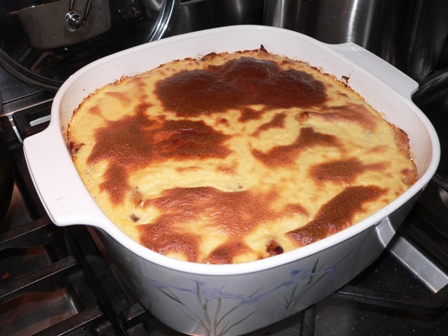
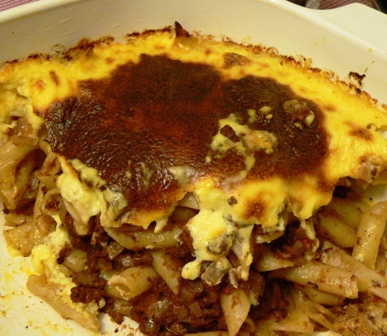
Good conversation is always enhanced by easy comfort food, and Pete’s pasticcio is as easy and comforting as they come.  Well, easy because I didn’t have to make it, but comforting and flavoursome nonetheless.  It’s a traditional Greek dish, characterised by the addition of cinnamon, which fills the kitchen with a delicious aroma as it bakes, and smothered in a golden bechamel , enriched with egg yolks.

  • 2 Tbsp olive oil
  • 2 onions, chopped
  • 500g minced lamb
  • 1 tsp cinnamon
  • 3 tsp dried oregano (if you can find Greek rigani, all the better)
  • 250ml (1 cup) red wine
  • 150g tomato paste (we used homemade, so it wasn’t quite as salty or thick)
  • 500g penne pasta (dried)
  • 125g salted butter
  • ¼ cup plain flour
  • 750ml (3 cups) milk
  • 80g (1 cup) grated pecorino or romano cheese
  • 4 egg yolks

1. Preheat oven to 180C.  Grease a deep baking dish or tray.

2. Heat oil in a large frying pan and cook the onion until soft.  Mix the cinnamon into the meat, then add this to the pan, breaking up the lumps and cooking for 5 minutes until brown and cooked through.  Stir through the oregano, red wine, tomato paste and 2 cups of water.  Reduce the heat and simmer for 45 minutes until the sauce has reduced and thickened.  Season to taste.

3. Cook the pasta in a large pan of boiling water for 10 – 12 minutes until just tender.  Drain and return to the pan.  Stir through the mince sauce, then spoon into the baking dish.

4. Melt the butter in a large saucepan and add flour.  Stirring, cook for one minute, then whisk in the milk until smooth.  Reduce the heat and whisk until the sauce is smooth and thickened.  Remove from the heat and whisk in the cheese and egg yolks (stir fast, so the yolks dissolve in rather than scrambling).

5. Spread the sauce over the pasta and bake for 30 minutes until golden, then rest in the dish for 10 minutes before serving.  Any leftovers reheat brilliantly the next day!

pasticcio-011

Read Full Post »

white-choc-cake-003

. . . . .

Joyce is my tribe.

A year or so ago, after an enjoyable café lunch, the Yummy Mummies had time to kill and wanted to spend it in a recently opened shabby chic store, full of cut crystal and vintage lace pillowcases.  I was appalled and lobbied very hard for a visit to the butchers instead (“maybe he’ll have beef cheeks this week!”), but my pleas fell on deaf ears.  When I complained to Pete, he said, “Joyce would have gone to the butchers with you.  She’s your tribe.”

Now that you know that, you can probably understand her pain at being without an oven for five months whilst her kitchen is being renovated.  One afternoon last week, the doorbell rang and there was Joyce, looking slightly harassed and asking, “Do you have any baked goods?  We’re desperate!”

Of course, we always have cakes and cookies of one sort or another, so I sent her home with a care package.  When she came to pick up a refill on the weekend, her son Red Roars, whom I adore, sidled up to me and said, “Auntie Celia”…(he only calls me that when he wants something)…”could you please bake me a birthday cake?” How could I  refuse?

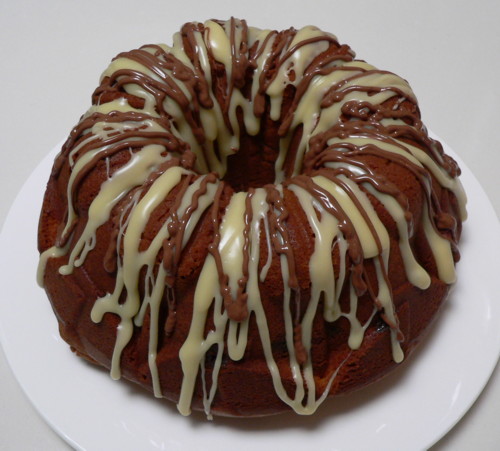
This white chocolate bundt cake is a tried and tested Mrs Fields recipe from her Great American Desserts cookbook.  It is Big Boy’s all time favourite treat.  The white chocolate you use will determine whether your cake is good or great – we use Callebaut, but I’ve successfully used white Lindt in the past.  I’ve substituted Greek yoghurt for the original sour cream with no ill effect – if anything, it’s a little lighter and easier to eat with the reduced fat content.  I finish the cake by either dusting it with icing sugar, or drizzling white and milk chocolate over the top, depending on how energetic I’m feeling.

White Chocolate Bundt Cake

  • 450g (3 cups) plain (AP) flour
  • 1 tsp baking powder
  • ¼ tsp bicarbonate of soda (baking soda)
  • ½ tsp salt
  • 250g (2 sticks/1 cup) unsalted butter, softened
  • 440g (2 cups) white sugar
  • 1½ tsp pure vanilla extract
  • 5 large (59g) eggs, at room temperature
  • 115g (4oz) white chocolate, melted and still warm
  • 250g (1 cup) thick Greek yoghurt
  • 115g (4oz) white chocolate chunks or chips

Topping  (optional)

  • 115g (4oz) white chocolate
  • 65ml (¼ cup) heavy cream
  • 115g (4oz) milk chocolate

1. Preheat oven to160C (320F) with fan.  Spray a 12 cup cast aluminium bundt pan with oil (I never bother dusting with flour, as the non-stick pans are really very good). Note that the original oven temperature was 175C (350F), but I always drop it down a little for the cast aluminium pans.

2. In a bowl, sift together flour, baking powder, baking soda and salt.

3. Cream the butter and sugar in a large bowl using an electric mixer on medium speed until light and fluffy.  Add the vanilla and the eggs, one at a time, beating for 20 seconds after each addition.  Slowly beat in the melted white chocolate.  Scrape down the bowl.

4. Add the flour mixture to the butter in thirds, alternating with the Greek yoghurt.  Beat for 45 seconds after each addition.  You want to end with flour  rather than yoghurt (improves the final texture of the batter). Place the batter in the pan in three layers, separating each layer with the white chocolate chips.

5. Bake for 55 – 60 minutes (I start checking it after 45 minutes) – the top will be brown and a sharp thin knife inserted in the centre will come out with a few crumbs on it.  Allow the cake to cool in its tin for 15 minutes (don’t be impatient), then gently loosen around the edges before inverting onto a wire rack to allow the cake to finish cooling at room temperature.

Topping (optional)

1. Original instructions : In a glass or ceramic bowl, heat the white chocolate with the cream on high until just melted – stir until smooth.  Allow to cool for 10 minutes, then drizzle over the cake.

2. In a separate bowl, heat the milk chocolate in the microwave until just melted – stir until smooth.  Drizzle over the cake.

I’ve never had much success with the white chocolate ganache (it always turns out too runny), so often I’ll just melt white and milk chocolate (separately) in the microwave and drizzle both over the top of the cake (which is what I’ve done in the photo above).  And whilst the chocolate topping does make the cake extra special, it’s really fantastically flavoured and works almost as well with just a dusting of icing sugar.

This is a very flexible recipe, which works well in smaller sizes – cupcakes or fancy mini tins – just adjust the time accordingly to ensure the cakes don’t overbrown.  Most bundt pans I’ve seen are a 10 cup capacity rather than 12, so you’ll have excess batter for baking little extras!

Click here for a printable version of this recipe

Read Full Post »
« Newer Posts - Older Posts »