Feeds:
Posts
Comments

Archive for the ‘Recipes’ Category

gfpb-cookiesq2

Pete A (so designated to distinguish him from Pete D, Pete V, Pete L and my Pete) is “allergic” to wheat.  At least that’s how Small Man describes it – what he actually has is coeliacs disease, which means his body can’t process gluten in any form. I’ve made it my quest to find him gluten-free treats which pass muster, with a particular focus on those that will satisfy his chocoholic tendencies (Pete is the proud and occasionally indulgent sire of the Boy Wonder, should anyone wish to join the dots).

Over the last few years, I’ve tried everything from tricky recipes which were no more than cream, butter and chocolate, held together by happy thoughts and fairy dust, to dead simple ones which are almost foolproof.  This is definitely one of the latter!

Edit: I’ve just realised that if you choose your chocolate chips carefully (read the label – most dark chocolate doesn’t contain any dairy), this recipe can be lactose-free as well as gluten-free.

Flourless Peanut Butter and Chocolate Chip Cookies

(based on a recipe from Bon Appetit, September 1999)

  • 1 cup chunky unsalted peanut butter (note: if you’re in Australia, the best one I’ve found is the Sanitarium 100% Natural Chunky Peanut Butter – give it a good stir before you start)
  • 1 cup (packed) dark brown sugar
  • 1 large egg
  • 1 tsp bicarbonate of soda (baking soda)
  • ½ tsp vanilla extract
  • 1 cup of dark chocolate chips

1. Preheat the oven to 175C (350F) or 160C (320F) with fan and line a large baking tray with parchment paper (Bake).  I have a 90cm oven – if yours is smaller, you might need two baking trays.

2. In a large mixing bowl, mix the peanut butter, sugar, egg, bicarb soda (sifted) and vanilla extract, and stir well to combine.  Mix in the chocolate chips. (You don’t need a mixer for any of this – just stir it all together with a large spoon).

3. Using a small greased icecream scoop, or a tablespoon, place generous balls of dough onto the baking tray(s), leaving a gap of about 5cm (2″) between each.

4. Bake the cookies until they puff up but are still soft to touch in the centre, about 10 – 12 minutes.  These cookies over-cook very easily, so watch them carefully and pull them out as soon as they’re golden brown (in my oven, that’s about 11 minutes).  I rotate them once during the baking time.  Don’t be put off by the fact they’re still soft when you pull them out, as they’ll harden as they cool.  Once the colour is right, they need to come straight out of the oven.

5. Allow to cool on tray(s) for five minutes, then transfer to racks and allow to cool completely.  If you’ve made these correctly, they’ll have a nice, loose crumb with melting chunks of chocolate sandwiched within them!


gfpb-cookies1

Read Full Post »

hot-chocolate2

Oh, to be fifteen again.  Yesterday I had this conversation with Timothy:

“Hey Celia, I’m glad you rang. I’ve just asked dad to take me to your house!”

“Have you, Tim?  That’s nice, why are you coming over?”

“Well, firstly because we’ve run out of hot chocolate, but also because I wanted to see you guys…”

It was delivered with so much charm and genuine affection that there was nothing I could do but get up early this morning to make him an extra-large batch (they’re on their way over now – the Boy Wonder can’t cope without his daily fix).

We’ve been making this recipe for years and Small Man has a mug every night before bed.  Inspired by an old Epicurious recipe, we make it with a mix of Belgian chocolate and Dutch cocoa, which is extravagant but oh-so-worth it. Because it includes finely ground chocolate rather than just cocoa, you’ll need to either heat the milk in a small saucepan and whisk the mix in, or buy a little whizzy gadget for a few dollars to ensure that it dissolves properly.  Trust me, it’s worth the extra effort!

Callebaut chocolate is our “house” brand and works particularly well because it comes in callet form, which makes the grinding process a lot easier. Whichever chocolate you choose to use, please hunt out the best you can afford – there isn’t a lot to this mix, so you really can taste every ingredient.

  • 2 cups white sugar (granulated)
  • ½ vanilla bean – scrape the seeds out (optional)
  • 12oz (340g) Callebaut 56% dark (semisweet) chocolate (sometimes I’ll use some 70% in this mix as well)
  • 4oz (115g) Callebaut milk chocolate
  • 1 cup Dutch process unsweetened cocoa powder (we use Callebaut, but apparently Droste is very good as well)

1. In the bowl of a really large food processor, grind the dark and milk chocolates until finely ground (do this by pulsing the processor in short bursts – you don’t want to melt the chocolate).

2. Add white sugar, cocoa powder and the scraped out vanilla seeds (if using) and process some more.  If your machine is too small, you can tip the chocolate into a large mixing bowl and stir the other ingredients in with a whisk.

The original recipe specified ¼ to 1/3 cup of mix to each cup of milk, but we use much less than that – about two heaped dessertspoons per cup.

Using the quantities above, you’ll end up with just over a kilo (about 21/4 lb) of hot chocolate mix.  It makes a fantastic Christmas present!

Read Full Post »

Clever Maureen, at the insistence of her son, discovered that Kevin Sherrie’s grain mix works brilliantly with dried fruit.  I made an overnight batch of sourdough and threw in a handful each of raisins and whole dried cranberries, as well as a couple of teaspoons of Herbie’s mixed spice (but didn’t add any sugar).  Because I used less leaven than I normally would, the end result was a chewy, substantial and totally addictive fruit bread, which Pete is wolfing down as I type (always a good measure of success!).

fruit-grain-003

Read Full Post »

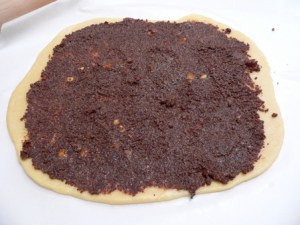
Today I tried making poppy seed beigli – a traditional European yeast roll filled with a mixture of ground poppy seeds and dried fruits.  Now, as a rule, working with poppy seeds freaks me out a bit, because I usually end up with little black seeds in every nook and crevice of the kitchen for weeks afterwards.  This time, however, I’d discovered tinned poppy seed filling, so the process was far less daunting.  The filling contained sugar, ground blue poppy seeds, candied rind, raisins and some citric acid, which was pretty much everything on the ingredients list of the recipe I had, with the exception of jam.  Whilst I didn’t add that this time,  in future I’ll include some apricot jam, which I’ve been told is a traditional part of the filling . As it was, the beigli were sweet enough, but  I think the jam will add a lovely  fruitiness to them.

The pastry dough is reminiscent of brioche, without the extended rest periods.  It was simple to knock together, and should be useful for lots of different fillings – ground walnuts are a common one  – and I’m planning to experiment with things like cream cheese and sour cherries.

Here is the entire recipe (from The Complete Book of Baking, 1984), including instructions for grinding the poppy seeds and making the filling from scratch, in case it’s of use to anyone.  Good luck if you go down that route, and expect your kitchen to be speckled with annoying black dots for a couple of weeks!

Filling:

  • 185g (6oz) poppyseeds
  • ½ cup (4oz) sugar
  • 2/3 cup milk
  • 3 Tbsp chopped prunes
  • finely grated rind of ½ orange
  • finely grated rind of ½ lemon
  • 2 Tbsp blackcurrant jelly

1. Grind poppy seeds in a blender.

2. Combine all the ingredients for the filling in a saucepan; bring to the boil, stirring constantly, then simmer for 15 minutes or until the mixture becomes thick and smooth.  Allow to cool.

OR substitute tinned poppy seed filling, adding any of the above ingredients that aren’t already included.

Sweet Yeast Pastry:

  • 10g instant yeast
  • 4 cups bread flour
  • 1/3 cup sugar
  • 250g unsalted butter
  • 1 egg yolk
  • ¼ cup sour cream (thick)
  • 3 Tbsp milk

1. Tip the flour into a large mixing bowl.  Whisk in the yeast and the sugar.  Cut the butter into small pieces and rub into the flour mixture until it resembles coarse breadcrumbs.

2. Add the egg yolk and sour cream, adding milk as required, and knead with a clean hand until the dough comes together into a soft, pliable dough.  Cover and allow to stand for 30 minutes.

3. Knead the dough gently on a lightly floured board, then leave to stand for a further 30 minutes, covered.

4. Divide the dough into three portions.  This recipe actually specifies that you use two portions of the dough to make poppy seed beigli and one to make hazelnut rolls, so there is only enough filling in the recipe for two poppy seed rolls.  It made no difference in this case, as I was using tinned filling!

5. Roll out two portions of dough fairly thinly into rectangles, spreading both with the prepared filling.  Carefully roll the dough up, starting at the narrow edge (so you get a short fat roll rather than a long skinny one).  Line a baking tray with parchment paper (Bake) and place the rolls on the tray, seamside down.  Allow to rest, covered with greased clingfilm, for an hour.  In the meantime, preheat the oven to 230C (220C with fan).

poppy-seed-003

6. Brush the tops of the rolls with a little milk, then bake for 10 minutes.  Turn the tray around if necessary, and reduce oven temperature to 180C  (170C with fan) and bake for a further 20 minutes or until golden.  Allow to cool on the baking tray before removing to a wire rack.  Before serving, dust generously with icing sugar mixture.

poppy-seed-006

. . . . .

More here : Poppy Seed Beigli – Revisited

Read Full Post »

lemon-curd1

I’ve just been on the phone to Christina, and I’ve promised her I’d post my lemon curd recipe.  Actually, it’s not really my recipe at all – I discovered it  here – and unbelievable as this sounds, it makes brilliant lemon curd in the microwave.  The first time I tried it, I made five batches, one after the other, because I simply couldn’t believe it was working.  I thought it was a fluke and kept waiting for it to fail, but it didn’t and I ended up with 15 jars of lemon curd in the fridge, all of which had to be eaten within a few weeks.  Ah well, the neighbours were happy.

Microwave lemon curd

1. Zest two big lemons into a large pyrex bowl. Juice both lemons, and strain the juice into the bowl (you want about 150ml of lemon juice). Add 50g unsalted butter and 150g caster (superfine) sugar. Microwave on high for 2 minutes (my micro is 1100 watts). Take it out and give it a good stir to make sure the sugar is dissolved and butter melted. Allow to cool just slightly.

2. In a separate bowl, whisk together 3 large free range eggs and one egg yolk. Whisk well – you want it to be an homogenous yellow with no white stringy bits. Pour the eggs through a sieve into the butter mixture, whisking as you go. Once it’s all combined, pop the pyrex bowl back into microwave.

3. Microwave for 30 seconds on high, then stir. Another 30 seconds on high, stir again. Then 1 minute on high, take it out, and give it a really good whisking until it becomes smooth and lemon curd like. You might need a little bit more time, but in my microwave, that’s it. You can then pour it into sterilised jars and stick it in the fridge, or pour it into a pre-baked tart shell and let it set in the fridge (which is how I made my tart), or you can freeze it.

You can also make passionfruit curd by adding 1/3 cup of passionfruit pulp when you add the eggs.  If you’re doing that, you might want to cut the lemon zest back a little bit.  Enjoy!

. . . . .

More on making microwave lime curd here… A Bowl of Sunshine..

Read Full Post »

« Newer Posts - Older Posts »