Feeds:
Posts
Comments

Archive for the ‘Recipes’ Category

Here’s my first attempt at working the caramelised white chocolate into a cookie.

Based on a white chocolate cookie recipe from Mrs Fields Best Ever Cookie Book!, these showcase the distinct flavour of the caramelised white chocolate, without being overly sweet. As always, I’ve changed the methodology a bit, adding a long rest in the fridge before the dough is shaped and baked. I think it always results in a prettier cookie!

  • 250g (1 cup) unsalted butter
  • 375g (2½ cups) plain (AP) flour
  • 1 teaspoon bicarbonate of soda (baking soda), sifted
  • ¼ teaspoon fine sea salt
  • 85g (3oz) caramelised white chocolate
  • 110g (½ cup) white sugar
  • 105g (½ cup, packed) brown sugar
  • 2 large (59g) eggs, at room temperature
  • 10g (2 teaspoons) vanilla extract (we always use homemade)
  • 230g (8oz) dark chocolate chips, preferably 70% cacao

1. Cut a 60g (4 tablespoon) chunk off the butter and chop it into smaller pieces.

2. In a medium mixing bowl, whisk together the flour, sifted bicarb of soda, and salt.  Stir in the dark chocolate chips.

3. Gently heat the caramelised white chocolate to soften if necessary. Scoop it into a small pyrex or ceramic bowl with the 60g butter and melt in the microwave in short bursts, being careful not to scorch the mixture. Stir until smooth and then allow to cool slightly.

4. In a large mixing bowl, beat the remaining butter with the two sugars until combined, but not fluffy.  Beat the eggs in one at a time, beating well after each addition, then beat in the vanilla and the caramelised white chocolate mixture.

5. Add the flour and choc chips and mix until just combined.  Scrape the dough into a container, cover and store in the fridge until firm, at least a couple of hours.

6. Preheat the oven to 150C (300F) with fan. Scoop rounded tablespoons of the stiff dough and roll into balls, placing them onto a baking sheet lined with parchment.  Bake for 20 minutes, rotating the pans halfway through the baking time.

7. Cool the cookies on the tray for a minute, then transfer to a wire rack to cool completely.  This recipe makes approximately 3 dozen cookies.

Click here for a printable version of this recipe

Read Full Post »

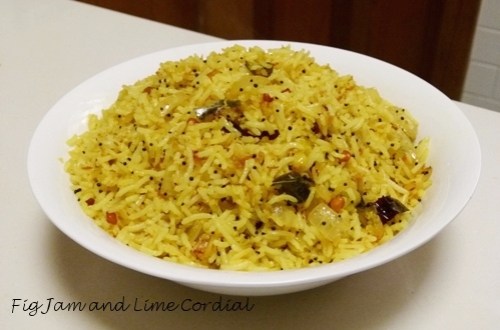
One of my favourite Indian dishes is lemon rice.

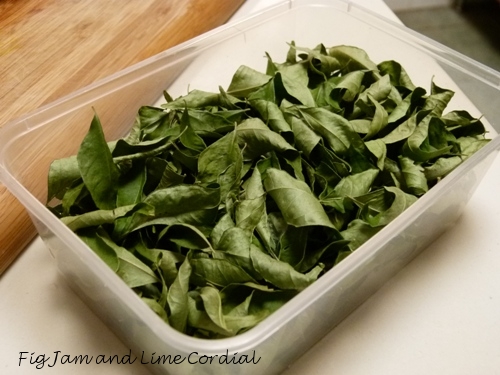
This version is based on a recipe from Mamta’s Kitchen, a wonderful Indian cooking resource managed by my friend Kavey and her husband Pete.  It was a great opportunity to use my new curry leaves, which have now dried crispy…

Here’s my take on Mamta’s recipe:

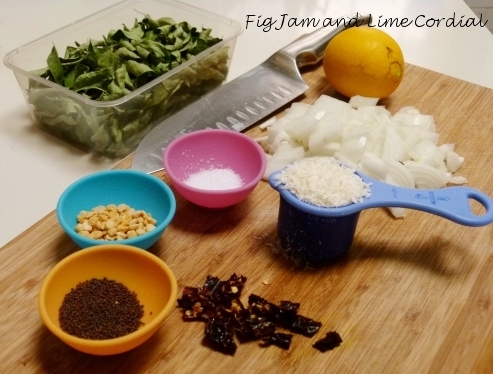
  • 3 cups cooked rice (cold)
  • vegetable oil for frying
  • 1 teaspoon brown mustard seeds
  • 1 teaspoon dried channa dal
  • 12 curry leaves
  • 1 onion,  chopped
  • ¼ cup shredded coconut
  • juice of 1 lemon (1 – 2 tablespoons, to taste)
  • 1 teaspoon fine sea salt
  • 1 dried Kashmiri chilli, chopped
  • ½ teaspoon ground turmeric

1. Heat the oil until hot in a large non-stick pan.  Add the mustard seeds and fry them until they start to pop.  Be careful not to get your face too close to the pan.

2. Add the channa dal and curry leaves, and stir until the channa just starts to brown.

3. Add the onions and fry until soft.

4. Add the salt, turmeric, chilli and coconut and stir well, then scatter in the rice, breaking up any lumps with your fingers as you go.  Add the lemon juice and then stir well until the rice is warmed through and uniformly yellow in colour.

I sometimes add a handful of peanuts to this dish, and it’s also quite delicious made with lime instead of lemon  juice.  It’s a tasty, easy Sunday lunch, and a great way to use up leftover rice!

Click here for a printable version of this recipe

Read Full Post »

A couple of years ago, David Lebovitz blogged about making caramelised white chocolate – a technique he’d learnt during a training visit to the Valrhona Institute.

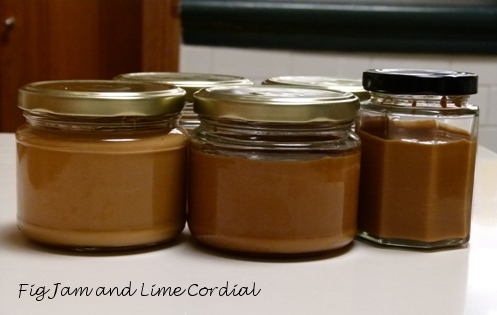
I was instantly hooked – whilst I’ve never been a big fan of white chocolate, this caramelised version is something completely different. It’s an easy process, but time consuming, and what you see in the jars above is pure white chocolate, with nothing added.

It’s been a while since I’ve made this, but a recent comment by Isabella on one of my old posts inspired me to cook up another batch last weekend.

I used Callebaut White Chocolate, which is slightly lower in cacao than the 30% suggested by Lebovitz, and as a result the chocolate went quite dry and grainy during the cooking process.  After a few minutes resting time out of the oven, it melted a little, and the graininess sieved out as it was poured into the jars.

I began with two trays of white chocolate callets – interestingly the purple tray baked much faster than the grey one.  Both went into a preheated 120C (with fan) oven…

The trays were taken out and stirred every ten minutes…

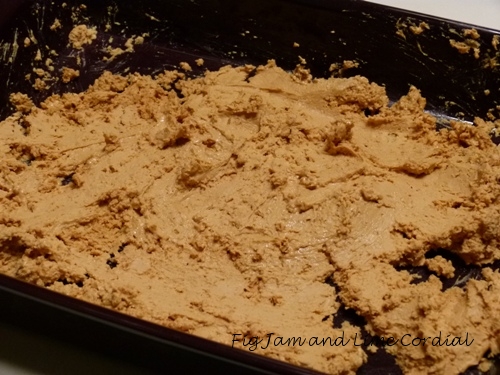
After an hour (stirring every ten minutes), the chocolate had darkened and was quite stiff…

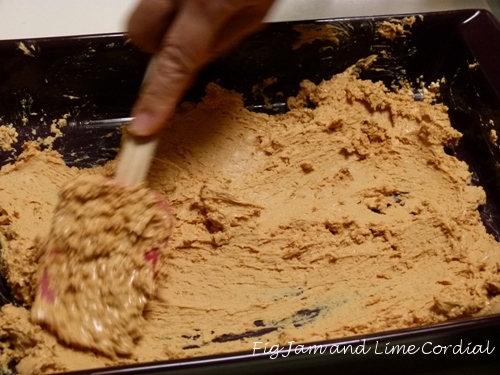
It needed a good stir…

…and after a few minutes resting time out of the oven, it loosened up a little…

As the melted chocolate was quite grainy, we strained it through a sieve into clean jars…

The grey pan was cooking more slowly than the aubergine one, and we ended up giving it an extra 15 minutes in the oven.  As a result, the chocolate was more caramelised, and you can see from the very top photo that the two jars on the right are a deeper brown than the one on the left…

One thing to note – the chocolate in the jars will set solid as it cools.  It will also bloom, with the cocoa butter separating out in a slightly worrying mould-like fashion.  It doesn’t look particularly attractive, but it won’t hurt the chocolate at all.

Just warm the jars slightly in the microwave (remove the lids first), and they will re-melt to gooey decadence.

Any suggestions on what to do with our new jars of liquid gold?

In the past I’ve stirred it into whipped cream, tempered and set it into bars and made a caramelised white chocolate bundt cake.  I’m still trying to figure out a cookie or brownie recipe to work the chocolate into, and I’m pretty sure it would make a truly amazing icecream.

Of course, all these machinations might be for nought – we usually end up eating it out of the jar with a spoon!

Read Full Post »

A couple of years ago, I created a training cookie for our old friend Marty, who had decided in his mid 40s to start competing in triathlons.

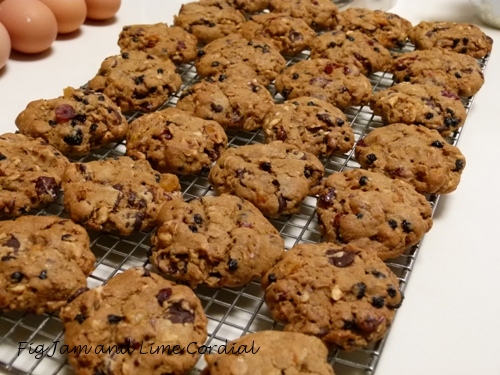
This new recipe was inspired by Dan Lepard’s blueberry and chocolate chip cookie, and is packed full of goodies, including dried fruit, chocolate, spelt and hazelnuts.  It makes a hearty breakfast or lunch box cookie, and because of all the other ingredients, there ends up being only four grams of butter and just under six grams of  brown sugar in each cookie.

Marty has some very specific requirements for his cookies.  They have to be chewy rather than crunchy, otherwise they shatter when he eats them on the run. They must contain a mix of low and high GI ingredients, including chocolate.  Finally, they have to taste good, and be easy to pack into the little box on the handlebars of his bike.  He’s pretty happy with these!

Marty’s Triathlon Cookies II
(makes approximately 30 cookies)

  • 125g unsalted butter
  • 175g dark brown sugar
  • 1 large (59g) egg
  • 200g wholemeal spelt flour
  • ½ teaspoon bicarbonate of soda (baking soda), sifted
  • ¼ teaspoon fine sea salt
  • 75g rolled spelt
  • 100g chocolate chips (see note)
  • 75g dried blueberries
  • 75g dried cranberries
  • 50g finely chopped candied peel
  • 50g blanched roasted hazelnuts, chopped
  • 1 teaspoon vanilla extract

Notes:

  •  Any combination of fruit and nuts can be substituted for the ones listed above.
  • Dan Lepard’s original recipe used rolled oats and wholemeal wheat flour, so either could be substituted if you can’t find spelt.
  • If I’m baking these cookies for our own consumption, I use 70% dark chocolate, but if I’m baking them for Marty, I use Callebaut baking sticks (44% cacao), broken up into pieces. The latter keep their shape when baked, and are much less likely to melt in the heat of competition.

1. Preheat oven to 170C or 150C with fan.  In a medium bowl, whisk together the flour, sifted bicarbonate of soda, and salt.  Add the rolled spelt, chocolate, hazelnuts and dried fruit, and stir to combine.

2. In a large mixing bowl, beat the butter and sugar until combined, then beat in the egg and vanilla.  Add the dry ingredients and mix until just combined.

3. Roll the dough into 4cm balls, and place them on a parchment lined baking tray.  Flatten each cookie slightly and bake for  15 – 20 minutes. I find that 20 minutes gives a harder, chewier cookie which is how Marty prefers them.

4. Allow to cool on a wire rack.  These cookies will keep for quite a while in an airtight container, or they can be sealed in thick plastic bags and frozen until needed.

Click here for a printable version of this recipe

Read Full Post »

We love our ciabatta recipe so much that I thought I’d try and come up with a similar recipe using yeast, for folks who don’t have a sourdough starter on the go.  Pete took lots of pics as I was making it, so be warned – this is a very photo heavy tutorial!

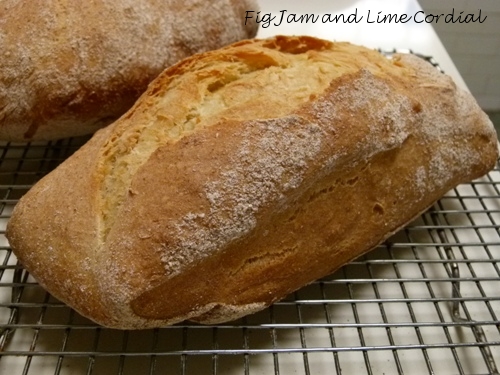
The finished loaves are slightly different from the sourdough version, but they’re even easier and quicker to make.  The recipe makes four small loaves, all with an elastic crumb and chewy crust.  The semolina helps them to keep well for a couple of days after baking, or you can freeze them for a later date.
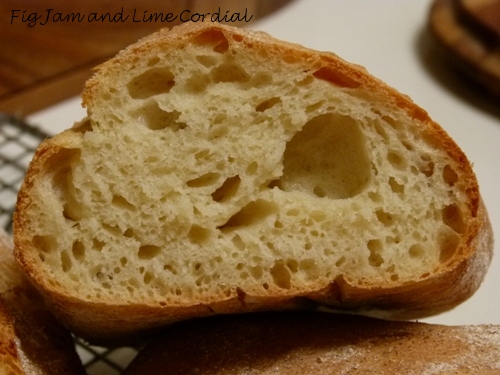
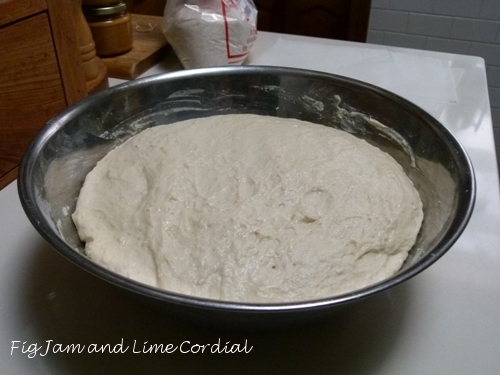
Because I’ve used cold water and a relatively small amount of yeast in this recipe, the proving time is longer than for regular yeasted loaves.  It will vary a little depending on ambient kitchen temperatures, and is fairly forgiving – just make sure the dough is puffy before you turn it out to cut, as there won’t be a second rise.

I always use scales to measure my ingredients, but I’ve included approximate cup measures as well.  If you have a smaller oven, please feel free to halve the recipe (use 4g dried yeast in that case).

Fig Jam and Lime Cordial Pane de Casa

  • 500g (3½ cups) bakers/bread flour
  • 500g (3½ cups) fine semolina (durum wheat) flour  (we use an imported Italian flour)
  • 7g (1¾ teaspoons) dried/instant yeast (or one sachet)
  • 18g (2¾ teaspoons) fine sea salt
  • 750g (3 cups) fridge cold water
  • rye flour, for dusting

Note: don’t be tempted to use fine or coarse semolina instead of semolina (durum wheat) flour – the former is too coarse and won’t absorb enough water, and you’ll end up with a soggy mess.  If you can’t find semolina flour, substitute more bread flour in its place and reduce the water by about 5%.

1. In a large mixing bowl, whisk together the flours, yeast and salt.

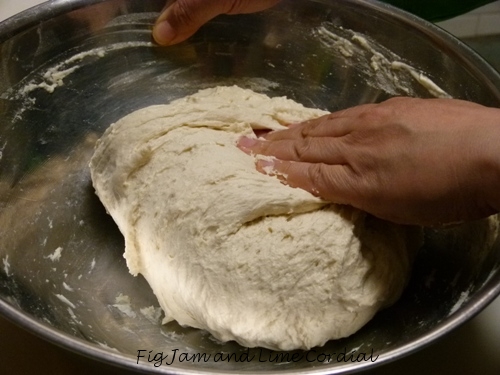
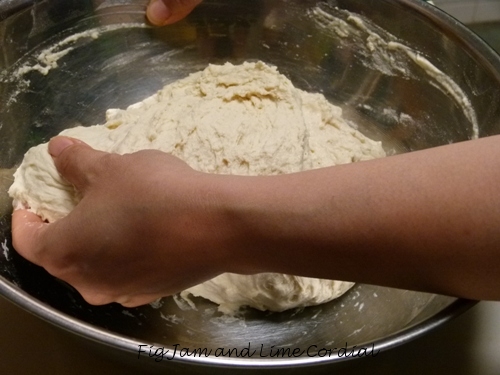
2. Add the cold water, and mix the ingredients together to form a sticky dough.  It’s easiest if you do this with one hand, so you can hold the bowl (or answer the phone!) with the other. Really squelch the mix through your fingers until evenly combined.  Scrape off your hand and cover the bowl with a tea towel.  Allow to rest for 15 minutes.
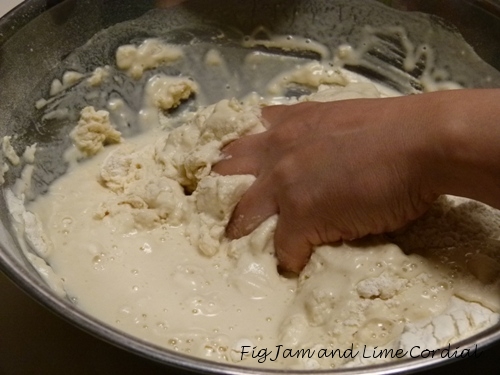
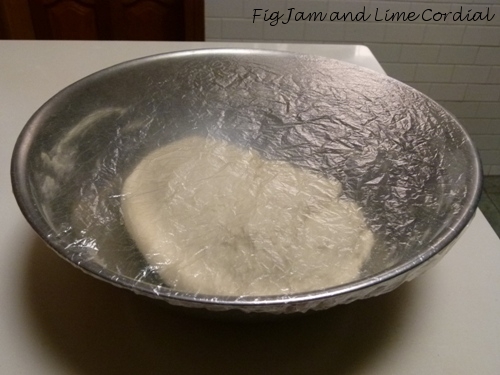
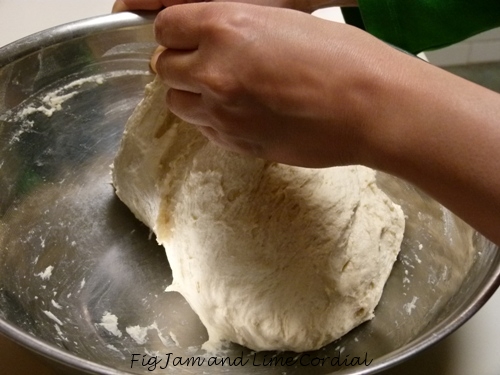
3. Give the dough a quick knead in the mixing bowl – after the short rest time it will have relaxed a little.  Just fold it over itself a dozen or so times, and then scrape your hand off again and cover the bowl with clingfilm or a shower cap.  Allow to prove until well risen – this might take up to three hours depending on your kitchen conditions.
4.  Once the dough is nearly risen, preheat the oven to 250C (480F) with fan.  If you’re using pizza stones, place them on the racks to heat up, and tear off four sheets of parchment paper.  If you don’t have pizza stones, line a couple of baking trays with parchment.

The dough is ready when it’s puffed up and airy – the photo below was taken after three hours rising time in our Sydney winter kitchen.
5. Heavily dust the bench and your hands with rye flour or fine semolina, then scrape the dough out gently – be careful not to knock all the air out of it.

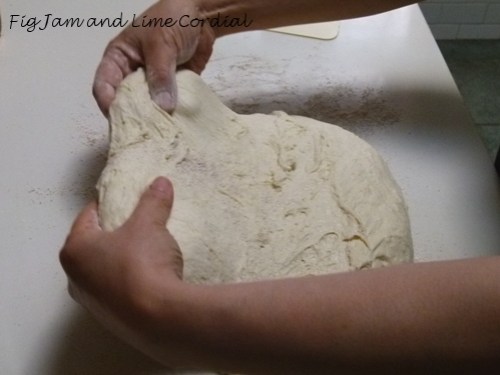
6. Fold the top of the dough into the middle, and then fold the bottom over to enclose it, forming a long rectangle.  It’s hard to explain, but the photos below should make it clearer.  Keep your hands well dusted with flour, and use your scraper if necessary to help you manoeuvre the dough.  It takes just a little practice to get this bit right.
7. Dust the top of the dough with more rye flour or fine semolina, then using your scraper, cut the dough into four roughly equal pieces.

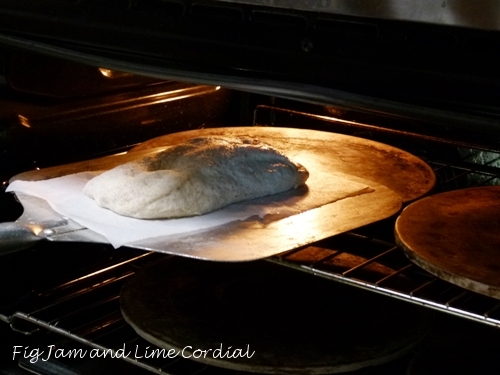
8. Dust your hands again with flour. Pick each piece of dough up by the ends, give it a little stretch, and then place it on a sheet of parchment to go onto the pizza stones, or onto the lined baking tray.

9. Spritz the top of each loaf with a little water.

10. Turn the oven down to 220C (425F) with fan, and put the loaves in to bake for 20 minutes.  Then rotate the loaves (if you’re baking on stones, remove the parchment now) or the oven tray, and lower the heat to 175C (350F) with fan.  Bake for a further 20 minutes, or until the loaves are crusty and hollow-sounding when tapped.  Note: please check your parchment paper instructions to ensure that it can cope with these oven temperatures.
11.  Allow the loaves to cool on a wire rack before cutting.

Whew!  Sorry to be so longwinded, but I wanted to make this tutorial as clear as possible.  I hope you’ll give this a go – it’s a lovely Saturday morning bake – and quite forgiving once you get the knack of handling the wet dough.  Every loaf looks a little rustic, but they all taste delicious!

Click here for a printable version of this recipe

Read Full Post »

« Newer Posts - Older Posts »