Feeds:
Posts
Comments

It was time to move the chook dome.

The chickens had their initial rotation several months ago, before the beds were planted out.  At the time, we were growing legume crops to improve the soil.

Now, for the first time, the hens will be moving onto finished beds – to eat the leftover vegetation, rotorvate the soil, and to weed, de-slug and fertilise the patch in readiness for the next round of planting.  Bed number one was pretty much spent – at the back you can see lucerne, grown specifically for the chickens, as well as an old kale plant, a finished sunflower and a few straggly clumps of curly parsley.

The ladies couldn’t wait – they were clustered at the front of the dome, willing it to move forward!

Watching them on the new bed reminded me of the famous scene in Willy Wonka and the Chocolate Factory, when the visitors are so overwhelmed by the chocolate room that they don’t know what to eat first!

Clever Queenie and Bertie immediately began spuddling for worms, Francesca went straight for the sunflower seeds, Harriet and Maggie attacked the lucerne and Rosemary..well, as she does, she ran around the coop like a mad thing trying to get a little bit of everything before anyone else did. As always, it’s such a joy to watch their individual personalities shine through, and to see them so happy in their new patch!

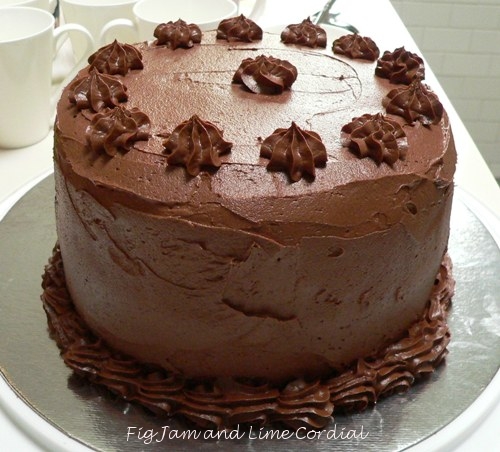
This is the birthday cake Big Boy requests every year!

Based on a recipe in the Mrs Field’s Best Ever Cookie Book, it uses the same batter as the chocolate slab cake, but instead of a roasting pan,  the batter is baked in two 20cm/8″ round cake tins (the original recipe specified 23cm/9″ tins, but I don’t have any that size).

Prepare the pans by greasing them well and lining the bases (or the base and sides) with parchment paper.  Divide the slab cake batter evenly between the two pans, and bake in a preheated 175C/350F fan forced oven for 30 to 40 minutes, or until the cakes are cooked when tested with a skewer.

The two cakes are then sandwiched together with frosting, iced and decoratively piped.  The frosting uses an indecent amount of butter and icing sugar, but it is a special occasion treat. The finished cake is always popular, and feeds a horde of hungry friends!

Chocolate Frosting

  • 315g (1¼ cups) unsalted butter, softened
  • 500g (4 cups) icing sugar mixture (powdered sugar), sifted
  • 110g (1 cup) unsweetened cocoa powder, sifted (I used dutched)
  • 10ml (2 teaspoons) vanilla extract
  • 65g (¼ cup) milk (or as required)

1. Sift the icing sugar mixture and cocoa together in a large bowl.

2. Using an electric mixer, cream the butter in a large bowl, then beat in a third of the icing sugar/cocoa mixture and the vanilla.   Beat in the remainder of the icing sugar/cocoa mixture alternately with as much milk as is required to create a spreadable frosting.

As regular readers will know, our backyard garden has been established following the permaculture principles taught in Linda Woodrow’s book, The Permaculture Home Garden.

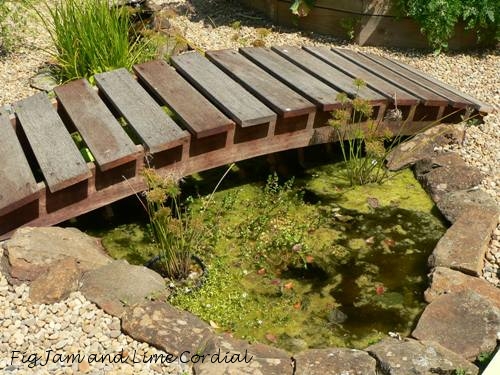
One fundamental tenet of the plan is the need for a backyard pond to attract natural predators into the garden.  The pond didn’t need to be pretty (Linda points out that a lined tractor tire filled with water would suffice) but ours is, and it provides a constant source of joy to us and our garden visitors.

It’s been fascinating to observe the pest-predator balance adjust itself in our garden.  Despite the frustration of watching the fruit fly descend en masse on our defenseless tomato plants, we haven’t used any chemical deterrents. For a couple of weeks, most of the tomatoes in our yard were filled with crawling grubs, and good for nothing more than worm and chook food.

Then the plants and the predators fought back – the plants by suddenly producing more fruit than the pests could eat, and the predators by eating every grub in sight.  Despite the heavy losses, we were still able to harvest a more than reasonable crop of roma and cherry tomatoes.

The pond bridge, which we had built to Pete’s design, affords shelter to our Australian rainbow fish.  Please excuse the murky photo above, but we’re inordinately proud of our little fish, and I really wanted to show them to you (it’s very hard to autofocus under the water!).

We initially bought six fish for the pond.  On the first night, one leapt out of the bucket they were acclimatising in, and when we put the rest of them into the pond, a second one died instantly.  We were quite worried about the remaining four – and I was quite concerned about the large quantity of mosquito larvae wriggling in the water.

A few weeks later, all the mosquito larvae were gone.  A month after that, the pond was full of tiny fry, swimming in the shallows and hiding in the plant roots.  I have no idea if they’ll survive, or what they’re eating, but they’re clearly thriving in their little space!
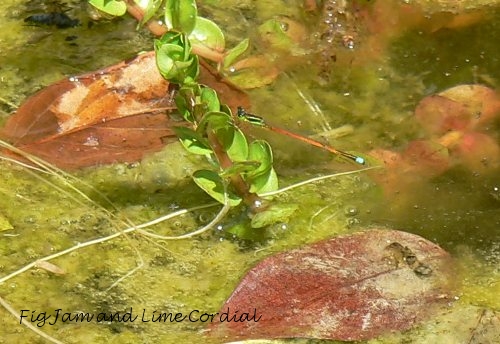
Having water in the garden attracts a large number of damselflies and dragonflies to our backyard. (Edit: I’ve just found out that the two pictured here are damselflies rather than dragonflies. Apparently damsels hold their wings in when they perch, whereas dragons always have them out.)

We have small multi-coloured ones (above), beigey-green ones (below), large red ones and large orange ones (although I’m yet to successfully photograph the latter two). My camera doesn’t have a working macro setting, so these pics were all taken from a distance and cropped.

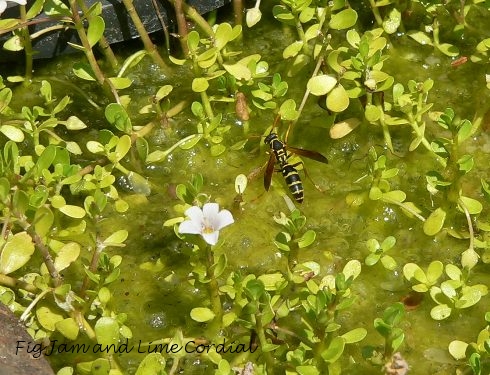
Paper wasps are quite prolific in our garden – we used to dislike having them in the backyard, until we realised what amazing predators they are!  We experienced our very own David Attenborough moment, as we watched a paper wasp land on a cabbage moth caterpillar, inject it with paralysing poison, then fly off with it to feed her young.
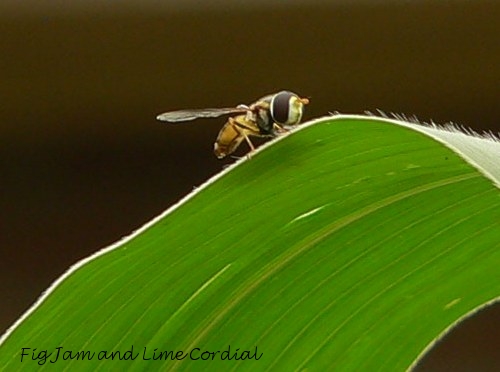
This little beauty is a hoverfly, and I think it alighted on the corn stalk simply to pose for a photo, because I’ve never seen one land before. Its larvae eat aphids and other small pests.
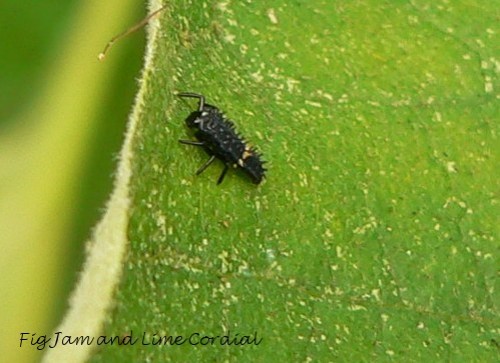
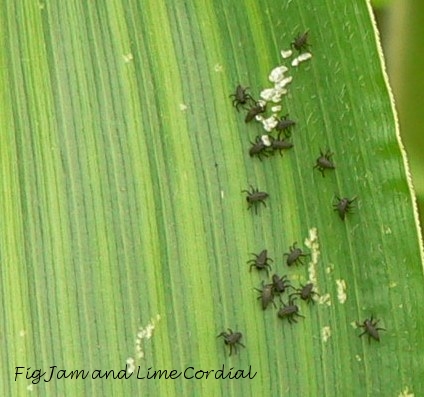
Ladybirds are a welcome visitor to our garden (unlike in parts of the UK, where they’ve reached plague proportions), but I never knew they metamorphed from the most scary looking larvae..

In the garden are a couple of spent broccoli plants, now covered with white fly and other pests.  We’ve enjoyed several meals from these plants, but  they’re now in their final stages – flowering, stalky and unappealing.

I asked Pete why we hadn’t fed them to the chickens before now.  He said that if we left them in the garden, they would attract bees and also help to build up predator numbers, by providing them with plenty of food, at no cost to us.  It does seem to be working, as there were at least half a dozen different species buzzing and crawling around the plants, feasting on the pests.

Look at all the aphids on the broccoli leaf!  The ladybirds can’t reproduce fast enough…

Permaculture in action – we’re finally starting to understand how all the pieces fit together!

 

(photo source: http://www.tutusandladybeetles.com)

Just for fun, do you have any minor superpowers?  We were discussing this over dinner recently, and were surprised by the number of people we know who actually do!

Big Boy’s friend John has a unique ability to negotiate even the most frightening traffic as a pedestrian.  On a recent band tour, his fellow musicians realised that the safest way to cross a busy road was to walk in line with John, as he had an innate ability to weave and duck through oncoming traffic.  His sixth sense extended to knowing when a car was going to run a red light, or judging exactly the right amount of time required to avoid an accelerating vehicle.  Big Boy and his mates refer to it as “Johnwalking”.

Small Man has a highly acute sense of smell, which is both remarkable and problematic.  He’s been known to walk into a kitchen where chocolate truffles were prepared hours before and pick up the scent of the strawberry puree used in the fillings.  Of course, the downside to this is that anything that smells even the slightest bit funky never makes it past his lips.

My friend the Spice Girl has the power to bend time.  Truly, she does.  She can ring and say, “I have a meeting that finishes at 1.15pm, so I should be able to get across town to you by 1.30pm for lunch, which will leave me plenty of time to get back to the kids at 2.15pm”.  Given we live 40 minutes apart, it’s amazing that she can do that, and yet she always manages to somehow.  She has the ability to squeeze more things into a short window of time than anyone I know!

Kevin Sherrie, all round good guy and miller extraordinaire, is one of those people who can find a parking spot any where, any time.  It’s always best to travel to busy events in Kev’s car, especially if high heels are involved, as it’s the surest way to guarantee the least amount of walking.  I’ve known Kevin to drive into town on Anzac Day and find free street parking.

What about you, do you have any minor superpowers?  Mine are very minor  indeed and relate more to experience than anything else, I suspect – I’m able to pick when the chocolate is almost at temper, and I’m often able to get to the kitchen timer as it’s counting down its final thirty seconds.  Given that I’ll still occasionally burn something in the oven though, it’s hardly an infallible superpower!

As we’re awash with new garlic, I thought it was prudent to use up the remains of my frozen stash from last year!

When we buy our new season garlic each year from Di and Ian, we keep some of it aside for immediate consumption and break the rest into cloves which we vacuum seal and freeze in a thick plastic bag.  After a full year in our stand-alone freezer, our cloves were still in great condition…

Freezing changes the texture of the cloves – they become translucent and softer.   Peeling is much easier, and we don’t really discern a noticeable difference in flavour or aroma, although we do always cook our frozen garlic.

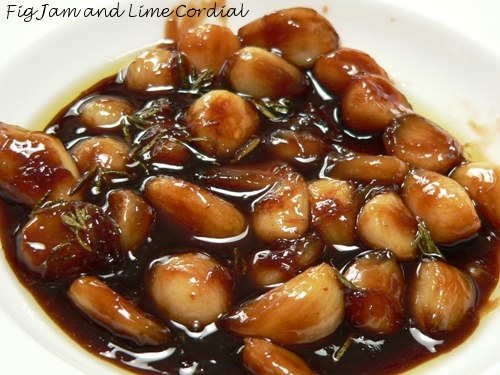
I made a caramelised garlic filling using a Dan Lepard recipe which I posted about almost exactly one year ago. The recipe specifies boiling the unpeeled cloves, but as our defrosted garlic was already quite soft, I simply immersed them briefly in a bowl of boiling water and then removed the papery skins.  You can see from the photo below that the defrosted cloves are a different  colour and texture to fresh – they’re no longer crunchy, but rather have a soft, almost gelatinous quality to them.

The blanched cloves were browned briefly in olive oil, before a mixture of water, balsamic vinegar, caster sugar, salt, pepper and fresh rosemary were added (quantities are here)…

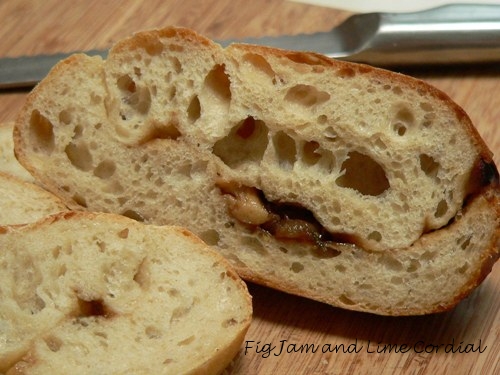
The thick caramel was allowed to cool slightly before being incorporated into a batch of white sourdough.  I simply flattened out the dough, spread over the mixture, and folded the sides over to enclose it.

The end result was delicious – sweet, but not overly so – and very garlicky!