Feeds:
Posts
Comments

My last post about bread braiding for a while…promise!

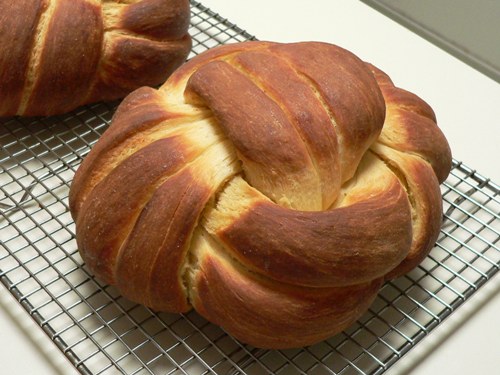
A few people asked about the Winston knot design that I made in the previous post, so I tried the pattern again, taking photos this time.  The original instructions for this shape are in Jeffrey Hamelman’s Bread.

Each of the loaves was made with a full batch of the braided bread dough recipe – approximately 850g each.  The dough was divided into six balls of approximately 140g each, and then rolled into long logs.

Note that the logs need to be looong, or you’ll run out of dough before the end.  Mine were about 60cm/24 inches each.  After rolling, very lightly dust the logs in a little flour to help improve definition in the finished loaf.

Step 1: Lay the dough out as shown below.  From now on, each group of three adjacent logs will be treated as a single unit. Note that when each group is woven, the rolls should not be turned over but simply rotated, so that the part that is face up continues to be face up for the whole process.  Please also note that I stuffed this up in step 2 (but it wasn’t too bad, as that bit ended up at the bottom of the loaf).

Step 2: Rotate group 1 down to lie adjacent to group 4.

Step 3: Rotate, without turning over, group 2 under group 4 and over group 1.  It should end up next to group 3.
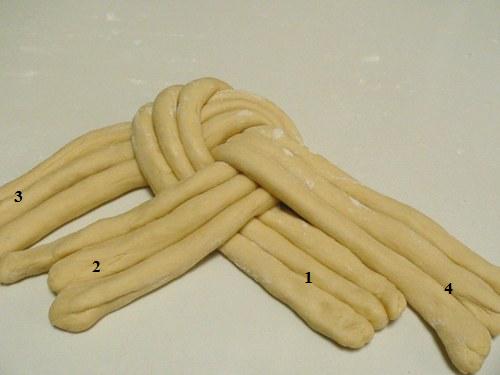
Step 4: Rotate group 3 over group 2 and lie it next to group 1.

Step 5: Weave group 4 under group 1 and over group 3.  Nearly there!

Step 6: Bring what you have left of group 2 over group 4, then squelch all the bits together at the bottom.  Don’t worry too much about neatness, as this ends up on the underside of the loaf.

Step 7: Fold the bottom of the dough (the bit you’ve just squelched together) upwards to the middle of the dough.
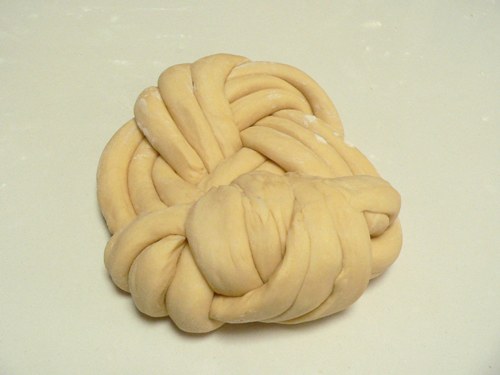
Step 8: Now repeat with the top of the dough.  Squish the two bits you’ve folded in together, but be careful not to squash the dough down, or you’ll flatten out the design.
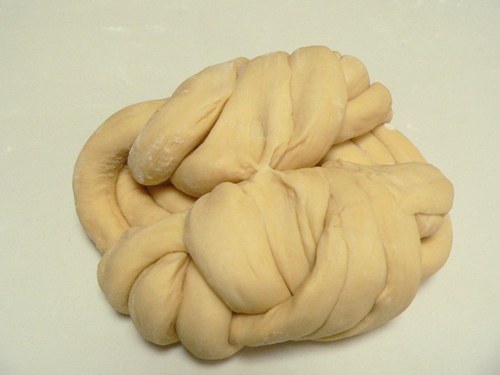
Step 9: Now turn the loaf over and admire your handiwork!  Place the dough on a parchment lined tray, then cover it with oiled clingfilm and leave it in a warm place to rise.  Preheat the oven to 200C (400F) with fan.

Step 10: To finish, brush the risen dough with a little melted butter, and bake for about 30 – 35 minutes, or until dark brown and hollow sounding.  Reduce the heat near the end if it starts to brown too much for your liking.  Remove from the oven and immediately brush the hot bread with extra melted butter, before allowing to cool on a wire rack.  Enjoy!

Click here for a printable version of this recipe

This is Tony.  We love him.  He was the maître d’ at our favourite Italian restaurant until a couple of years ago.  Over the time that we’ve known him, he’s watched our boys grow up from little kids to young adults, and marveled with us at their voracious appetites for pizza and pasta.

Completely by chance, I discovered a few days ago that he and his sister Carm have just opened their own place in the nearby suburb of Russell Lea.  We couldn’t resist heading out last night for a meal at their new La Casa Ristorante.

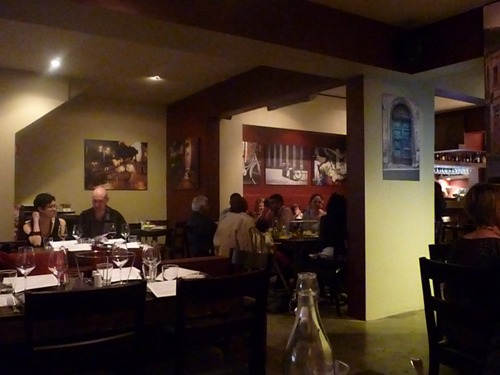
The restaurant has a wonderful, welcoming ambience – gently lit, adorned with photos of Italy, with comfortable seating and earthy, rough-hewn tables.  It’s a very elegant yet easy room to settle into.

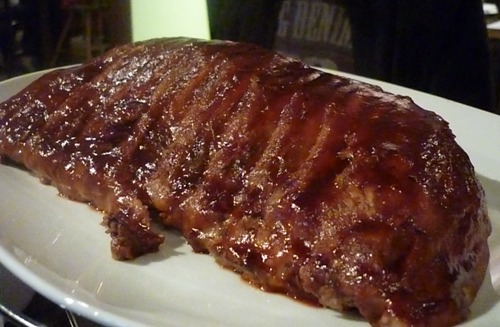
My main meal, which I had no chance of eating on my own, was a full rack of sticky pork ribs, oven roasted for eight hours and served with a side of chunky fries.   Big Boy and I agreed that these were, without doubt, the best ribs we’d ever eaten; they were unbelievably tender – literally falling off the bone – and perfectly accentuated by the sweet, sticky sauce. There were plenty of grill options available – half or full racks of pork or beef ribs, and a variety of different cuts and weights of steak.

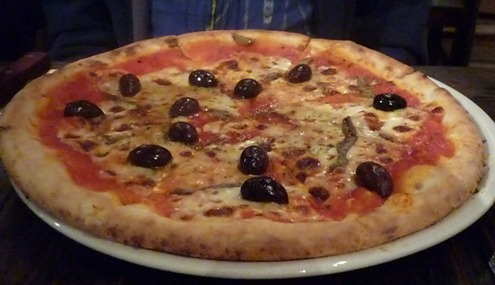
Small Man demolished a bowl of fries and an entire pizza – this one had a thin, crispy base, and was topped with all of his favourite ingredients – olives, anchovies, tomato, cheese and oregano.  I told him Tony had created that pizza just for him…

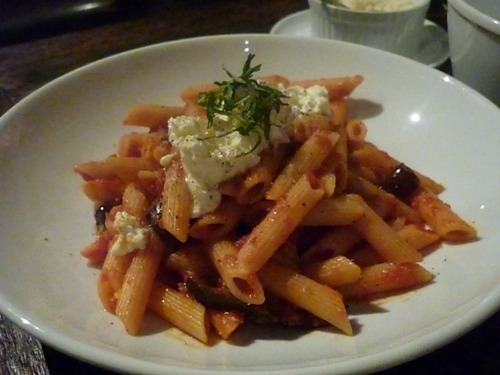
Pete’s main was a simple pasta of eggplant and olives, topped with fresh ricotta.  The flavours were fresh and sweet…

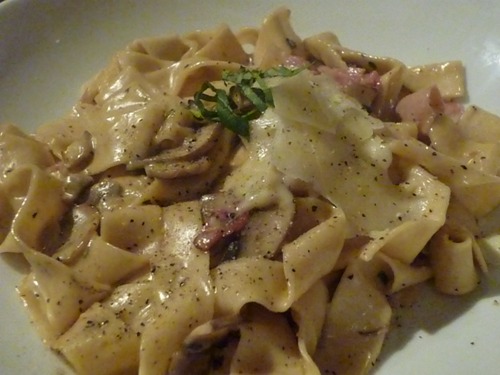
Big Boy had the handmade pappardelle with pancetta and mushrooms in a white wine and cream sauce, before eating half of my ribs…

The boys and I chose gelato and sorbet for dessert, while Pete opted for the ricotta cannoli (of course!)…

We had a wonderful night – the boys in particular enjoyed themselves enormously, and were really happy to see Tony again. We’ll definitely be back there again soon!

. . . . .

La Casa Ristorante
271 Lyons Road
Russell Lea  NSW
Open Tuesday – Sunday, from 5pm
Tel 9712 3882

www.lacasaristorante.com.au

To those of you who’ve been gardening for years, thank you for putting up with our excited ramblings.  I know this isn’t really a big deal, but because it’s all so new for Pete and I, being able to go out and harvest all these vegetables from our garden was an incredible thrill!

As we didn’t make it to the markets last week, our vegetable crisper was decidedly empty, which made being able to wander outside to pick all these edible greens even more of a buzz.  And we certainly haven’t emptied the first bed – just selectively chosen the plants that were ready, and the ones that needed pulling out to allow room for others to grow.

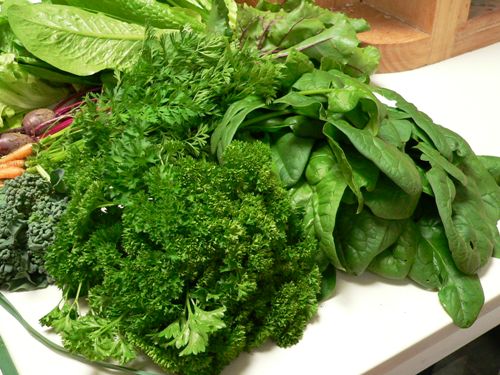
There was (and still is) a mountain of spinach and curly parsley growing…

We cut the sprouting broccoli (apparently you need to keep trimming it, or it flowers and dies), thinned the overcrowded carrots, and pulled a couple of baby beets to try.  Pete also pulled out a perennial leek, replanting all of her babies for another day…

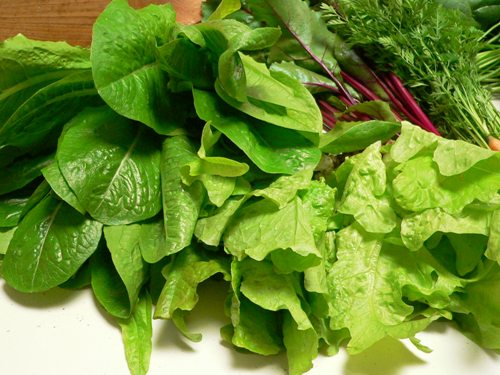
Finally, six small heads of lettuce came out, leaving room for the others to continue growing…

Our perfect Sunday lunch…Caesar salad, with homegrown mixed lettuce (cos, oak, butter), homemade sourdough croutons and a dressing made with Harriet’s freshly laid egg…

…and lunch today was a stir-fry of mung bean vermicelli, spinach, broccoli, teeny weeny carrots, leek and egg, seasoned with peanuts, fish sauce and lime juice.  Happy days!

I’m really taken with how versatile the braided dough recipe is!

It’s deliciously buttery, yet only has 40g of butter in the mix, making it a reasonable lower-fat substitute for brioche.  The overall preparation time is quite short – whereas regular brioche can take a full day or more to prepare, a batch of this dough started at 9am would easily be ready for lunch.  Best of all, it works brilliantly in a variety of different forms, making it great for shaping!

This morning I made a double batch of the dough, using 50:50 bakers flour to plain (AP) flour.  This was divided into one 500g and two 600g pieces.

The 500g dough was shaped into a linked chain loaf, following the step by step instructions at The Shiksa Blog.  It’s an easy loaf to make, and involves shaping five fat rolls into linked rings, and then joining the last ring to the first to form a closed circle.

. . . . .

One of the 600g pieces of dough was divided into six long thin rolls, then shaped into a Winston knot – a tricky woven design from Jeffrey Hamelman’s Bread book.  It was moderately successful in form, but I think I’ll need to try with a larger quantity of dough next time.  The crumb, though, was perfect.

. . . . .

The remaining 600g piece of dough was divided into eight balls, which were packed snugly against each other in a parchment lined loaf tin.  The end result was this gorgeous faux brioche, with its wonderfully tender texture.  Here are a couple of crumb shots to tempt you!

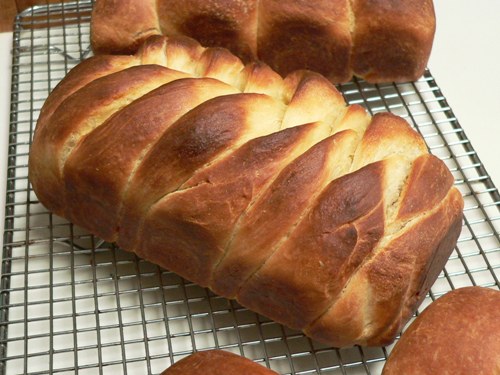
Edit: Today’s loaf: a simple six braid design baked in a loaf tin…

Warning: braiding bread is addictive!

Every month, the Mellow Bakers nominate three recipes from Jeffrey Hamelman’s Bread for a group bake-off.  September included the recipe for Soft Butter Rolls, which appealed to me in its simplicity, but not in its form.

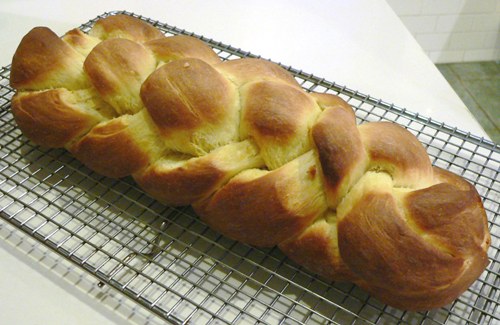
I decided to try making the dough into a braided loaf, and was absolutely thrilled with the results!  The bread is quite reminiscent of brioche (albeit a little denser), which is surprising given the relatively small amount of egg and butter in the dough.  It worked beautifully into logs for plaiting, and held its shape well on baking.

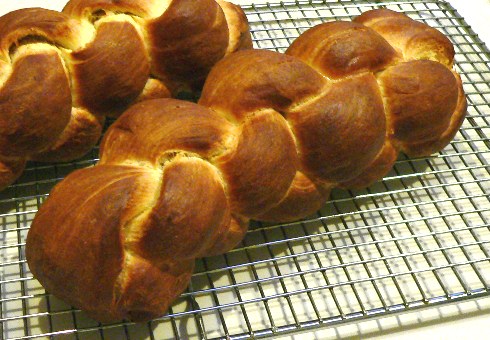
I’ve made the recipe three times now, each with a slightly different mix of flour.  The lighter loaf above was made with pizza flour, but the darker four-strand braid below was made with half bakers flour and half plain (AP) flour.   I think both options give the bread a more tender crumb than straight bakers flour.

It’s quite hard to explain how to braid, and difficult to take photos as I didn’t have a free hand, but I found this wonderful YouTube clip for the six braid which you might find useful.  If you have Hamelman’s book, I used the six braid (method two) on page 304 for the loaf above, and the four braid on page 300 for the two smaller ones below.

Braided Loaves
(adapted from Jeffrey Hamelman’s Soft Butter Rolls)

  • 500g (4 cups) pizza flour or 50% bakers flour and 50% plain (AP) flour
  • 230g (1 cup) water
  • 1 egg
  • 40g (3 tablespoons) butter
  • 30g (2 tablespoons) sugar
  • 25g (3 tablespoons) powdered milk
  • 11g (2 teaspoons) fine sea salt
  • 4g (1 teaspoon) instant dried yeast
  • melted butter, for brushing

Note: I used the metric amounts (converted from the imperial provided in the book); the cup and spoon measures are as listed in the original recipe.

1. In a large mixing bowl, combine the flour(s), sugar, milk powder, salt and yeast.  Cut the butter into small pieces, and rub it into the dry ingredients until crumbly.

2.  Add the water and egg, and mix with your clean hand, squelching the dough together to make sure it’s well combined.  Scrape off your hand, cover the bowl with a tea towel and allow the dough to rest for 10 minutes.

3. Spray a clean bench with oil, the turn the dough out and knead it briefly until it develops a silky elasticity.  Spray the scraped out mixing bowl with oil, then return the dough to the bowl, cover with cling film and allow to prove for about an hour and a half.  The dough won’t rise much, but it will soften in that time.

4. Turn the dough out and divide it into six equal pieces for the six-braid loaf, or eight pieces for two four-braid loaves.  Roll each piece into a long log, and then braid accordingly.  Lay the loaves onto a tray lined with parchment paper.  Spray a piece of clingfilm with oil, then fit it snugly over the top of each loaf to keep out draughts.  Allow to rise for a further 30 minutes to one hour. Preheat the oven to 200C (400F) with fan.

5. Remove the clingfilm, brush the loaf with melted butter and bake for 20 – 25 minutes, rotating the tray halfway through the baking time.  When the loaf is cooked through, remove from the oven and brush again with melted butter while it’s still hot.  Allow to cool on a wire rack before photographing and scoffing!

The dough recipe is sufficient for one large six-braid loaf or two smaller four-braid ones.  The latter are pictured below, and were made with a mix of plain (AP) and bakers flour.  As these were smaller, they baked a little browner, but the bread was still tender and delicious.  We’ve just eaten the last of the loaf sliced up and cooked as French toast!

Click here for a printable version of this recipe

Edit: Serendipitously, Brydie has just posted about plaited loaves as well. Maybe it’s the weekend for braiding bread!  If anyone else makes a loaf, let me know, and I’ll add the link here…