
There are only two ways to live your life.
One is as though nothing is a miracle.
The other is as though everything is a miracle.
Albert Einstein
(photo by my friend Dan of Tutus and Ladybeetles)
There are only two ways to live your life.
One is as though nothing is a miracle.
The other is as though everything is a miracle.
Albert Einstein
(photo by my friend Dan of Tutus and Ladybeetles)
Posted in Musings | 23 Comments »
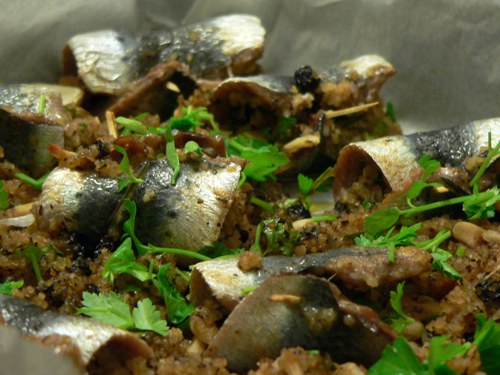
It’s funny what motivates us sometimes. I bought this tray of sardine fillets simply to avoid paying parking at the Sydney Fish Market (I needed to spend more than $50 to get free parking), and it sat in my freezer for a few weeks until I came across this lovely recipe in my Ottolenghi cookbook.
It’s a recipe with lots of ingredients, but most of the work is in the assembling – the actual cooking part is quite easy. Sorry, no imperial measures this time – as the cookbook is a UK edition, all ingredients were provided in metric.
1. Soak the bulgur in a bowl of cold water for about 20 minutes, until soft. Drain in a fine sieve and squeeze out any excess moisture.
2. In a separate bowl, soak the currants in a little warm water for five minutes, then drain.
3. Add the currants and almond slivers to the bulgur, along with the zest, juice and most of the chopped parsley, keeping back a little to garnish. Mix in the crushed garlic, spices, mint, molasses, sugar and 5 tablespoons of oil, then season with salt and pepper to taste. Try not to eat this with a spoon (which is what I found myself doing..)
4. In yet another bowl, mix the sardine fillets with 1 tablespoon of olive oil and season with salt and pepper. Preheat the oven to 180C.
5. Stuff the sardines by lying them on a plate skin-down, and spooning a little of the stuffing mixture into the middle of each fish. Roll the fillet around the stuffing and secure with a toothpick or cocktail skewer.
6. Arrange the sardines on a baking tray lined with parchment and roast for 5 – 6 minutes, until just cooked through. My sardine fillets were quite small, so I scattered all the excess stuffing around the rolls prior to baking in the oven. Serve scattered with the remaining parsley and accompanied by the lemon wedges.
Posted in Recipes | Tagged Ottolenghi, sardine rolls, sardines stuffed with bulgar | 22 Comments »

Congratulations, Soy! Linda’s book will be on its way to you soon!
. . . . .
I can’t believe how fast our garden is growing!
Here’s what the first bed looked like in late August…

…and here it is today. Over the past five weeks, we’ve harvested broccoli, a dozen lettuces, kale and several beetroots from this bed.

The cabbages haven’t been a great success – we planted them too close together, and possibly a little late. As a result, they’ve been making lots of leaves, but not forming a tight ball. They haven’t been going to waste though – the chickens absolutely adore them…

The broadbeans seem to be growing before our eyes at the moment! We can’t decide whether to eat them young as Linda suggests, or to wait until they’re a bit bigger and shell them..

. . . . .
Bed number two was newly planted when these photos were taken just over a month ago…
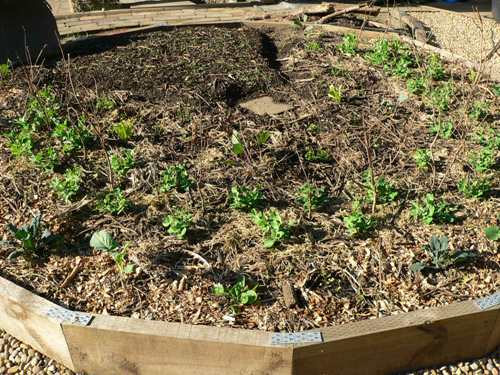
…and it’s grown prolifically! In amongst the jungle of pea shoots, you can see kale, cabbage, broccoli, as well as carrots and lettuce. We’re following Linda Woodrow’s plan from her book, The Permaculture Home Garden, which very cleverly allocates part of the space in each bed to growing feed for the chickens…

The baby pea pods are forming. I’m very new to gardening, so I didn’t realise that each flower would turn into a pod. Now I’m excitedly counting the flowers to see how many peas and broadbeans we’re going to get…

. . . . .
The dwarf peach and nectarine trees seem to be making lots of fruit, although it’s unlikely they’ll all develop…

. . . . .
Garden bed number three has potatoes, capsicums, eggplants and tomatoes – this single cherry tomato plant has grown like a weed and is threatening to take over the whole bed…

. . . . .
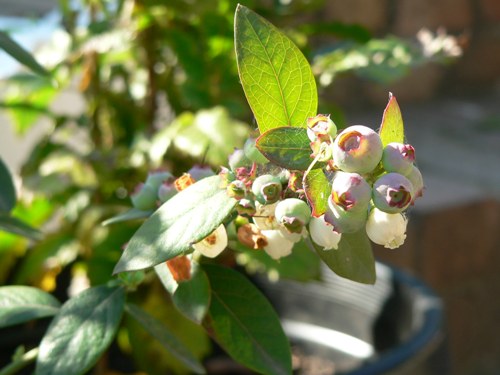
We have a blueberry plant growing in a pot, waiting for a permanent home, and somewhat surprisingly, given our temperate climate, it seems to be fruiting! Maybe it has something to do with all the bees who visit our backyard now…
In a patch of soil where the chicken dome was originally situated, a small crop of wheat is growing from the uneaten grain mix we were feeding to the girls…

Today’s harvest of sprouting broccoli will be eaten at dinner tonight, simply dunked in boiling water and dressed with a little butter and salt..

. . . . .
I thought you might also enjoy seeing how the chickens are travelling..here’s Rosemary glaring at me for spying on her while she was laying…

…and Queenie, being very vocal and reminding the others that she’s the boss!
. . . . .
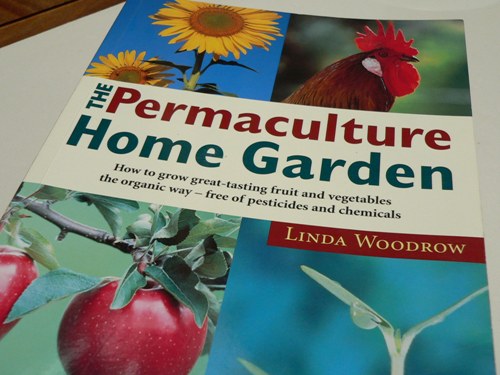
If you live in Australia and would like to undertake a garden project like ours, we have one copy of Linda Woodrow’s book, The Permaculture Home Garden, to g!ve @way (the funny characters are an attempt to avoid the search bots – I want to g!ve the book to someone who actually reads our blog!).
I was buying a copy for our friend Ian the Chicken Whisperer, and couldn’t resist picking up an extra copy for you. Linda’s book is tailored for Australian gardens, and is full of brilliant and inspired ideas – you can dip into it for suggestions, or go all out and follow her plan completely as we have.
To εnter, please leave a comment (before 14th October) and tell us which state you live in and what your favourite vegetable is. And apologies to our international visitors, but we can only ship to Australian addresses this time!
Posted in Food & Friends, Frugal Living | Tagged backyard chickens, backyard garden, growing vegetables, growing vegetables at home, Linda Woodrow, Permaculture Home Garden | 66 Comments »

Tonight, we had dinner at home.
We’ve been carefully growing a prize head of broccoli (well, it’s a prize to us!) – an errant seedling from our punnet of sprouting broccoli which grew into a large, old-fashioned cluster. After carefully removing the five cabbage moth caterpillars, we broke the head into florets and cooked it with anchovies and a clove of garlic, and then served it with our homemade pasta.

As we sat down together for dinner, I commented to Small Man that life is all about swings and roundabouts. The meal tonight cost us almost nothing – the broccoli came from the garden; the pasta was homemade using eggs from our lovely ladies. All up dinner for the four of us would have been about $3.
I tried to explain to the boys (and they politely refrained from rolling their eyes) that it’s all about finding a balance – we had the most wonderful dinner at La Casa last week, but eating out isn’t something we do all the time. That certainly doesn’t mean we deprive ourselves – furthermore, not dining at restaurants every night makes the occasions when we do go out special!
For us, frugal living isn’t about penny-pinching; rather it’s about making conscious choices about how we spend our money, reducing waste, and most importantly, appreciating what we have and being content with the lifestyle we can afford.
Our philosophy is this: no matter what our circumstances in life, everyone of us has finite resources, and wanting…lusting…for more than we can afford is a sure path to misery. So we’ve always worked to keep the bar low – we try to find excitement and joy in simple things, rather than lamenting the expensive luxuries we can’t afford. And as I pointed out to the boys tonight, we were having a meal that we just couldn’t buy at a restaurant – where else could you dine on broccoli less than an hour after it’s picked, or pasta made with eggs that were laid that morning?
. . . . .
For I have learned, in whatever state I am, to be content.
Philippians 4:11b
Posted in Frugal Living, Musings | 32 Comments »
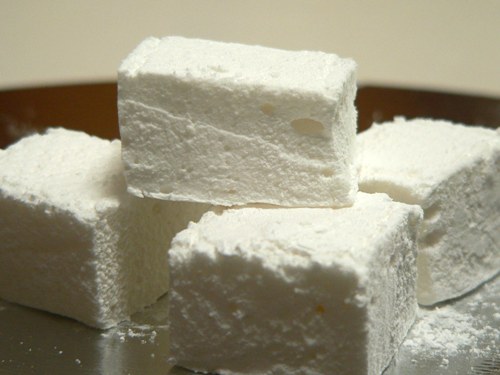
I watched the gorgeous Annabel Langbein making marshmallows on her new show, The Free Range Cook, and couldn’t resist trying them out! We adapted her recipe and this one by Hugh Fearnley Whittingstall to come up with our own version.
These moreish morsels only have four ingredients – sugar, gelatine, vanilla extract and egg white. The texture is reminiscent of a firm meringue pie topping – quite different from the commercial versions which are bouncy and rubbery (and made in a very different way). These have a lovely old world charm to them.
Make sure you allow plenty of time for the mix to set before cutting – the marshmallows will continue to firm up over the next day or so. Instead of greasing and dusting the pan, we lined it with a sheet of parchment, which was then lightly sprayed with oil. The finished sweets then only needed a light dusting of cornflour (cornstarch) and icing sugar to keep them from sticking together.
1.Line a rectangular baking tray with parchment paper, and lightly spray the top of the paper. I used a 33cm x 22cm (13″ x 9″) roasting tray.
2. In a medium saucepan with a long handle, stir the sugar and water over a low heat until the sugar dissolves, then raise the heat and bring to a rapid boil. Clip on a candy thermometer and boil the syrup until it reaches hard ball stage (122C/252F). This will take approximately 10 – 15 minutes.
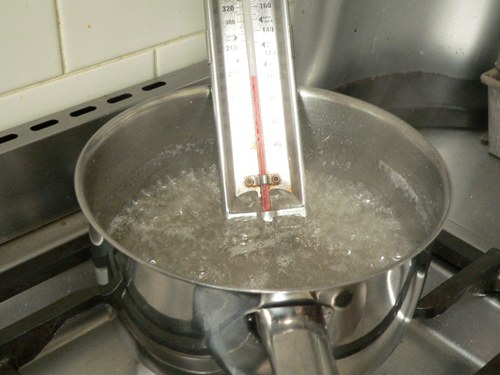
3. Soak the gelatine leaves in a bowl of cold water for about 10 minutes.
4. Before the syrup reaches temperature, place the egg whites in the bowl of a sturdy stand mixer and beat until stiff peaks form. Timing is quite important, and the sugar syrup, egg whites and gelatine need to be ready at the same time. It helps, but isn’t essential, to have two people on the job – one to watch the syrup thermometer and the other to prepare the other ingredients.
5. Once the syrup is at the right temperature, remove the saucepan from the heat. Turn the mixer on to low, and gently trickle the hot syrup into the stiff egg whites, beating constantly as the mixture turns creamy. Please be very careful – the sugar syrup is blindingly hot!
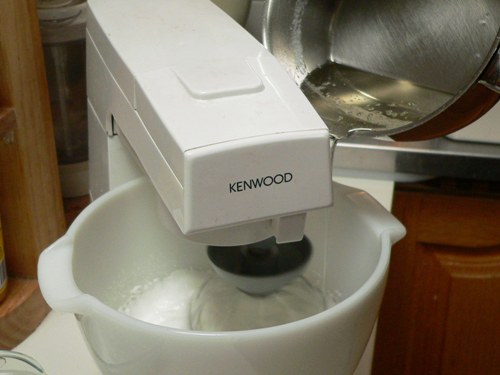
6. As soon as all the syrup is added, quickly remove the gelatine from the water and squeeze out the excess water from the softened leaves, then add the gelatine to the mixing bowl while the mixture is still hot, and beat until combined. Add the vanilla extract and continue beating.
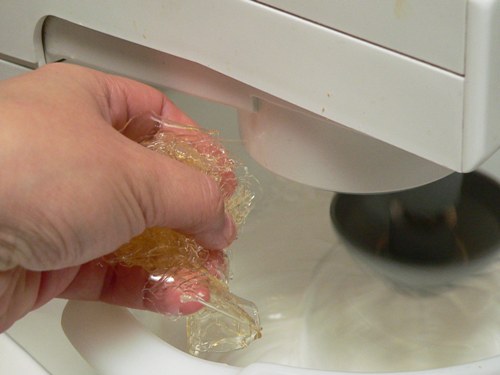
7. Turn the speed up and beat the mixture until it thickens – Annabel suggests beating until the mixing bowl feels just warm – this can take up to 10 minutes. The finished mix will be very thick but still pourable (even thicker than photo below).
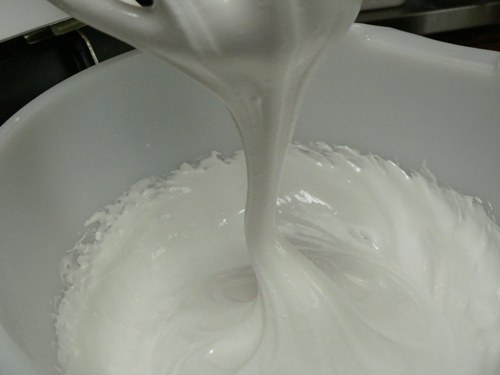
8. Scrape the marshmallow into the prepared pan and smooth out the top. Leave to set for at least four hours or overnight. When firm, lift the slab out using the parchment paper, cut with a warm, dry, sharp knife into squares, and dust each with a fine coating of cornflour (cornstarch) and icing sugar mixture.
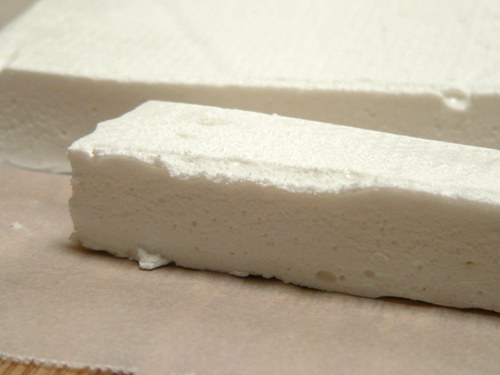
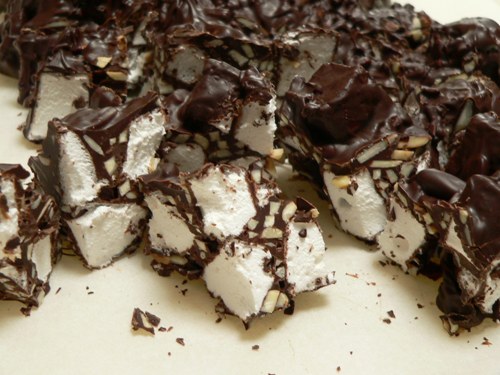
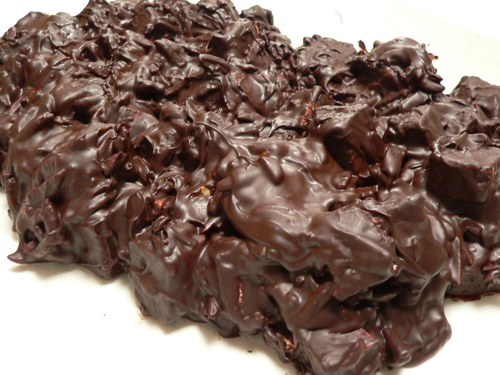
Of course, once we had homemade marshmallows, we had to make dark chocolate rocky road! We used 500g of tempered dark Belgian chocolate, 125g slivered almonds and 200g of homemade marshmallows, chopped into cubes. It’s wickedly good!
Click here for a printable version of this recipe
Posted in Recipes | Tagged Annabel Langbein, dark chocolate rocky road, homemade marshmallows, how to make marshmallows, Hugh Fearnley Whittingstall | 44 Comments »
© All text and photos are copyright 2009 - 2024 Fig Jam and Lime Cordial. All rights reserved. Please ask first.


