Feeds:
Posts
Comments

Am I boring you yet with all these chicken posts?

Just one more to complete the set – I thought those of you who were following their antics might like to know what we eventually named them all.

. . . . .

Top of the pecking order is Queenie, full working title “Queenie the Meanie”.  She rules the roost like the Emperor ruled the Dark Side.

. . . . .

Bertha, with her crooked comb and fierce eyes, is Queenie’s enforcer.  She does most of the pecking in the flock.  She is by far the smartest chicken, and Pete’s favourite, as she’ll eat from his hand and likes to follow him around the garden.  She’s also the healthiest, moves the fastest and digs up the most worms. I once watched her in amazement as she tried to catch flying insects, Mr Miyagi-style.

. . . . .

Harriet, who is so similar to Queenie that it’s sometimes difficult to tell them apart (she has a  marginally lighter coloured head), sits third in the order.  This little gang of three can often be seen eating together, to the exclusion of the others, although Harriet will be pecked away once there’s less food to go around.

. . . . .

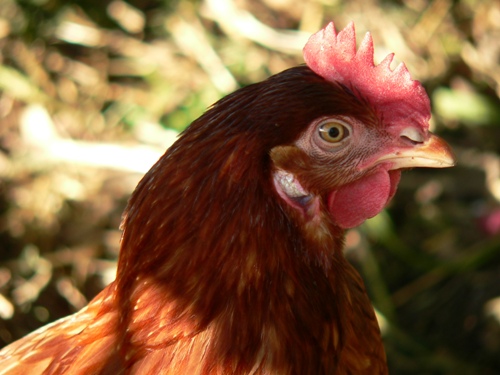
My favourite chicken is Francesca.  With her distinctively dark head and red comb, she is by far the most beautiful lady in the group.  She’s a bit of an enigma, and it’s hard to be sure exactly where she sits in the hierarchy. I’ve never seen her pecked, nor have I seen her pecking anyone else.  All the other chickens leave her alone, but perhaps that’s because she’s learnt to keep out of their way.

Frannie doesn’t particularly like to fly, so will try her hardest to roost anywhere other than the raised platform.  We’re perpetually having to pull her out of the laying box, and she once tried to roost on a stick on the ground.
. . . . .

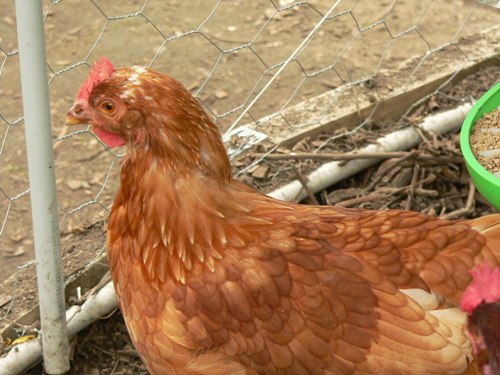
Timid little Maggie, with her pecked head, clearly hasn’t learnt how to get out of everyone’s way like Francesca has.  We’re not sure what goes on in the roost each night, but we suspect she doesn’t know her station, and gets pecked mercilessly for stepping out of line.  Chickens are like the mean girls at school – if I watch them for too long, I start having  flashbacks…

. . . . .

Right at the bottom of the pecking order is little Rosemary.  She’s not shy. Clearly the youngest in the group, she can be downright annoying at times, running around the pen like a mad thing and bodyslamming into the dominant hens while they’re feeding.   She has big yellow legs and I suspect she’ll end up the largest of them all.
. . . . .

Aside from the pecked heads, our ladies seem very happy, and they certainly have healthy appetites.  We now have four hens a-laying, which provides us with two to four eggs a day.  They looove leftovers, particularly pasta and rice, although Pete won’t let me feed them too many carbs, as he insists it’s very bad for them to get fat.  I guess watching your weight really is the bane of females everywhere!

If I’m ever feeling weary or blue, I watch this clip. It always makes me laugh, no matter how many times I’ve seen it before.

It’s an out-take from the Carol Burnett Show of the 1970s, with Tim Conway reducing his colleagues to hysterical tears with his completely ad-libbed lines.   I’m posting it here so that I can find it again easily, but also in the hope that it gives you all a good belly-laugh this weekend!

. . . . .

I can’t believe how popular these have been!

I’ve made three batches to date, and Pete and the boys continue to nibble at them whenever they walk past the cookie jar.  We took them to the markets for our suppliers, and sent them with Big Boy for his friends.  They’re easy to make and even easier to share.

This was the first time I’d tried this recipe from my trusty Mrs Field’s Best Ever Cookie Book – somewhat surprising given that I’ve made dozens of other treats from it thus far.  As always, she never fails me.  I’ve sized the recipe up to use five egg whites – the number left over from Pete’s latest batch of icecream.

The end result is two cookie jars worth of crunchy, non-marshmallowy meringues that store well.  The cocoa and unsweetened chocolate (you could probably use a 70% dark instead) temper the usual meringue sweetness, making them just as appealing to adults as they are to littlies.

  • 85g  unsweetened chocolate (I used Callebaut cocoa mass)
  • 140g  icing sugar mixture (powdered sugar), sifted
  • 50g  unsweetened cocoa powder, sifted (I used Dutch-processed)
  • 5 large (59g) egg whites
  • ½ teaspoon cream of tartar
  • 185g caster sugar

1. Preheat oven to 150C (300F) with fan.

2. Blitz the unsweetened chocolate in a food processor or grate if finely, and set aside.

3. In a small bowl, sift together the icing sugar mixture and cocoa.

4. In a large bowl and using a whisk attachment, beat the egg whites and cream of tartar with an electric mixer until thickened, then slowly add the caster sugar.  Beat until stiff peaks form and the mixture turns glossy.

5. Gently fold the cocoa mixture and chopped chocolate into the egg whites until no streaks of white remain.

6. Fit a piping bag (I use a large disposable one) with a large star tip and fill with the meringue mix.  Pipe pretty shapes onto parchment lined trays.

7. Turn the oven down to 100C (200F) with fan, and bake the meringues for an hour.  Once they’re cooked, prop the oven door open slightly and allow them to cool completely in the oven.  Store in an airtight container, or freeze.

Note: For Heidi and my US friends, here are the original quantities as written:

  • 2oz unsweetened baking chocolate square
  • ¾ cup powdered sugar, sifted
  • 3 tablespoons unsweetened cocoa powder, sifted
  • 3 large egg whites
  • ½ teaspoon cream of tartar
  • ½ cup granulated sugar

Click here for a printable version of this recipe

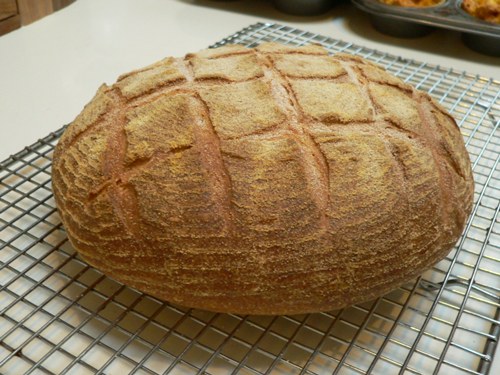
As I mentioned in the snippets, I baked Joanna’s cornbread and Sally’s semolina loaf over the weekend.

The semolina loaf (above) is a charming yet easy yeasted loaf, which went down well with my family of sourdough lovers.  The fine semolina gives the bread an interesting flavour and a smooth, creamy coloured crumb.  I made it exactly to Sally’s formula, although I kneaded it by hand rather than machine.

. . . . .

I also baked a version of Joanna’s corn bread, using sourdough starter instead of poolish.  I meant to include yeast as specified in the original recipe, but completely forgot, so this loaf took much longer to rise  and is slightly flatter than expected.

Having said that, Pete absolutely adored this bread and waxed lyrical about its texture and flavour.  The crumb was chewy, elastic, and the most gorgeous shade of yellow…

So, for my own future reference, here’s our version:

  • 225g active sourdough starter (100% or 166% hydration)
  • 115g maize meal
  • 190g water
  • 225g bakers flour
  • 9g salt
  • 20g olive oil

1. Mix the maize and water in a small bowl and allow to sit for 15 minutes.

2. Mix all the ingredients together to form a wet dough, then cover and allow to rest for 15 – 20 minutes.  Turn the dough onto a lightly oiled surface and knead briefly until smooth.  Cover and allow to rise until doubled in size.

3. Shape the risen dough into a ball and allow to prove until doubled in size (I use an oiled and floured plastic basket to rise the bread in).  Preheat oven to 240C with fan.

4. Turn the dough out onto a peel and slash, then dust with semolina.  Reduce the oven temperature to 220C with fan, and bake the loaf on a pizza stone for 20 minutes, then reduce heat to 180C with fan and bake for a further 40 minutes to set the crust.

One thing to note – this loaf will only work with fine corn maize.  I’ve tried making it previously with polenta, and the resultant dough was gritty.  It’s definitely worth searching out the maize flour – we found ours at the markets.

It was the perfect loaf to serve with Pete’s beetroot dip!

I’m worried about bees.  They’re such an important part of our existence – without them to pollinate our crops, we’d all be up a creek without a paddle.  And they’re under serious threat – many of the world’s bee colonies are infected with dangerous parasites that are killing honeybees at an alarming rate, possibly also leading to problems like colony collapse disorder.  Worse still, these mites are now developing resistance to miticides which have worked in the past.  According to Wikipedia, a third of the bees in the US (!!) didn’t survive winter 2009.

Australia is almost the only country left whose bee industry remains unaffected by the ominously named Varroa destructor mites.  Most experts agree, however, that it’s just a matter of time before these make it to our shores, especially as they’re now prevalent in neighbouring New Zealand and Papua New Guinea.

Whilst I can’t do anything to stop the parasites, and will continue to fret about the welfare of the world’s bees, I decided today that I needed to put away some Australian honey.  I know it’s crazy – we only go through a couple of jars a year – but honey lasts almost forever, and I want to continue eating it in a chemical-free form for as long as possible (which will presumably only be until the Varroa mites make it here).

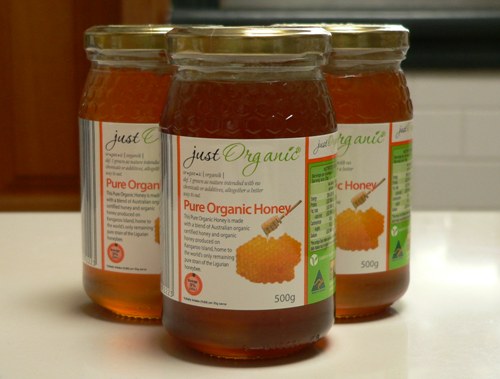
Fellow Aussies, did you know that we can buy organic honey, from the only remaining strain of pure Ligurian bees in the world, at Aldi?  For just $5 a 500g jar?  It’s a ridiculous bargain, and since a Sydney Morning Herald article was written about it last year, the price has actually gone down.

I have my ten glass jars of liquid gold stashed away.  Even if you’re not as nutty as I am, I hope that the next time you have a spoonful of honey, you’ll spare a thought and a prayer for the plight of the world’s bees. And if you’re living here in Oz, give thanks that we still have access to organic honey at such a reasonable price!