Feeds:
Posts
Comments

fudge-007

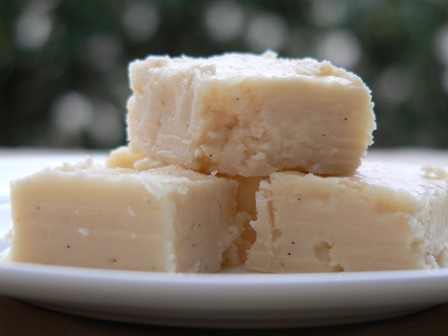
After eleven attempts, I’ve finally figured out how to make fudge which keeps my family happy.  Unlike the rest of the universe, they don’t want hard, crumbly fudge.  They want soft, silky, melt-in the-mouth fudge, which is firm to touch, but halfway in texture between cream and cake.

The most important thing I’ve learnt is this: fudge making is about gentle handling and calmness, and if you can relax and work peacefully, the whole process will be much easier.  It’s something that really can’t be rushed – the sugar needs to be melted very slowly in order for the crystals to dissolve completely, the mix needs to be boiled over the lowest possible heat, and the beating needs to be done at the minimum setting on your mixer to ensure the fudge candies with the smallest possible crystals (thereby ensuring a smooth texture).

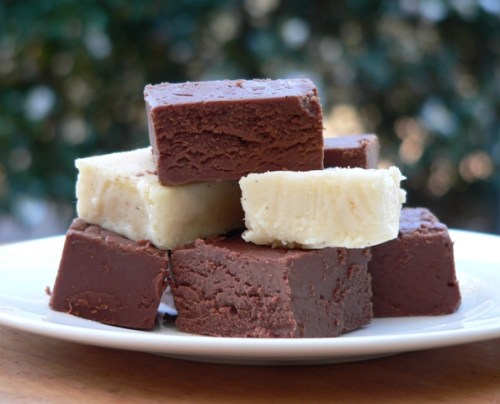
Here is a recipe for a creamy vanilla fudge. It tastes astonishingly like a good vanilla milkshake. The methodology is essentially the same as the chocolate fudge recipe, except that this makes a lesser amount, so you might wish to set it up in a smaller pan.  In my opinion, the key to successful fudge doesn’t lie with the ingredients, but rather with the handling of the candymaking process.  Remember – gently does it.

  • 2 cups sugar
  • 1 cup heavy cream (35% fat)
  • 1 Tbsp glucose or corn syrup
  • 45g (1.5oz) unsalted butter, chopped into small pieces
  • 2 tsps vanilla extract
  • seeds scraped from half a vanilla pod (optional)

1. Combine the sugar, cream and glucose syrup in a medium sized saucepan. Calmly, over a low heat, stir the mixture  until the sugar is dissolved and the spoon no longer feels like it’s running over grit at the bottom of the pan.  This can take several minutes. Try to dissolve the sugar completely before the mixture boils.

2. With a pastry brush dipped in hot water, brush the insides of the pan to wash down any sugar crystals (if you don’t do this, these crystals can cause the fudge to go grainy later).  Use as little water as you can. When the mixture boils, stop stirring and clamp a candy thermometer onto the side of the pan, making sure it doesn’t touch the bottom.

3. Allow the pan to boil without stirring, over a medium-low heat, until the temperature reaches 238F (which is one notch below the “Soft Ball” mark on my thermometer).  This can take up to 10 minutes – you might need to turn the heat up a little bit, but resist the temptation to turn it up too high, or you’ll ruin the fudge. You want to keep the mixture at a rolling boil but with the smallest amount of heat you can get away with. Keep an eye on the pan to make sure it doesn’t boil over.

4. When it reaches 238F, place the pan on a heat proof surface to cool, leaving the thermometer in place. Add the butter, vanilla extract and (optional) vanilla seeds, but do not stir.  Breathe and stay calm.  Get a cup of coffee and unstack the dishwasher while you’re waiting for the fudge to cool.

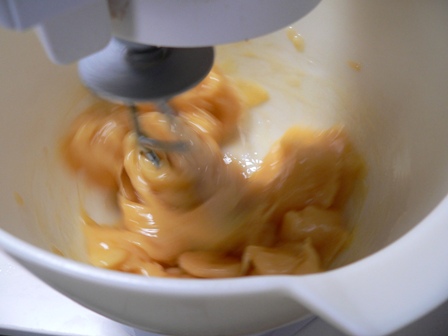
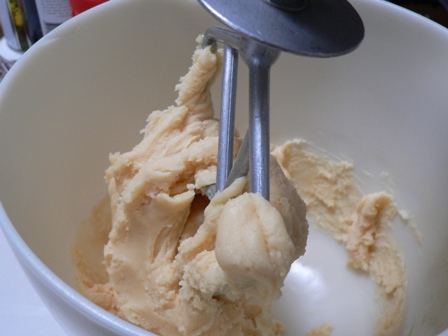
5. When the temperature reaches 120F, check to see if a slight skin has formed on the mixture, under the melted butter.  If so, scrape the fudge , butter and vanilla into the bowl of a stand mixer (if not, allow to cool a little longer).  Mix at a very low speed, pausing occasionally, until the fudge “sets up”.  The mixture undergoes a chemical change – it starts off sticky and similar to pulled toffee and seems to do nothing for a while in the mixer, then suddenly, in an instant, it changes – losing its gloss and becoming more granular and dull in colour.  Here are photos of the fudge before and after it has “snapped”, to give you some idea of what I’m talking about.  Interestingly, when the fudge does snap, it also releases heat (as a result of the chemical reaction), so the mix in the bottom photo was quite warm and tacky to touch (as opposed to gooey and sticky, which is how it was prior to mixing).
vanilla-fudge-021

vanilla-fudge-007

6. Tip the fudge into a buttered pan and work it in with your hands.  When it has cooled slightly, score or cut into small pieces.  It can take several hours to set completely.
vfudge-010

eggplant3

We’ve just started making chutneys and pickles – this was one of our first.  I wasn’t actually intending to make any more, as I still had half a dozen jars from the last batch, but when I spotted an 8kg box of firm, if oddly shaped eggplants at the markets for $5, I couldn’t resist.  I split the box with Pete D and Maude, which still left me enough to do a double batch of this recipe.

Based on a recipe from Jams and Preserves by Murdoch Books.

  • 800g (1lb 10oz) eggplant (about two large), cut into 1cm (½”) cubes
  • 4 cloves garlic, chopped and peeled
  • 50g ( ½oz) fresh ginger, chopped
  • 2 red chillies, chopped
  • 100-125ml (½ cup) vegetable oil
  • 1 onion, chopped
  • 1 Tbsp ground cumin
  • 1 tsp fennel seeds
  • 1 Tbsp ground coriander
  • ½ tsp ground turmeric
  • 250ml (1 cup) white wine vinegar
  • 160g (2/3 cup) white sugar
  • 1 tsp salt (if required)
  • 1 Tbsp salt, additional, for salting the eggplants

1. Put the eggplant in a colander over a bowl and sprinkle with 1 Tbsp salt.  Leave for at least 20 minutes (I left if for over an hour) to drain the bitter juices out.  It helps if you put a weight on top of the eggplants as they’re draining, but it’s not necessary.

2. Once the juices have drained out, rinse the eggplant well in a large bowl of cold water and pat dry with paper towels or a large teatowel.

3. Chop the garlic, ginger and chilli in a food processor or blender, adding a little water to make a paste.  Add all the spices and blitz briefly to blend.

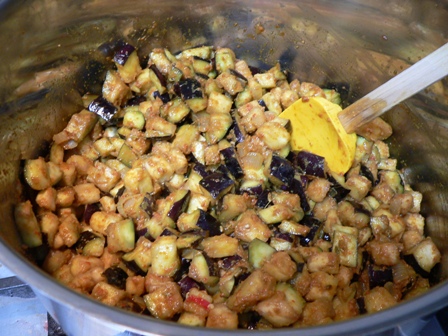
4. Heat the oil in a large pan, add onion and cook for a few minutes until soft, then add the garlic ginger spice paste.  Cook, stirring for another minute, then add the eggplant and cook for 5 – 10 minutes or until the eggplant has softened.

eggplant1

5. Add the vinegar, sugar and 1 tsp salt, if necessary, and stir to combine.  Cover and simmer gently for 15 minutes, or until soft.

6. Spoon into sterile warm jars. Pour boiling water over the tines of a fork , and use it to remove any air bubbles (you might not be able to get them all).  Screw on the lids, then boil the sealed jars in a hot water bath for a minimum of 10 minutes, making sure the water covers the lids by at least  2.5cm (1″) .

Leave the jars for a couple of weeks to allow the flavour develop.  Once open, the pickle should keep in the fridge for up to six weeks. You can also puree the contents of the jar to make a wonderful eggplant dip.

This is traditionally served with curries, but I’ve developed a passion for it with couscous and blue cheese – a bizarre combination, I know, but one I find oddly addictive!

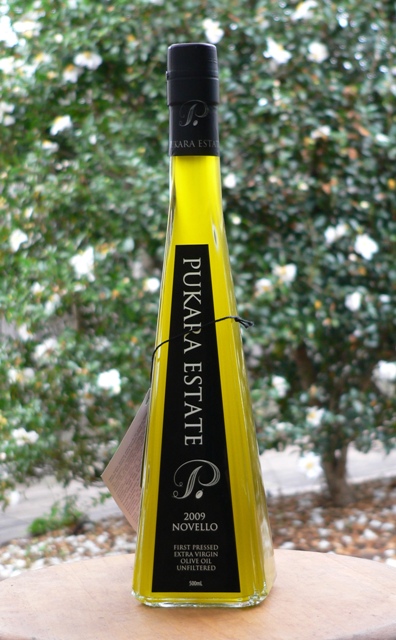
pukara-013

I was giddy with excitement to see the sales rep from Pukara Estate at the cheese shop today.  That’s because he was pulling out long elegant bottles of this year’s release of the Pukara Estate Novello.

This amazing liquid is the very first cold pressed olive oil from Pukara’s 2009 harvest. It’s bottled straight off the press, unfiltered, and is designed for immediate consumption.  Unlike most olive oils which are allowed to settle in dark glass to increase their shelf life, the Novello is bottled in clear, and is to be used straight away, while it is still young, cloudy and green.  Basically, it is fresh fruit juice, bottled from olives that were on the tree a week ago.  It has a delicious, slightly peppery flavour, a luscious mouthfeel and a long, long finish you can taste for minutes afterwards.  In some ways, the Novello is to regular EVOO what fresh apple juice is to apple cider.

While the keeping time is supposedly six months, the oil  is really at its best as soon as it is pressed.  We will enjoy our bottle right now, while it is at its peak, mourn its passing when the last drop has been consumed, and look forward with eager anticipation to next year’s release.  Only 1500 bottles were made in 2009, all of them numbered (ours is bottle 668).  At $35/bottle, it’s a very affordable annual indulgence!

pukara-014

pizza-and-apple-pie-023

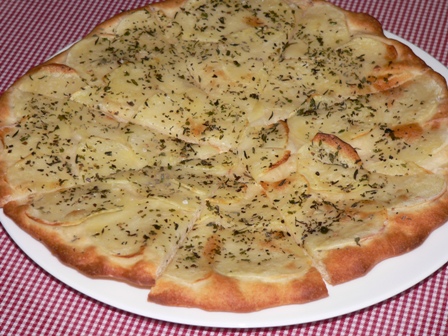
I promised Bobby the Builder that I’d post  instructions for potato pizza, but this is the basic method we use for all our pizzas. The night they were over for dinner, we also had homemade passata, pancetta flat, Kalamata olives and anchovies on one, and Stilton, finely sliced onion and nodini on another.  We make thin pizzas with sparse but carefully considered toppings – we’ve never been fans of the deep-dish, cheese-filled crust Super Supreme.

Step 1: Make the basic bread dough following the tutorial here.  You’ll need to use a high protein flour – bakers or bread flour is great.  If you can find pizza flour (we buy it in 12.5kg bags), all the better.

Step 2: After the first rise (step 5 of the basic bread tutorial), divide the dough into four equal portions of @ 220g each.  Shape each portion into a round ball and place in an oiled plastic container to rise.  Cover with a lid and allow to prove for about 30 minutes. Put a pizza stone into the oven and preheat to 250C.

pizza-and-apple-pie-007

Step 3: Turn one ball of dough out onto a sheet of parchment paper. Dip your fingertips into flour and gently work the dough into a flat round circle.  Work carefully to ensure you don’t tear the dough and don’t use more flour than you need to, or the dough will lose its elasticity.

pizza-and-apple-pie-012

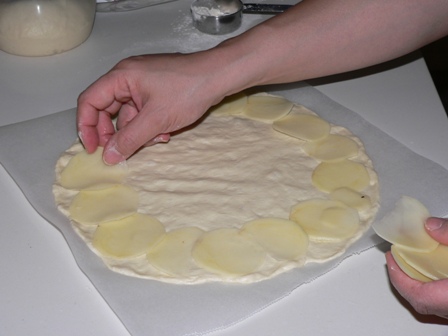
Step 4: Peel two potatoes and slice them finely on a mandoline. Lay the potato slices over the pizza base, overlapping just a tiny bit.

pizza-and-apple-pie-018

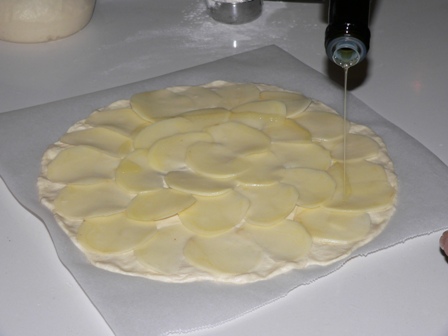
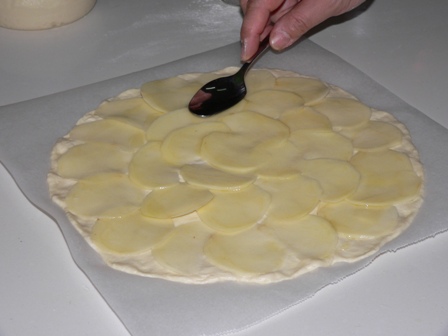
Step 5: Pour a small amount of garlic oil over the potatoes and spread it out with the back of a spoon.

pizza-and-apple-pie-019

pizza-and-apple-pie-020

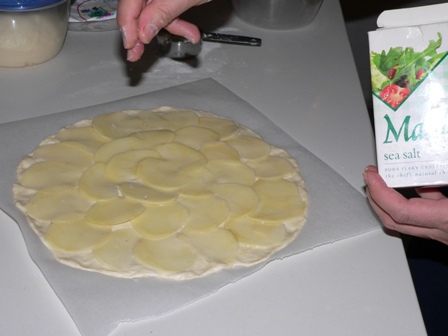
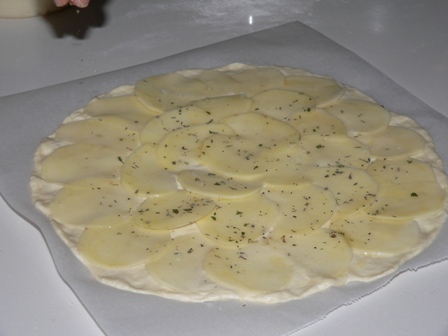
Step 6: Sprinkle with salt and a generous amount of dried herbs  – we use Herbie’s Italian Spice mix, but any mix of oregano, thyme and basil would work well.  Note that you need lots more than the bottom picture – Pete  took the photo before we were finished!

pizza-and-apple-pie-021

pizza-and-apple-pie-022

Step 7: Slide the pizza with its parchment sheet onto the hot pizza stone.  If you don’t have a stone, you can bake the pizza on an oven tray (although you might need to lower the heat slightly to ensure your parchment doesn’t scorch).  If you are using a stone, let the pizza cook for a few minutes, then carefully slide it off and remove the parchment paper, to allow the base to brown.  Bake until crisp and golden (which doesn’t take long – so don’t go wondering off).  If you’re not baking all the pizzas at once, make sure the oven reheats before you put the next one in.  Enjoy!

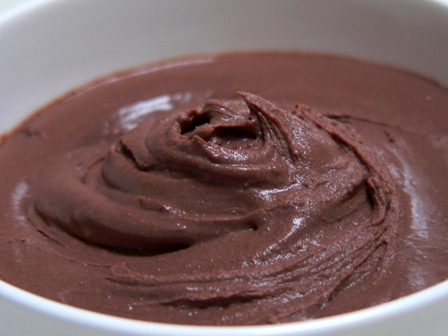
ganache-022


Have you ever made chocolate ganache?  It’s the easiest thing in the cooking world and oh so wickedly decadent.  It’s a great thing to do with any quality leftover chocolate (in the past we’ve used Lindt Easter eggs), and the finished ganache will keep in the fridge for at least a couple of weeks.

There are only two ingredients in ganache – heavy cream and chocolate.  You can make it with just about any sort of chocolate, although I’d strongly suggest that you use the very best you can afford.  There really isn’t much to this, so the flavour of the chocolate won’t be masked in any way.  We normally use Callebaut 54% dark callets, but in the past we’ve also made milk and white chocolate versions.

The proportion of chocolate to cream determines, not surprisingly, the viscosity of the finished product.  The recipe I’ve given here results in a creamy ganache that will stay soft in the fridge, but if you increase the chocolate content, you can make a firm ganache that will set hard enough to form into centres for chocolate truffles.

  • 3 cups of heavy cream (35% fat)
  • 450g (1lb) dark chocolate, either in callet form or finely chopped

1. Put the chocolate in a heatproof mixing bowl. In a saucepan, bring the cream to a boil,  then pour over the chocolate. Stir gently with a whisk until smooth – this can take a few minutes, so don’t rush it. Don’t whisk it hard – you don’t want to beat air into it. At first it will look like it’s not combining, but soon you’ll have a velvety chocolate liquid.

2. Pour the mix into containers, cover and store in the fridge, until cold. The photo above was taken after the ganache has been chilled and stirred.

Having a tub of ganache in the fridge is very empowering!  We use it as a chocolate sauce over icecream, a glaze for cakes, an easy hot chocolate mix or sometimes we simply eat it with a spoon.  Swirl it through custard before churning in an ice cream maker, or heat it gently,  and serve fondue style at the table with cut up fruit.

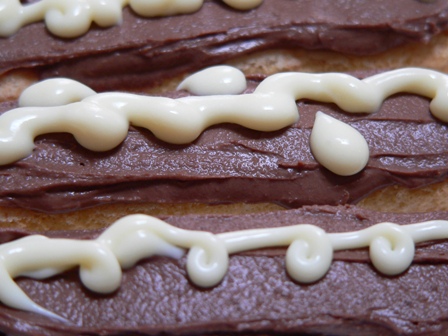
Last night we had friends over and I needed an instant dessert – all my addled brain could come up with on short notice was savoiardi biscuits (ladyfingers) topped with dark and white chocolate ganache. They were delicious, if somewhat artistically challenged.

ganache-saviordi-006


ganache-saviordi-003

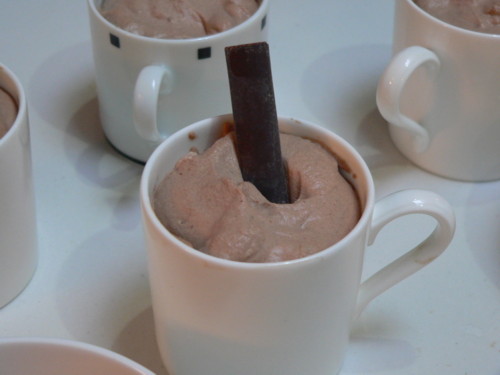
Chef Ming Tsai suggests making an easy chocolate dessert by mixing whipped cream with a generous dollop of ganache.  This produces a dark chocolate mousse (without any raw egg angst), which we serve in little espresso cups, accompanied by Belgian chocolate sticks for dipping. Be warned, it’s very rich – you really can’t eat a lot of this!

chocmousse