Feeds:
Posts
Comments

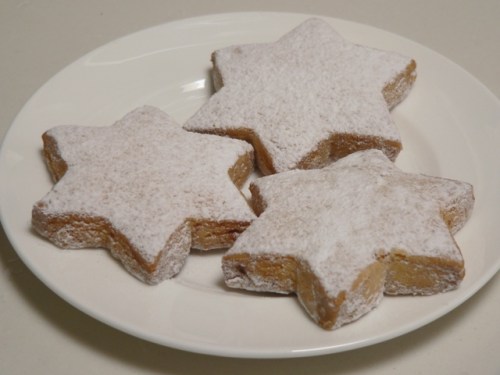
kifli 009

Have I persuaded you to make June’s Vanilla Kifli yet?

If not, please let me try again, because these little treats are melt-in-the-mouth delicious.  Granted, the word kifli means crescent, so making them star-shaped is somewhat unconventional.  But they appeal to the littlies, so we now make “star and moon” vanilla kifli.  The ones above are part of a batch I made for Mother’s Day (my mum likes stars as well!).

I’ve now made this recipe numerous times and have a couple of tips to add to my original post.  Firstly, if possible, go by weight rather than cup measurements when you’re putting the ingredients together.  Doing so will ensure a consistently moist dough – a cup of flour can vary enormously depending on everything from ambient humidity to your hormonal state, so if you have scales, this is a good time to pull them out and use them.

Secondly, don’t spread the mix too thinly – Pete measured the dough this morning and declared the perfect thickness to be 1.5cm (5/8 “).  I usually roll or press out half the dough at a time, onto a sheet of parchment paper.

kifli 001

Thirdly, substitute ground unblanched almonds for a small portion of the almond meal.  This batch had 50g  ground almonds to 200g almond meal.  The recipe will work perfectly well with straight almond meal, but the unblanched almonds add interesting texture and colour.

Finally, don’t overbake.  I set my oven to 160C (fan) and bake for no more than 18 minutes, and sometimes even that’s too much.  I do, however, have a hot and occasionally temperamental oven, so you’ll need to adjust accordingly to suit your baking conditions.  As you can see from the photo below, the absolute ideal is a kifli which is light golden the whole way through, without a darkened brown bottom.  That bit takes a bit of practice, but the rest of the recipe is actually remarkably simple!
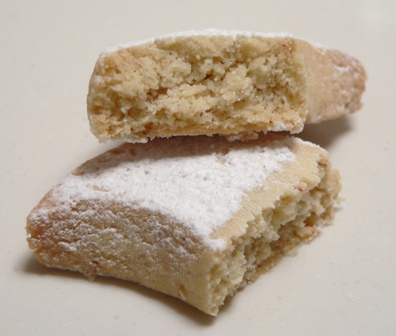
kifli 018

These cookies seem to improve with a little time, so make sure you hide some until the second day (hard to do in this house).  You can also shape the unbaked dough into logs and freeze them (make sure you wrap them well to prevent freezer burn).  I’ve defrosted frozen dough a month later and it’s  baked up beautifully!

If you can’t see the video above, please view this page in Firefox.

. . . . .

I adore our fish.  They live in a large four and a half foot  bespoke tank in the dining room, and provide us with endless distraction and entertainment.  A few years ago, Pete converted the tank from a standard tropical aquarium to one designed to house African Cichlids. These fish have fairly specific requirements – hard, foliage-free water, and rocks and shells in which they can hide. After researching the price of commercial rockery (too scary to discuss), my clever husband created a backdrop out of carved polystyrene packaging and concrete. It resembles a large rocky lake bed, and the fish seem to enjoy it immensely.

Four species of fish share our home with us. The main ones are the Labidochromis caeruleus, a bright yellow species originally from Lake Malawi, who have established their dominance in the tank partly through their ability to breed.  We now have three generations living in the tank.  Only one baby fish from any spawning ever seems to survive, but it’s always the cleverest one, who hides himself in a tiny hole under the big rock on the far right. A classic example of survival of the fittest, presented right before our eyes as we eat our Weetbix.  The Labs are mouth breeders, and it’s fascinating to watch them keep their numerous fry inside their mouths – wriggling and bulging like a scene from Aliens.

The grey-blue fish with yellow tails are Cyprichromis from Lake Tanganyika, but given that I was promised bright blue fish, the less said about them, the better.  Although they did provide us with a wonderful mating display yesterday, as they circled each other with their dorsal fins raised majestically.

My favourites are the Lamprologus stappersii, small mottled grey fish commonly known as Shellies.  Completely fearless, each guards its chosen shell with ferocity, boldly chasing the larger fish away if they get too close.   When Pete puts his hand into the tank to clean it, the Shellies nibble on his fingers, while the other fish hide in the caves.  They’ve also developed an unnerving habit of hovering right next to the glass, on the other side of the bubble stream, which makes them appear to be floating on the outside of the tank.

The last fish we have in the tank is not an African Cichlid at all – it’s an Amazon Basin catfish.  Our Plecostomus is now about three years old, and it’s the second one we’ve had – the first one lived for over twelve years.  Plecs are the vacuum cleaners of the aquarium world.  They start off fairly small – maybe 5cm (2”) – and grow continuously until they reach an appropriate size for the given tank – in our case, that’s about 25cm (10”) long.  Picasso, as Small Man has christened him, is now too large for the other fish to annoy, and too old to care.  He’s a grumpy old curmudgeon, who spends most of his days glued upside down to the roof of a cave,  coming out at night to eat the algae when  all the annoying young upstarts have gone to bed.  I couldn’t get a decent photo of him, but found this one online – our fish looks almost exactly like this:

Our fish tank is a constant source of joy for us –  a tiny slice of the outside world that we wouldn’t normally get to experience.  And it’s always changing! One morning, Pete noticed that all the gravel in the tank  was moving.  Overnight, we’d had a plague of snails – all hatched from tiny eggs which, unbeknownst to us,  had come in with the pebble mix.  Within a few days, they’d all been eaten, but obviously not before they had reproduced, because the same thing happened again about a month later.  The snail and fish populations have now reached an equilibrium, and we rarely have to clean the tank anymore – the snails eat the algae and the fish poop, and the fish eat the snails!

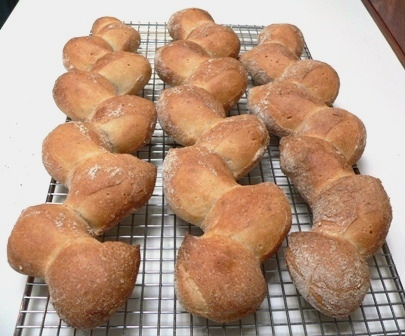
If you can bake a regular loaf of bread, you can make epi.  This decorative loaf, traditionally fashioned to mimic a stalk of wheat, is always impressive, providing you don’t show anyone how easy it is to make.

Start with your normal batch of dough (mine was a white sourdough, but it will work equally well with yeasted dough) and when it has finished its first rise, divide it into 250g – 300g portions.  Stretch and roll these out into long baguette shapes and allow them to prove on a floured tea towel until well risen – about 30 minutes for a yeasted dough, perhaps a bit longer for sourdough.  I dust my tea towel heavily with rye flour – plain flour seems to stick quite badly. Place the long rolls seam side up, so you can flip them over when you go to bake them.  As shown below, pleat the tea towel to form channels for the baguettes to rise in, then fold the ends of the tea towel in to cover the top of the dough while it rises.

Preheat the oven to 250C (480F), then drop the temperature down to 220C (430F) – or your usual baking temp – when you put the dough in.

090409-003

Move each proved sausage carefully to a baking tray lined with parchment paper.  Using a pair of scissors, snip through the dough and twist the little knobs to alternate sides.

090409-010

090409-011

Once you’ve finished, spritz the top of the epi with water and bake in the oven (dropping the heat down when you put them in) for 20 – 30 mins, or until golden brown and crusty.  For my dough, I allow 15 minutes on 220C, then drop the heat to 175C for a further 10-15 minutes, rotating the trays when I reduce the heat.

090409-012

Epi are the perfect bread for sharing – a stick or two on the dinner table can be easily broken up, resulting in lots of little individual bread rolls.  It’s also the perfect bread for dipping in the Pukara Novello!

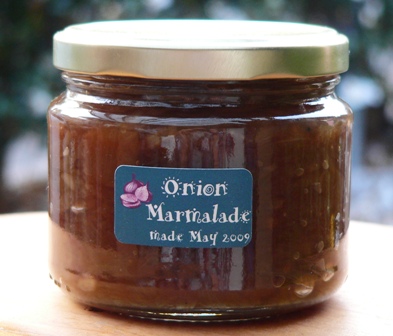
onion-marmalade-001

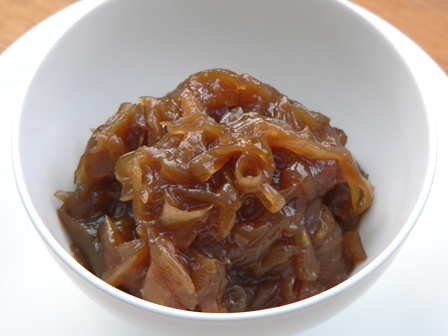
This is the third recipe I’ve tried for onion marmalade, and the first one I’ve been really happy with.   While the others have been too sweet, this one is subtle, with delicious complex flavours that were a perfect complement to last night’s sausages and mash.

The most important thing is the slow, slow cooking of the onions – don’t rush this or the texture and flavour won’t be right.  Also, I’d strongly suggest you prep your onions with the slicer attachment of your food processor, as 2kg is a lot of onions!  Even with the food processor, I shed a few tears – which made me think of the Muppets clip below.

Onion Marmalade

Makes 3 x 300ml jars  (Adapted from Preserves by Pam Corbin)

  • 100ml olive oil
  • 2kg onions, peeled and finely sliced
  • 200g brown sugar (original recipe used demerara sugar)
  • 150g lilly pilly or quince jelly (original specified redcurrant jelly)
  • 300ml white wine vinegar (original recipe used cider vinegar)
  • 50ml balsamic vinegar
  • 1 rounded tsp salt
  • 1/2 tsp freshly ground black pepper

1. Heat oil in a large heavy pan (I used a large Le Creuset pot) over a medium heat and add the onions.  Reduce the heat to low, cover the pan and cook, stirring occasionally, for 30 – 40 minutes until the onions are completely wilted and just beginning to colour.

2. Add the sugar and jelly, and increase the heat.  Remove the lid and cook, stirring frequently, for about 30 minutes until the mixture turns dark brown and most of the liquid has evaporated.

3. Take the pan off the heat and allow to cool for a few minutes, then add the vinegars (this is important, as adding vinegar to the hot pan will cause it to all steam up and evaporate away).  Return to the heat and cook for another 10 minutes or so, until the mixture becomes thick and gooey, and a spoon drawn across the bottom of the pan leaves a clear track across the base for a couple of seconds.

4. Remove from heat and season with the salt and pepper. Spoon into hot sterilised jars and seal with vinegar-proof lids.

Note: the original instructions don’t mention this, but we routinely boil our sealed jars in a hot water bath for ten minutes, ensuring that the lids are covered by at least 2.5cm (1″) of hot water.

onion-marmalade-005

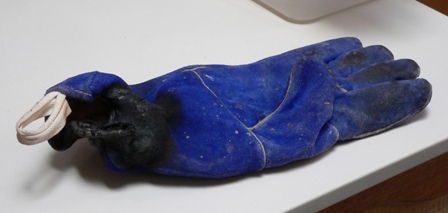
Here’s another reason my welding gloves are cool – they don’t burst into a fireball and burn down the house when you accidentally leave them on top of a lit gas burner and go off to play Spider Solitaire on the computer.

Thankfully Big Boy noticed all the smoke in the kitchen and went to investigate, then used his powerful brass musician lungs to blow the fire out.  The leather gloves were actually burning away quite gently – I guess they wouldn’t work for welding if they burst into flames whenever a spark landed on them. Nevertheless, I’m feeling incredibly grateful right now that the house is still standing.

fudge-006