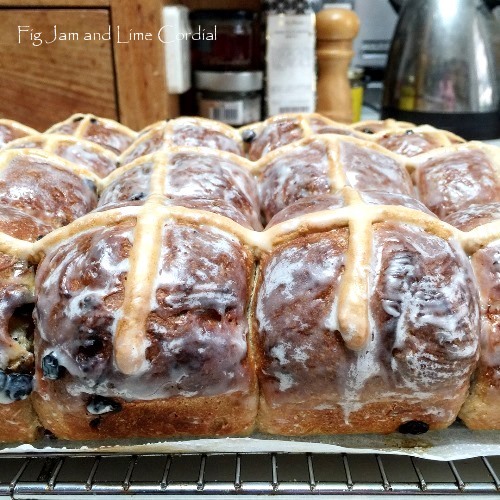
Here’s a new sourdough hot cross bun recipe that I’ve been playing with! It’s an adaptation of our tried and trusted yeasted bun recipe, but with a slightly better flavour (according to Pete and Small Man).
A couple of tips: firstly, make sure to use a ripe, bubbly sourdough starter. Pop a teaspoonful into a glass of water and if it floats, it’s generally good to go. If you’re not sure how your starter should look, please visit our FAQ for photos and tips.
Secondly, don’t rush the final prove. Hot cross buns are notoriously slow to rise once shaped, so make sure your dough is nice and puffy before you pop it into the oven. Mine took an hour and a half today, but it was worth the wait – if you bake too soon, you’ll end up with heavy buns. Here’s how my dough looked just before piping…

Dough
- 1kg bakers/bread flour
- 100g ripe, bubbly sourdough starter
- 14g fine sea salt
- 80g brown sugar
- 120g unsalted butter, melted and cooled
- 3 large (60g) free range eggs
- 4 tsp mixed spice or allspice
- 150g currants
- 500g full cream milk, heated gently and then cooled to blood temperature, or UHT milk, unrefrigerated
Cross
- 3 Tbsp self raising flour
- 2 Tbsp cold water
Glaze
- 4 Tbsp milk
- 4 Tbsp caster (superfine) sugar
Note: this makes 24 hot cross buns and bakes perfectly in a sheet pan measuring 40cm x 28cm (15½ x 11″). I used to bake a dozen at a time, but there were never enough to go around! The recipe should halve well if needed.
1. The evening before baking, whisk together the starter, sugar, melted butter, eggs, milk, currants and mixed spice in a large mixing bowl. Add the flour and salt. (Note: I use UHT full cream milk, unrefrigerated and straight out of the carton.)
2. Squelch all the ingredients together with clean hand to form a shaggy dough. Allow the dough to sit in the mixing bowl, covered with a clean tea towel or a pot lid, for about 30 minutes.
3. Uncover the bowl and give the dough a brief knead.
4. Cover the bowl again and allow to rise overnight (8 – 10 hours). I leave it on my kitchen bench to do this.
5. The next morning, turn the risen dough onto a floured bench and give it a couple of gentle folds, then divide it into 24 equal pieces (about 90g each). Shape each piece into a small ball, trying to keep the currants inside the ball as much as possible (currants on the outside tend to burn). Place them side by side on a quarter sheet pan which has been lined with a sheet of parchment paper (four rows of six, evenly spaced – they’ll rise into each other). Allow to rise, loosely covered with a tea towel, until doubled in size (mine took about an hour and a half, don’t rush this bit, let them get good and puffy). In the last half an hour of rising, preheat your oven to 210C with fan.
6. Mix the SR flour and water together to form a paste and spoon it into a plastic freezer bag or small piping bag. Clip off the very end of one corner. Pipe crosses over the top of the buns, doing all the lines in one direction first, then the other. Spritz the tops with water.
7. Turn the oven down to 200C with fan and put the buns in. After 15 minutes, turn the buns around and bake for a further 8 – 10 minutes, or until golden brown.
8. When you’ve rotated the buns, start making the glaze. Heat the milk and caster sugar together in a small saucepan until thick and syrupy. Stir constantly and keep an eye on it to make sure it doesn’t boil over. When the buns are finished, pull them out of the oven and paint the hot buns with the glaze. Allow to cool on a wire rack before scoffing.
I splodge the glaze on with a pastry brush using a swirling action. Just for fun, actually…

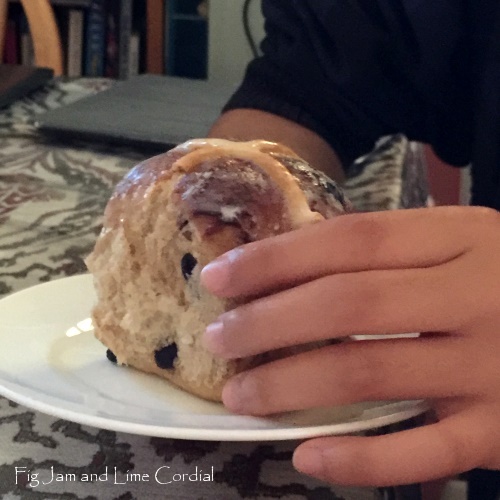
The buns are surprisingly tender…

Best of all, baking two dozen at a time lets you share with all the neighbours…
Four dozen made, and it’s not even Easter yet! If sourdough sounds a bit time consuming, rest assured that our yeasted buns are also very tasty and much quicker to make. Opinion is divided on which is better, actually! If you’d like to give them a go, the recipe is here. Enjoy! ♥

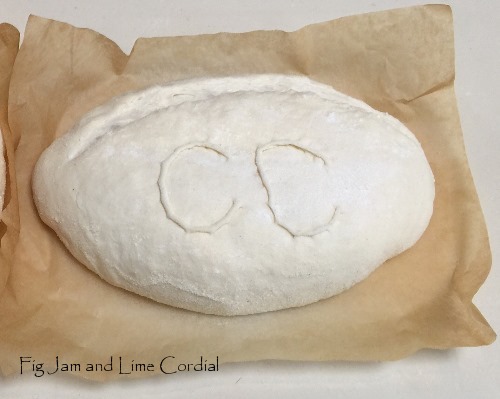





 Fig Jam and Lime Cordial