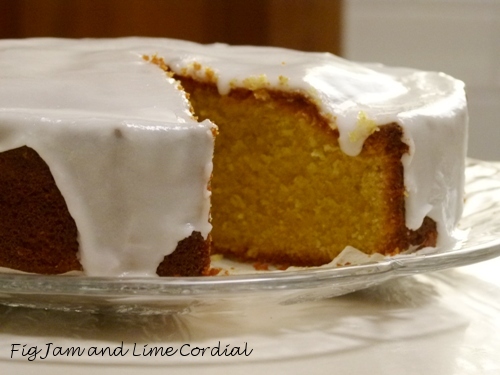
Grab a cup of tea and pull up a chair – this is a loooong post!
I’ve discovered a cake baking secret (thanks Gill!).
It’s not really a secret at all, but it’s new to me, and understanding it has provided me with the necessary formula to create a wide range of exciting cake recipes.
Invented in Britain in the 1700s, pound cakes were based on a gloriously symmetrical recipe:
- a pound of butter
- a pound of sugar
- a pound of self-raising flour
- a pound of eggs
Converting this to manageable proportions (in this case, halving the quantities) gives us:
- 8oz (250g) butter
- 8oz (250g) sugar
- 8oz (250g) SR flour
- 4 large (59g) eggs
These cakes seem to mix up particularly well in the food processor.
If you don’t have self-raising flour, substitute 250g (8oz) plain (AP) flour whisked with three (3) teaspoons of baking powder.
Basic instructions :
1. Have all the ingredients at room temperature before starting. Preheat the oven to 160C (320F) with fan. Grease and line a 20cm (8″) round springform tin.
2. In the large bowl of the food processor, pulse together the butter and sugar until well combined and light in colour. Scrape down the bowl.
3. Add the eggs one at a time and continue pulsing to combine. Add a spoonful of the flour each time (if required) to stop the batter from curdling. Then add the remaining flour, pulsing until just combined (do not overmix).
4. Scrape the batter into the lined tin and bake for about an hour (start checking at the 50 minute mark), until a cake tester inserted into the thickest part of the cake comes out cleanly. Baking time will vary if a different shaped tin is used. Allow to rest in the tin for 10 minutes before releasing the springform and transferring to a wire rack to cool completely.
♥ ♥ ♥ ♥ ♥
Now this is where it gets fun!
Providing the proportions are kept roughly the same, the ingredients can be varied. It’s a little bit like cake baking by numbers! Some of the successful substitutions I’ve tried so far are as follows…
- Butter: the white chocolate cake I made below used 185g (6oz) unsalted butter and 65g (2oz) melted white chocolate in place of the 250g (8oz) butter. I’ve also tried substituting half the butter with a neutral vegetable oil, and it worked acceptably well.
- Sugar: I’ve made a chocolate pound cake with a mix of white and brown sugar. I’ve also used castor (superfine) sugar in several of the cakes below.
- SR flour: In the chocolate and hazelnut cake, I substituted Dutch-process cocoa powder and hazelnut (or almond) meal for half of the total flour weight.
- Additional flavourings: I almost always add a little homemade vanilla extract, and I’ve added citrus rind to the lime and almond cake below.
- Baking tins: I’ve baked these cakes in a 20cm (8″) round springform tin, a cast aluminium bundt pan and 22cm (8½”) loaf tin. The round and bundt pans worked well in all instances. The loaf tin was fine for our chocolate and hazelnut cake, but I had less success with the lime and almond cake in it – the centre of the cake collapsed as it baked.
- Scaling: I haven’t tried making a smaller cake yet, but I’ve read that the recipe can be easily scaled, providing we keep to the ratio of one large egg to 2oz (roughly 60g) of each of the other ingredients.
These changes will naturally alter the flavour and texture of the finished cake, which means every new combination will result in a unique creation.
♥ ♥ ♥ ♥ ♥
Here are a few of my recent attempts…

Lime and Almond Cake
- 250g (8oz) unsalted butter
- 250g (8oz) castor (superfine) sugar
- 175g (5½ oz) self-raising flour
- 75 (2½ oz) blanched almond meal
- 1 teaspoon homemade vanilla extract
- 4 large (59g) free range eggs
- 2 teaspoons grated lime rind
- lime icing (made from icing sugar mixture and lime juice)
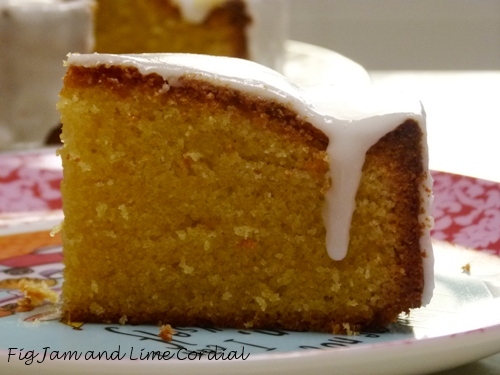
This one is Pete’s favourite! The almond meal gives the finished cake a moist texture which contrasts well with the sharp, acidic icing.
♥ ♥ ♥ ♥ ♥

White Chocolate Pound Cake I
- 185g (6oz) unsalted butter
- 65g (2oz) white chocolate, melted
- 250g (8oz) white sugar
- 250g (8oz) self-raising flour
- 1 teaspoon homemade vanilla extract
- 4 large (59g) free range eggs
- extra white chocolate chips
- tempered white and milk chocolate, for decorating
I ladled half the batter into the lined 20cm (8″) springform tin, scattered over the extra white choc chips, then poured over the remaining batter. The finished cake had a slightly airier crumb than the lime cake, with a pronounced white chocolate flavour. Melted milk and white chocolate was drizzled over the top in a criss-cross pattern.

♥ ♥ ♥ ♥ ♥
White Chocolate Pound Cake II
This version was made to use up the leftover chocolate from our Easter tempering…
- 185g (6oz) unsalted butter
- 65g (2oz) white chocolate, melted
- 175g (5½ oz) castor sugar
- 75g (2½ oz) light Muscovado sugar
- 250g (8oz) self-raising flour
- 1 teaspoon homemade vanilla extract
- 4 large (59g) free range eggs
- 125g (4oz) assorted chocolate bits
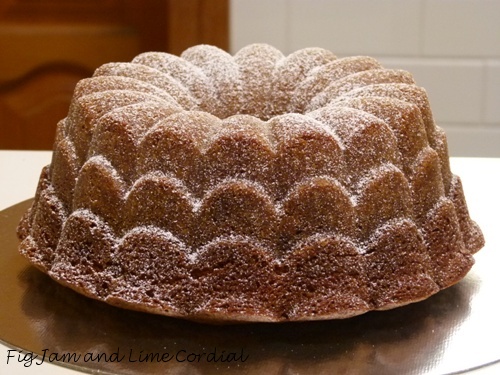
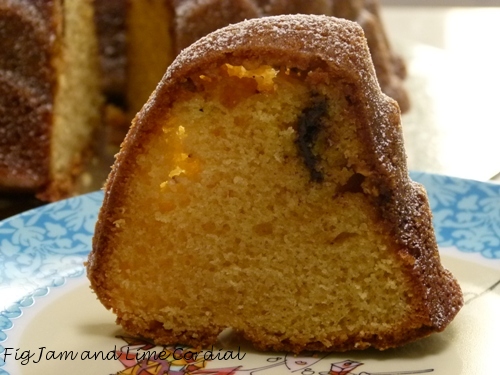
The batter was ladled into a greased bundt tin in three layers, with a scattering of chocolate bits between each layer. It took just 45 minutes in a 160C (320F) fan-forced oven – the shorter baking time was probably due to the dark coating and central tube of the cast aluminium bundt tin. The gaps in the crumb are where the white chocolate bits have melted into the cake…
♥ ♥ ♥ ♥ ♥
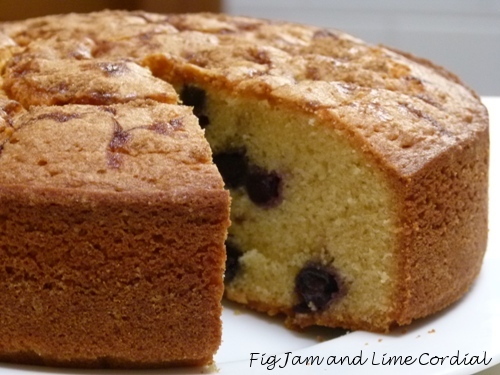
Blueberry Pound Cake
- 125g (4oz) unsalted butter
- 125g (4oz) vegetable oil
- 250g (8oz) castor (superfine) sugar
- 250g (8oz) plain (AP) flour
- 3 teaspoons baking powder
- 1 teaspoon homemade vanilla extract
- 4 large (59g) free range eggs
- 125g (4oz) fresh or defrosted frozen blueberries
- Light Muscovado sugar, for scattering on top before baking
This cake was purely experimental – I wanted to see if I could replace part of the butter with oil, and also to see if plain flour plus a raising agent was a suitable alternative for the SR flour.
Both substitutions worked well, although the batter was far wetter than usual (due to the oil) and the blueberries (which were scattered on top prior to baking) sank as the cake rose. Having said that, I’m quite happy that they didn’t all sink to the bottom.
I think I prefer these cakes made with butter, as the flavour of the oil came across a bit too strongly in this one. However, the fact that it worked so well with all the substitutions attests to the versatility of the recipe!

♥ ♥ ♥ ♥ ♥
Now, please don’t write and tell me that my metric to imperial conversions are out – I’m aware of that, but the proportions are the same in each case, and it’s much easier to work in round numbers.
There are oodles of possible variations on this basic cake recipe! Fresh or dried fruit could be added, flavourings might include coffee, liqueurs or spices, or the basic cake could be split in half and sandwiched with cream and jam.
Play around with a combination of flavours that you like, and you’ll end up with a cake recipe that is uniquely yours. And if you do, please share – we’d love to see what you come up with!
♥ ♥ ♥ ♥ ♥
Related Post: Food Processor Chocolate and Hazelnut Cake
Read Full Post »




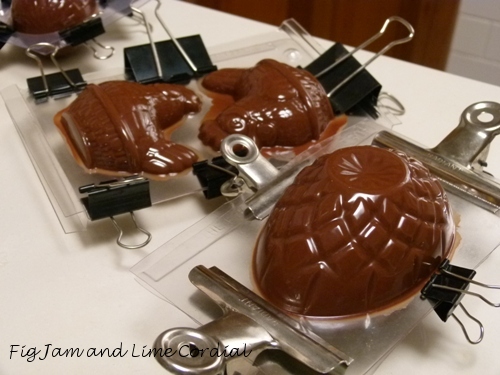
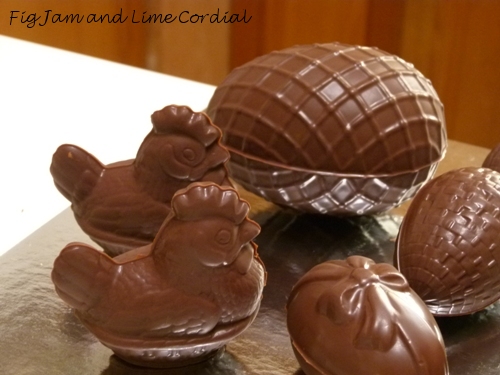



 Fig Jam and Lime Cordial