Feeds:
Posts
Comments

Archive for the ‘Recipes’ Category

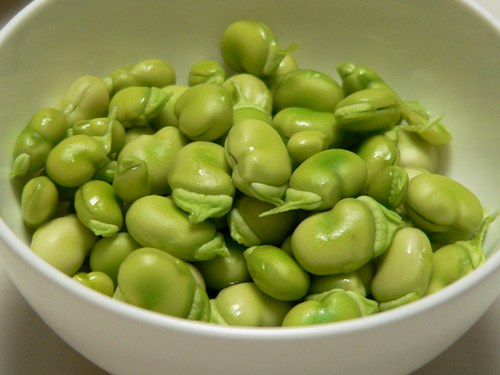
I’d never tasted young broad beans before!

These were the first pods off our backyard plants, and the beans were so fresh and tender that they didn’t need double peeling…

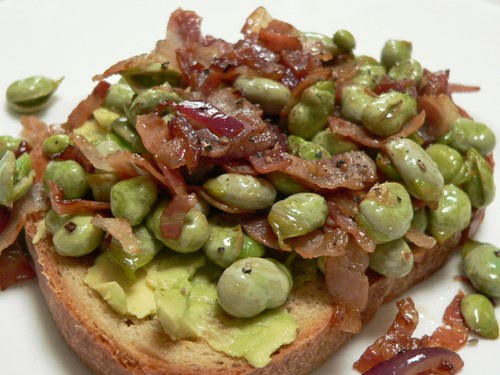
I had beans on toast for lunch, made to this fabulously simple Hugh Fearnley-Whittingstall recipe.

The baby broad beans were blanched briefly (oh, how I love alliteration), then panfried with pancetta, slices of spanish onion, lemon juice and a little olive oil.  It was simply sublime on sourdough.

(If inspired, feel free to cleverly comment with a-little alliteration!)

Read Full Post »

This recipe is for my friend Ellen, who took umbrage with my comment that our chocolate slab cake was almost as easy to make as a packet mix (truly it is, El, but maybe not at 11pm).

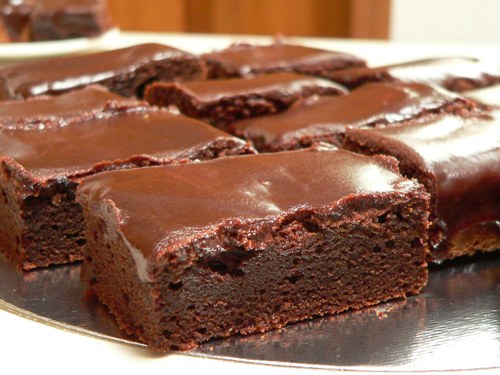
This cake is even easier, only requires a few ingredients, and is made and iced in the blink of an eye.  It’s not as moreish or luscious as the chocolate slab cake – but a pleasant treat nonetheless.  And it’s perfect for those times when you just need something super quick and easy.

Chocolate Fudge Cake
(adapted from the Australian Womens Weekly’s Cakes and Slices Cookbook)

  • 250g (9oz) dark chocolate, chopped (I used Callebaut 811 54% callets)
  • 125g (½ cup) unsalted butter, chopped
  • 150g (2/3 cup) castor (superfine) sugar
  • 100g (2/3 cup) self-raising flour
  • 4 large (59g) free range eggs

1. Preheat oven to 190C (375F) or 175C (350F) with fan.

2. Line a 23cm (9″) square tin with parchment paper.  The original instructions called for a 19cm x 29cm lamington tin (7½” x 11½”), but I didn’t have one.  The cake would probably work just as well in a 20cm (8″) square, but it might need a slightly longer baking time.

2. In a large pyrex mixing bowl, melt the chocolate and butter together in the microwave, using short 30 second bursts on high and stirring well between each (this could also be done in a double boiler on the stove).   It will only take a minute or two – take care not to scorch or boil the mixture.  Stir well to combine and allow to cool slightly, to ensure  the eggs don’t scramble in the next step.

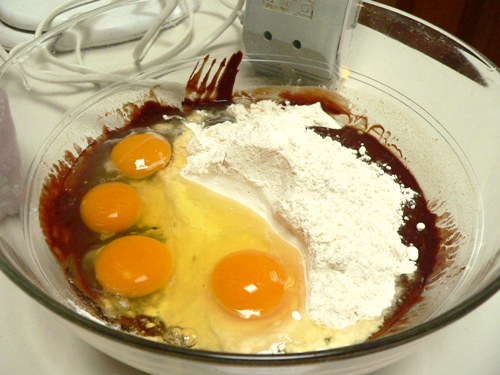
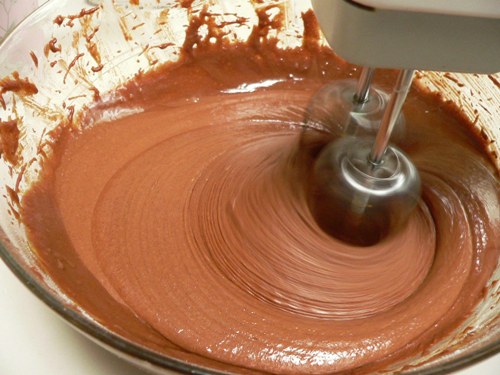
3. Add the castor sugar, self-raising flour and eggs to the bowl and beat with an electric mixer on low until all the ingredients are combined.  Then raise the mixer speed and beat well for 3 minutes until the batter is smooth and light.

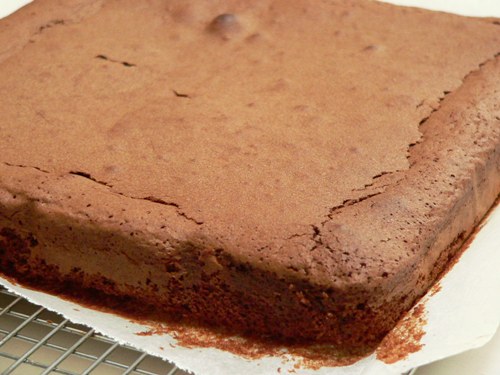
4. Pour and scrape the  batter into the lined pan and bake for 20 – 30 minutes, until a toothpick inserted into the cake comes out cleanly. The original recipe specified 30 minutes, but in my fan forced oven, this cake was ready in just 20 minutes.  Allow to rest in the pan for about 10 minutes before lifting onto a wire rack to cool.

5. The original recipe was served simply dusted with icing sugar, but I topped ours with a half batch of our ever reliable Jamie Oliver chocolate icing, using the quantities below:

Chocolate Icing
(from Jamie Oliver’s Return of the Naked Chef)

  • 50g/1¾ oz unsalted butter
  • 50g/1¾ oz dark chocolate (I used Callebaut 811)
  • 50g /1¾ oz icing sugar (sifted)
  • 1½ tablespoons (6 teaspoons/30ml) milk

Melt the ingredients in a bowl over some lightly simmering water. Stir until blended well and allow to cool slightly. Pour over cake and allow to set.

Click here for a printable version of this recipe

Read Full Post »

It’s funny what motivates us sometimes.  I bought this tray of sardine fillets simply to avoid paying parking at the Sydney Fish Market (I needed to spend more than $50 to get free parking), and it sat in my freezer for a few weeks until I came across this lovely recipe in my Ottolenghi cookbook.

It’s a recipe with lots of ingredients, but most of the work is in the assembling – the actual cooking part is quite easy.  Sorry, no imperial measures this time – as the cookbook is a UK edition, all ingredients were provided in metric.

  • 100g medium bulgur (burghul) wheat (I used fine, leftover from my attempt at tabbouleh)
  • 30g currants
  • 30g slivered almonds, lightly toasted (original recipe used pistachio nuts)
  • grated zest of 1 lemon
  • 40ml lemon juice
  • 2 tablespoons chopped flat-leaf parsley
  • ½ teaspoon ground cinnamon
  • 1 teaspoon ground allspice
  • 3 tablespoons dried mint
  • 2 garlic cloves, crushed
  • 2 tablespoons pomegranate molasses
  • 1 teaspoon caster (superfine) sugar
  • 6 tablespoons olive oil
  • 8 fresh sardines, scaled, boned and butterflied (I used a tray of sardine fillets)
  • salt and black pepper
  • lemon wedges to serve

1. Soak the bulgur in a bowl of cold water for about 20 minutes, until soft.  Drain in a fine sieve and squeeze out any excess moisture.

2. In a separate bowl, soak the currants in a little warm water for five minutes, then drain.

3. Add the currants and almond slivers to the bulgur, along with the zest, juice and most of the chopped parsley, keeping back a little to garnish.  Mix in the crushed garlic, spices, mint, molasses, sugar and 5 tablespoons of oil, then season with salt and pepper to taste.  Try not to eat this with a spoon (which is what I found myself doing..)

4. In yet another bowl, mix the sardine fillets with 1 tablespoon of olive oil and season with salt and pepper.  Preheat the oven to 180C.

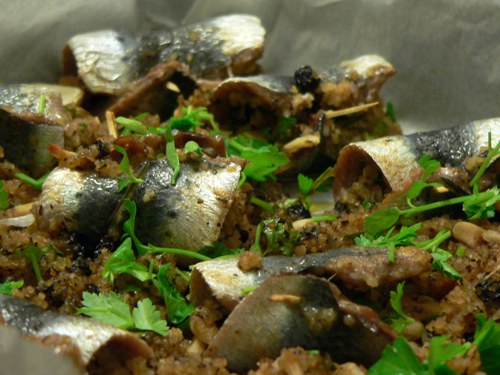
5. Stuff the sardines by lying them on a plate skin-down, and spooning a little of the stuffing mixture into the middle of each fish.  Roll the fillet around the stuffing and secure with a toothpick or cocktail skewer.

6.  Arrange the sardines on a baking tray lined with parchment and roast for 5 – 6 minutes, until just cooked through.  My sardine fillets were quite small, so I scattered all the excess stuffing around the rolls prior to baking in the oven.  Serve scattered with the remaining parsley and accompanied by the lemon wedges.

Click here for a printable version of this recipe

Read Full Post »

I watched the gorgeous Annabel Langbein making marshmallows on her new show, The Free Range Cook, and couldn’t resist trying them out!  We adapted her recipe and this one by Hugh Fearnley Whittingstall to come up with our own version.

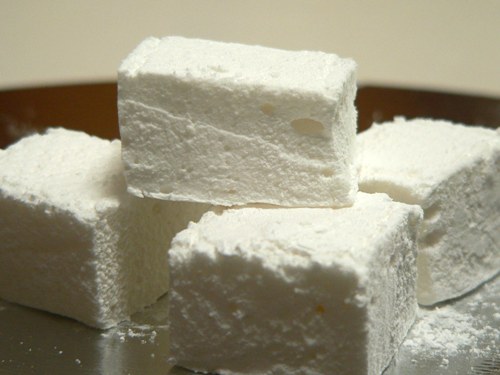
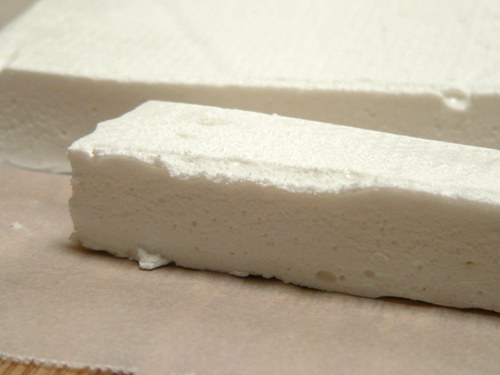
These moreish morsels only have four ingredients – sugar, gelatine, vanilla extract and egg white. The texture is reminiscent of a firm meringue pie topping – quite different from the commercial versions which are bouncy and rubbery (and made in a very different way).  These have a lovely old world charm to them.

Make sure you allow plenty of time for the mix to set before cutting – the marshmallows will continue to firm up over the next day or so.  Instead of greasing and dusting the pan, we lined it with a sheet of parchment, which was then lightly sprayed with oil.  The  finished sweets then only needed a light dusting of cornflour (cornstarch) and icing sugar to keep them from sticking together.

  • 2 large free range egg whites (as fresh as possible)
  • 500g (2¼ cups) white sugar
  • 250ml (1 cup) water
  • 25g (0.88 oz) leaf gelatine (see Hugh’s recipe if you’re using powdered gelatine)
  • ½ teaspoon of vanilla extract (we used homemade)
  • mixture of cornflour (cornstarch) and icing sugar, for dusting

1.Line a rectangular baking tray with parchment paper, and lightly spray the top of the paper.  I used a 33cm x 22cm (13″ x 9″) roasting tray.

2. In a medium saucepan with a long handle, stir the sugar and water over a low heat until the sugar dissolves, then raise the heat and bring to a rapid boil.  Clip on a candy thermometer and boil the syrup until it reaches hard ball stage (122C/252F).  This will take approximately 10 – 15 minutes.
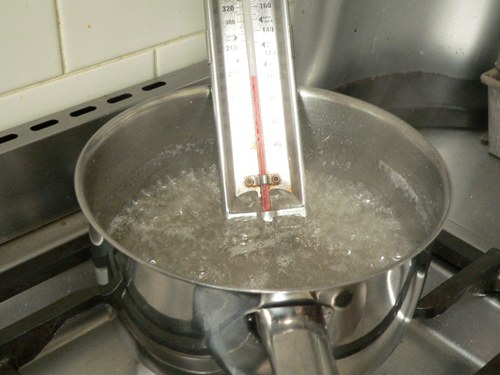
3. Soak the gelatine leaves in a bowl of cold water for about 10 minutes.

4. Before the syrup reaches temperature, place the egg whites in the bowl of a sturdy stand mixer and beat until stiff peaks form.  Timing is quite important, and the sugar syrup, egg whites and gelatine need to be ready at the same time.  It helps, but isn’t essential, to have two people on the job – one to watch the syrup thermometer and the other to prepare the other ingredients.

5. Once the syrup is at the right temperature, remove the saucepan from the heat.  Turn the mixer on to low, and gently trickle the hot syrup into the stiff egg whites, beating constantly as the mixture turns creamy. Please be very careful – the sugar syrup is blindingly hot!
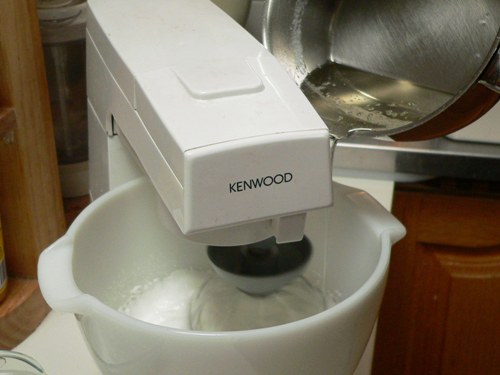
6. As soon as all the syrup is added, quickly remove the gelatine from the water and squeeze out the excess water from the softened leaves, then add the gelatine to the mixing bowl while the mixture is still hot, and beat until combined.  Add the vanilla extract and continue beating.
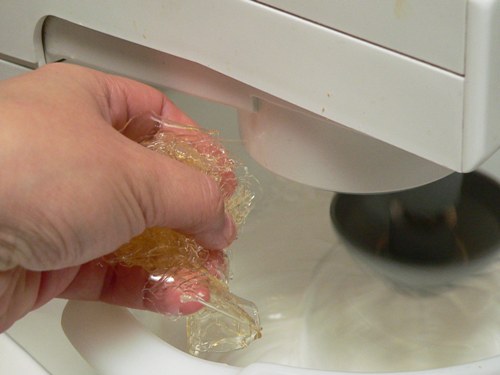
7. Turn the speed up and beat the mixture until it thickens – Annabel suggests beating until the mixing bowl feels just warm – this can take up to 10 minutes.  The finished mix will be very thick but still pourable (even thicker than photo below).
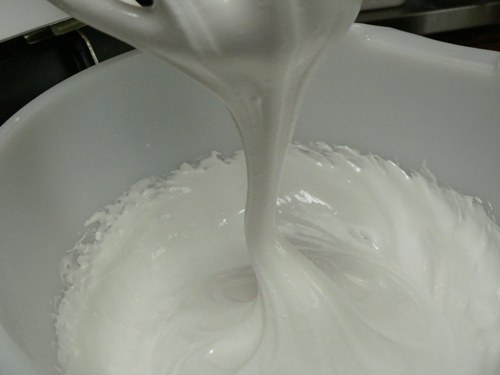
8. Scrape the marshmallow into the prepared pan and smooth out the top.  Leave to set for at least four hours or overnight.  When firm, lift the slab out using the parchment paper, cut with a warm, dry, sharp knife into squares, and dust each with a fine coating of cornflour (cornstarch) and icing sugar mixture.
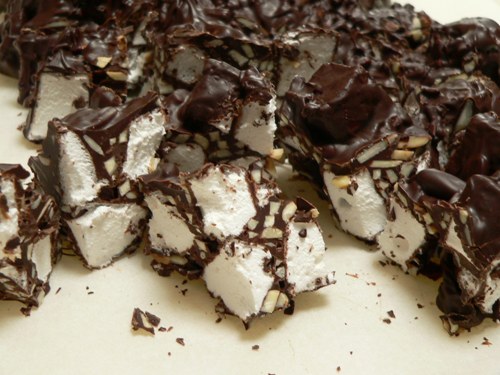
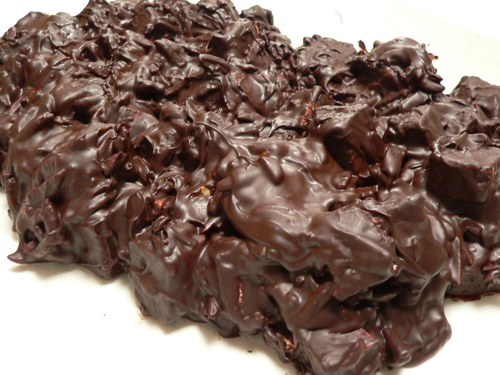
Of course, once we had homemade marshmallows, we had to make dark chocolate rocky road!  We used 500g  of tempered dark Belgian chocolate, 125g slivered almonds and 200g of homemade marshmallows, chopped into cubes.  It’s wickedly good!

Click here for a printable version of this recipe
Read Full Post »

My last post about bread braiding for a while…promise!

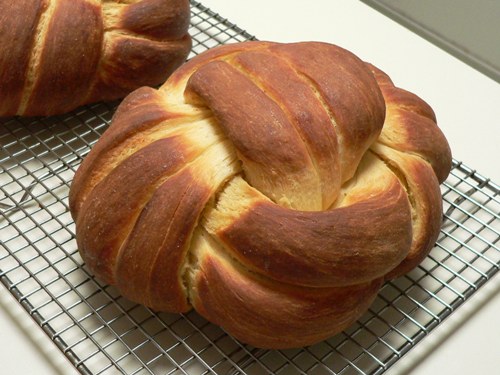
A few people asked about the Winston knot design that I made in the previous post, so I tried the pattern again, taking photos this time.  The original instructions for this shape are in Jeffrey Hamelman’s Bread.

Each of the loaves was made with a full batch of the braided bread dough recipe – approximately 850g each.  The dough was divided into six balls of approximately 140g each, and then rolled into long logs.

Note that the logs need to be looong, or you’ll run out of dough before the end.  Mine were about 60cm/24 inches each.  After rolling, very lightly dust the logs in a little flour to help improve definition in the finished loaf.

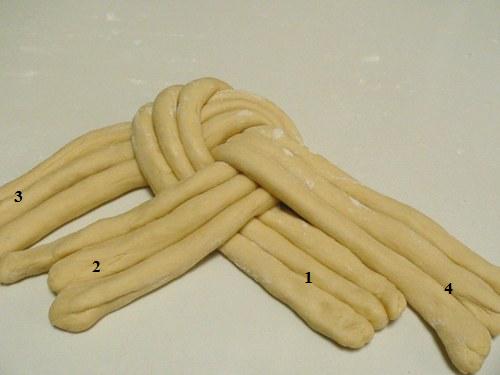
Step 1: Lay the dough out as shown below.  From now on, each group of three adjacent logs will be treated as a single unit. Note that when each group is woven, the rolls should not be turned over but simply rotated, so that the part that is face up continues to be face up for the whole process.  Please also note that I stuffed this up in step 2 (but it wasn’t too bad, as that bit ended up at the bottom of the loaf).

Step 2: Rotate group 1 down to lie adjacent to group 4.

Step 3: Rotate, without turning over, group 2 under group 4 and over group 1.  It should end up next to group 3.

Step 4: Rotate group 3 over group 2 and lie it next to group 1.

Step 5: Weave group 4 under group 1 and over group 3.  Nearly there!

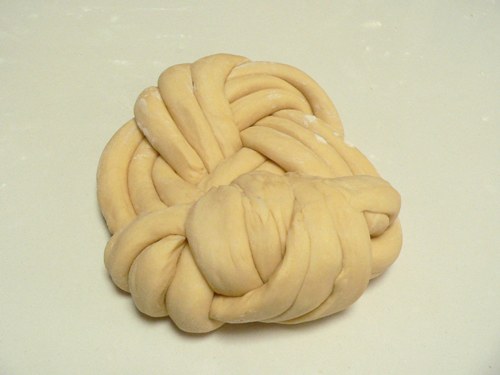
Step 6: Bring what you have left of group 2 over group 4, then squelch all the bits together at the bottom.  Don’t worry too much about neatness, as this ends up on the underside of the loaf.

Step 7: Fold the bottom of the dough (the bit you’ve just squelched together) upwards to the middle of the dough.

Step 8: Now repeat with the top of the dough.  Squish the two bits you’ve folded in together, but be careful not to squash the dough down, or you’ll flatten out the design.

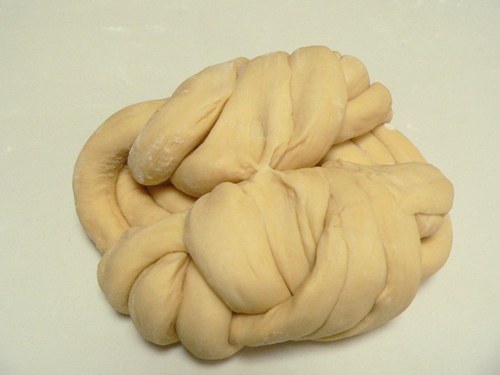
Step 9: Now turn the loaf over and admire your handiwork!  Place the dough on a parchment lined tray, then cover it with oiled clingfilm and leave it in a warm place to rise.  Preheat the oven to 200C (400F) with fan.

Step 10: To finish, brush the risen dough with a little melted butter, and bake for about 30 – 35 minutes, or until dark brown and hollow sounding.  Reduce the heat near the end if it starts to brown too much for your liking.  Remove from the oven and immediately brush the hot bread with extra melted butter, before allowing to cool on a wire rack.  Enjoy!

Click here for a printable version of this recipe
Read Full Post »

« Newer Posts - Older Posts »