Feeds:
Posts
Comments

Archive for the ‘Recipes’ Category

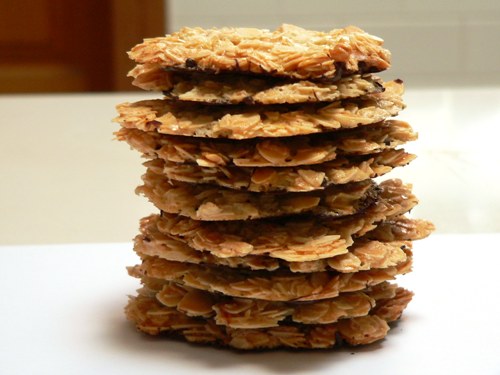
Yet another recipe from my wonderful Ottolenghi cookbook, and this one is an absolute winner.

If, like me, you’re a florentine fan, this is a very easy version which results in a crisp, delectable cookie.  I’ve modified the methodology just the tiniest bit, added a little Kirsch and omitted the orange zest – simply because I didn’t have any on hand.  I also measured everything in cups as I went along for my friends in the US.

  • 2 free-range egg whites
  • 100g (¾ cup)  icing sugar mixture (confectioner’s sugar)
  • 260g (3 cups) flaked almonds
  • splash of Kirsch (optional)
  • 70% dark chocolate, tempered (optional)

1. Preheat the oven to 150C (300F) with fan.  Line a couple of baking trays with parchment paper, then spray the paper with a little vegetable oil (I used canola oil).

2. Whisk the egg whites gently for about 30 seconds (just to break it up a bit, not to get it whipped up or aerated), then sift in the icing sugar mixture and  optional Kirsch and whisk gently to combine.  Now using a spatula, carefully stir in the flaked almonds until well coated.

3. Spoon small mounds of the mixture onto the prepared baking trays – you want to end up with about 20 in total.   Leave room between each mound.  Now, with a wet fork and a wet hand, gently flatten out each mound as thinly as possible without too many gaps between the almond flakes (or they’ll fall apart).

4. Bake until the florentines are golden brown – the original instructions recommend 12 minutes, but my three batches took 15, 18 and 14 minutes respectively.  All I can suggest is that you keep a close eye on them after the 12 minute mark, as the cooking time will depend greatly on how flat you’ve managed to get the mixture before baking.  What you want to achieve is a well cooked bottom, so once the tops appear done, take the trays out and carefully spatula one over to check.  It should look like the photo below, without any soft bits on the base.
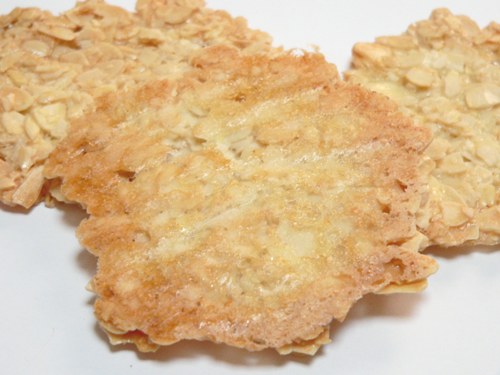
5. The florentines will harden as they cool on the trays, after which time they can be removed to finish cooling on a wire rack.  If you find that some of the bases are still a little undercooked when you start removing them from the parchment, turn those particular florentines upside down and put them back on the trays, and bake for a few more minutes in the oven (I like these really crisp!).

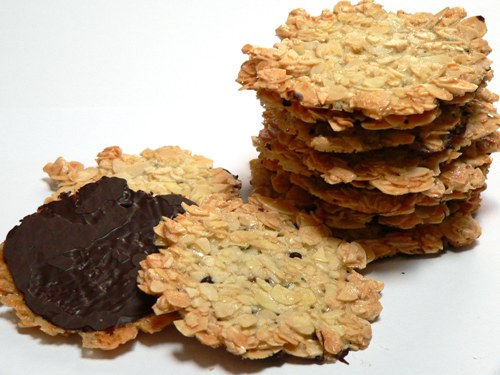
6. The florentines can be left plain, or they can be coated with tempered chocolate.  I spread it over the bottom of each cookie, and then place them chocolate side down onto a sheet of parchment to set.

Click here for a printable version of this recipe
Read Full Post »

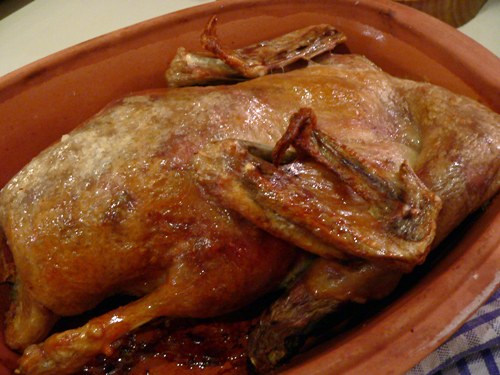
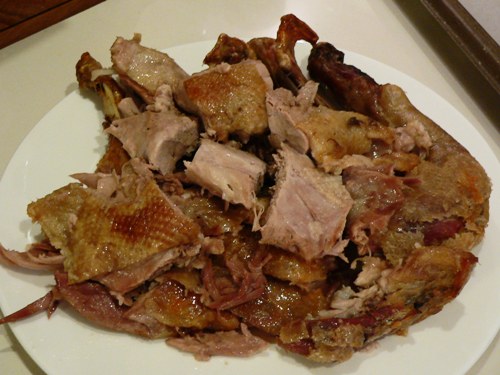
On a whim yesterday, we bought a duck during our visit to the butchers. We’d never cooked a duck before, and thought it might be fun to try. Pete suggested that we roast the bird in our Römertopf clay baker, and it worked brilliantly!

We began by washing the bird under running water and removing any loose fat.  It was dried and rubbed with a little Maldon salt, then laid in the presoaked clay baker and covered with the lid.  The Römertopf baker needs to be submerged in cool water for at least 15 minutes before use, and it needs to go into a cold oven to ensure it doesn’t crack.

Once the pot was in the oven, the temperature was set to 200C with fan, and the duck was left to bake for two hours with the lid on.  We took it out a couple of times during the cooking process and carefully poured the excess fat and liquid into a bowl.  After the initial two hours, the bird was given an additional half an hour with the lid off to brown.

Edit July 14: we now bake the bird for 40 minutes at 200C with fan (lid on), followed by 2 hours at 150C with fan (lid on), then finish at 175C with fan (lid off) to brown and crisp. The fat and stock are poured off at both the 40 minute mark and when the lid is removed near the end. This results in a super tender duck!

Despite the long oven time, the meat was very tender – possibly a product of the clay baker, which effectively steamed the bird as it was roasting.  And because we’d poured the excess liquid off, the end result wasn’t particularly fatty, which was somewhat surprising.

We served the roast duck with our homemade plum sauce, steamed rice and a side of stir-fried green vegetables.

. . . . .

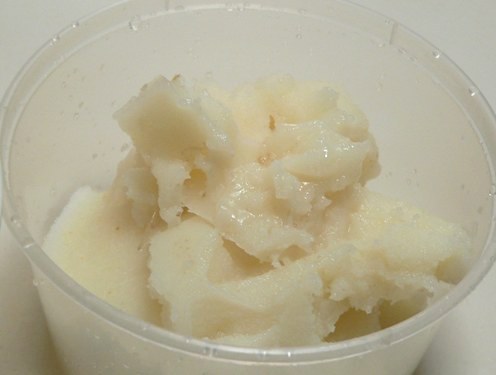
The bowl of liquid we’d drained off as the duck was roasting was left overnight in the fridge, during which time it separated and set.  This morning I was able to stash into my freezer a container of duck fat, which will be perfect for very naughty roast potatoes…

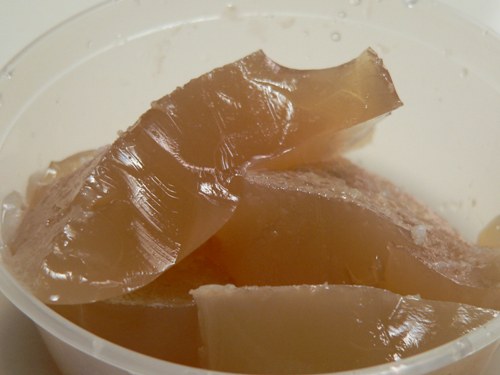
…and a container of the most wonderfully concentrated duck stock.  It set to a solid jelly – an indication of the high gelatin content.  It will form the basis of a delicious mushroom risotto in the near future.

We always roast chickens (and now ducks) in the Römertopf baker.  There are several reasons for this – the oven stays clean (notice how that was my first consideration?), and because the pot is presoaked, the cooked meat is moist and flavoursome.

However, the real bonus is that we end up with a small container of fantastically concentrated stock, which forms the basis of a second meal.  I believe that if we’re going to eat meat, then we have a responsibility not to waste any of it, so being able to extend it just that little bit further makes me very happy!

Read Full Post »

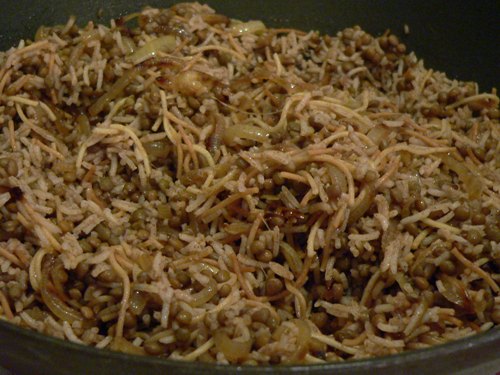
Kosheri

When Lisa gave me the Ottolenghi cookbook a few months ago, I had no idea that I’d end up quite this smitten with it!

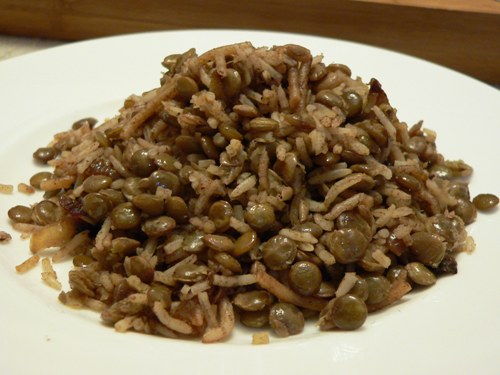
It has a huge range of interesting recipes, including this one for kosheri – Egyptian lentils and rice.  I modified the recipe slightly to finish the cooking process in the microwave, but only because I needed space on the cooktop for other dishes.

  • 300g green or brown lentils
  • 200g basmati rice
  • 40g unsalted butter
  • 50g fine vermicelli or egg noodles, broken into 4 cm pieces
  • 400 – 500ml water*
  • ½ teaspoon grated nutmeg
  • 1½ teaspoons ground cinnamon
  • 1½ teaspoons salt
  • several grinds of black pepper
  • 4 tablespoons olive oil
  • 2 large onions, thinly sliced

* The original recipe specifies 400ml water, but I found that I needed 500ml to cook my Basmati rice (apparently it varies enormously from region to region).  Check your rice halfway through the cooking process, and if it looks like the liquid has been completely absorbed, add a little more.

1. Pick over the lentils well, removing any debris, then wash in a sieve under cold running water.  Place in a large saucepan and cover with lots of cold water and bring to a boil.  Reduce heat and simmer until the lentils are tender but not mushy (about 20 minutes).  Alternatively, you could use drained and rinsed tinned lentils.

2. Rinse the rice well in a sieve under running water and leave to drain.  In a large saucepan, melt the butter over medium heat and then add the uncooked vermicelli and fry until it turns golden brown. Add the drained rice and stir well to coat with the butter.

Original instructions at this point are to then add the water, nutmeg, cinnamon, salt and pepper to the pan.   Bring to the boil, cover and then reduce the heat to a minimum and simmer for 12 minutes.  Turn off the heat, remove the lid and cover the pan with a clean teatowel before replacing the lid and allowing the rice to sit for a further five minutes. 

What I did was transfer the fried rice and vermicelli to a microwave-proof container, added the water and spices and cooked the rice in my microwave for 5 minutes on high, and then 16 minutes on medium (timing will vary depending on your microwave).

Alternatively, I think that you should be able to put everything into an electric rice cooker, adjusting the amount of liquid if necessary and cooking the rice in there.

3. While the rice is cooking, heat the olive oil in a large frying pan and sauté the onions over a medium heat until they turn a dark brown.  Drain them on a kitchen towel.

4. Once the rice is cooked, stir in the lentils and most of the onions, reserving a few for decoration.  Adjust for seasoning if required.

This dish is traditionally served with a spicy tomato sauce, but we had it with a chermoula chicken tagine!

Click here for a printable version of this recipe
. . . . .

Addendum: I started writing this post a couple of weeks ago, and since then I’ve made this dish again.  Second time around I cooked it on the stove as instructed, using egg noodles and two x 400g tins of lentils (rinsed and well drained).  I needed at least 500ml water, and figured out that the most important part of the dish is the fried onions – don’t skimp on them!

Read Full Post »

These chocolates are made very simply, by mixing Nutella with milk chocolate.  I rarely weigh the ingredients for this, and usually only make it when I uncover half a jar of open hazelnut spread in the back of the pantry.  As Pete pointed out, the combination is better than either the milk chocolate or Nutella on its own!

I start by tempering a bowl of Belgian milk chocolate (Callebaut 823) and once it’s at the right temperature (86 – 88°F), I quickly stir in several heaped tablespoonfuls of Nutella.  There needs to be more chocolate than spread to ensure that the bar sets well enough to cut – I probably use about twice as much chocolate to Nutella by weight.

The mix is then poured and scraped into a parchment-lined cake tin, and allowed to set in the fridge.  Allow it a little time on the bench before you slice it. The slab might crack anyway but, in our house at least, there’s never a shortage of people to eat the broken bits.

The end result is a delicious sweet confectionary which tastes a little like Italian gianduja and a little like Ferraro Rochers.  The whole neighbourhood loves these!

Addendum: If you’re not au fait with tempering, you could try making these by simply melting the milk chocolate gently in the microwave or over a water bath, and then letting it cool to lukewarm (about 31C/88F) before stirring in the Nutella.  Pour it into the parchment lined tray as above and set it in the fridge.  I tried this today and it worked quite well, but the chocolate is more likely to melt and bloom at room temperature than the tempered version, so it’s best to keep the finished pieces in the fridge.

Read Full Post »

I have a bit of a crush on Dan Lepard.

Apart from being a really nice guy, he’s also incredibly innovative – rare in a profession that’s thousands of years old, particularly one in which the base ingredients don’t vary much. Dan’s recipes are always different and interesting, involving unusual ingredients and methodology that I’ve never tried before. I’m sure I can feel new synapses forming  in my brain every time I bake one of them.

This particular recipe is a good example: I’ve never used soaked semolina before, I’ve never shaped buns in this way, and I would never have thought to add yoghurt and honey to the dough.

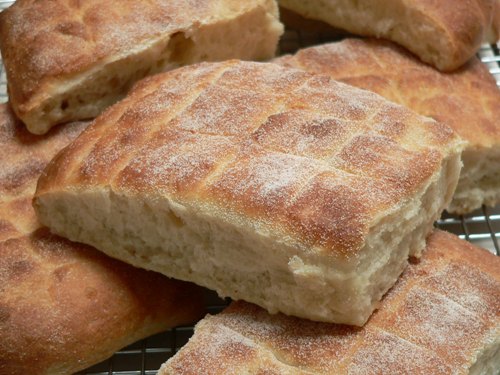
A recommendation to my  breadbaking buddies – bake these as soon as possible!  They’re easy, quick and truly delicious.  My breads are usually chewy, hard crusted sourdoughs, so these made a nice change and the boys devoured them in record time.  The photos here are of my second batch – baked this morning at Pete’s request.

The recipe is here, and there are additional photos on Joanna’s blog as well.

Some construction pointers:

1. The dough is shaped into a rectangle (I used my fingers rather than a rolling pin) and then cut into eighths, but not separated, so the finished buns look like the photo below.

2. Dan provided me with a little more detail about the scoring process (albeit after the buns you see here were baked):

Liberally sprinkle the semolina over the top then press lines in the dough right down to the base, using a downward motion then pull the knife straight back up again. These lines should be very heavily indented in the dough, as if you are embossing it with the knife.

3. I baked these at a lower temperature and for less time than specified – 210C with fan for 15 minutes, although I suspect my oven might be running a bit hot at the moment.

Dan talks about serving these with barbecued pork belly, but they’re also absolutely to-die-for perfect with peanut butter…

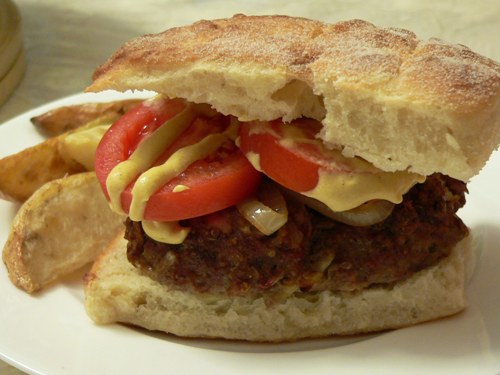
We ate them with Jamie Oliver Botham burgers for dinner – fantastic fare for a cold winter’s night!

. . . . .

Other Dan Lepard recipes:

Read Full Post »

« Newer Posts - Older Posts »