Feeds:
Posts
Comments

Archive for the ‘Recipes’ Category

I can’t believe how popular these have been!

I’ve made three batches to date, and Pete and the boys continue to nibble at them whenever they walk past the cookie jar.  We took them to the markets for our suppliers, and sent them with Big Boy for his friends.  They’re easy to make and even easier to share.

This was the first time I’d tried this recipe from my trusty Mrs Field’s Best Ever Cookie Book – somewhat surprising given that I’ve made dozens of other treats from it thus far.  As always, she never fails me.  I’ve sized the recipe up to use five egg whites – the number left over from Pete’s latest batch of icecream.

The end result is two cookie jars worth of crunchy, non-marshmallowy meringues that store well.  The cocoa and unsweetened chocolate (you could probably use a 70% dark instead) temper the usual meringue sweetness, making them just as appealing to adults as they are to littlies.

  • 85g  unsweetened chocolate (I used Callebaut cocoa mass)
  • 140g  icing sugar mixture (powdered sugar), sifted
  • 50g  unsweetened cocoa powder, sifted (I used Dutch-processed)
  • 5 large (59g) egg whites
  • ½ teaspoon cream of tartar
  • 185g caster sugar

1. Preheat oven to 150C (300F) with fan.

2. Blitz the unsweetened chocolate in a food processor or grate if finely, and set aside.

3. In a small bowl, sift together the icing sugar mixture and cocoa.

4. In a large bowl and using a whisk attachment, beat the egg whites and cream of tartar with an electric mixer until thickened, then slowly add the caster sugar.  Beat until stiff peaks form and the mixture turns glossy.

5. Gently fold the cocoa mixture and chopped chocolate into the egg whites until no streaks of white remain.

6. Fit a piping bag (I use a large disposable one) with a large star tip and fill with the meringue mix.  Pipe pretty shapes onto parchment lined trays.

7. Turn the oven down to 100C (200F) with fan, and bake the meringues for an hour.  Once they’re cooked, prop the oven door open slightly and allow them to cool completely in the oven.  Store in an airtight container, or freeze.

Note: For Heidi and my US friends, here are the original quantities as written:

  • 2oz unsweetened baking chocolate square
  • ¾ cup powdered sugar, sifted
  • 3 tablespoons unsweetened cocoa powder, sifted
  • 3 large egg whites
  • ½ teaspoon cream of tartar
  • ½ cup granulated sugar

Click here for a printable version of this recipe

Read Full Post »

As I mentioned in the snippets, I baked Joanna’s cornbread and Sally’s semolina loaf over the weekend.

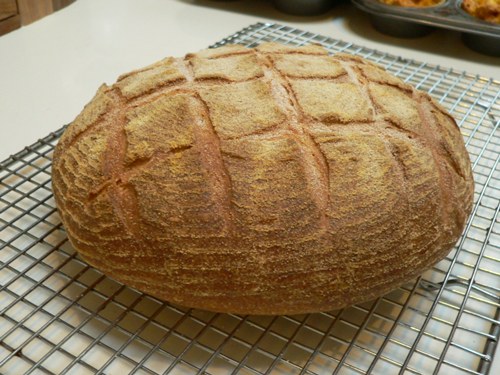
The semolina loaf (above) is a charming yet easy yeasted loaf, which went down well with my family of sourdough lovers.  The fine semolina gives the bread an interesting flavour and a smooth, creamy coloured crumb.  I made it exactly to Sally’s formula, although I kneaded it by hand rather than machine.

. . . . .

I also baked a version of Joanna’s corn bread, using sourdough starter instead of poolish.  I meant to include yeast as specified in the original recipe, but completely forgot, so this loaf took much longer to rise  and is slightly flatter than expected.

Having said that, Pete absolutely adored this bread and waxed lyrical about its texture and flavour.  The crumb was chewy, elastic, and the most gorgeous shade of yellow…

So, for my own future reference, here’s our version:

  • 225g active sourdough starter (100% or 166% hydration)
  • 115g maize meal
  • 190g water
  • 225g bakers flour
  • 9g salt
  • 20g olive oil

1. Mix the maize and water in a small bowl and allow to sit for 15 minutes.

2. Mix all the ingredients together to form a wet dough, then cover and allow to rest for 15 – 20 minutes.  Turn the dough onto a lightly oiled surface and knead briefly until smooth.  Cover and allow to rise until doubled in size.

3. Shape the risen dough into a ball and allow to prove until doubled in size (I use an oiled and floured plastic basket to rise the bread in).  Preheat oven to 240C with fan.

4. Turn the dough out onto a peel and slash, then dust with semolina.  Reduce the oven temperature to 220C with fan, and bake the loaf on a pizza stone for 20 minutes, then reduce heat to 180C with fan and bake for a further 40 minutes to set the crust.

One thing to note – this loaf will only work with fine corn maize.  I’ve tried making it previously with polenta, and the resultant dough was gritty.  It’s definitely worth searching out the maize flour – we found ours at the markets.

It was the perfect loaf to serve with Pete’s beetroot dip!

Read Full Post »

I don’t particularly like sweet muffins, but I adore savoury ones, so I was quite taken with this recipe created by Linda Woodrow’s son, Casey.

I adapted the recipe slightly to use the ingredients I had on hand, and was delighted with the end result – the muffins were deliciously non-stodgy and very moreish. My neighbour Ellen made me promise to blog about them immediately.

Earlier in the day I’d roasted beets and butternut pumpkin, so those were added to the muffins. You could probably use any vegetables you have on hand – the original recipe specified roast pumpkin, sundried tomatoes and zucchini.  I omitted the pinenuts and feta as I didn’t have any in the pantry.

Here’s my version:

  • 265g (1¾ cups) self-raising flour
  • 1 teaspoon baking powder
  • ¼ teaspoon nutmeg
  • ¼ teaspoon fine sea salt
  • 140g (1  cup) fresh corn kernels (approximately 1 ear of corn)
  • 225g (1 cup) roasted vegetables (I used peeled and roasted butternut pumpkin and beetroot), diced
  • 60g (2 oz) grated cheese (I used a sheep’s milk cheese)
  • 1 large (59g) egg
  • 190g (¾ cup) milk
  • 60ml (¼ cup) extra virgin olive oil

1. Preheat oven to 200C (400F) or 180C (350F) with fan.  Line a 12-hole muffin tray with paper cups.

2. In a large mixing bowl, stir together the flour, baking powder, nutmeg and salt.  Add the vegetables and grated cheese and stir to combine.

3. In a separate bowl or jug, beat together the egg, milk and olive oil.  Pour the egg mixture into the dry ingredients, then stir very gently until just moistened – do not overmix.

4.  Spoon the ingredients evenly into the muffin cups, and bake for 20 – 25 minutes until golden brown, and a skewer inserted into one of the muffins comes out clean.  Cool on a wire rack.

Casey, thanks for the inspiration and a great base recipe – we’ll certainly be baking these often!

. . . . .

Edit: Just made another batch of these – a variation on the variation:

  • 200g self-raising flour
  • 65g corn maize flour
  • 1 teaspoon baking powder
  • ¼ teaspoon nutmeg
  • ¼ teaspoon fine sea salt
  • fresh corn kernels from 2 ears of corn
  • 150g roasted butternut pumpkin, diced
  • 60g grated cheese
  • 1 large (59g) egg
  • 190g (¾ cup) milk
  • 60ml (¼ cup) extra virgin olive oil

The maize flour gave them a golden yellow hue…

As suggested by Amanda, this batch is going straight into the freezer!

Read Full Post »

Labneh Balls

I recently made a batch of labneh, or strained yoghurt cheese, and Joanna suggested I turn it into these flavoured balls.

The labneh was quite easy to make – we spooned our homemade Greek yoghurt into a colander lined with a clean cloth (I think it’s traditional to use muslin) and left it over a bowl for several hours until all the whey had drained off, and the yoghurt had thickened to a consistency similar to cream cheese.

After chilling in the fridge, I rolled spoonfuls of the labneh into balls and coated them in a variety of different spice mixes.  It was a messy job – I found it easiest to  shape the balls with slightly damp hands and then roll them in generous amounts of the coating mixture scattered on a sheet of parchment paper.

From front to back, the photo above shows the finished balls flavoured with chermoula, za’atar and a dried Italian herb mix.  Apparently these will keep for a while in the fridge if covered with olive oil, but we don’t need the extra fat in our diet!

Read Full Post »

A few people have asked us how Pete makes his Greek yoghurt, so I thought I’d upload the tutorial we wrote for friends a few years ago.

We purchased an Easiyo Yoghurt Maker, but this method will work with any suitably sized plastic thermos and jar, providing it can keep the milk warm for 8 – 12 hours.

Traditionally, yoghurt is made from milk which has been boiled first to sterilise it, then cooled to room temperature.  We sidestep that process by using long life (UHT) milk, which has been ultra-heat processed.  In order to ensure it remains sterile, we always open a new carton for each fresh batch of yoghurt.

(more…)

Read Full Post »

« Newer Posts - Older Posts »