Feeds:
Posts
Comments

Archive for the ‘Recipes’ Category

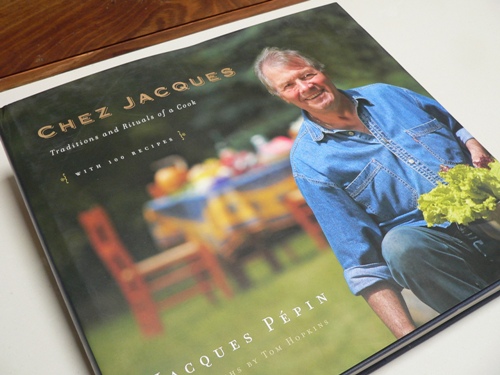
If you’ve been reading our blog for a while, you’ll know that we’re big Jacques Pépin fans.  His recipes have never let us down!

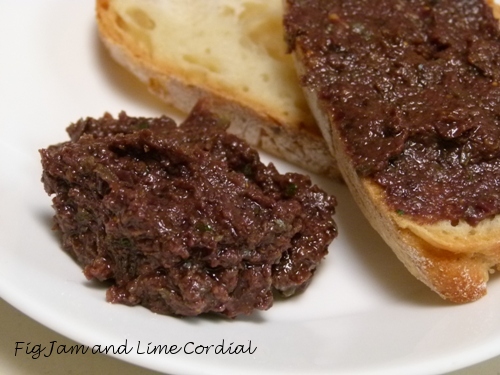
This tapenade recipe, from Chez Jacques, Traditions and Rituals of a Cook, was simple to make and absolutely delicious.  It’s an unusual twist on the straight olive version. Pépin mentions that in the south of France, tapenade is often known as the “butter of Provence”…

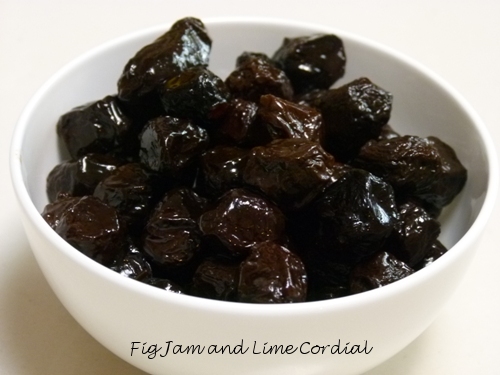
For this recipe, I used a mix of Kalamata olives and these  shriveled dried black Italian olives (which are normally pan-fried or roasted). Both were bought whole and pitted before use.

  • 300g (1½ cups) pitted olives
  • 2 tablespoons capers, drained
  • 2 cloves garlic, peeled and crushed
  • 8 anchovy fillets, in oil
  • 3 dried figs, quartered
  • 8 mint leaves
  • freshly ground black pepper
  • ¼ cup extra virgin olive oil

Note: As my figs were very dry, I began by soaking them in hot water first.

Place all the ingredient into a food processor and pulse until well combined.  Pépin prefers his tapenade fairly coarse, but I made mine a little finer.  The figs and mint add an extra dimension to the salty olives and anchovies.

Serve on slices of toasted sourdough, with a cold glass of wine.

. . . . .

Read Full Post »

Sometimes I come across a recipe which is just so simple and so perfect that I have to run straight into the kitchen to try it out.

Last week, this happened twice!

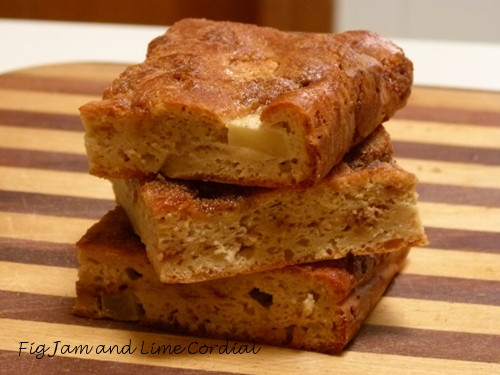
First was Emily’s delicious Wholegrain Double Apple Breakfast Cake.  This one demanded immediate action –  I was literally pulling the cake out of the oven within an hour and a half of reading the recipe.  The batter was baked in a lined roasting pan and Em’s instructions were dead simple (mix the wet stuff together, then add the dry).  Best of all, it gave me an opportunity to use up some of the apple butter that we’d made a couple of years ago.

The combination of bicarbonate of soda (baking soda) and yoghurt caused the batter to honeycomb, giving the finished cake a spongy texture somewhere between a thick pancake and an apple Danish.

Oh, how my boys loved this one!  Big Boy took a giant slab to uni for lunch, and I caught Pete nibbling on it all the next day.  The recipe and instructions are here, and I substituted apple butter for the applesauce, and plain (AP) flour for the sorghum and wholemeal. Emily suggested that any leftovers would make a great bread and butter pudding!

. . . . .

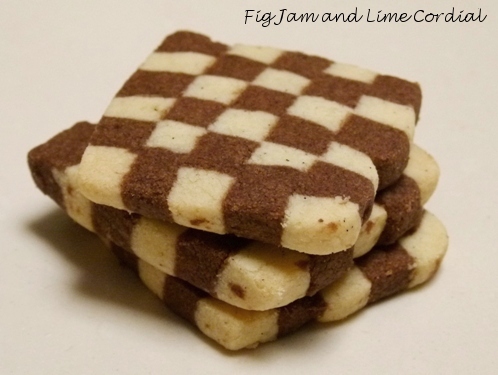
The second thing that had me charging into the kitchen was this gorgeous shortbread recipe by Dan Lepard.  I’ve been calling them Alice in Wonderland cookies, and they were great fun to make, albeit a little fiddly.

I made the two doughs in the food processor, but ended up making the stripes thinner than Dan recommended, which made them a little harder to work.  Most of them turned out quite well…

…but I did end up with a couple of “Picasso” cookies…

My darling friend Joanna has done a much neater job with them here.

Thanks to Dan and Emily for such great recipes.  I’ll definitely be making both of them again soon!

Read Full Post »

Strawberries have been in abundance at the markets recently, so I made this easy tart for morning tea last Sunday.

It’s simple to make – I used June’s sweet pastry dough (defrosted from the fridge) to line a quiche dish and then blindbaked it until golden.  I’m sure packaged shortcrust pastry would work just as well.

This was filled with a batch of microwave pastry cream, and then topped with halved strawberries.  The boys loved it!

Here’s the microwave pastry cream recipe again (with metric conversions added)…

  • 2 cups (500ml) full cream milk (I used UHT)
  • 6 large (59g) free range egg yolks (use the whites for meringues)
  • ½ cup (110g) white sugar
  • 1/3 cup (45g) cornflour (cornstarch), sifted
  • 1½ (8ml) teaspoons vanilla extract
  • 3½ tablespoons (50g) unsalted butter, at room temperature, cut into small pieces

Step 1: In a large pyrex bowl, mix together the milk, sugar, cornflour and vanilla extract. Whisk well to combine, then microwave on high until hot but not boiling (in my 1100 watt micro, this took two minutes).  Remove from the microwave, whisk well to smooth out any lumps.

Step 2: In a separate bowl, whisk egg yolks together until smooth.

Step 3: Continually whisking, pour the egg yolks into the milk, mixing until smooth.  Microwave on high for one minute, then in 30 second increments, whisking after each burst, until the pastry cream is thick.  In my microwave, this took 2½ minutes.

Step 4:  Whisk well, then add the butter pieces and whisk them into the pastry cream until smooth.  Press a sheet of cling film to the surface of the cream to stop it forming a skin and store in the fridge until cool.

. . . . .

Read Full Post »

It’s still Chocolate Week!

To celebrate, I was keen to create a completely over-the-top, heart-racing brownie that squeezed as much chocolate as possible into each bite.  The end result was this once only treat that Pete and the boys loved (it actually gave me the sugar shakes, so I don’t think I’ll be baking it again).

I used five types of chocolate in the recipe – Callebaut 70%, 54%, 44%, Dutched cocoa, and caramelised white chocolate – a total of 620g in the eight inch slab.  I was inspired by a recipe from Debbi Field’s Great American Desserts (the original recipe used white chocolate, dark chocolate, Brazil nuts and caramel).  Please feel free to improvise as desired …

  • 185g (¾ cup) unsalted butter, melted
  • 110g (1 cup) Dutched cocoa powder
  • 165g (¾ cup) white sugar
  • 100g (½ cup, packed) brown sugar
  • 2 large (59g) free range eggs
  • 1 teaspoon vanilla (I used homemade)
  • 112g (¾ cup) plain (AP) flour
  • good pinch of fine sea salt
  • 150g (1 cup) skinned, roasted hazelnuts, chopped
  • 150g (½ cup) caramelised white chocolate, melted
  • 90g (½ cup) Callebaut 70% dark chocolate callets
  • 90g (½ cup) Callebaut 811 54% dark chocolate callets
  • 90g (½ cup) Callebaut 44% dark baking sticks, broken up
  • 90g (½ cup) caramelised white chocolate chips

1. In a bowl, combine the chocolate callets, broken up baking sticks and caramelised white chocolate chips.  Add the chopped hazelnuts and stir to combine.  Preheat oven to 175C (350F) with fan.  Line a 20cm (8″) square pan with parchment paper.
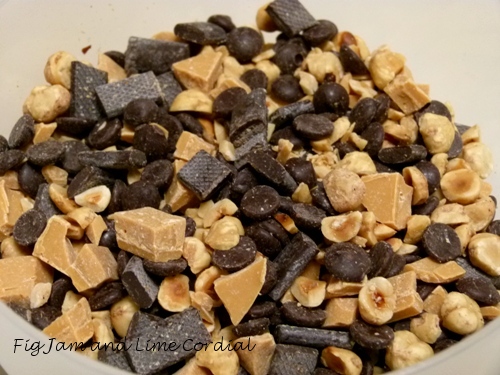
2. In a large mixing bowl, whisk together the melted butter and cocoa powder until smooth.  Add the white and brown sugar and beat with an electric mixer until combined.  Add the eggs and vanilla and beat well.

3. In a small bowl, stir together the flour and salt, then mix this into the batter. Add the chocolate callets, chocolate chips and hazelnuts and mix gently until just combined.

4. Scrape the mixture into the pan – it will be stiff and lumpy.  Smooth the surface as much as possible, then pour the melted caramelised white chocolate over the top.

5. With the point of a sharp knife, cut the liquid chocolate into the mixture – this is a messy process as the batter will be quite stiff.  When you feel that the melted chocolate has been sufficiently mixed in, smooth the top out a little, but try to keep the surface a little marbled.

6. Bake the brownies for 30 minutes, or until the edges are set and the centre is moist but not runny.  Allow to cool completely in the pan before slicing.

I didn’t let the slab cool quite enough before slicing into it…
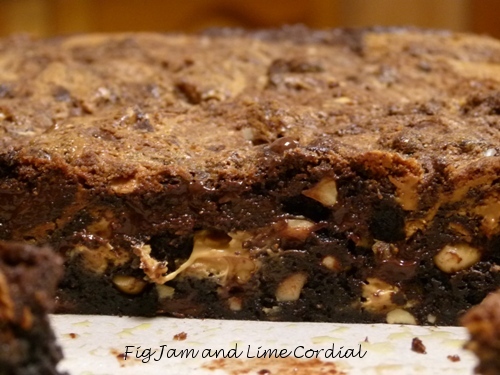
When completely set, the brownies have a firm texture, akin to a dense (and very delicious) fudge.   It’s the perfect treat to share with lots of friends, because it really isn’t possible to eat more than a piece or two!

Read Full Post »
Did you know it’s National Chocolate Week in the UK?

To join in the festivities, here are some of the chocolates I’ve been playing with recently…

Maude’s daughter is a mad keen dragon buff, so I made her a flight of them for her birthday.  I used a 50:50 blend of Callebaut 811 (54% dark) and 823 milk…

There were large Lord of the Rings’ style beasties…

…and smaller Chinese snake dragons.  I love the detailing of the scales!

. . . . .

This crocodile was made for a friend’s birthday, but he broke in half as he was being unmoulded – hence the join in the middle of his back.  He’s made mostly of 54% dark with a little milk chocolate added for sweetness…

. . . . .

Some musical instruments for Will (who plays the saxaphone) and Bethany (who’s an accomplished pianist).  Small Man insisted that the trumpet was his alone…

. . . . .

As I’ve mentioned before, I buy almost all my moulds from Candyland Crafts in the US.  The shipping to Australia is expensive, but the moulds themselves are just $1.99 each – cheap enough to splurge on a new one for each occasion. The detailing and quality are astonishing for the price.

I was placing an order for Christmas moulds and couldn’t resist picking up this 3D chef to make a gift for my friends at Chefs’ Warehouse…

. . . . .

Learning to temper chocolate takes a little practice, but once you find a technique that works for you, you’ll never be caught short for a last minute gift again.

I wrote up the method I use here, but it’s a little fiddly.  If you google tempering, you’ll find easier techniques, which usually involve melting two-thirds of the chocolate and then stirring in the remainder until the right temperature is achieved.  You might also find this article  by David Lebovitz useful.  It’s all about trial and error – and in this case, all the mistakes are delicious!

Remember, getting chocolate to temper is reasonably easy, but keeping it there is tricky.  Dark chocolate needs to go into the mould while it’s between 88 – 90F (milk chocolate: 86 – 88F), but if it cools below that, it can drop out of temper and won’t set properly.  The real secret to success is to find a way to keep the chocolate at the right temperature while you work it.  I use heat mats for this purpose – I like the Australian-made ones from Shin Bio, but my friend Christina tells me that a hot wheat pack wrapped in a plastic bag works just as well.

Hope you all enjoy National Chocolate Week – and thanks to the Frugal Feeding Blog and C from Cake, Crumbs and Cooking for the headsup!

Read Full Post »

« Newer Posts - Older Posts »