Feeds:
Posts
Comments

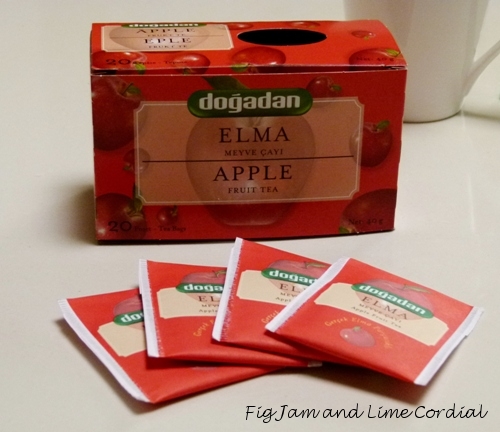
I found this Turkish apple tea during my last visit to Harkola.

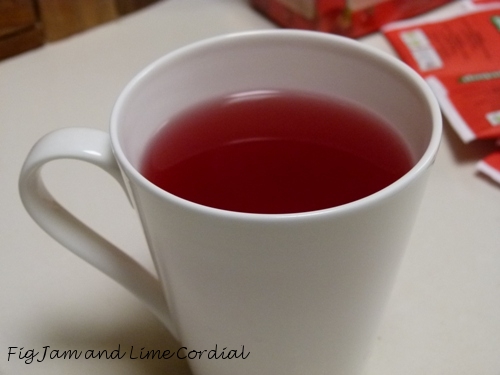
Unlike the powdered version, this tea is unsweetened, and a gloriously bright red.  It contains apple, hibiscus, blackberry leaves, apple flavour, lemon peel and cinnamon.  The packet of 20 tea bags cost me just $2.80.

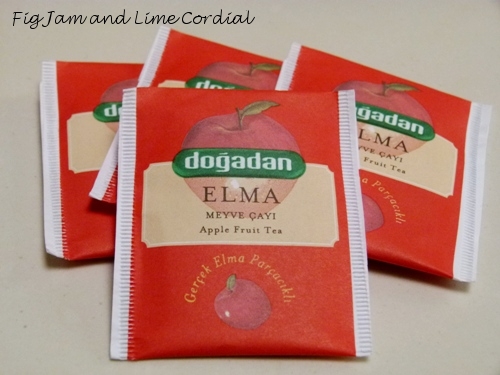
I was particularly taken with the lovely wrappers…

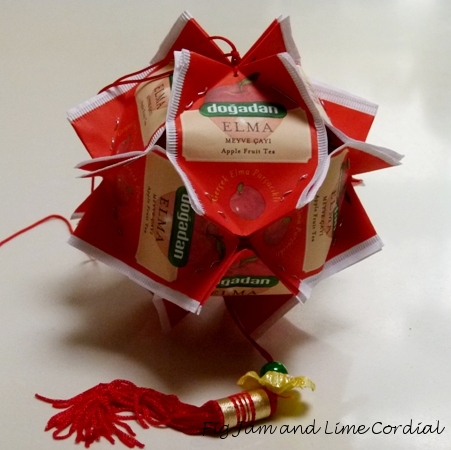
…and, loathe to waste them, I turned them into a little red lantern, using the instructions I posted here.  It’s now hanging in the kitchen doorway.

If you’d like to play around with some pretty tea bag wrappers, my friend Mazza the Toymaker has several to print out on her website.  They’re gorgeous, and come complete with a Wind in the Willows quote!

For the longest time, Dan Lepard’s Cobnut Loaf with Honey and Grains has been calling to me from my well-worn copy of The Handmade Loaf.

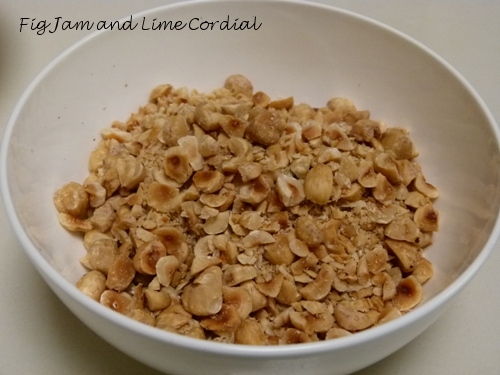
The problem is, cobnuts aren’t readily available here in Australia.  Hazelnuts are a reasonable substitute, but as I’ve mentioned before, I’ve always been too lazy to roast and skin them.

So one of the first things I did with my newly discovered blanched roasted hazelnuts was to give this daisy-shaped loaf a go.  It’s a wet, sticky dough, but the final shaping is quite easy, and can take a reasonably heavy flouring.  I simplified Dan’s methodology a little, but found it still worked well.

As I didn’t have straight rye grains, I used a grain mix that I found in the fridge.   On cooking and soaking, the grains swelled up to several times their starting weight, which meant I had enough for these loaves plus a couple of others (more on those soon).

Here are some photos of the process…

My friend Joanna has baked this recipe several times, in a variety of different shapes – please have a look at her post here.  I can now understand why she finds this bread so appealing!

The hazelnuts and tender, sweet grains are a delicious combination, and the loaf kept surprisingly well – it was still soft after three days on the kitchen bench. I took one loaf to a barbeque, and sliced the other for breakfast – it was a great foil to our poached eggs. Definitely a bread I’ll be baking again!

My friends Mark and Bruce at Real Food Has Curves create some truly delicious recipes.

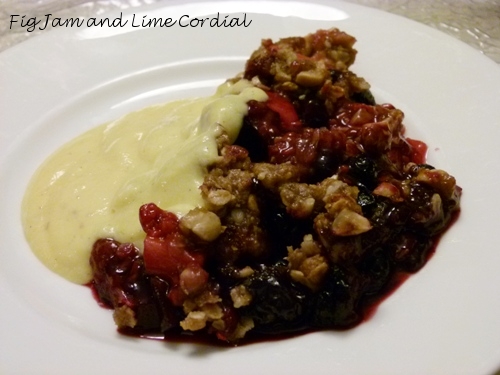
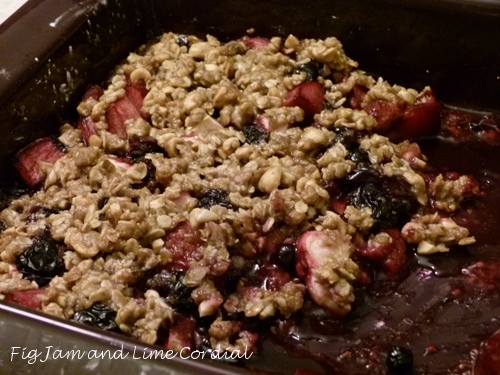
In the past I’ve blogged about their Paris-Brest ring, baked numerous batches of their figgy rolls, and eaten copious quantities of their caramelized leek tabbouleh.  Mark’s recent Apricot Rhubarb Crisp inspired me to make a version using the frozen berries we’d bought in Marrickville recently.

The great thing about this recipe is its simplicity – the topping comes together with a stir (because it uses nut oil instead of butter), and the fruit is simply chopped and combined.  It’s so easy, in fact, that I’ve made it twice in the past week – once to try it out, and then a second time as a dinner party dessert.

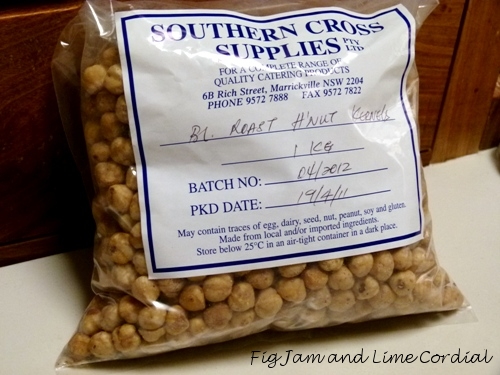
My version is sweeter than Mark’s, and uses hazelnuts instead of pecans in the topping.  I was excited to discover blanched roasted hazelnuts at Southern Cross Supplies – in the past I’ve avoided buying hazelnuts because I couldn’t be bothered skinning them.  I know it’s not a difficult process, but it  makes such a mess!

Topping:

  • 60g plain (AP) flour
  • 45g rolled oats
  • 70g brown sugar
  • 60g chopped blanched hazelnuts
  • 60g hazelnut oil
  • 30ml maple syrup
  • ½ teaspoon ground cinnamon
  • pinch fine sea salt

Note: I used my scales to weigh out the ingredients, but Mark also has cup measures listed in his post.

1. Combine all the topping ingredients in a large bowl and stir until evenly moistened.  Preheat oven to 175C with fan.

2. Fill a large roasting pan (I used my new Emile Henry dish) with an assortment of chopped fruits and berries – I used some of our new season rhubarb, about 500g of frozen berries, four peeled and chopped Bilpin Pink Lady apples, and some frozen cherries that I found in the freezer.

3. Sprinkle a tablespoon of cornflour over the fruit and sweeten with some plain or vanilla sugar, then stir gently to combine.

4. With your hands, crumble the topping over the fruit. It won’t cover the fruit completely, which is fine, because the topping is quite rich and needs a fair bit of fruit to balance it out.

5. Bake for 35 – 40 minutes, until the fruit is bubbling and the topping is, as the name suggests, crisp.

We accompanied ours with microwave custard, and the batch served six adults, with leftovers.

PS. I forgot to mention that this is a great do-ahead dessert.  I baked the one below mid-afternoon, and then left it on the bench until evening.  It only required a few minutes in the oven to reheat!

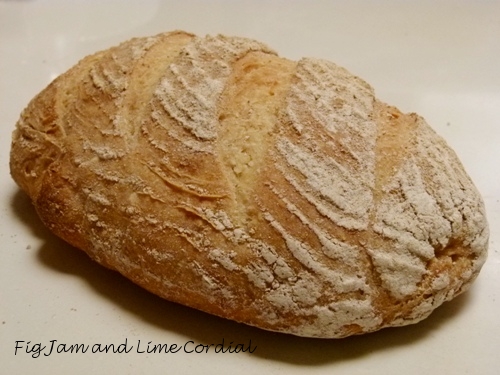
I tried baking my high hydration ciabatta dough in my new bannetons.

It was a fiddly process – the ciabatta dough was almost too wet to shape – but the end result was quite pleasing nonetheless.  I rose both loaves in my oval bannetons, and slashed one with three long vertical cuts, and the other with diagonal horizontal slashes.

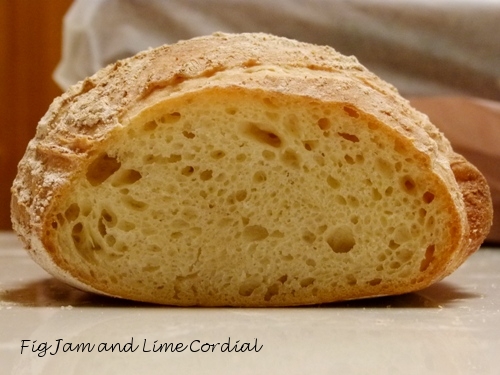
The dough stuck a little to the cane baskets – I suspect I’ve reached the maximum hydration that I can prove in the bannetons – but the excess brushed off quite easily.

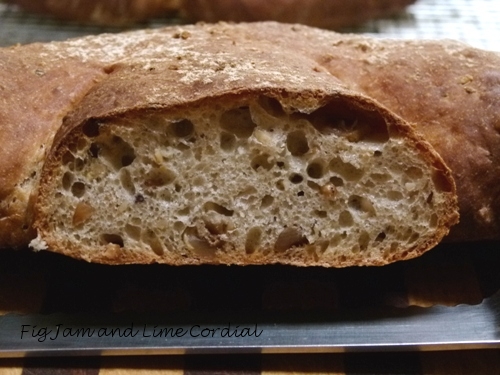
I managed to get a crumb shot this time before the wolves descended!

. . . . .

My lovely friend Joanna recently posted her recipe for 100% Russian rye sourdough loaves.

Both the recipe and the process were intriguing – the dough is mixed in two stages without kneading, and then left to rise for an extended time.

I didn’t bother bulk proving the dough, and instead scraped the batter into two long loaf tins as soon as it was mixed.   These were covered and then left to rise on top of the fish tank for about seven hours, until the dough appeared over-inflated and on the verge of collapse.

After baking, we wrapped the loaves in paper and left them overnight (as instructed).  They were quite nice the following day, and delicious the day after that – the crumb softened and the flavour developed as the loaves matured.

It’s a tasty and very interesting bread to bake, especially if you’re partial to rye loaves.  Joanna’s original post is here!

Edit: here’s a photo of the risen, unbaked rye loaf – as you can see, it really didn’t rise at all after it went in the oven.  Having said that, several hours before this photo, it was only an inch high in the pan.

Before we had chickens, an egg wasn’t anything special to me.

I’d certainly bought and used a lot of them, and in more recent years, influenced by terrible accounts of battery hen farming, we’d made a concerted effort to only buy free range eggs.

But I’d never really given much thought to eggs, other than wondering whether or not there were enough in the fridge for my latest baking project. They’re relatively cheap and readily available, and as a result, I’d always taken them for granted.

It wasn’t until we finally had our own chickens that I came to appreciate how special and precious eggs really are. And whenever possible, and because we now can, I want to eat eggs from chooks I know.

Our hens do much more than just lay eggs – their primary function is actually to garden.  They dig up the spent beds, eat all the grubs and weeds, fertilise the soil, and then move onto the next patch.  The eggs are an added bonus!

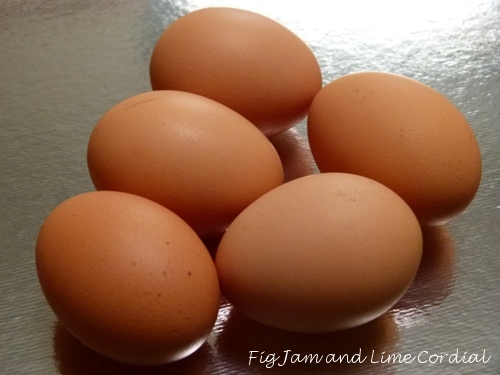
Some of our chickens lay quite distinct eggs, and it always makes me happy to be able to match an egg to the chook who laid it!

Francesca’s eggs, for example, are always different from the rest, just as she is different from the rest of the flock.  They’re smaller, darker and always a little speckled.  I save these for my mum, because she loves the more petite size…
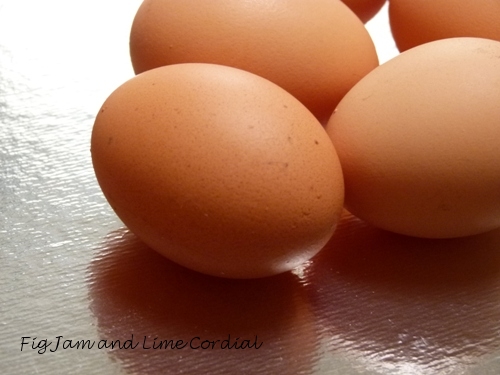
Bertha, on the other hand, lays the lightest coloured eggs, and occasionally the shell will be rough and quite pale.  We think she has a dodgy shell-gland, so her eggs aren’t usually as picture perfect as the others.   She has, on occasion, laid a shell-less egg, although she’s been in good form for months now…
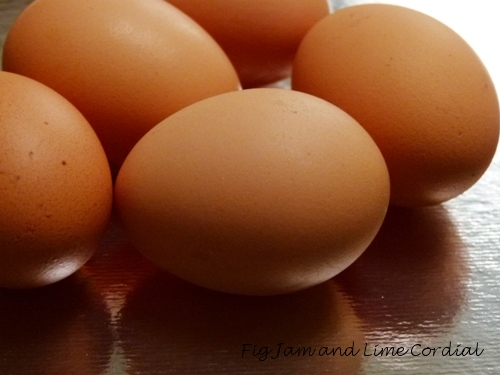
Finally, it’s always easy to pick Queenie’s egg.  Our dominant hen rules the roost like a dictator, and will always insist on first pass at any protein that comes into the coop.  Her eggs are always the largest of the clutch, dwarfing Frannie’s little dark ones…

Every time I crack open one of our homegrown eggs, I feel a little wave of gratitude.  It’s like a tiny bubble of joy – I ponder whose egg it might be, admire the colour of the yolk, and think about how blessed I am to have something so fresh and magnificent to feed to my loved ones.

I know this all sounds like the ramblings of a chicken-obsessed madwoman.

I also know that it’s not possible for most people to have chickens, and I realise how incredibly fortunate we really are.

I hope though, that the next time you’re baking, you’ll spend a moment admiring the wondrousness of the humble egg, spare a thought for the chook who laid it, and thoroughly enjoy eating whatever you create with it!