Feeds:
Posts
Comments

I last made these cookies in 1994.

They were so addictive that our then neighbours asked me to stop making them, as they couldn’t stop eating them.  One even froze her stash, only to find that they were just as good to eat frozen.

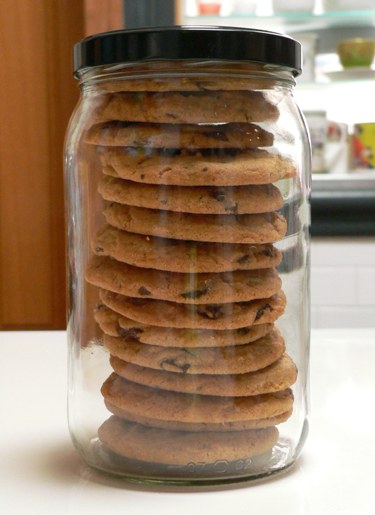
Sixteen years later, and I decided the recipe was worth a revisit, especially since Big Boy is a big peanut butter fan. These cookies are huge, stuffed with chocolate, and our son ate two between breaths.  I don’t think they’re going to last very long!

Peanut Butter Chocolate Chip Cookies

(adapted from a recipe in the Mrs Field’s Best Ever Cookie Book!)

  • 300g (2 cups) plain (AP) flour
  • ½ teaspoon bicarbonate of soda (baking soda), sifted
  • ¼ teaspoon fine sea salt
  • 265g (1¼ cups, packed) brown sugar
  • 275 (1¼ cups) white sugar
  • 250g (1 cup) unsalted butter, cold, cut into cubes
  • 3 large (59g) eggs
  • 275g (1 cup) creamy peanut butter
  • 2 teaspoons vanilla extract
  • 360g (2 cups) dark chocolate chips – I used 240g of Callebaut 811 54% and 120g of Callebaut 44% baking sticks, broken up.

1. In a medium bowl, whisk together the flour, salt and sifted bicarb of soda.  Add the chocolate chips and stir to combine.

2. In a large mixing bowl, beat together the butter and sugars to form a grainy paste.  Add the eggs, peanut butter and vanilla and mix again until just combined and no streaks remain – do not overwork the mixture.

3. Add the flour and chocolate mixture and mix on low until just combined.  Scrape off the beaters, cover the bowl and refrigerate for at least an hour.  Preheat oven to 150C (300F) with fan.

4. Scoop large tablespoons of mix onto a large tray lined with parchment paper, leaving about 4cm (1½”) between each cookie (I use an icecream scoop).   Gently flatten cookies slightly and press a cross hatch onto the top of each with the tines of a wet fork.

5. Bake for 18 to 22 minutes or until the cookies are lightly browned.  Allow to cool on a flat surface or wire rack.  Eat with abandon or freeze some for later – they’re the perfect cookie to pull out for an after school snack!

Click here for a printable version of this recipe

It’s taken over six months, but we’re finally reaping the rewards of our garden on a daily basis.  And reward really is the right word – I never knew it could be so satisfying to wander outside and fill a small basket with vegetables for dinner!

We’re by no means self-sufficient, but at the moment we’re able to source almost all our greens from the backyard.  Hopefully we’ll be able to add tomatoes, cucumbers and potatoes to the list soon.

The absolute winners in the garden so far have been the perennial leeks.  Christine, bless you for putting us on to these!  Since we bought our initial five plants from Cornucopia Seeds in July, these little treasures have multiplied like mad.  When we pulled out the young leek you see above, we were able to replant nearly ten baby leeks that were budding off her.

The sprouting broccoli plants, which have provided us with weeks of constant greens, are now going to seed and the chickens absolutely adore them.  Very soon the peas and broadbeans will be finishing up, and that bed will be emptied out, ready for planting with corn seedlings.  As corn is wind pollinated, the seedlings need to be planted en masse, or they won’t produce cobs. We’ll have two whole beds of corn soon (110 plants!), and I’ll be watching for the arrival of Shoeless Joe Jackson. If you build it, he will come…

We probably haven’t thinned our carrots out enough, although we are getting some reasonably sized baby carrots, including this interesting mutant…

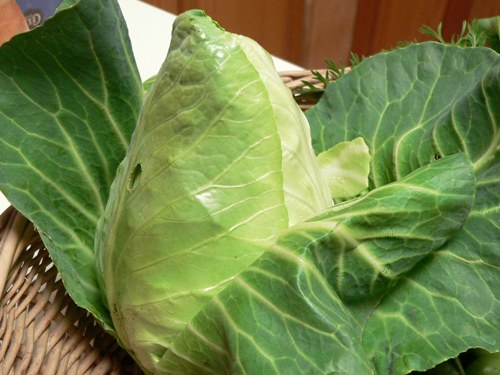
Cabbages haven’t been a huge success, although a couple did finally start to form small pointy heads.  We’ve decided they take up too much space and take too long to grow for our garden – and no-one particularly likes them!  Next year we’ll plant more cavolo nero (kale) and kohlrabi instead…

Pete had intended to leave the rhubarb uncut this year, to enable it to establish properly.  As a result, the leaves on some of the more mature stems grew to nearly 60cm (two feet) in diameter! My husband, in his infinite wisdom, then decided they had been left too long, and harvested these  old woody stems. It took a bit of experimenting, but in the end we were able to turn them into quite a nice rhubarb and tomato ketchup…

Pete made a simple but very delicious risotto for dinner tonight – carnaroli rice and chevapi sausages, with leeks, celery, carrots, peas and beans from the garden, all cooked in white wine and tomato water stock.  It was a fabulous way to end the day!

Every blade of grass has its angel that bends over it and whispers, ‘Grow, grow.’ … The Talmud

This post has been sitting in my drafts folder for the longest time! I’m posting it up now for Heidi, who has quinces in her kitchen..

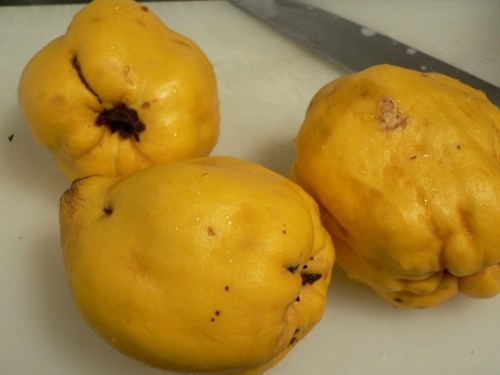
Quinces are an intriguing fruit – they’re hard and inedible when raw, undergo an astonishing colour change from bright yellow to deep red as they cook, and scent the whole kitchen with their sweet fragrance while they’re boiling.  We had a lot of fun with these!

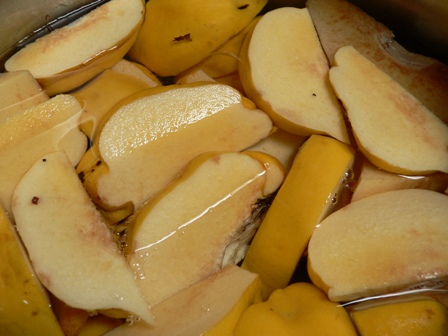
1. Wash the quinces well in a sink of cold water, scrubbing off the external fur with your fingertips.  Don’t peel or seed the fruit; instead chop them into small pieces and put them into a wide, deep pot.  Pour in enough filtered water to float the fruit.

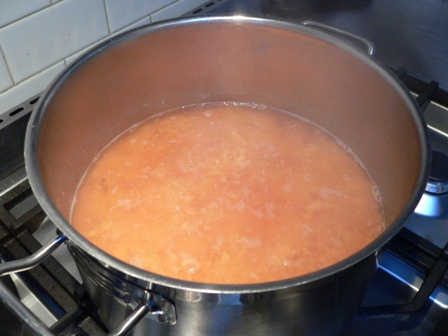
2. Bring the pot to boil, covered, and stew the fruit until it has completely turned to mush. Stir occasionally and watch that the pot doesn’t boil over.  Once the fruit begins to soften, break it up with a potato masher to speed up the process.  This can take quite a long time (a couple of hours or more, depending on the amount of fruit you have), so don’t rush it.

quince jelly 001

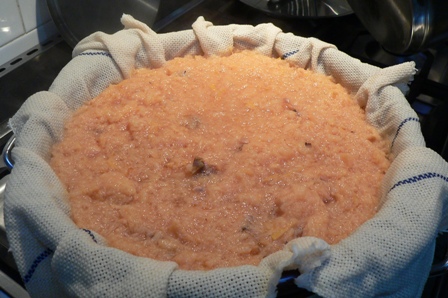
3. Line a colander with a clean, open-weave cloth and pour boiling water over it to sterilise.  Place the colander over a large bowl and pour the quince liquid and pulp in.  Allow to drain until quite dry – several hours or overnight.  Don’t press the fruit in any way, or you’ll get cloudy jelly.

quince jelly 003

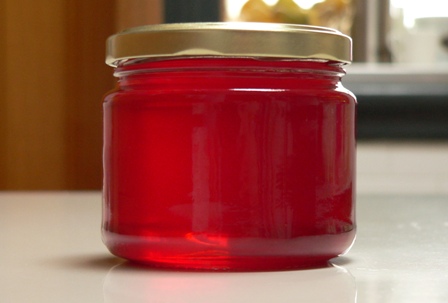
4.  Measure the drained juice and pour it into a large wide pot. For every litre of liquid, add 1 jar of homemade pectin (300ml), the strained juice of 1 lemon and 1 kg of sugar.  Bring the pot to a gentle boil, uncovered over a high heat, skimming often to remove any foam or scum that floats to the top.  Foam is an indication that the pectin is working, so it’s a good thing, even though it’s a pain to skim off.  Pete believes it’s actually the pectin and lemon juice working together to clarify the jelly, so the more gunk you can remove from the top of the liquid, the clearer your jelly will be.

5. Bring the jelly to a rapid boil until it reaches 220F (104.5C) on a candy thermometer and a small blob of jelly wrinkles on a cold plate when given a little poke.  If the jelly has reached temperature and doesn’t set, try adding a little more sugar – if a jelly doesn’t set, it’s usually because the magic combination of pectin, sugar, fruit and acid isn’t quite in balance.

6. Once the jelly is setting up, pour it into sterilised jars, seal tightly, and hot water process by boiling them for at least 10 minutes in a large saucepan of water, with the liquid covering the lids by at least 1″ (2.5cm).  Make sure you don’t pour cold water onto the hot jars, or they’ll crack – have the water already boiling and gently lower the sealed jars in.

Quince jelly has lots of applications, both savoury and sweet. I’ve been eating it on toast with Stilton cheese, but it’s also brilliant with roast lamb.  I’ve used it in onion marmalade and Pete V recently pointed me to a recipe for quince aioli which looks delicious!

quince jelly 006

. . . . .

See our Jam Making Primer for more tips on making jam.

Pete’s cousin Andrew and his wife Rachel were in town today, so I was up early baking scrolls for morning tea.   It was a fun thing to do on an otherwise wet and gloomy Sunday!

I began with sourdough cheese and olive scrolls – Small Man’s lunches for the coming week. They were made from a batch of dough mixed yesterday evening and left on the bench to prove overnight.  The same dough also made two 750g loaves, which will be eaten over the next  couple of days.

For morning tea, I made nutella scrolls (recipe here)

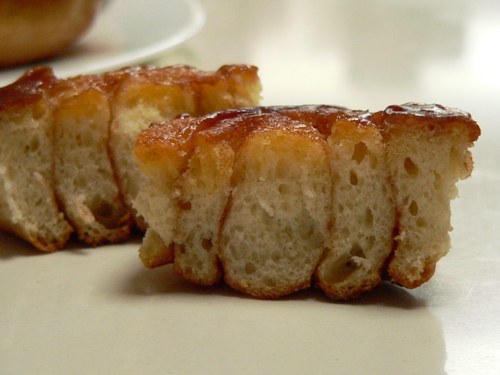
…and these caramel and cinnamon ones.  They’re quite easy to make, and Big Boy absolutely loves them.

  • 1 batch of bread #101 dough or sweet bread dough, proved
  • ½ cup unsalted butter, softened
  • ¼ cup brown sugar
  • 1/3 cup white or caster (superfine) sugar
  • 1 teaspoon ground cinnamon

1. Preheat oven to 220C with fan.  Blend together half (¼ cup) of the unsalted butter and brown sugar in a small bowl.  Spread this over the base of a parchment lined rectangular baking pan.

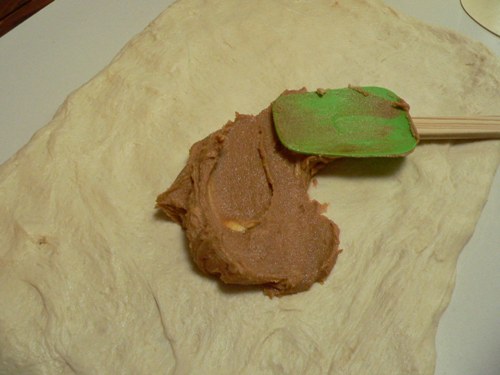
2.  Oil a clean bench, then press the dough into a large rectangle.  Mix together the remaining butter, white sugar and cinnamon, and spread over the dough, then roll up tightly.

3. Slice the dough into twelve rolls, and position them over the butter and sugar paste in the baking pan.  Cover and allow to rise for about 30 minutes.

4. Spritz the top of the scrolls with a little water, then reduce the oven temperature to 200C with fan, and bake for 20 – 25 minutes, rotating the pan once during the baking time.  Be careful not to burn the tops of the buns.

5.  Allow to cool for a few minutes in the pan before turning out (carefully, as the caramel will be hot!) onto a wire rack over a sheet of greaseproof paper to catch any drips.

When cool, these can also be frozen – they’re a nice treat to have on standby!


I used to be a truly rubbish cook.

I’m certainly no über-chef now (competent and adventurous, perhaps), but I’ve come a long way from where I started. Until my early 20s, I’d never so much as boiled an egg.  There have been some truly magnificent disasters along the way – usually brought about by convoluted decision making and occasional over-enthusiasm.  The apricot lamb incident, as Pete likes to refer to it, still comes up in dinner conversations some twenty years later.

It took me a few years to figure out that cooking is one of those activities where it’s easy to be brave. It’s not like jumping off a bridge with a bungee rope attached to your feet;  it’s not even as scary as walking into  a room full of people you don’t know. And since we’re rarely playing with expensive ingredients, most of the time experimenting in the kitchen is a fairly economical exercise.  A little care needs to be taken with things like sharp knives and hot caramel (I’m a klutz, so I feel it necessary to include this sentence), but with just a little caution, I usually come out physically unscathed.

I really enjoy getting comments from all of you – thank you – but the ones I love the most are when people write to say they’ve tried making something which they’d previously thought would be too difficult. I’m so thrilled whenever someone else discovers how easy it is to make their own butter, or to bake a loaf of bread for their family.

So I’d like to encourage you all to have kitchen bravery!  Don’t be discouraged when something doesn’t work; just bin it or compost it or feed it to the chooks.  After a little while, you’ll figure out which recipes have a better chance of success, and which don’t.  You’ll understand how to adjust temperature guides to suit your own oven, and you’ll instinctively know when your bread dough is proved enough to shape.

Some recipes take a long time to get right.  Don’t be put off if your early attempts are complete disasters – just see it as a challenge!  Our fudge recipe took eleven attempts to perfect; our ricotta cake took eight (although the neighbours were happy to eat those rejects).  We still can’t make torrone to our liking, but we’re taking a break after our fifth attempt – I’m sure we’ll revisit it one day.  Our first loaves of  bread were pretty ordinary, but lots of practice has made them easy and delicious.  Have a go, don’t give up, and I can almost guarantee you’ll surprise and delight yourself!

And truly, there is nothing in the world quite as satisfying as having friends and family say, “You made that?  Wow…”