Feeds:
Posts
Comments

I started baking bread in December 2006. I’d made the occasional loaf prior to this, but it wasn’t until Maude  bought me a copy of Richard Bertinet’s Dough that the mania really set in.  This book was great for two reasons – firstly, it was easy to follow with lots of gorgeous photos and great techniques.  Secondly, there was a dvd included, which showed the eye-candy Frenchman simplifying the breadmaking process to something my seven year old niece was able to master.

Bertinet’s book focuses on yeast breads, but it wasn’t long before I wanted to make my own sourdough.  After a couple of failed attempts at brewing my own (I did manage to grow some rather scary looking purple mould), I opted to purchase some dried starter over the internet. About three seconds after I’d hit the “Pay Now” button, it occurred to me that I’d asked for little sachets of white powder to be sent to me from the US. Visions of trying to explain this to the AFP led to several frantic calls to friends – “Look, I know this sounds bonkers, but if the Federal Police ever ask you, please tell them that I mentioned I was buying sourdough starter, ok?”.  Surprisingly, nothing ever came of this – the envelope arrived unopened.  I placed a second order a few months later and that was opened, but quarantine approved it and sent it on through.  I guess wild yeasts just aren’t a problem.

The dried starter took off like a dream and within a week I’d made my first loaf of sourdough.  This was in January 2007, and we haven’t purchased a loaf of bread since (except for when we’ve been on holidays).  Neither has Maude, whom I passed a jar of bubbling leaven to as soon as it was healthy enough to bud off. Since then I’ve shared the starter with half a dozen friends, most of whom are still using it today.

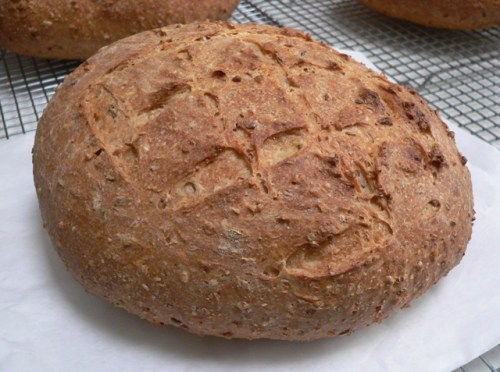
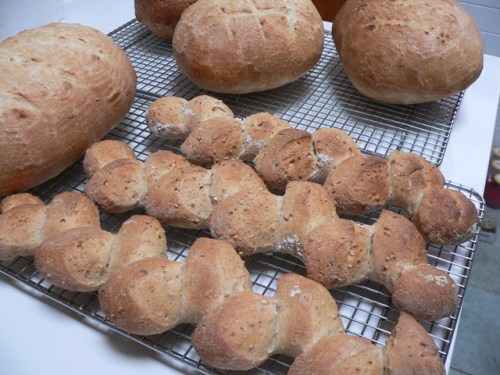
Here is our midweek sourdough bake – three loaves of white for school lunches, a loaf of grain bread for Pete and I, and some mixed grain epi, using Kevin’s pre-mix.  This will feed our family well for three to four days, so I’ll be baking again on the weekend.
050309-001

Friends often ask me why I bother, given that it’s now possible to buy great sourdough locally.  Of course, there are the usual reasons – being able to control what goes into the bread, huge cost savings and the warm inner glow that comes from some small measure of self-sufficiency.  But there is  another reason I “bother”, and that is because I find the rhythm and routine of the process very comforting.  We bake our own bread, that’s just what we do, and I know that twice a week, the house will be warm and filled with hot, fresh loaves that smell divine, and I’ll be filled with a sense of peace and contentment.

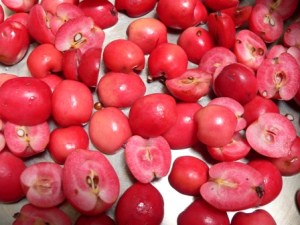
We have a crabapple tree in our backyard which, to our great disappointment, never fruits.  I suspect it isn’t particularly suited to our suburban clime, but every year we watch it hopefully, willing it to provide us with some treasure to play with.  Sadly, it never has, so when Christina offered to share some of her dad’s bounty with us, I gratefully accepted.  A couple of hours later, a handsome man rang our doorbell and presented me with a plastic bag of ripe, red crabapples.

They were so beautiful!  I’ve never seen crabapples en masse before, and I was amazed by their rosy colour.  They reminded me a little of the lilly pillys we’d harvested for jelly last month, only the fruit was much larger.  I suggested the we turn them into pectin (crabapples have wonderful setting properties), but Pete argued that crabapple jelly is the queen of all preserves, and that it would be a shame to do anything less with them. There was a little over a kilo of fruit and we began by washing and cutting it all into pieces.

050309-006

The chopped fruit was covered with water and brought to a boil, then left to simmer for (literally) hours, until the crabapples had completely softened and turned into mush.

050309-007
We tipped the boiled mass through a sieve lined with a clean piece of calico (I’d poured boiling water over the cloth to sterilise it first), then allowed it to drip through for a couple more hours.  It’s important not to press the fruit during this sieving process, or you end up with cloudy jelly.

050309-017
Once it had finished dripping (you’re meant to let it go for four hours or overnight, but we were a little impatient), we added 700g sugar and lemon juice to the litre of strained liquid in the pot.  This was brought to a gentle boil, skimmed carefully and then taken to a rolling boil until the jelly reached its setting point. Pete seems to instinctively knows when this is, but I still test a blob on a cold plate (when you push it and it wrinkles, then it’s set).

crabapple-002

The crabapples produced the reddest, most jewel-like jelly I’ve ever seen, with a delicious, slightly tart and very distinctive flavour. The kilo of fruit produced three large jars and one baby jar of jelly.  Such a fun afternoon!  Thanks Christina!

crabapple-006

. . . . .

See our Jam Making Primer for more tips on making jam.

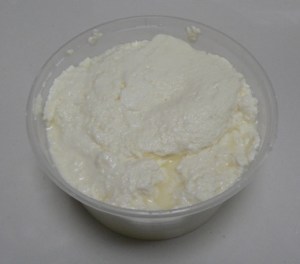
The Gorgeous Terri (as Pete calls her) dropped off some warm ricotta for us today.  Life is pretty good when your ricotta is so fresh that it hasn’t had a chance to cool yet. (Jane, this photo is for you!)

ricotta-0021

When it’s this fresh, you have two options – scoff it straight away on toast, or let it drain in a sieve and store it in the fridge.  The draining is quite important, as the liquid will sour if left on the curds too long, and the ricotta won’t keep as well.  We did both – ate some warm and stored the drained remainder in the fridge for Big Boy’s lunch tomorrow.

welding-gloves-001

I am abysmally clumsy.  I regularly burn, cut and bruise myself – in the kitchen, mind you, not at parkour or rock climbing.

And whilst I’m fairly injury prone with sharp things, I seem to be much, much worse with hot things.  Once I pulled a tray of cookies out of the oven, straight into my knee, branding myself with a lovely crescent shaped scar (I no longer bake in shorts).  I’ve burnt myself with hot liquids, hot handles, hot trays and hot tools.  I gave myself a really bad burn once trying to rescue a cordless phone that I’d dropped into a pot of curry.

In an attempt to do something about the burns, I went on a quest to find really good oven gloves.  I tried silicone mitts, which are fine for some things (like pulling jam jars out of boiling water), but I desperately wanted moveable fingers.

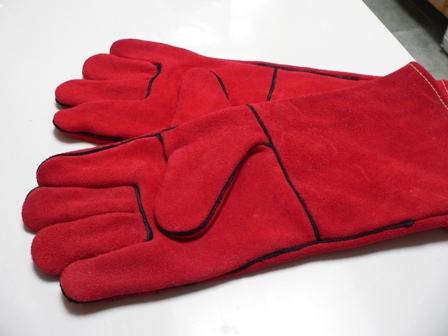
I’d read about flameproof Kevlar gloves worn by racing car drivers, but they were both prohibitively expensive AND nearly impossible to find.  In the end, my cousin-in-law Brian suggested welding gloves.  The man is a genius, because these thick leather gloves are absolutely fantastic.

We found them at Gasweld for $6/pair and they have revolutionised my kitchen life. Because they’re long gloves, I no longer burn myself on the oven racks as I pull loaves of bread off their baking stones, or steam-burn my wrists when I lift the lid off a boiling pot of jam.  They’re heat resistant, but not heatproof, which means they’ll get quite warm after a little while (especially if they get wet), but for the day to day “dealing with hot things” in the kitchen, they’re absolutely perfect.

We’ve had dark blue ones for a year now, and I’m about to replace them with the gorgeous red ones in the photo.  Best $12 we’ve spend in ages!

. . . . .

Another reason welding gloves are cool…read more….

Last week, my friend Kevin the miller sent me a bag of his light grain premix to test for him. Kevin is a big guy with a big heart – straight talking, smart and brutally hardworking – a kind of modern day Daniel Boone. He’s also an incredible miller, and his bread flour is the best I’ve ever used. I would never normally buy a premix, but I knew that coming from Kev, it was going to be great. The ingredient list was certainly promising – “Bakers Flour, Kibble Wheat, Mung Bean, Maize, Rye, Triticale, Soya Beans, Linseed, Barley, White Sorghum” – an amazing array of grains, some of which I’d never heard of before.

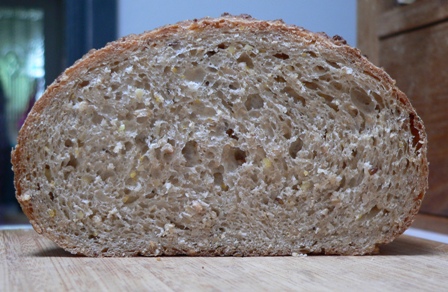
I baked three loaves of sourdough grain bread on Saturday and was absolutely delighted. Despite the inclusions, the dough rose very well, and the slight sourness of the bread really complemented the grain mix. The grains had obviously been chosen with care, because they cooked to a delicious chewiness rather than the teeth crunching hardness of some commercial grain loaves. Small Man won’t go near it, but Pete and I love it – we’ve been eating it today with our fig and rhubarb jam – a perfect match!

280209-012

welding-gloves-003