Pizza starts with the dough. Ours is hardly traditional, but we love it.
Pizza Dough for Four (double this to make eight)
• 500g pizza flour (bread flour is ok too)
• 10g instant yeast
• 8g fine sea salt
• Scoop of sourdough starter (optional)
• 320ml water
• 50ml extra virgin olive oil
The flour goes into a large mixing bowl and the yeast and salt get whisked in. The water, starter and olive oil are poured into the flour, and the whole lot is squelched together by hand. This is quite a wet dough, so I knead it by lifting it up, slapping it on the bench, and folding it onto itself. Over and over and over. It helps if you let it rest for 10 minutes or so before you start. The kneading doesn’t take very long, and when the dough is smooth, it’s left to rest for an hour in an oiled covered container.
Once it has doubled in size, the dough is divided into four pieces (about 220g each), shaped into balls, and left to rise again, covered in oiled Gladwrap.
Tomato sauce
Lately we always seem to have tomatoes in the house. That’s because Jimmy the Tomato Man at Flemington markets is so darn persuasive, and Pete and I feel bad if we don’t buy something from him every week. I think we’re a part of his weekly cashflow now, and I’d hate to make life difficult by depriving him of the $12 a week we normally give him. It’s really silly too, because we then spend the week trying to find something to do with 10kg of tomatoes. At first we were making our own semi-dried tomatoes, then we tried our own passata, and last week Pete made tomato relish, and I made pizza sauce. Jimmy’s got it made, because Big Boy has pronounced our pizza sauce to be massively better than the “bought stuff”. Sigh…there’s no going back now.
To make pizza sauce, I roast a tray of tomatoes, which have been cut in half, trimmed and sprinkled with Maldon sea salt. I usually line the tray with Bake first, to make cleaning up easier. We have a BIG oven (90cm Smeg – you should see our electricity bill), and it usually takes about 3kg of tomatoes to fill a tray. These are roasted at 220C (fan forced) for half an hour, then added to a pan in which some chopped onion and garlic have been cooked in olive oil. The whole thing simmers on the stove for about half an hour, and then it’s pureed in a jug to a smooth paste.
Toppings
The quest for the perfect pizza topping continues. It doesn’t help that Big Boy won’t eat a pizza with olives and anchovies, and Small Man won’t eat one with onions. In the end we make one each for them. I’ve finally moved Small Man off the daft and boring Spanish olives in a glass jar that he used to like, and onto some deliciously salty Kalamatas marinated in oil. The anchovies are always bought from the Italian supermarket in little glass bottles, and lately I’ve taken to rinsing them before I use them – they’re still salty, but not mouth-puckeringly so.
We used to put ham on our pizzas, but it was never quite right. Johnny at the cheese shop, our oracle of knowledge when it comes to all things deli related, put me onto coppa, and when that was out of stock, suggested I try pancetta. Oh my. The pancetta coupled with the roasted pizza sauce created an astonishingly delicate yet complex flavour, and, to use wine tasting terminology, fantastic mouthfeel. It didn’t just taste good, it felt good in the mouth when you ate it. I suspect it has something to do with all the fat on the pancetta, but I tried not to think about that as I was scoffing my eighth slice.
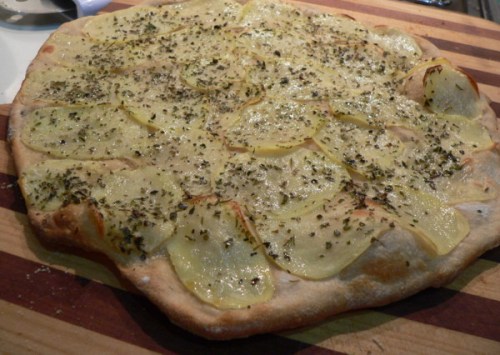
Another perennial favourite is potato pizza. We use pink potatoes – usually Desiree although we buy Royal Blues on a semi-regular basis as well – peeled and sliced on a mandoline to get super-thin slices. These are laid onto the flattened dough in a barely overlapping pattern, then topped with garlic oil (a gift from Robyn last Christmas) and sprinkled with some mixed Italian herbs. If Small Man and I had our way, we would only ever eat potato pizza. It’s like eating potato chips baked onto crispy pizza crust. I can’t see how it could possibly be good for you, except for the fact that it often makes us truly happy!

 Fig Jam and Lime Cordial