Feeds:
Posts
Comments

Archive for June, 2009

Neighbours

080609 001

We have the best neighbours in the universe.

Some of them, like Maude and Pete V, have been our friends for over 25 years and moved into the neighbourhood after we did (we were deeply flattered by the inferred compliment that living near us wasn’t going to drive them bonkers).  Others, like Dredgey and El, have become our friends since we moved in.  These people aren’t family, but they are our tribe.  Together, we share our time, our food and anything else we have to offer in the give and take of village life.

A day doesn’t pass without some interaction with our neighbours, be it Dredgey arriving unannounced with a home-smoked trout for us, or Big Boy ringing Pete V to ask a history question about Julius Caesar, or Maude popping over for our regular cups of tea.  I feel blessed that we have people so close by whom we can call on for help at any time and who, conversely, know that we’re here should the need ever arise.

At the end of the day, this old house we live in is just bricks and mortar.  What makes our urban village a joyous place is the community we have, and the relationships that have evolved with the people who share our street with us.  Happy days indeed – long may they continue!

Read Full Post »

dan's cake 017

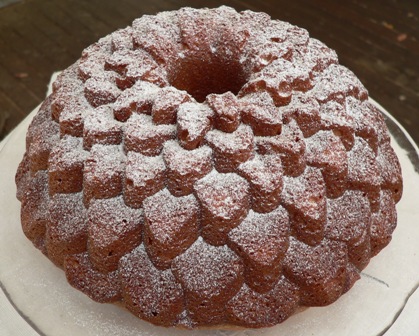
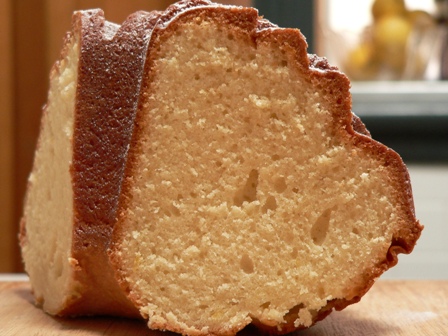
It’s Dan’s birthday today, but she’s on the other side of the world, so I baked her a virtual birthday cake.  Here it is – a lemon pound cake, adapted from a Debbi Fields recipe, and baked in a Nordic Ware Chrysanthemum bundt pan.  Dusted with icing sugar, it is simple, smooth textured and easy to eat. And, whilst it used up every mixing bowl and cup measure in the house, this cake, and Dan, are worth the effort!

Dan, we’ve had a little party here – eaten cake, wished you well, and delivered Sunday morning packages of pound cake to the neighbours.  Hope you’re being thoroughly spoilt today – you deserve it!

dan's cake 020

Lemon Pound Cake

adapted from recipe in Debbi Field’s Great American Desserts

  • 3 cups plain (all-purpose) flour
  • ½ tsp bicarbonate (baking) soda
  • ½ tsp fine sea salt
  • 250g (1 cup) unsalted butter, softened
  • 2 cups white sugar
  • 2 tsp vanilla extract
  • Grated rind of one large lemon
  • 4 large (59g) eggs, separated
  • ½ cup buttermilk
  • 1/3 cup Greek yoghurt

1. Preheat oven to 160C (with fan).  Spray bundt pan with oil, making sure to coat well.

2. Whisk together the flour, bicarb of soda and salt.  Set aside.

3. In the large mixing bowl of a stand mixer, cream butter and sugar together until fluffy, about 4 to 5 minutes.  Add vanilla and lemon rind, then the egg yolks one at a time, beating well after each addition.  Scrape down the bowl.

4. In a separate bowl, stir the buttermilk and yoghurt together until smooth.

5. Beat in one cup of the flour mixture, followed by half the buttermilk mix, then another cup of flour, then the remainder of the buttermilk, and finish with the final cup of flour.  Mix for 45 seconds after each addition.

6. Pour the egg whites into another mixing bowl and beat until stiff peaks form.  Stir a large spoonful of the eggwhites into the batter to lighten it, then gently fold the rest into the softened mixture.

7. Pour the batter into the bundt pan and bake for 50 to 55 minutes, or until the top is brown and a toothpick inserted into the centre comes out with a few crumbs sticking to it.  Note: This recipe makes more batter than needed for the bundt pan – I baked my excess in mini bundt tins for 25 minutes and stashed the little cakes in the freezer.You could easily use muffin pans if you don’t have the mini bundts.

8. Allow the finished cake to cool in the pan for 20 minutes, (don’t rush this, or the cake might stick) then turn out onto a wire rack to cool completely.

Leftover pound cake makes a wonderful base for trifle!

Read Full Post »

Milestone

orchids

We’ve reached a milestone!

Fig Jam and Lime Cordial began just four months ago at the end of February 2009, and today we’ve had our 10,000th hit.  I know that’s tiny compared to the “serious” bloggers, but for a pet project I play around with on the weekends, that kind of feedback is desperately rewarding.

Thank you for your kind support, particularly to all our friends who have made all their friends read our blog.  Thank you to the people who have taken the time to make comments, and particularly to those who’ve actually tried a recipe – I can’t tell you how exciting that is for me!

Last week, Big Boy put me onto My Life Is Average, which is the sort of thing that appeals to his quirky sense of humour.  It made me reflect on our lives and how un-average they really are.  I wouldn’t trade this life with anyone or for anything; there isn’t a single aspect of it that I would want to change.  In many ways this blog is an outlet for that happiness.  Thank you for sharing it with us!

Read Full Post »

220609 007

For a far more detailed tutorial on tempering chocolate, please have a look at our Chocolate #101: Tempering at Home post. Thank you!

. . . . .

Pete finds these ironic.  Whilst they have the shape of a regular chocolate frog, they’re really an adult version – 70% dark Belgian chocolate studded with cacao nibs (crushed cocoa beans).  They’re super dark both in colour and taste, and I’m sure they’re good for you, given that 70% dark chocolate is supposed to be both low GI and high in anti-oxidants.

Several years ago, instructed by David Lebovitz’ The Great Book of Chocolate, I taught myself to temper chocolate.  It’s a great skill to have up your sleeve and, once you’ve got your head around it, it’s actually quite easy to do.

It’s helpful to understand from the outset that all candy making works on similar principles. Whether you’re tempering chocolate, making fudge or creating nougat, the aim is dissolve the crystal structure and teach it to reform in a different way.

Tempering chocolate is about melting the chocolate into a liquid form, then teaching the crystals to reform in a manner that will allow it to set hard and glossy, rather than dull and brittle.  From experience, there are two important elements in all candy making – temperature and patience.  If you want to temper chocolate well, you need to invest in a good thermometer.  Mine is digital and waterproof and I use it as frequently as my dishwasher, so it has well and truly justified its $70 purchase price.

Tempering Chocolate #101 – Dark Chocolate

Step 1: Pour some chocolate callets (50 – 70% cocoa) or finely chopped chocolate into a small pyrex bowl.  The amount isn’t really important, although you want enough to make it worthwhile – I use a minimum of 400g.

dark choc 010

Step 2: Melt the chocolate in short 30 second bursts in the microwave.  You need to get the melted chocolate to a temperature of 115F to ensure that all the crystals are dissolved.  Make sure it doesn’t get much hotter than that, or you’ll scorch the chocolate. (Now you can see why a good thermometer is critical.)

Step 3: Put a large chunk of tempered chocolate into the melted liquid.  The theory here is that the tempered chocolate will “teach” the melted crystals to reform in a particular way.  I keep large pieces of chocolate in the fridge specifically for this purpose.   Keeping them cold speeds up the process, but you’ll still need to be patient.

Instead of one large lump, you could use pieces of chocolate – the important thing is that the chocolate should be hard and glossy (tempered) to start with.

Give the bowl a good stir and check the temperature.  Allow the molten chocolate to drop to a temperature of between 88F – 90F.  Go away, read a book or play solitaire on the computer, coming back occasionally to give it a stir.

dark choc 014

Step 4: When the melted chocolate has reached 90F, start testing it by smearing a little onto a plate and putting it in the fridge.  Once it’s tempered, it will set hard and glossy quite quickly (untempered chocolate will stay soft and sticky). Using a large fork, scoop the remains of the chunk out of the melted chocolate and wrap it in a sheet of parchment paper to reuse another day.

Step 5: In order to work with the chocolate, it needs to be kept at a temperature of 88F – 90F.  If it falls below this it will be out of temper (cranky?)  and won’t set properly.  I use a heat mat covered with a folded tea towel, which holds  the chocolate at the perfect temperature for enrobing.

dark choc 018

Step 6: The tempered chocolate is now ready to use.  You can stir inclusions into it, as I did (they’re cacao nibs you see in the photo below), dip truffles into it, pour it into moulds or pipe it onto a cake.  One of the easiest things to make is nut bark, which involves stirring in a variety of nuts and then spreading the whole mix onto a large sheet of parchment.  Once it has set hard, it can be broken into irregular shapes and stored in an airtight container.

dark choc 020

dark choc 021

Note: Milk and White Chocolate can be tempered in the same way, although the setting temperatures for these are slightly lower than for dark.

Read Full Post »

vanilla syrup 006

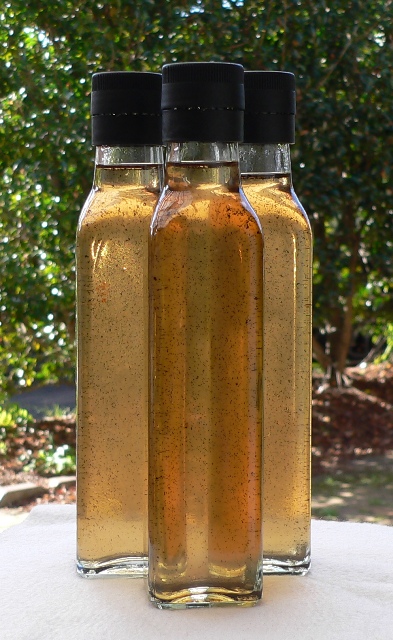
Here is the recipe for Pete’s fantastic vanilla syrup.  It works brilliantly in milkshakes, for poaching fruit, or as a drizzle over oat porridge or icecream.  Because he used our homemade extract, the syrup has a clean, almost crisp, vanilla flavour and a flotilla of  small black seeds.  It’s an easy recipe to prepare, providing you remembered to make extract three months before, but tricky to get just right.  Pete has a particularly fine palate when it comes to syrups and jams – he always manages to produce a perfect balance of flavours and textures.

  • 2 litres filtered water
  • 1 kg white sugar (possibly more)
  • ¼ cup brown sugar
  • 1 or more fresh vanilla pods
  • 2 Tbsp homemade vanilla extract (plus a couple of vanilla pods that were soaking in the vodka)

1. Scrape out the fresh vanilla pod and add the seeds, plus the pod into a large pot.  Add the water, sugar, soaked vanilla pods and brown sugar and heat gently until the solution boils and the sugars dissolve.

2. Add the vanilla extract and bring back to the boil briefly.  Allow to cool a little, then check that the syrup has thickened slightly (otherwise you’ll just end up with sugary water).  The thickness of the syrup is related to the amount of sugar – if you’d like greater viscosity, simply add more sugar until it reaches a consistency you’re happy with.  Taste for vanilla – you want to add as much vanilla extract as you can whilst still keeping the syrup in balance. This recipe is all about tasting as you go to ensure the flavour is smooth and well-rounded.

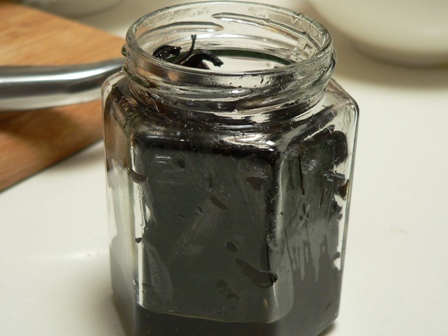
3. Ladle the syrup into sterilised bottles and seal well. Place the used vanilla pods in a small jar and top up with a little syrup.  Store this in the fridge and use it as a “starter” for your next batch, by putting it into the pot with the other ingredients.  The starter can be used several times before the macerated beans lose their oomph.

vanilla syrup 002

Read Full Post »

Older Posts »