Feeds:
Posts
Comments

Archive for the ‘Food & Friends’ Category

. . . . .

Photos of loaves from the bake-off can be found here.

. . . . .

The cottage loaf is a traditional English bread that has fallen out of favour in recent years.  I absolutely adore making them. Despite a bit of a dodgy start, my last few attempts have turned out quite well, and it’s lovely to have such an unusually shaped loaf to serve at dinner.

I’ve met several fellow bread bakers since starting this blog  (and converted a couple to the cause) – would any of you be interested in joining me in a cottage loaf bake-off?

By “bake-off”, I don’t mean to imply anything competitive.  Rather, I thought it might be fun for us all to bake a cottage loaf or two, and then I’d put pictures up as we go on the Cottage Loaves page.  And since it’s not a contest (and there aren’t any prizes – sorry), I won’t bother with rules – just bake your dough of choice in a cottage loaf shape.   Then leave a comment here with a link to your photo, or let me know and I’ll email you to get a copy if you don’t have a website to upload them to.

Here are my tips – please chime in if you have any others…

  • Use a lower hydration dough.  This is not the time for a wet 75% dough, as the two halves will fuse into each other when you join them, and you’ll end up with some weird looking spaceship.  I use a 60% dough for my sourdough cottage loaves.
  • Let the two storeys have a second rise until almost doubled, before you put them together and give them a third brief rise as a combined unit.
  • Look, I know this bit is cheating, but if you can get it right, the  oven shelf above can stop the loaf from rising too much and “popping” its top off.
  • I aim for the top layer to be half the dough weight of the bottom layer.  I find this works well.  Also, small loaves seem easier to get right than  large ones.
  • Finally, poke a hole all the way through the middle and work the dough outwards with your fingers to try and weld the two layers together.  Slash well – I find lots of cuts helps the dough to rise more evenly.

It takes a bit of practice, but don’t give up, because these are heaps of fun to make.  After all, if Wallace and Gromit can make them, how hard can it be?  (She says, in her best Jeremy Clarkson voice.) And if you’d like a good laugh, have a look at  my failed first attempts.

Edit: If you’re after a bread recipe, you might want to try this Pain de Campagne de Cottage Loaf recipe.  It uses commercial yeast rather than sourdough and works well in this shape.

Please join in – it’ll be great fun!  Let’s bring cottage loaves back into vogue!

Photo from Wallace & Gromit – The Official Site

Read Full Post »

Last night we made spring rolls, filled with pork mince, shredded vegetables and vermicelli noodles.  The mixture was stir fried with a little light soy, before being rolled in spring roll wrappers and deep fried…

Thinned with a little water, Pete’s plum sauce made the perfect accompaniment to these!

. . . . .

We marinated belly pork in plum sauce, soy, sherry, a little cornflour and sesame oil, then braised it in pan.  Not quite the right cut of pork for this dish, but delicious nonetheless!

Read Full Post »

Over the past few months, Pete and I have turned in excess of 100kg of roma tomatoes into homemade passata. It hasn’t been a difficult task, but putting the roasted toms through the food mill was always a little laborious.

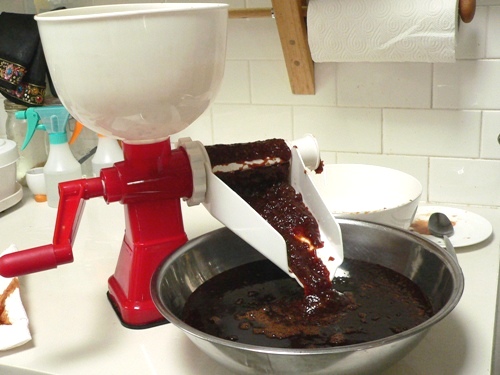
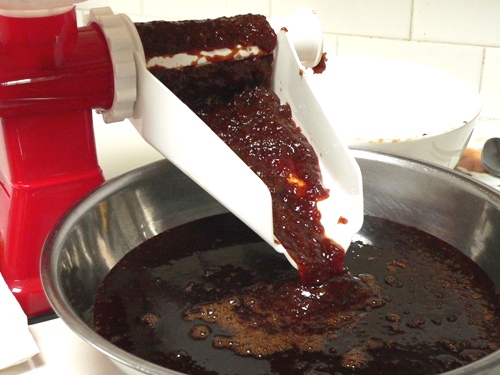
A few weeks ago, Pete made the management decision to buy a new tomato juicer.  It cost $49 and is mostly made from plastic (apart from the sieve), which means that we have to let the sauce cool before processing.  Notwithstanding the fact that it leaks a little from the handle, it works brilliantly.  There is a clever corkscrew spiral in the middle, which forces the  mix through a sieve, producing sauce down the chute and pulp out the end.

The handle is almost effortless to turn, and it’s much faster than the old food mill.  We’ve recently been using it to make Chinese plum sauce from our President plums, which is what you can see in the photos.  We put the extruded pulp through a couple of times, to extract the last bit of goodness from it.

. . . . .

My friend Ozoz, the Kitchen Butterfly, surprised me yesterday with a package in the mail, all the way from the Netherlands!

One of the many items she sent included this poffertjes pan, for making traditional Dutch pancakes.  We had to try it out straight away – the pan turned out perfectly round mini pancakes. Oz even sent me the little wooden fork needed to flip them over…

Poffertjes are traditionally served with icing sugar and butter.  Big Boy had a huge plateful for dessert, drizzled with maple syrup.  He’d been studying for an exam, so was extremely grateful for the carb hit.  Thank you, Ozoz!

Read Full Post »

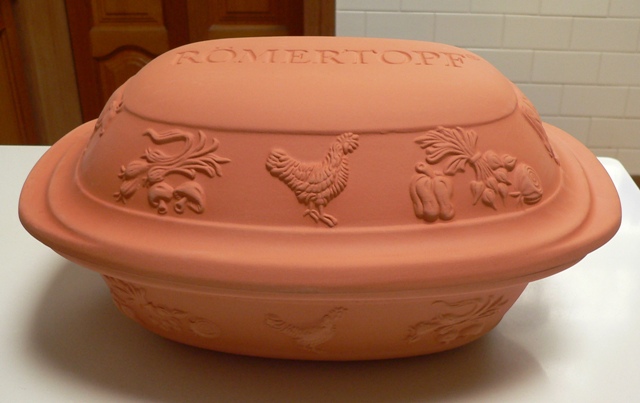
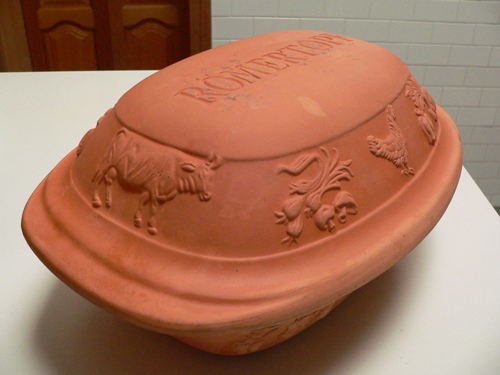
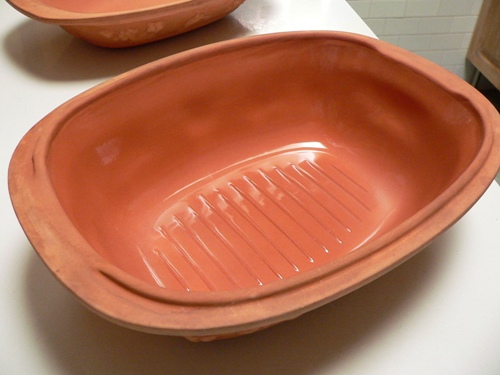
We’ve now had our Römertopf baker for over six months.

Compared to the photo above, taken when it was new, it’s now a little battle-worn…

…but the glaze on the inside remains perfect.  We take care not to scratch it with metal implements, and it rewards us by cleaning up a treat in the dishwasher.  The pots we get in Australia come directly from Germany, whereas the ones available in the US are made in Mexico and I don’t believe they have the interior glazing. Edit 2014: they’re now selling the glazed German made models in the US: http://romertopfusa.com/

We use our Römertopf at least once a fortnight and we’re astounded every time by how simple the process is.  There aren’t lots of pots and pans to wash up, and it’s an easy way to make use of whatever ingredients we have on hand.

In a nutshell, the procedure for our all-in-one rice and meat dinner is:

1. Soak the baker in cold water in the sink for at least 15 minutes.  We put it in before we start prepping ingredients.

2. Rinse one cup of Basmati rice and soak it in water.

3. Chop vegetables, prepare any meat.  No pre-browning or frying required.

4. Put the drained rice and vegetables in the bottom of the wet Römertopf, add two cups of stock, then lay the meat over the top.  Or, mix the whole lot together and put it in the baker, then cover with liquid, ensuring all the rice grains are submerged.  Often, instead of stock, we’ll use water, salt and seasonings.

5. Put the lid on and place the baker into a cold oven.  Turn the temperature up to 200C with fan, and bake for about an hour and a half.

Recently, I laid lamb shanks, seasoned with a little salt and pepper, over the top of the rice and vegetables and they cooked to sticky perfection.  The boys ate it so fast that I didn’t get a chance to take a photo.

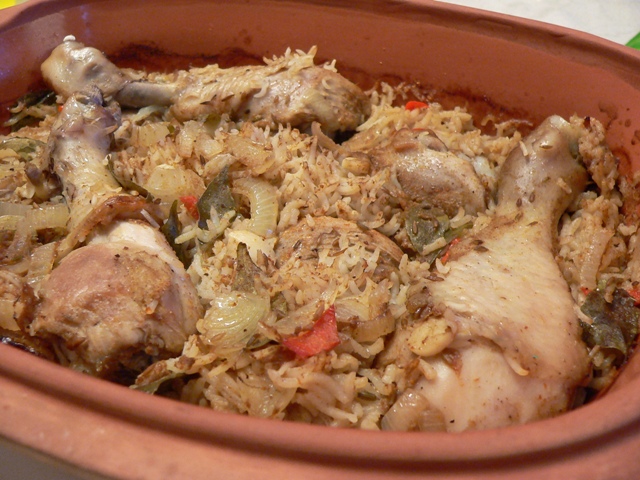
Last week we made a chicken biryani in the Römertopf, adding half a packet of purchased seasoning mix, some onion, garlic, tamarind and curry leaves.  It was spicy, delicious, and just so easy.

The Römertopf Rustico baker is still only $39 at Peters of Kensington, which I think makes it the bargain of the year. It has certainly simplified our mid-week dinners.  The lack of added oil in the cooking process means that we’re eating better as well!

Read Full Post »

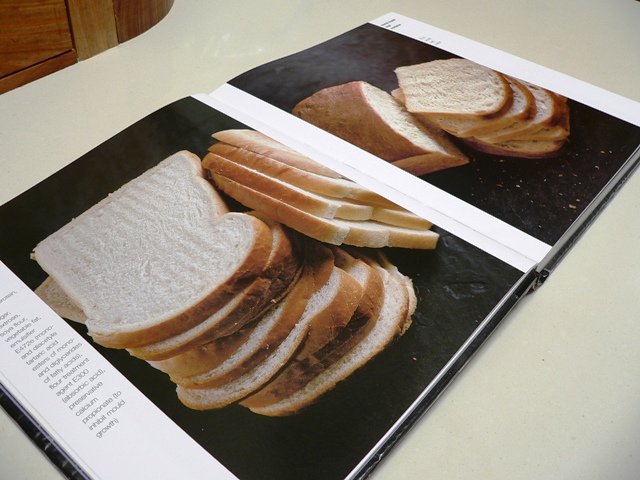
Richard Bertinet’s Dough presents a very persuasive argument for baking bread at home.  Over a two-page spread, it describes the difference between a typical shop-bought loaf and one made at home.  Here’s what it says:

Shop-bought loaf typically contains:

  • wheatflour
  • water
  • yeast
  • wheat protein
  • salt
  • vinegar
  • dextrose
  • soya flour
  • vegetable fat
  • emulsifier E472e (mono- and diacetyle tartaric acid esters of mono- and diglycerides of fatty acids)
  • flour treatment agent E300 (ascorbic acid)
  • preservative calcium propionate (to inhibit mould growth).

Home-made loaf contains:

  • flour
  • yeast
  • salt
  • water

That was enough to convince us to start baking our own bread in 2006.

Now, three years on, we know where every ingredient in our bread comes from – our flour is Australian grown and processed in Kevin Sherrie’s state of the art mill; our oil is extra virgin cold-pressed from cousin Andrew’s olives.  We buy Australian sea salt and control the exact amount we use, making our homemade bread about 30% less salty than supermarket loaves.  Our sourdough leaven is constantly being renewed, providing us with crusty, low GI loaves two to three times a week.  Additionally, baking bread satisfies my creative urges, and instills a rhythm and cadence in our lives that I find particularly comforting.

All this for a total outlay of 65c per loaf, about $4.50 a week.  Can you see why we just can’t bring ourselves to buy commercial bread anymore?

If you’d like try baking your own bread at home, you might find our Bread #101 Tutorial useful.  There are also lots of recipes on our Bread page. Have fun!

Read Full Post »

« Newer Posts - Older Posts »