
“The craft is your rocking chair, you lean back
on it so you can rest, and then have the artistry..”Frank Oz
. . . . .
When I wrote my Bread #101 yeasted and sourdough tutorials, I wanted to come up with a really simple way to create a delicious loaf of bread. The posts were only ever intended to offer a starting point, because I knew that once someone had convinced themselves that it was actually possible to bake a successful loaf, then they were off and running.
And that’s certainly proven to be the case! In the space of just a few short weeks, Michelle has moved from yeasted to sourdough, Rachel has baked both grain and olive breads, Alison has perfected her chewy ciabatta, and Clare has created gorgeous fruit loaves. My darling friend Wendy, whom I passed starter to several years ago, is now busily teaching all her friends how to bake sourdough bread.
With just a little practice, a novice baker will soon develop the confidence to experiment and play, developing their own unique style in the process. Experience enables us to know intuitively whether or not a dough is too dry, sufficiently proved or baked long enough in the oven. And as the Frank Oz quote above says, once we’ve attained a little mastery of the craft, we can lean back on those skills, and be creative.
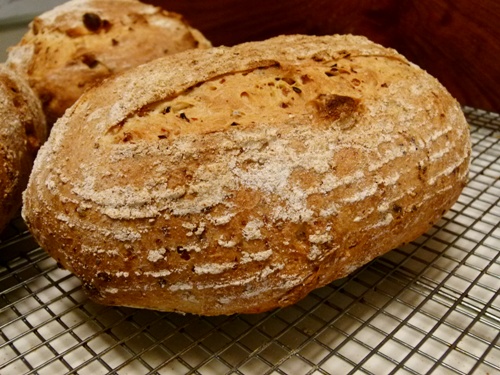
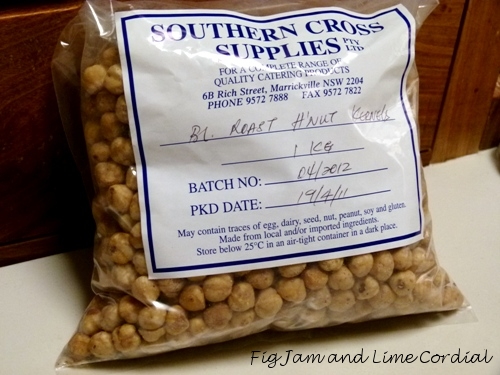
Last week, I wanted to make a grain loaf for a friend, so I pulled Priscilla out of the fridge and gave her a couple of good feeds. A rummage through the kitchen uncovered a half bottle of vintage riesling and the remnants of our bag of roasted blanched hazelnuts…
I emptied the last of the grain mix into a bowl and poured over the riesling, intending to soak it for a few hours before adding it to the dough. Then I remembered an old Dan Lepard recipe that I’d tried a while back, and instead tipped the grains and wine into a small saucepan, and cooked them over a low heat until all the liquid had been absorbed, and the grains were swollen and a little tender to the bite.
Here’s the dough recipe I used (adapted from the basic sourdough tutorial):
- 300g ripe sourdough starter (fed with equal parts flour to water by volume)
- 500g water
- 50g olive oil
- 1kg bakers/bread flour
- 135g (dry weight) mixed grains, cooked in riesling, and allowed to cool
- 165g roasted blanched hazelnuts
- 20g fine sea salt
I started off with slightly less water – to adjust for the added liquid in the grains – but added the full amount as I felt that the dough was a little dry when I was mixing it. Once the dough had been squelched together (but not kneaded), it was allowed to rest for nearly an hour before being given a quick fold in its container.
I then left it to prove on the dining room table overnight, and woke to find an enormous, puffy mass (bless you, Priscilla), which needed a well floured bench to be manageable. I shaped three loaves and gave them a short prove in my bannetons (even though the dough was quite high hydration, I was reasonably confident of being able to turn them out).
After slashing, the loaves were baked in a preheated 220C fan oven for 25 minutes, followed by an additional 20 minutes at 175C with fan for the smaller loaf, and 30 minutes for the larger ones.

The finished loaves were deliciously flavoursome from the wine and roasted hazelnuts, and quite rich. We ate the small round loaf, and passed the other two on to friends. This was a bread for savouring rather than scoffing.
And as I spread peanut butter over my slice, it occurred to me that this was the true gift of bread making – the ability to experiment and create and play. I’ve baked a wide assortment of different loaves over the past few years (with varying degrees of success), many of them one-offs, and each loaf has fed my creative soul and provided a greater understanding of the craft.
If you’ve just started baking your own bread, then I’m truly excited for you, because I know what a great adventure you’re on. I wish you as much joy and satisfaction in your journey as I’ve found in mine!




 Fig Jam and Lime Cordial